Complied by Morag T Fyfe
The indexers have now reached 1867, and the number of records indexed in the last three months is as follows:
| Oct-22 | 396 |
| Nov-22 | 428 |
| Dec-22 | 400 |
Our database of persons buried or commemorated in the Necropolis now stands at 45905 entries at the end of December 2022 of which 19160 entries represent persons buried in common ground with no grave marker.
Thomas Allan
An enquiry about a Thomas Allan in the 1841 Census resulted in the discovery of a former soldier and Waterloo veteran buried in the Necropolis. When the enumerator came to the last household in Drygate Lane he amended the address from Drygate Lane to Bridge of Sighs. Thomas and Jane Allan were living here with four children and Thomas gave his occupation as gate keeper. Living at that address and with an occupation as Gate keeper, Thomas must have been employed as gate keeper for the Necropolis. It turned out Thomas was an out-pensioner of Chelsea Hospital having reached the rank of colour sergeant in the 57th Regiment of Foot retiring in 1832 after 27 years. His service was split between twelve years (1804-1816) in the Royal Horse Artillery and almost sixteen years (1816-1832) in the 57th Foot. He had been discharged to pension from the RHA in May 1816 due to a reduction in the size of the army at the end of the Napoleonic Wars and re-enlisted in September 1816. During his time with the Royal Horse Artillery, he served in the Peninsular War between 1810 and 14 and his service record states he was present at the battles of Busaco, Fuentes de Onoro and Albuhera, the storming of Ciudad Rodrigo and the battles of Salamanca and Vitoria. He spent less than a year back in Britain before embarking for the Netherlands and fighting at Waterloo in D Troop under the command of Captain Mercer and spending a year in France as part of the occupying army. Service in the 57th Foot very probably entailed some time in Ireland, but it is not known whether Thomas was part of the force that escorted convicts to New South Wales from 1825 or whether he remained with the regimental depot. He had been born in Bothwell Parish c1788 so it was natural for him to settle with his family in Glasgow where he died in 1848 aged approximately 60.
Rev Duncan Macfarlan, DD (1771-1857)
One of the most grandiose monuments in the Necropolis is that in honour of Rev Duncan Macfarlan, Principal and Vice Chancellor of Glasgow College (1823-1857) and minister of the High Kirk of Glasgow (1824-1857). By July 1860 £800 had been subscribed for a monument to be designed by J. A. Bell, architect of Edinburgh, which was erected the following year.
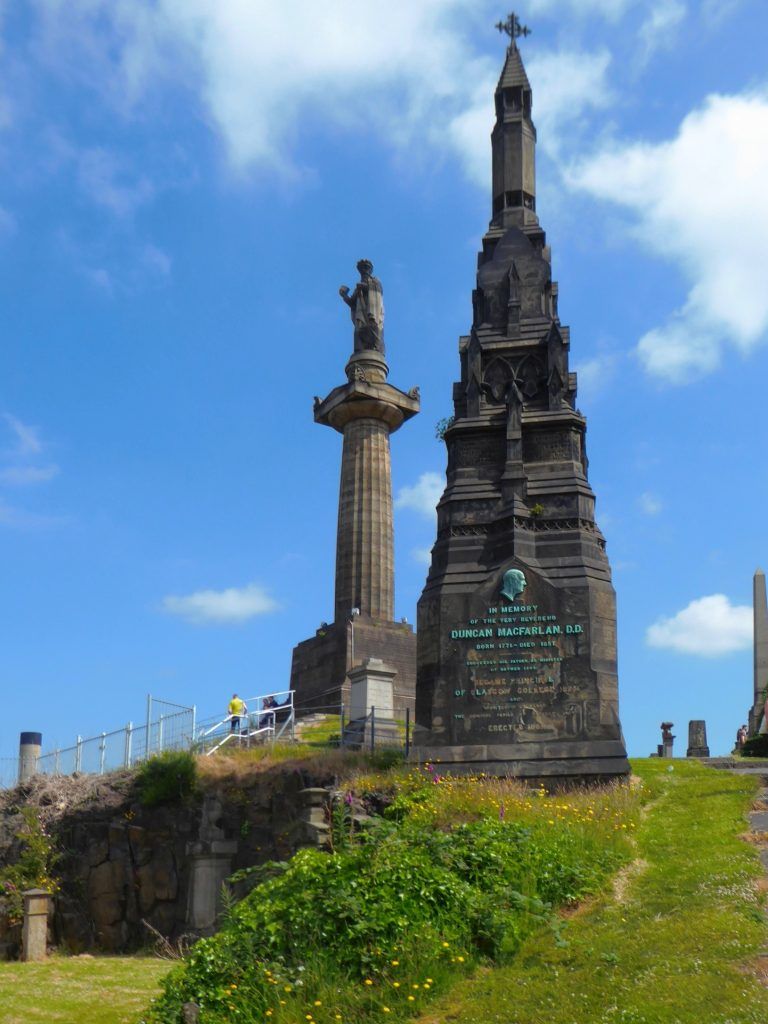
What may not be appreciated is that MacFarlan is not buried under his monument but across the path from it in the family lair which had been purchased for the burial of his daughter Helen, Mrs Alexander Campbell in 1845. As well as Helen and her husband and father, another married sister Susan, Mrs Mason is buried there along with an assortment of MacFarlan relations.
TAPHOPHILE: One who is interested in funerals, cemeteries and gravestones. ‘Tombstone tourists’ are a subset.
Henry Darwin Rogers
On the 31 May 1866 the coffin of Henry Darwin Rogers, LLD, FRS was placed in the Egyptian Vaults. The entry in the burial register was very terse and gave no further information as to age, address, place of final interment. It was a surprise to learn he was Professor of Natural History at the University of Glasgow and first Keeper of the Hunterian Museum. Born in Philadelphia in 1808 to Irish immigrant parents he did not settle in Scotland until 1855. Prior to this he had been director of the Geological Survey of New Jersey from 1835 to 1839 and then State Geologist of Pennsylvania,
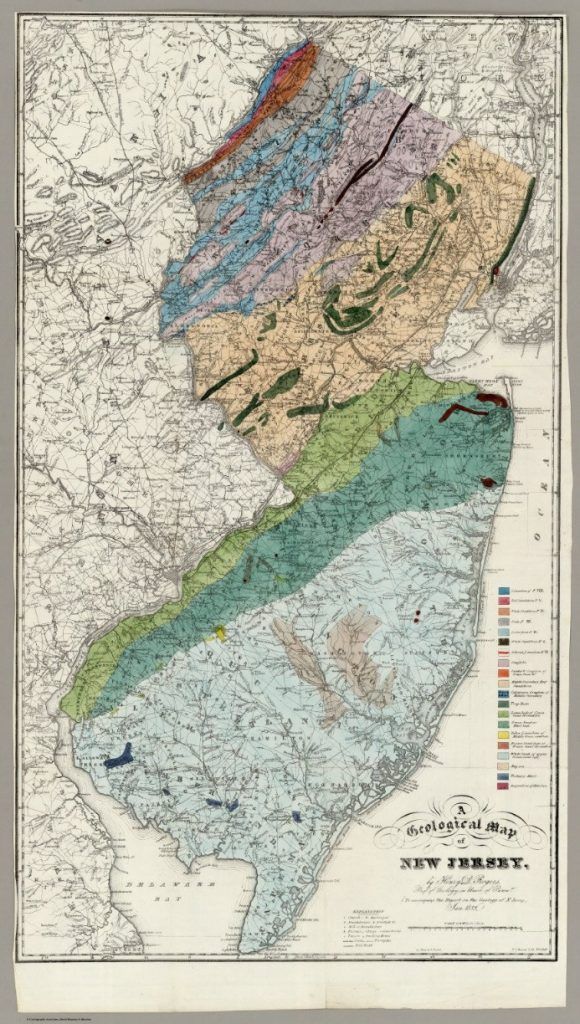
responsible for the inaugural Geological Survey of Pennsylvania. In his role as state geologist, Rogers proved to be an imperious figure whose relationship with his staff was contentious and challenging at best. In an attempt to publish the final report on the geology of Pennsylvania he came to Edinburgh. The Geology of Pennsylvania, was finally printed in 1858 as two volumes and a map atlas, totalling 1,631 pages with 778 engraved woodcuts, 23 full-page plates and 18 folded sheets. W. and A. K. Johnston of Edinburgh, Scotland, engraved the maps and illustrations, and the quarto volumes were co-published by William Blackwood and Sons, of Edinburgh, and J. B. Lippincott and Company, of Philadelphia.
During his time at the University of Glasgow Rogers undertook fieldwork on the structure of granite on the Isle of Arran and published an essay on the parallel ‘roads’ (geological terraces) of Glen Roy. He died at 5 Elgin Villas, Shawlands and after resting in the Egyptian Vaults was buried in the Dean Cemetery, Edinburgh (below).
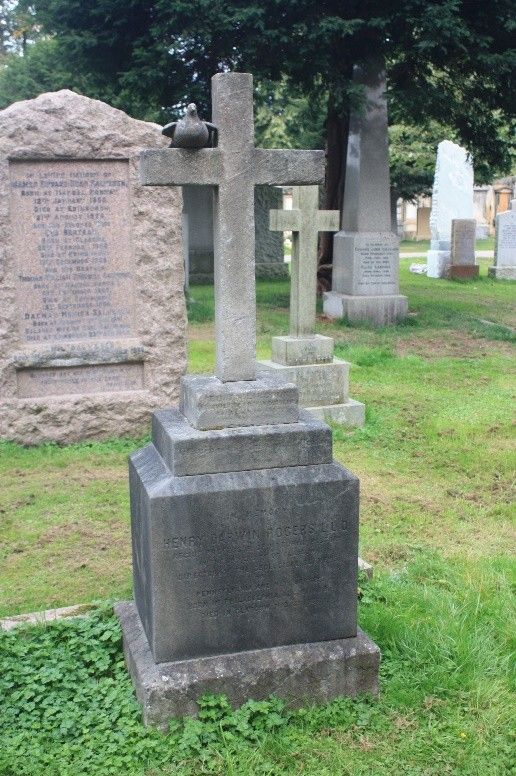
(CC BY-SA 4.0)
Last resting place?
In Grave Matters 5 I asked the question ‘Are people buried where expected?’ and a number of examples like Henry Darwin Rogers (above) are known. Generally the indexers find a note against an entry in the Burial Registers that so and so has been ‘removed’ elsewhere. This can be to elsewhere in the Necropolis or to somewhere else entirely. There seems to be several reasons for this. Seventeen-month-old Archibald Colquhoun Allardice died at Greenfield House, Shettleston and his coffin was placed in the Egyptian Vaults on 14th August 1857. Six weeks later on the 23rd September it was removed to Edinburgh. In this case the name of the Edinburgh cemetery is not given but findagrave.com helpfully gives his final resting place as Warriston Cemetery, Edinburgh.
Charles Tennant Dunlop (Grave Matters 14) and two of his children were buried in the Tennant family vault in compartment Omega between 1854 and 1857. Charles was buried on 11th August 1857 and he and his children were moved to Roseneath Cemetery, Dunbartonshire on the 26th September of that year. In the 1870s Janette Mary Fernie, his wife, and another son were also buried at Roseneath.
In both of the examples above it seems the Necropolis was never more than a temporary resting place as the remains were quickly moved elsewhere but the case of Harriet Simson is different. Harriet died in 1864 at the age of 5 years and remained in the Necropolis, the only occupant of the grave, until July 1885 when she was moved to Helensburgh. In this case her parents had settled in Helensburgh sometime in the 1870s and it looks as though they planned to be buried there and decided their daughter should join them. The empty grave was probably sold to the Rowe family and not reused until 1914.
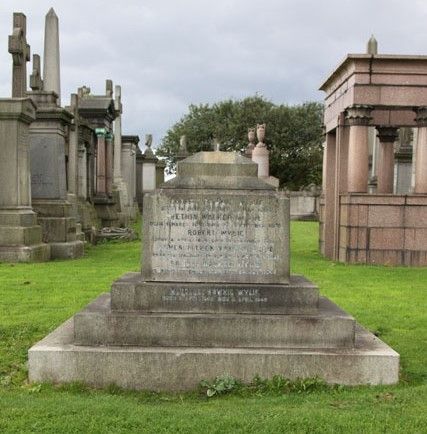
But folk were also shuttled from one grave to another within the Necropolis. The most extreme example known so far is that of Robert Downie Wylie (of the Wylie & Lochhead dynasty) who was buried in a Wylie family grave in Compartment Gamma on 2nd June 1866, removed to another family grave in compartment Zeta on 5th April 1869 and finally ended up in yet another family grave also in compartment Zeta on 11th June 1901. The first grave belonged originally to his father Robert Wylie, senior and later passed to his married sister Jessie Orr Wylie, Mrs Archibald Hill, and her family. The present stone on the lair (below) commemorates the Hill part of the family.
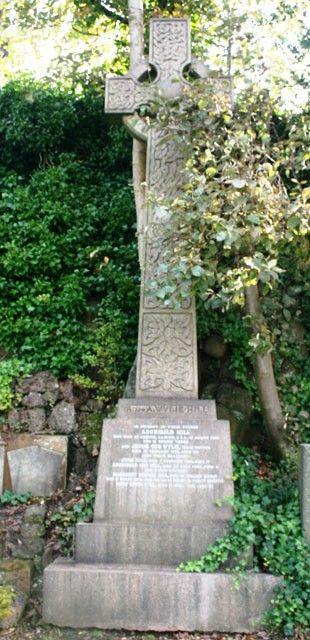
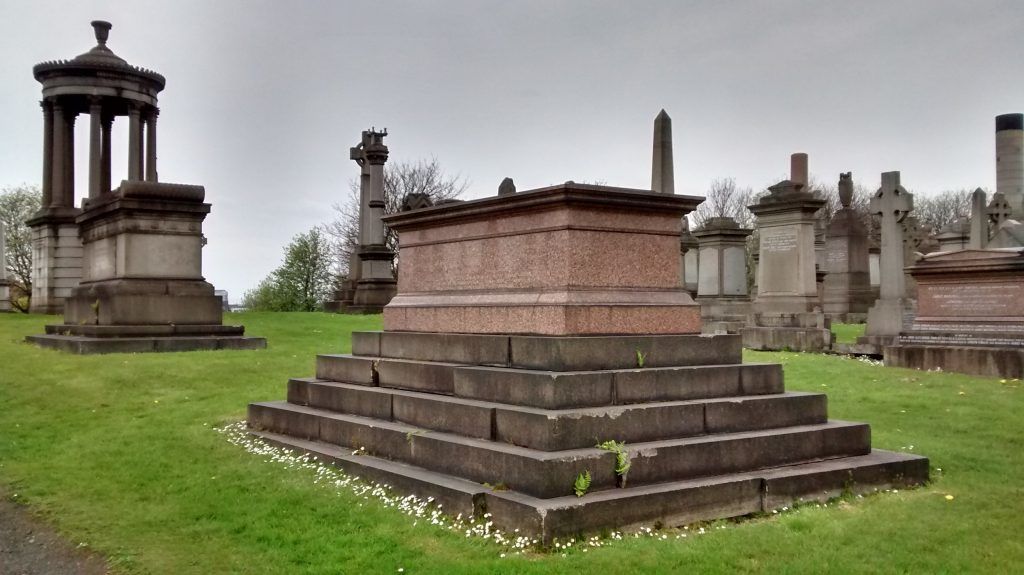
Part of the reason for Wylie’s moves is the fact that in the 1860s two prestigious Compartments were laid out on top of the hill and attracted many of the upper classes. Robert Wylie, senior and his wife Margaret Downie gave up the original family grave in Compartment Gamma and bought a new lair in Compartment Zeta (below) where their son was reburied in 1869.
By the early 1900s Robert D Wylie’s widow Bethia Walker seems to have been making plans for the burial of herself and her adult children. This resulted in the purchase of another Wylie grave in Compartment Zeta (below) to where Robert D Wylie was transferred in 1901 seven years before Bethia joined him.
James Lyall
In compartment Omega is the grave of the Scott family who perished when the PS Orion struck rocks off Portpatrick on 18th June 1850 (see Grave Matters 10). Also in compartment Omega is the family grave of James Lyall a Glasgow merchant who survived the disaster.
James Lyall, though born in Montrose in 1799, came from an Aberdonian family. By 1833, when he married his first wife Susan Jolly, he was living in Glasgow. He was a merchant trading to Mexico and at some stage in his life spent about seven years there. Susan Jolly was dead by 1838 when James married his second wife Eliza Martyn in Aberdeen. Three years later Eliza too was dead and in 1843 James married another Eliza, daughter of Dr Mitchell at Dingwall. Eliza Mitchell died less than a year after her marriage but happily Harriet Sarah Koch who married James as his fourth wife in 1846 survived him.
Alexander Lyall, James’s elder son, born in 1834 to Susan Jolly, was on board the Orion with his father in 1850 and also survived. James’s elder daughter Alexina was born in 1840 to Eliza Martyn and the following year a second daughter, Eliza Jane, was born but her mother died of puerperal fever and became the first member of the family to be buried in the Necropolis. In 1844 Eliza Mitchell (Mrs James Lyall the third) died giving birth to James Mitchell Lyall and joined Eliza Martyn in the Necropolis. Sometime in the 1850s James Lyall and his family moved from Glasgow to Earnock House, Hamilton where he died, suddenly and unexpectedly, on Wednesday 25th November 1863 about 11am.
None of his four children are buried in the Necropolis. Alexander died at Madeira in 1857 aged 23. James also died at the age of 23, at Pau, France in 1867. Alexina died at Hounslow also in 1867, the wife of Captain Samuel Barrett, 3rd Kings Own Hussars. Eliza Jane was the only one of the four siblings to live to a reasonable age and have children, with her husband Robert Watson. She lived most of her adult life in London and the south of England and is last known of in the 1901 census living in a hotel in Torquay.
Duncan and Lachlan McBean of Tomatin
A recent enquiry directed attention to two McBean graves in the Necropolis, one in compartment Kappa and one in Epsilon. They turned out to belong to a father and son, Duncan (1781-1854) and Lachlan McBean (1833-1924), Glasgow merchants and owners of Tomatin House and estate, 15 miles south-east of Inverness. McBeans have been known at Tomatin since 1639 and the property did not pass out of the family’s hands until it was sold about 1926/8.
Several of Duncan McBean’s brothers were active in the Caribbean in the early part of the nineteenth century and Duncan himself married Jane Moore born c1791 on St Eustatius in the Dutch West Indies and whose mother Adriana Heyliger was of Dutch stock. Internet sources suggest Duncan and Jane married in 1814 but do not state where. Duncan starts to appear in the Glasgow Post office Directories from 1818 onwards so it is possible he married on St Eustatius and remained there for a few years. By 1829 he is listed as a partner in the firm McBean, Smith & Co. Bearing in mind Duncan’s mother was a Smith it is possible that Hugh Smith who was also a partner in the firm was related to Duncan. From 1836 the firm seems to have become M’Bean, Jamieson & Co described variously as merchants, general commission merchants, West India merchants and iron merchants in its lifetime. Duncan and Jane had a large family few of whom married and they, together with three unmarried daughters are buried in the Necropolis. For many years the family home was 187 Atholl Place, Bath Street but sometime after Duncan’s death in 1854 Jane and some daughters moved to Helensburgh where she died in 1873.
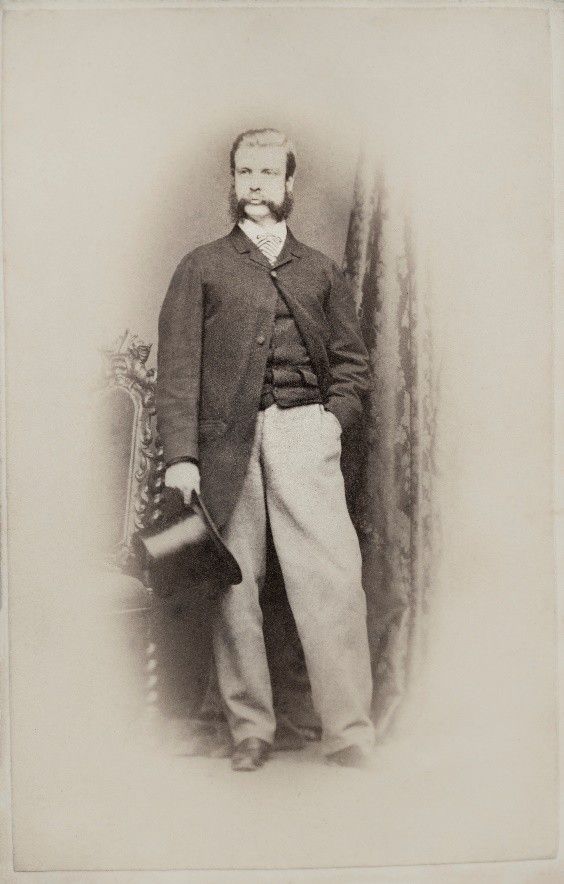
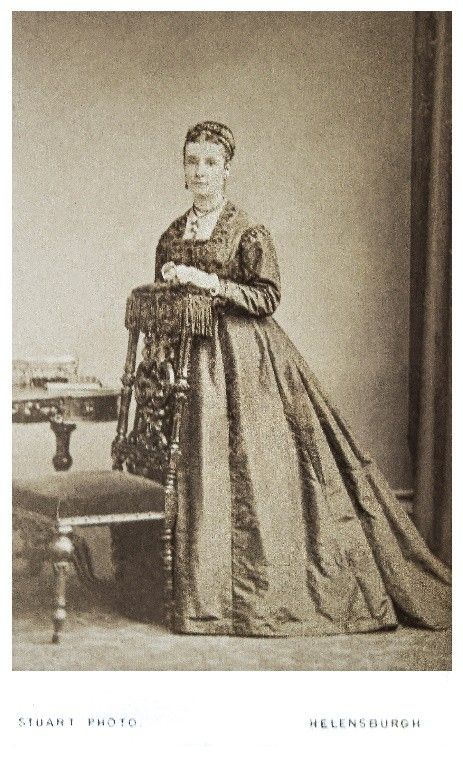
Like his father, Lachlan McBean was a merchant in Glasgow and a partner in M’Bean, Jamieson & Co. Also like his father he married a woman from St Eustatius, in this case his first cousin Jane McBean Moore a daughter of his uncle Raapzaat Heyliger Moore and his wife Feliciana A M Clarencieux. In the 1861 census young Jane is found living with her aunt Jane Moore, snr at the family home in Bath Street, Glasgow while her future husband is visiting his married sister, Mrs Williamina Irving, and her family at Milkbank House, Kettleholm, south-west of Lockerbie. The following year Lachlan and Jane chose to be married at Milkbank House rather than in Glasgow. Internet sources suggest this portrait of Jane was taken around the time of her marriage to Lachlan. [As a side note, it was not until 1863, a year after Lachlan and Jane married, that slavery was finally abolished in the Netherlands Antilles, including St Eustatius.]
Twelve children of the marriage have been traced and some of their names like Antonio Martins McBean (1869-70), Adriana McBean, Mrs White (1873- ) and Antonia de Veer McBean (1883-85) make reference to their Dutch antecedents.
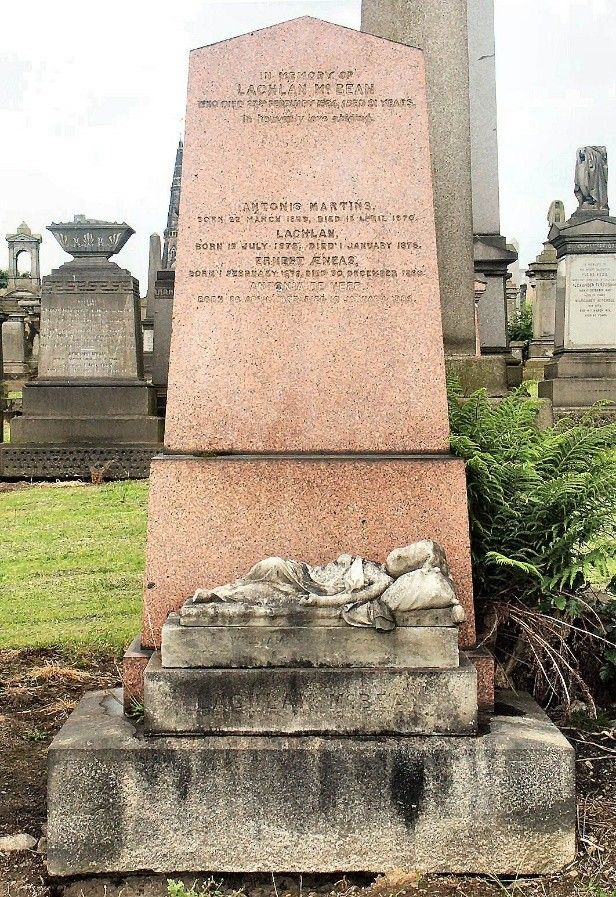
The gravestone erected by Lachlan McBean (above) has space left for the name and dates of his wife to be added but she died at Hendon, Middlesex in 1933 and did not join her husband in the Necropolis. The carving of the young child in front of the main stone is a memorial to Lachlan and Jane’s eldest son, William, who died in 1865 and is the first burial in the lair.
There is a detailed family tree for the McBeans of Tomatin and their relations at https://www.ancestry.co.uk/family-tree/person/tree/36577709/person/28426099328/facts (accessed 2nd Jan 2023)
New profiles
Two new profiles have been added to the website. One is for James Menzies, fish curer of Glasgow and the other is a detailed profile for Julia Flynn and her family expanding the information first given in Grave Matters 6.
******************************
Anyone who would like to help indexing the Burial Registers is very welcome to join us by contacting me at research@glasgownecropolis.org