Compiled by Morag T Fyfe
The indexers continue to make progress and the number of records indexed in the last three months is as follows –
| October 2019 | 408 records |
| November 2019 | 490 records |
| December 2019 | 431 records |
This brings our database of persons buried or commemorated in the Necropolis to 30889 entries at the end of December 2019.
James Monteath Douglas
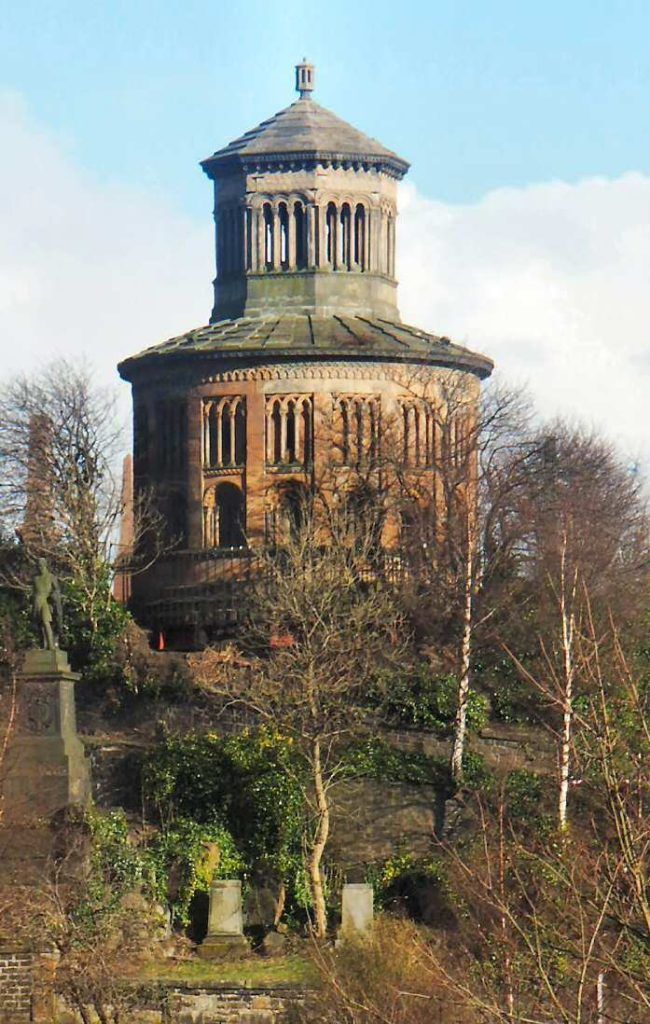
In June 1850 James Monteath Douglas, the last surviving child of Walter Monteath of Kepp, died and was buried alongside his brother Archibald Douglas Monteath in the Monteath mausoleum, constructed after the death of Archibald in 1842. Unlike his other brothers and most of his Monteath uncles James had not gone to Jamaica or India to make his fortune. He remained in Glasgow as a partner in the firm of Hamilton, Monteath & Co, wine merchants and was appointed to the post of Distributor of Stamps in the city at a salary (in 1848) of £1285 when he was responsible for collecting Stamp Duty in the city.
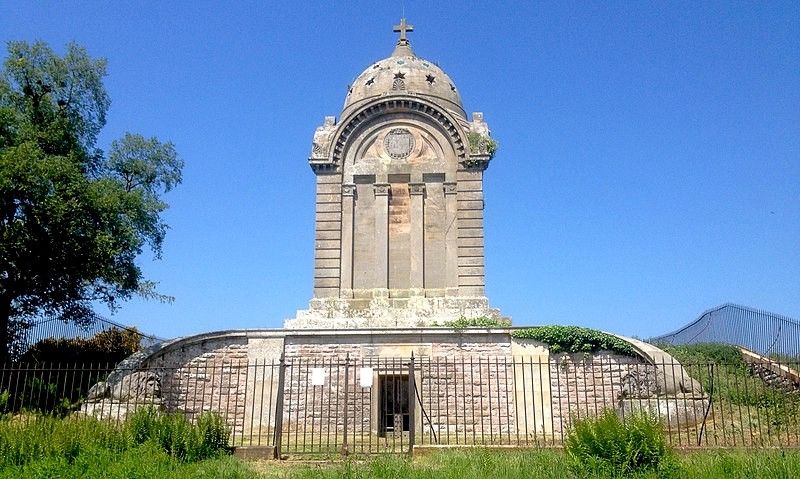
Archibald and James’s paternal grandmother, Jean Douglas of Mains, a younger sister of Margaret Douglas of Mains, married Archibald Douglas first and last Duke of Douglas. Duchess Margaret died childless and, in a complicated will, left her fortune entailed on various nephews and nieces. On the death of the childless Catherine Douglas, Mrs Charles Pye, in 1847 James Monteath inherited the Douglas fortune as next in line and, as required under the terms of the will, added the surname Douglas to his own name. His heir was his cousin Brigadier Thomas Monteath who also assumed the surname Douglas in addition to his own. On his death in 1868 the brigadier was buried near Ancrum in his own mausoleum (below).
The loss of SS Orion off Port Patrick
Readers may recall the loss of the car ferry Estonia during a storm in the Baltic in 1994 and the capsizing of the Herald of Free Enterprise off Zeebrugge in 1987 while those with particularly long memories may recall the loss of the Princess Victoria in the North Channel between Scotland and Northern Ireland in 1953. Just over 100 years before the loss of the Princess Victoria the SS Orion ran on to rocks off of Port Patrick and sank with a substantial loss of life.
At 1.35am on Tuesday 18 June, on a fine calm night, the Orion struck the Outer Ward Rock off Port Patrick resulting in a large gash in her hull which caused her to sink within fifteen minutes. It is not known exactly how many passengers were onboard as recording the number of passengers travelling was not compulsory at that date but it estimated to have been between about one hundred and sixty and one hundred and eighty in total.
James Scott, his wife Lillias Ure and daughter Marion, and a widowed sister in law, Janet Ure, Mrs William Smith, had arrived in Liverpool by the Cunard steamer RMS Europa from New York a day or two previously and were continuing their journey to Glasgow. The two sisters had married their respective husbands in a double wedding on 12 April 1831 and seem to have spent most of their married lives in Canada as their husbands were both merchants based in Montreal. All four were lost in the disaster and a stone in compartment Omega commemorates them:
In memory / of / JAMES SCOTT / Merchant, Montreal, aged 55. / LILLIAS URE, his wife aged 46. / And MARION, their only child, aged 7. / Also of JANET URE, aged 40, sister of Mrs SCOTT, and relict of / WILLIAM SMITH, Merchant, Montreal, / who all perished in the wreck / of the steam ship Orion, / off Port Patrick, / 18th June 1850, / and are here interred / except the child MARION / whose body was not found.
According to newspaper reports James Scott’s body was found quickly and sent to Glasgow. Janet Ure, his sister in law’s body was found by a diver in the wreck at the foot of a companion stair and brought to Glasgow on Friday 21st. Both James and Janet were buried in the Necropolis on Tuesday 25th June one week after the tragedy. On Friday 9th August a female body, supposed to be that of Lillias Ure, was washed ashore at Ballywater near Dondghadee, Ireland and her funeral took place on 12 August. By this time fifty five bodies had been found. The same newspaper report that tells of the discovery of Lilias’s body also reported that a silver tea and coffee service belonging to the Scotts had been recovered. The inscription said ‘Presented to Mr and Mrs Scott on their leaving Canada by a few sincere friends’.
The burial of James Laurie of Laurieston
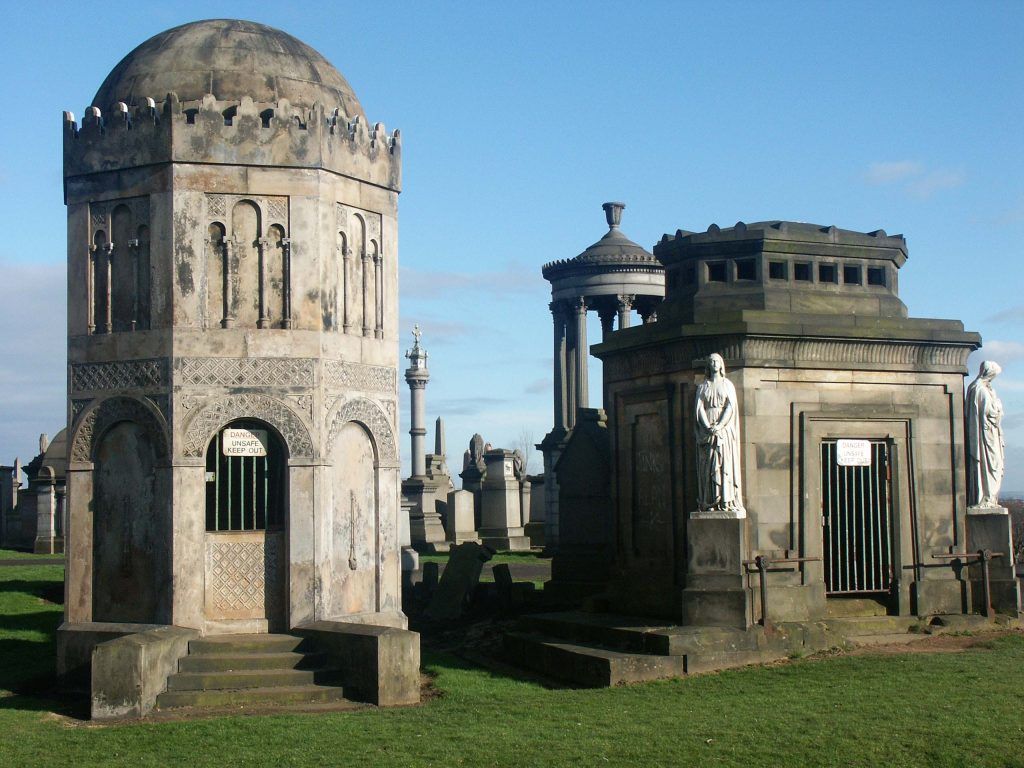
Standing side by side in compartment Alpha of the Necropolis is the Rae Wilson Moorish kiosk (left) and the Holdsworth monument (right). It is well known that the Rae Wilson monument was constructed to hold the remains of the traveller William Rae Wilson who died in 1849.
What came as a great surprise was to discover that, according to the burial registers, James Laurie of Laurieston is also buried there. This is all the more surprising as the Laurie family grave can be found not far away in compartment Sigma. The Laurie stone commemorates James (d 1851) and his brother David (d 1837), who were responsible for developing the district of Laurieston on the south bank of the river Clyde in the early decades of the nineteenth century, and members of their family. James Laurie died at 8 Carlton Place on 10th December 1851. This house, Grade A listed and on the Buildings at Risk Register, and its neighbour at number 7 form the centre piece of the eastern terrace of Carlton Place designed by Peter Nicholson for the Laurie brothers and finished in 1806.
So where is James Laurie buried? If the burial register is correct he is in the Wilson tomb but if it is wrong (and that is not inconceivable) he is buried along with the rest of his family in Sigma. On balance the evidence points to him being buried in the Wilson tomb, as the first recorded burial in the Laurie grave was not until 1855 and that suggests the Lauries may not have bought their lair until sometime between 1851 and 1855. Does anyone want to suggest opening the Wilson vault and seeing if the coffin plates are legible?
John Stephen, Architect
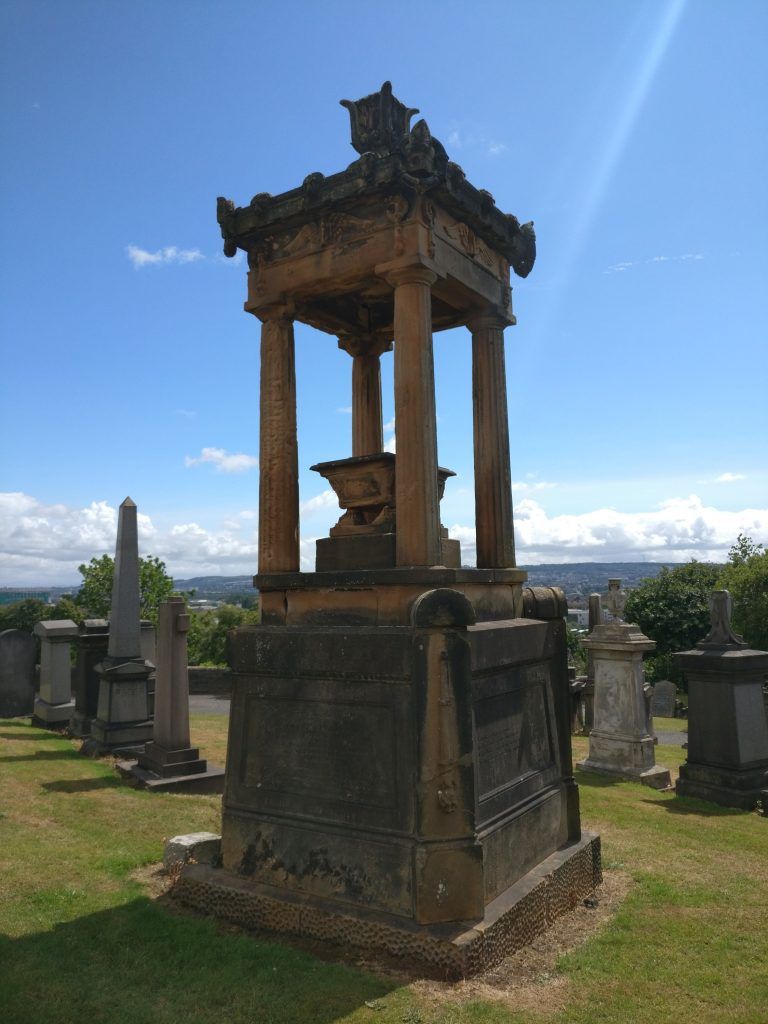
This monument to the Rev Robert Muter can be found in the Glasgow Necropolis but the architect who designed it lies in an unmarked grave elsewhere in compartment Lambda of the Necropolis. John Stephen died from pneumonia on 20th November 1850 at the early age of 43 and was buried beside three of his young children who had predeceased him.
Stephen was responsible for St Jude’s Episcopal Church (now the Malmaison Hotel) started in 1838.
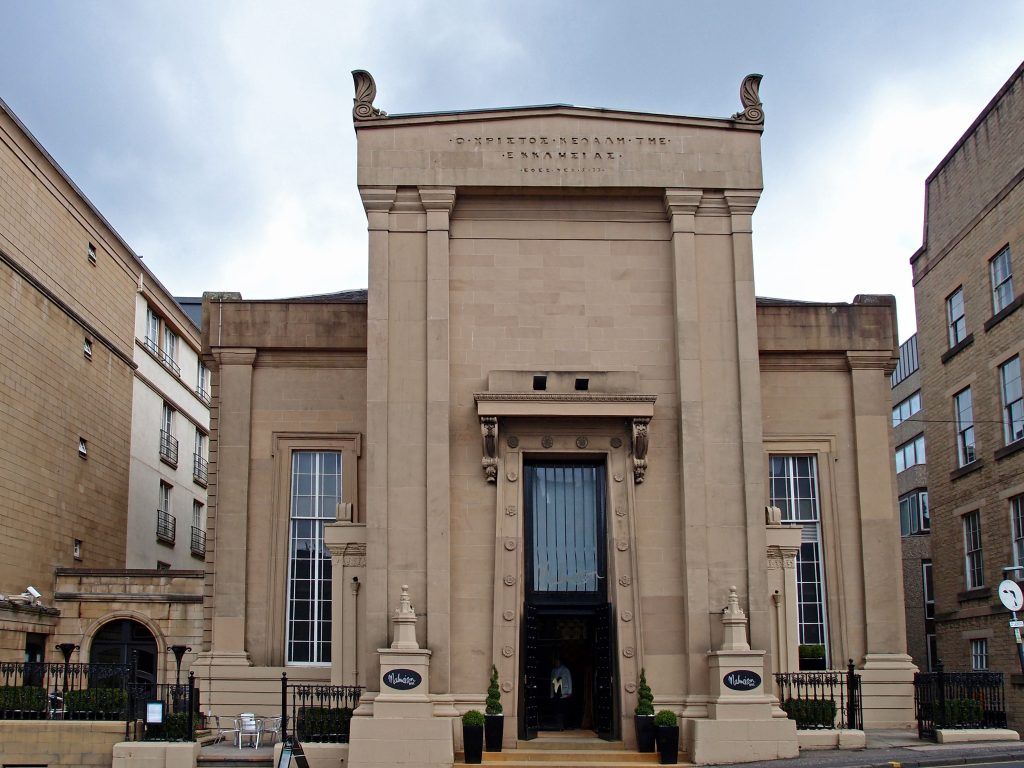
Photo © wfmillar (cc-by-sa/2.0)
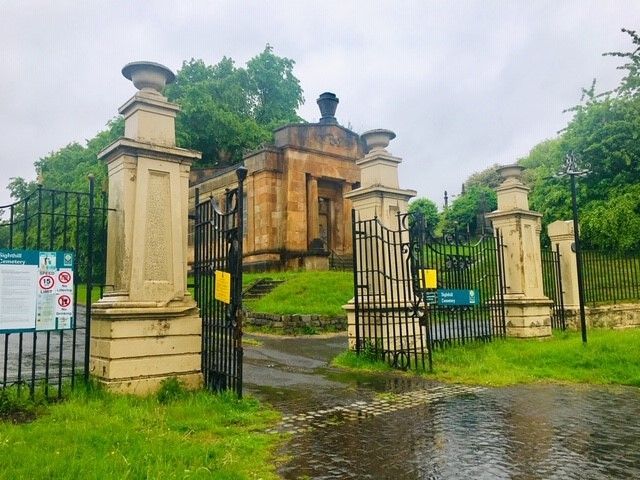
Amongst other jobs he also designed the Egyptian style lodge of Sighthill Cemetery in 1839 together with its gates and chapel.
The Eccles family of West Indian merchants
So far, due to lack of wo(man) power the FOGN has not made any systematic study of the number of people buried in the Necropolis who benefited, directly or indirectly, from the slave economy of the Caribbean and elsewhere. Slavery had finally been abolished in British possessions in 1833 and generous compensation paid to the existing slave owners.
The most high-profile slave owner in the Necropolis is undoubtedly James Ewing of Strathleven –Lord Provost, Member of Parliament for Glasgow, Dean of Guild and one of the founders of the Glasgow Necropolis. His heirs, the Crum Ewings, were also extensive plantation owners.
A less well known family of slave owners is that of the Eccles. There are three adjoining lairs in compartment Beta owned by descendants of William and James Eccles. These brothers were West Indian merchants with interests mainly in Trinidad and British Guiana. The extended family had interests in six plantations in Trinidad and three in British Guiana. When compensation to the slave owners was paid after 1833 the Eccles and their associates claimed £39253 14s 1d though, as some claims were disallowed, the final sum was somewhat smaller.
By the late 1840s/early 1850s the brothers were dead and the businesses had passed to the next generation but it was an unhappy time for the family. In 1848 the family firms went bankrupt and in 1849 two cousins, part of the next generation to take over the reins from their fathers, died within two months of one another and were buried in adjoining graves.
Captain William Eccles of 6th Regiment of Foot, son of William Eccles, died in London in September 1849 from a liver complaint resulting in dropsy. His body was returned to Glasgow and he was buried beside his father on 1st October 1849. He left a widow and at least one daughter and his widow was in such financial straights that she applied for a pension from the government.
Two months later, on 27th November, George James Eccles, son of James Eccles, died from apoplexy at the age of 32. Little is known about him except that he lived in Greenock where his firm of George James Eccles was based. The third lair was owned by George James’s brother in law, William F Burnley, also a partner in the Eccles’ firms and in which George James’s nephew and sister were buried.
******************************
Anyone who would like to help indexing the Burial Registers is very welcome to join us by contacting me at research@glasgownecropolis.org