Compiled by Morag T Fyfe
The last few months have been tough for everyone and this was reflected by the fact that family matters forced one indexer to stop indexing for us; we have also lost a second indexer who has retired after three years hard work. Thank you to Thia and Donna for their contributions. Fortunately the gap has been partially filled by Katie who has joined us.
The current indexers continue to make progress and the number of records indexed in the last three months is as follows –
| October 2020 | 675 |
| November 2020 | 544 |
| December 2020 | 524 |
Our database of persons buried or commemorated in the Necropolis now stands at 36025 entries at the end of December 2020.
The Forrester Family
On the 29th May 1857 a mother and two children were buried together in one coffin in common ground in the Necropolis. Since the start of 1855 the cause of death has no longer been routinely recorded in the burial register but in this case the circumstances were so tragic that it was – ‘Burned to death’. The accident was widely covered in the press based on the report which appeared in the Glasgow Herald on Monday 1st June:
A WOMAN AND TWO CHILDREN BURNED TO DEATH. -On Friday morning, about two o’clock, a family residing on the second floor of a tenement, 550 Dobbie’s Loan, Port Dundas, Glasgow, were awakened by the smell of smoke. They rose, but not perceiving any appearance of fire, retired again. Shortly after five o’clock the inhabitants of a house on the ground floor of the tenement in question were awakened by a portion of the roof, which was on fire above their bed, falling in. The alarm was immediately communicated to the Cowcaddens police station, and the fire brigade turned out with all haste, and in a short time extinguished the fire, which had broken out in the house of a boatman on the Forth and Clyde canal, named David Forrester, adjoining the dwelling of the people who first perceived the smell of smoke. On the firemen entering the room, a sad spectacle met their view. The wife of the boatman lay on the floor, and near to her a boy about three years of age, both of them burned almost to cinders. On proceeding to the house below, into which a portion of the burning floor had fallen, the firemen found the charred remains of an infant about fifteen months old, who had fallen through the floor along with the burning timber. Forrester’s family had only removed into the house the previous day, and it is said they had not built in their grate and had lighted a fire on the hearthstone; but, from the fact of the fire having broken out in a concealed bed, it is supposed that some light must have communicated with the bed clothing, and ignited it. The unfortunate woman must have been suffocated, as no cries of distress were heard by any of the neighbours. The remains of the three bodies were interred in one coffin on Friday afternoon in the New Necropolis. The husband was from home when the occurrence took place.
The newspaper report does not name the mother and children, they are simply identified as the family of David Forrester. However the Burial Register names them as Margaret Forrester aged 22, Thomas Forrester aged 3 and Catherine Forrester aged 2.
Remembrance Sunday 2020
Normally two of our guides conduct tours of some of our First World War graves on Remembrance Sunday. In spite of the restrictions imposed by the COVID pandemic we felt that the day should still be commemorated even if it was not possible to organize a proper tour. Remembrance Crosses were placed at each grave in the run-up to Remembrance Sunday and our guides produced a short virtual tour which can be found on our Twitter feed:
Charles Tennant Dunlop
Charles Tennant Dunlop (1821-1857) was a grandson of Charles Tennant of St Rollox and joined the family business in due course as a chemist. He does not seem to have attended the University of Glasgow and it is more likely that he studied at Anderson’s University as it was then known (now, after a number of name changes, the University of Strathclyde).
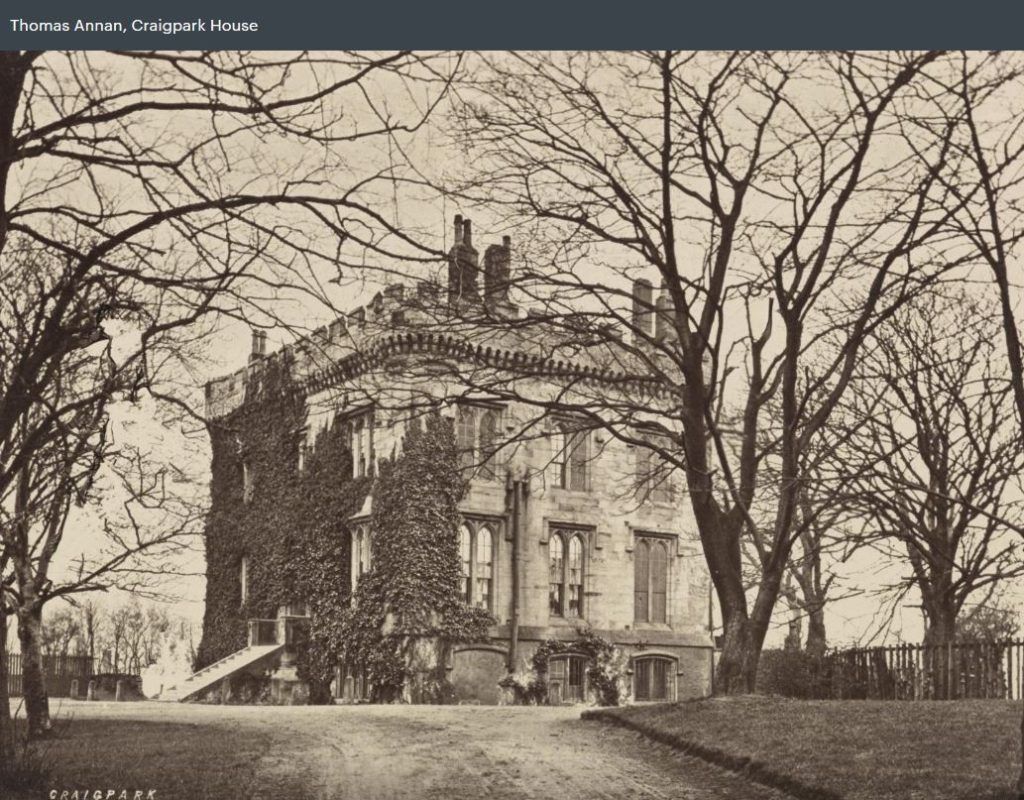
In the 1851 census Dunlop was living at Craigpark House, Townmill Road, Glasgow with his wife and four young children. He and his wife eventually had eight of a family, the youngest being born in 1857 a few months before Dunlop died. They employed six servants including a butler and two nurse maids. Craigpark House and grounds had been acquired by Alexander Dennistoun of Golfhill in 1850 as part of his plans to establish a new suburb so Dunlop must have been renting the house.
C T Dunlop died at the Royal Hotel, Holyhead, Anglesey on 6August 1857 at the early age of 36. His body was brought back to Glasgow and buried in his grandfather’s grave on the 11 August alongside two of his infant children who had predeceased him. Rachel and William Dunlop had both died of hooping cough in June 1854. Seven weeks later on the 26th September he and these two children were exhumed and reburied at Roseneath Cemetery, Dunbartonshire. Efforts to find any links between the family and Roseneath have been unsuccessful; the most likely explanation is that they had a country house there.
By 1861 Janette Dunlop and her children were living in Edinburgh and she was still found there in the 1871 census but when she died next year it was in London.
Some light is thrown on Dunlop’s interests by an advert that appeared in the Glasgow Herald after the funeral on several days leading up to 28 August 1857. On that day an auction was held at Craigpark House to sell Dunlop’s stud of ten horses (including five mares, three colts and one filly) and three foals together with a collection of carriages, chariots and other vehicles.
Alexander and Charles Craig
The Glasgow Herald of 25 December 1857 is the source for another report relating to burials in the Necropolis.
Melancholy Affair – Suposed Suffocation.-Yesterday morning about half-past seven o’clock, James Hume, master of the schooner Catherine Campbell, of Belfast, presently lying at the South Quay, called his men to rise, from their berths in the forecastle and commence work. One of the hands, a young lad named Patrick M’Kinty, answered the call, after which the master went on shore to see the work begun. The other hands not making their appearance, he returned to the vessel and caused M’Kinty to light a candle and ascertain if all was right. The boy did so, and reported that he was afraid something was wrong. The master then immediately proceeded to the forecastle and found the two hands named, Alex. Craig and Charles Craig (cousins), lying dead. The master instantly reported the circumstance to the police. It appears that the unfortunate men, who were natives of Carlow, county Antrim, Ireland, had gone into the city the previous evening about six o’clock and returned to their vessel about eight, and went to bed. The boy remained on watch till relieved by the master at eleven o’clock, at which time he retired to bed in time same place with the Craigs. He did not speak to the men, and heard nothing of them until told by the master to call them. The case has been reported to the Fiscal, who has caused a post mortem examination to be made on the bodies.
The two cousins were buried in common ground in the Necropolis on 28 December. Alexander was 20 and Charles 18. The cause of death in each case was ‘supposed to be suffocated or poisoned’. Although it is reported that post mortems were carried out nothing further is reported in the newspapers so it looks as though the suggestion of poisoning was ruled out.
Catherine Campbell was a wooden sailing smack built by Scott & Son of Greenock for John Campbell of Glasgow in 1842. In 1852 she was sold to Wm Higgins and Jas Morrison of Grangemouth and in 1857 she was sold again to unknown buyer in Belfast. She ran aground and was wrecked on 17th February 1874 near Amble on the East coast of England and was declared a total constructive loss.
Friends of Glasgow Royal Infirmary
A new charity has been set up called the Friends of Glasgow Royal Infirmary (http://friendsofgri.org/). Their main aim is to raise money to celebrate the heritage and history of GRI and one of their first projects is to create a small medical history museum. It is hoped that FOGN and Friends of GRI may be able to collaborate on some projects.
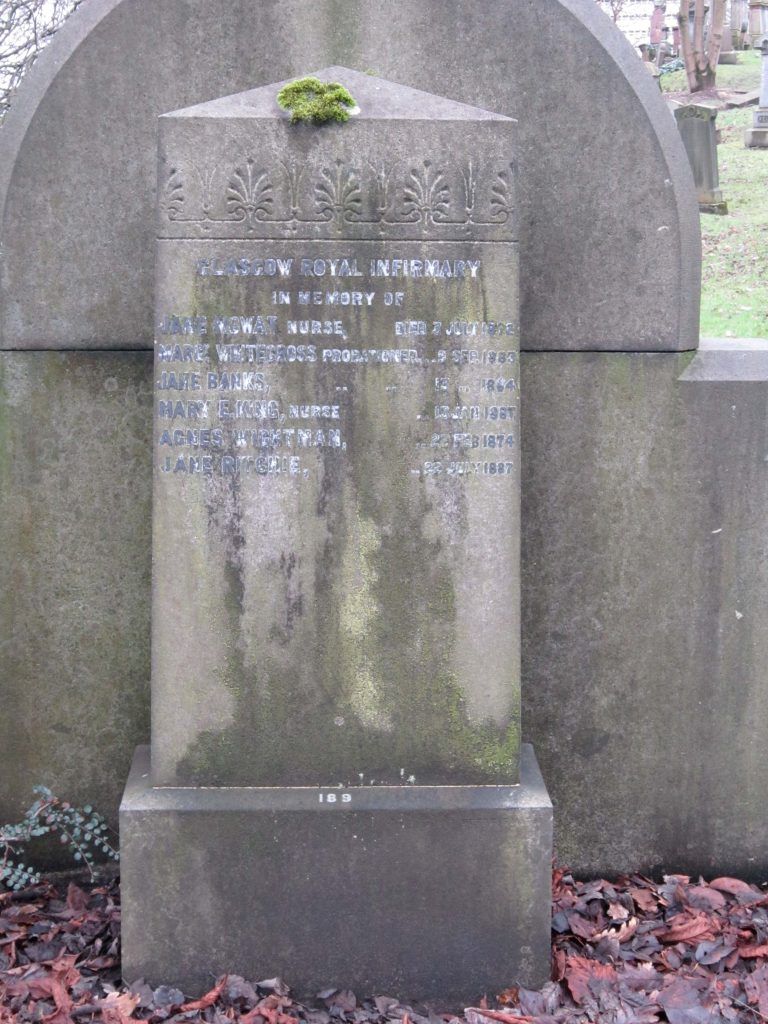
There are three graves in the Necropolis in which GRI nurses and domestic staff are buried and FOGN is in the process of raising funds to renovate these gravestones as a mark of our gratitude to all the medical staff who have worked so hard and selflessly on our behalf in the last months during the COVID pandemic.
Major Alexander Martin (c1782-1857)
There is a stone in Compartment Epsilon which displays military accoutrements and commemorates Major Alexander Martin of the 45th Regiment of Foot who died at Ardrossan on 25 November 1857 aged 75.
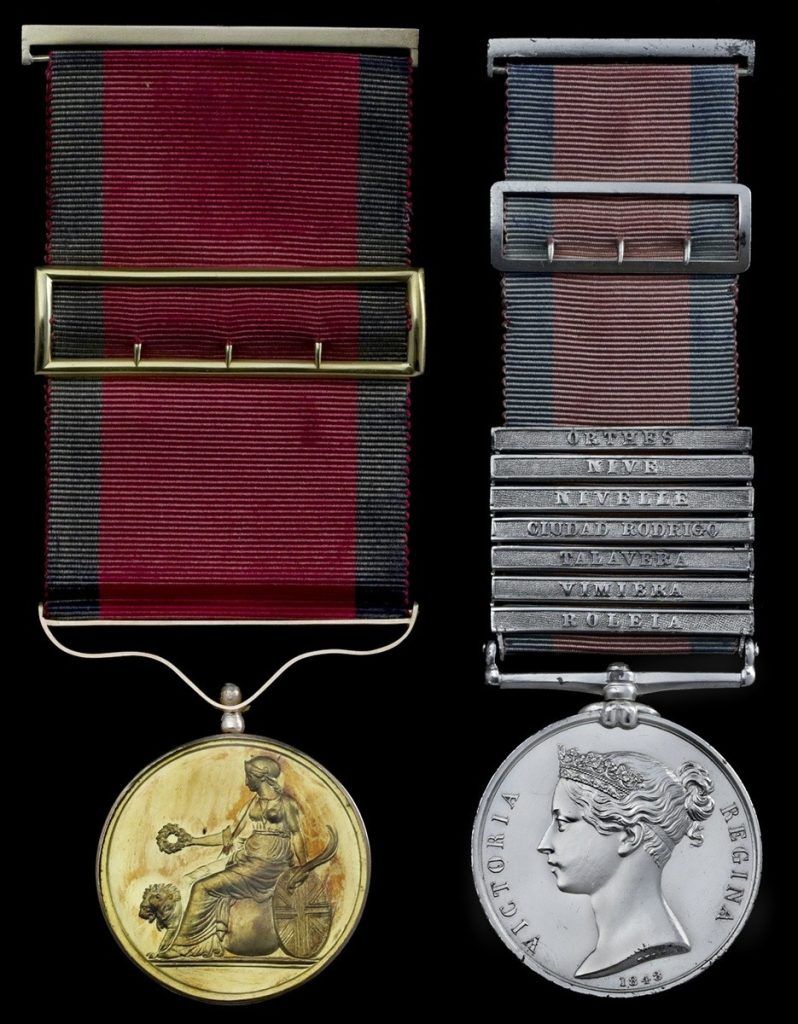
Alexander Martin was commissioned in the 45th Regiment of Foot in 1802 and served for twenty three years until 1825. He had an eventful career serving in South America in 1806-7 and participating in the attack on Buenos Aires. The 45th were hardly back from South America when they embarked for Portugal in 1808. Martin spent much of the next six years in Portugal, Spain and France. This service was interrupted by a spell in England recuperating from wounds received during the storming of Cuidad Rodrigo in 1812 where he commanded the forlorn hope leading the assault. When he returned to his battalion after recovering from his wounds he further distinguished himself in the battles in the Pyrenees and the south of France in 1813-14. At the battle of Toulouse on 10th April 1814 he actually commanded the battalion after the more senior officers were killed or wounded. As a result of his leadership at Toulouse, Martin was awarded an Army Gold Medal, a very unusual award for a Captain.
When this medal, together with his Military General Service Medal, was auctioned by Spink a detailed biography of Major Martin was prepared and this note is based on that text www.spink.com/lot/19002000277
Martin retired from the army in 1825 and by 1837 he and his first wife Ellen (or Eleanor) Lyle were to be found living at Mayville Cottage, Stevenston, Ayrshire. It is not known what brought the couple to Ayrshire as Martin was most likely of English birth and his wife hailed from Coleraine, Co Londonderry. By 1842, when Ellen died, they were living in Ardrossan and Martin remained there for the rest of his life. He remarried two years after Ellen’s death to Frances Hilton Miller a daughter of John Miller of Muirshiels. It is probably thanks to his second wife that Martin was buried in the Necropolis. Her parents, John Miller and Mary Mccook, had already been buried there and it must have seemed the obvious place to choose for Martin’s burial.
New profiles added to the website
Three new profiles have recently been added to our website. They are for Ebenezer Bell who died as a result of the boiler explosion on the Earl Grey steamer; John Blacklock who committed suicide by cutting his throat with a razor; and Colonel Robert Easton Aitken VD, JP, CA who had a successful career as a chartered accountant and stockbroker and served for many years in the 1st Lanarkshire Rifle Volunteers.
Garngad House
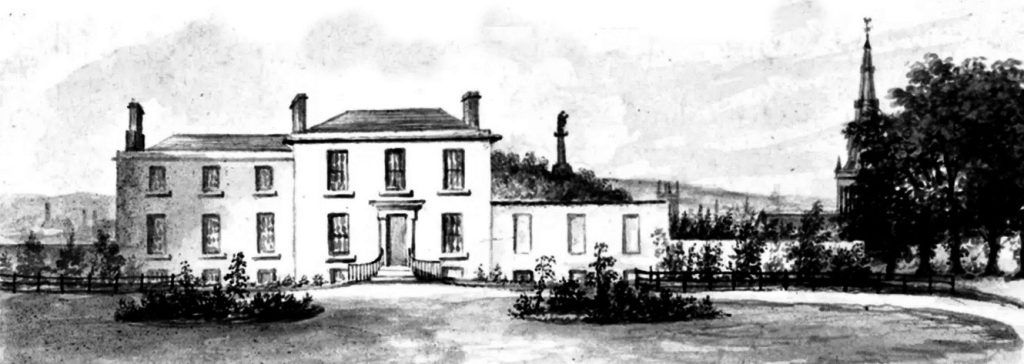
In 1858 three entries appeared in the burial registers which gave the residence of the deceased as Garngad Asylum. The three persons were William Lang, Elspeth Murray and Elizabeth Stratten, William Lang being specifically described as a patient. All three were buried in common ground. William Drury, formerly Superintendent of the Glasgow Royal Asylum, established a small private asylum in Garngad House in 1823. By 1858 Drury had retired and Dr James Hill had taken over the asylum. At this time a maximum of twenty eight patients could be accommodated though by the time it closed in 1872 it could cater for about eighty patients.
Martha McCairn
The burial of an infant called Martha McCairn on the 15th January 1859 caught my eye as her address was given as Kenmure Row which was a row of colliers’ houses built by Carron Co on the south side of the Forth and Clyde Canal. The location is less than two miles (as the crow flies) from my childhood home so, naturally, I was interested in this family. Kenmure Row had only been built about six years before the McCairn family lived there. In 1910 a report on “The housing condition of miners” by Dr John T Wilson described it as twelve stone-built one-storey two apartment houses. In 1910 they had no gardens, no wash houses, no coal cellars, one standpipe at the east end of the row, one outside sink shared between two houses and two privy middens, each with four seats, situated at either end of the row. The houses had been renovated internally about 1894 so one wonders what like the living conditions were in 1859.
Martha’s family proved relatively easy to trace thanks to their unusual surname. She was one of at least eleven children of David McCairn and Mary McLaughlan born between 1853 and 1874. Her father, David, was Irish and is first found in the 1841 census as a twelve year old coal miner living with his mother, Martha, and several siblings in High Possil, Barony parish, Lanarkshire. Ten years later he was working as a coal miner as were two brothers and an eleven year old nephew. He must have married soon after that census because his eldest son, Edward, was born c1853. Young Martha’s death in 1859 is the only evidence for their sojourn at Kenmure Row as by 1861 the family was living at the Old Basin, Maryhill and ten years later they can be found at Climpy, Carnwath where David and Edward are both coal miners. One puzzle about this family is why they buried Martha in a common grave in the Necropolis as it was not the closest burial ground; Sighthill Cemetery had opened in 1840 and there were churchyards at Cadder Church and what is now the Auld aisle Cemetery, Kirkintilloch which were all closer to Kenmure Row.
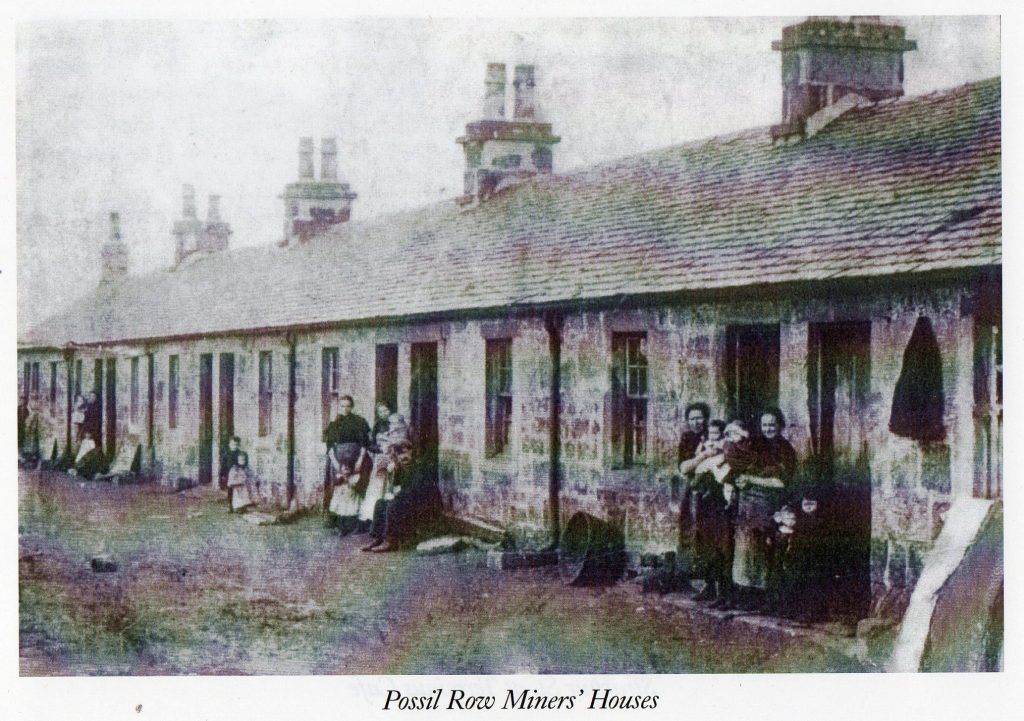
A row of miners’ houses close to and very similar to Kenmure Row.
******************************
Anyone who would like to help indexing the Burial Registers is very welcome to join us by contacting me at research@glasgownecropolis.org