Complied by Morag T Fyfe
The indexers have almost finished 1875, and the number of records indexed in the last three months is as follows –
| April 2024 | 396 |
| May 2024 | 364 |
| June 2025 | 300 |
Our database of persons buried or commemorated in the Necropolis now stands at 50854 entries at the end of June 2024 of which 21856 entries represent persons buried in common ground with no grave marker.
James Johnston, manager of the Kolpino Iron Works, St Petersburg
On 18 June 1874 two coffins were removed from the Southern Necropolis and reburied in lair 425, Compartment Epsilon, Glasgow Necropolis. James Johnston had been buried in the Southern Necropolis Western Section on 7 August 1856 and his daughter Agnes Margaret was buried there on 21 October 1873. The lair in the Necropolis was purchased by James’s son John William Johnston on 12 November 1873 less than a month after his sister died.
The gravestone in the Necropolis describes James Johnston as ‘of the Golpino Iron Works, near St Petersburg’ and Agnes as being born there in 1847. James was born at Falkirk in 1802 and it is very tempting to wonder whether he trained at the Carron Iron Works before moving to St Petersburg but that has not been substantiated. If the supposition is correct he would not have been the first Carron employee to migrate to Russia.
A report in the Falkirk Herald of 11 May 1854 decries the decision of Nicholas Baird (presumably an ex-Carron employee) to remain in the employment of the Russian Emperor even though the two countries were now at war. By way of contrast ‘our fellow-townsman, Mr James Johnston (second surviving son of the late Mr Thomas Johnston, bookseller, Falkirk), who has held the important office of principal engineer at the “ Admiralty Works” of the Emperor of Russia, at Kolpino, on the Neva, for upwards of twenty years past, has deemed it inconsistent with the allegiance he owes his Sovereign, and his duty as a British subject, to continue longer in the service of the Czar. He accordingly resigned his appointment some months ago, and is now, with his family, in this country.’ The report goes on to explain that James was responsible for building steamers for the Russian navy.
Common graves in the Necropolis 1833-1872
The indexers of the Burial Registers of Glasgow Necropolis passed a milestone in February 2024 when the burial of 9 months old Mary McFadyen in common ground in Compartment Eta on 5 October 1872 was added to the database. This burial marked the end of the use of common ground for burial in the Glasgow Necropolis. Between 19 June 1833 and that date 21,856 burials took place in common ground, 69% of the total number of burials for that period. Over the course of these 39 years plots of common ground opened, closed and re-opened in various parts of the Necropolis. The numbers buried varied from 235 squeezed into Compartment Delta to 4,674 in Compartment Iota and 8,094 in Compartment Eta.
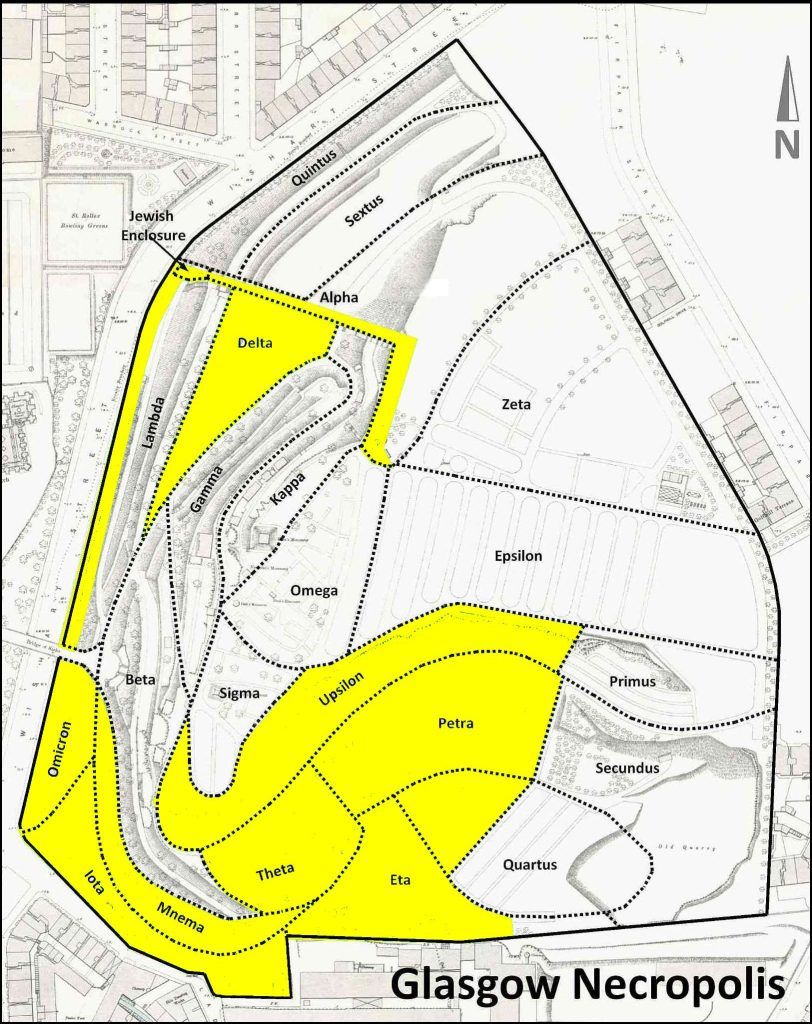
Now that we know how many people were buried in common graves we can start to find out a little bit about them. The male/female ratio amongst the total number of burials was almost exactly 50/50 while in 50 cases, generally still births, the sex was unknown.
We know the ages of just over 17,000 of the persons buried and the chart below summarises the distribution by decade of age.
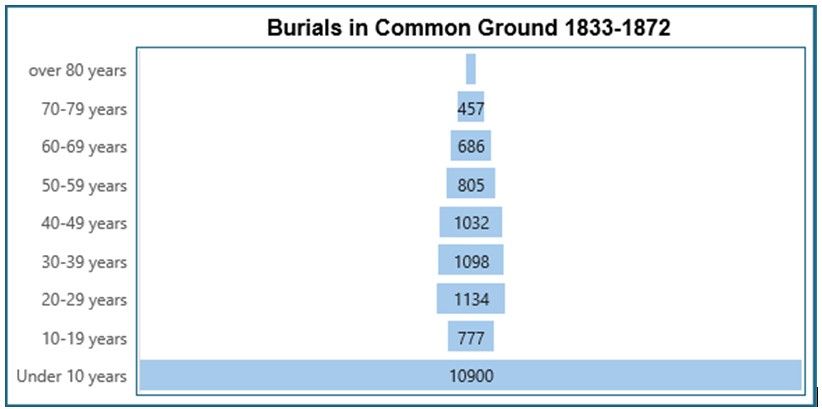
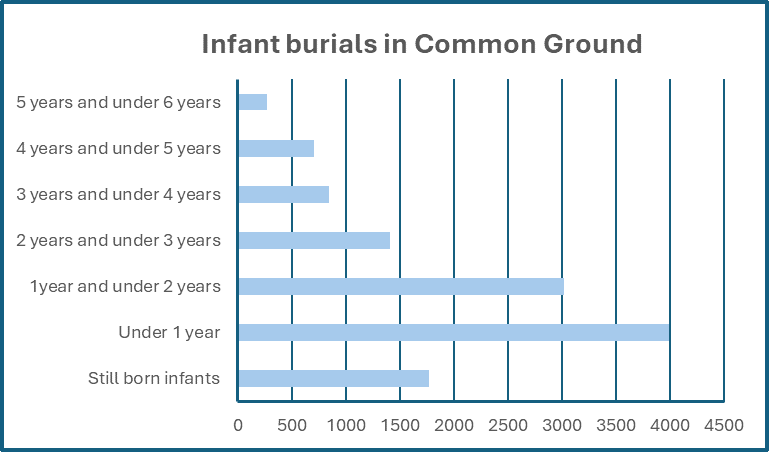
8,488 burials took place before the introduction of civil registration on 1 January 1855 and provide causes of death but seldom an address. From 1855 the reverse is true, causes of death disappear immediately from the burial register and addresses start to make their appearance.
Articles in previous issues of Grave Matters show it is possible to tentatively identify families and then use civil records to confirm the identification. See, ‘Two brother drown’ in Grave Matters 6, ‘John Duncan and family’ in Grave Matters 27 and several articles about persons buried in common graves in Grave Matters 16.
The precise location of the common graves within the various compartments is unknown but in 2015 the Friends of Glasgow Necropolis obtained funding from HLF for a geophysical survey of five of the possible areas. That identified an area to the north east of the large open triangular area of Compartment Eta in the lower Necropolis which contains the unmarked graves of over 8,000 people. We subsequently approached GCC for permission and assistance to mark the boundary of this area with a Wildflower Border and, in 2021, further bulbs and wildflowers were planted with the help of volunteers. The final touch will be to place a stone marker at this site with the numbers of people buried there on it.
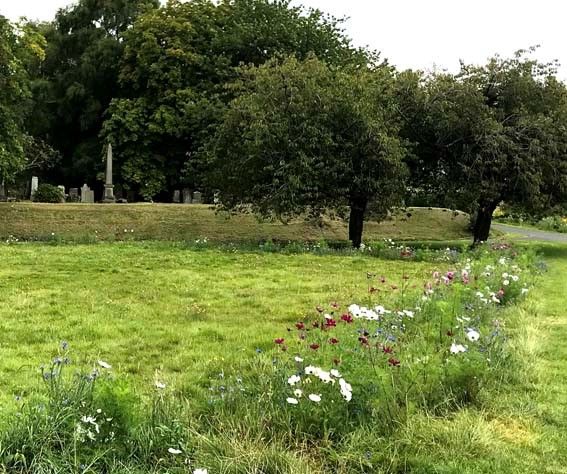
In 2023 Angus Farquhar, creative director of Aproxima Arts (https://www.aproxima.co.uk/) a Scottish arts based charity launched Glasgow Requiem, a three year creative programme. One aspect of this is to embellish our earlier efforts and make the whole area of Eta a flower meadow as a memorial to those unremembered thousands. Planting started in December 2023 and further planting occurred in May 2024.
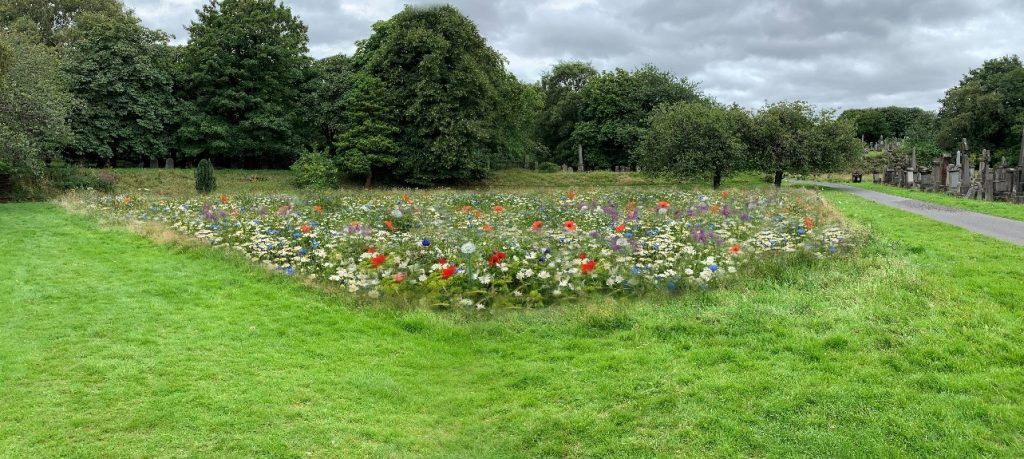
The Friends now have further GCC funding to mark another area and our plan is to continue until all areas of common ground are marked with Wildflower Borders.
Margaret Watson Cairns
On 23 March 1875 Murdoch Muir, aged 50 was buried in the Necropolis and the following day (24 March) Margaret W Cairns aged 24 was buried. A degree of confusion was caused in interpreting these entries by the fact that ‘died at W Infirmary’ was inserted between them and it was not clear to which entry this note referred. The only thing to do was to obtain both death certificates. These quickly showed that it was Murdoch who died in the Western Infirmary. However the death certificate for Margaret Cairns turned out to be unexpectedly interesting.
By the time Margaret died on 20 March 1875 she and her two surviving sisters had lost both parents, their father having died only three months previously. The family home at 13 Hamilton Drive West, Partick had not yet been disposed of but Margaret actually died at 219 St Vincent Street, the home of her maternal uncle William Brown Watson. Margaret had been unwell for at least two months (and probably longer) prior to her death which was caused by exhaustion after amputation. The cause of the amputation was necrosis of metatarsus; necrosis is the premature death of healthy living cells due to external or internal injury, the metatarsus is a group of bones in the middle section of the foot. Putting both these facts together it would seem one of Margaret’s feet had been amputated.
Margaret was the eldest daughter of John Cairns, cotton broker and Margaret Watson and niece of William Brown Watson, cotton manufacturer, Alexander P Watson and Mary Watson. By 1881 the two remaining Cairns sisters, Agnes and Elizabeth were living with their aunt Mary Watson at Airthrey Croft, Logie, now Stirlingshire and seem to have remained in their aunt’s household from then on.
Alexander Thomas Assafrey and his family
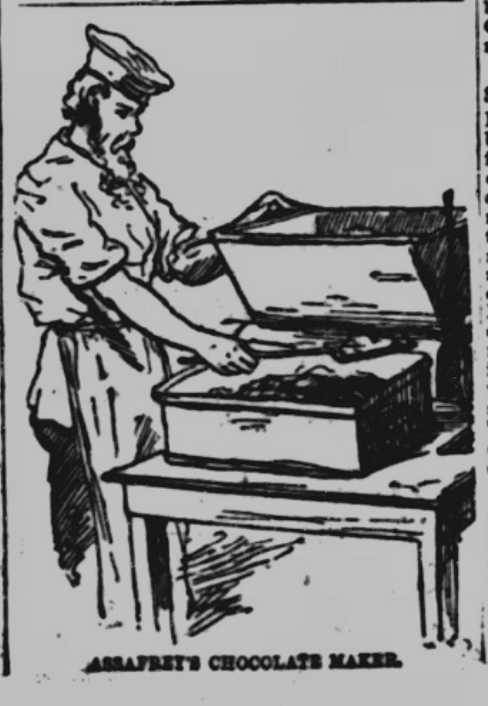
On 8 May 1888 the Prince of Wales, accompanied by the Princess opened the International Exhibition of Science, Art and Industry in Kelvingrove Park. While touring the event the Princess of Wales was presented with a box of bonbons and chocolates by the wife of A T Assafrey who had a very popular stall at the exhibition where people could watch chocolates and other sweets being made. He also had an oriental kiosk where “all manner of fanciful bonbons and preparations of sugar and chocolate and ices [we]re sold.”
Alexander Thomas Assafrey arrived in Glasgow about 1870 from Reval (Tallinn) in Russian Estonia. He was a confectioner by training and very quickly established himself in Glasgow with a factory and retail shops. He married in 1871 and applied for naturalization in 1876. In January 1877 his second daughter, Olga Rachel, died at the age of 2 ½ years and he purchased a lair (Lambda 247) in the Necropolis for her. He and his wife were lucky in their family and their other five daughters survived to adulthood. The lair remained unused until 1899 when John Paul Assafrey, aged 64 or 65 was buried there. No trace of John Paul has been found in Scottish records except for his admittance to Woodilee Asylum on 1 February 1899 and his death there on 19 March 1899 from apoplexy. John Paul and Alexander must be brothers as they share the same parents according to their death certificates but it looks as though John Paul may only have been on a visit to Alexander, though why he should have finished up in Woodilee is a puzzle.
By 1909 Alexander seems to have got into financial difficulties and in 1915 it was resolved at an EGM wind up the company. When Alexander died on 29 April 1930 he left no will and his estate amounted to £256 13s 2d. Alexander was not buried beside his daughter and brother, instead the lair passed to one of his married daughters Hilda Alexandra Bamford and her family. Instead he chose to be buried in Craigton Cemetery beside another daughter, Alma (Alina Feodora Maud) who perished in the sinking of the Empress of Ireland in the St Lawrence River on 29 May 1914. Her body was recovered, identified and returned to Scotland where she was buried in Craigton on 19 June 1914.
Necropolis Families Reunion – March 2024
by John Taylor Park
In an article in GM18 entitled Necropolis Networks Morag Fyfe discussed links between different families buried in the Necropolis. The diagram from the article (below) demonstrated how links from the family of John Taylor senior (1792-1866) extended out to reveal connections with at least six other families.
Necropolis Networks
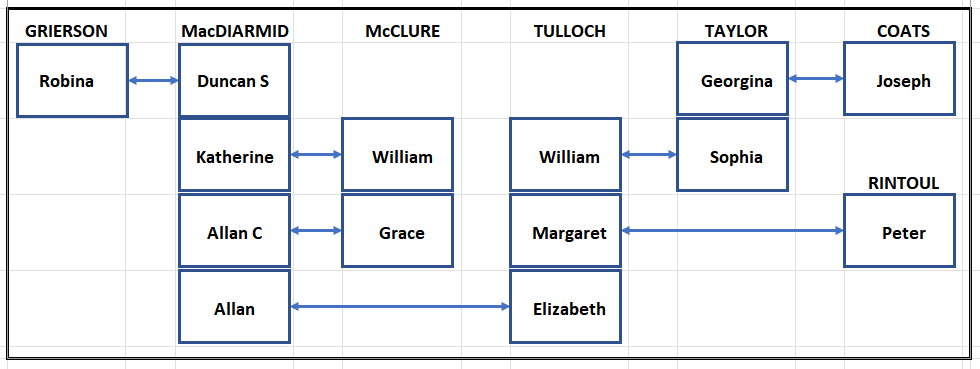
The article also mentions Baptist Church connections and three of these families, Taylor, Tulloch, and MacDiarmid, who were part of a small group of individuals who founded Hillhead Baptist Church in 1883. With the exception of the Coats, the other families in this network would all later become linked to the founders families through a series of marriages.
A quite unique reunion involving descendants of these same families took place at the Necropolis in March 2024. The following is an account of events which led to this family reunion.
In the beginning
The story began in early 2021 after I discovered my 3xGreat Grandfather John Taylor senior was buried in the Necropolis and this first brought me into contact with FoGN and Morag. Through a combination of Morag’s expertise and the indexed burial records I was able to discover further Taylor relatives buried in a number of other family lairs
The first link was to the Tulloch family lair. I had already researched my Great Grandfather’s extensive family and was aware of a marriage between his daughter Sophia and Baptist ministers’ son William Tulloch but finding a record of Sophia’s burial next to William in the Tulloch family lair uncovered the first link.
Research into the Tulloch family then revealed that William’s sister Elizabeth was buried ‘next door’ to the Tullochs in the MacDiarmid family lair, with Elizabeth having married an Allan MacDiarmid. Further research into both these families then uncovered links to the Rintoul, McClure and Grierson family lairs, and almost by accident this whole network of Necropolis family links became apparent.
Family profiles and a Church offering
Another benefit of this somewhat unplanned research was to gain sufficient information to write profiles for the Tullochs, the MacDiarmids, and the Taylors (senior and junior) which can be found in the Profiles section of the FoGN website
I also contacted Hillhead Baptist Church around the same time, in part to offer this information about their founders but also to enquire if they had any further details. This proved to be an inspired decision as the reply from an enthusiastic church secretary Anne Muir revealed that not only was she aware of the founders, but that she had also written a booklet about the history of the church during its centenary year in 1983. We exchanged much information which gave me a fascinating insight into the charitable work of the founders during the early years of the church.
DNA breakthrough and long-lost cousins
I now had a very clear picture of these families’ lives but there was still one further lead to explore. The Tulloch name had appeared on a list of DNA matches on my Ancestry account and some digging revealed this was a descendant of the very same Tulloch family. I contacted them and was introduced to like-minded family historian Angus Tulloch who not only held a large collection of family records and photographs but was still in contact with some descendants of the other families.
We arranged to meet and I travelled to Scotland to meet with new members of the family. I told of visiting addresses and churches which had been part of the Taylors’ lives and this included the network of family lairs in the Necropolis. This was completely unknown to the Tullochs and other descendants as was the connection to Hillhead Baptist Church.
Following in our ancestors’ footsteps
The idea of a family ‘tour’ to visit the various lairs at the Necropolis and the church at Hillhead was later floated and created much interest and a date was set.
Family reunion tour, Friday 8th March 2024
After months of careful planning our family group finally met at the entrance to Glasgow Necropolis. After many friendly greetings and handshakes we posed for group photographs at the entrance facade.
We then set off along the maze of pathways which lead into the grounds and up towards the higher ‘Epsilon’ section where our ancestors were waiting for us. As we made our way uphill we were afforded elevated views of Glasgow Cathedral and the Royal Infirmary. We were also able to view some of the grand monuments of famous Glaswegians.
Our first visit was to the family lair of William & Sophia Tulloch, two of the founders of Hillhead Baptist Church. This William Tulloch (1848-1923) was the father of John Taylor Tulloch and the Grandfather of William Alexander Tulloch. His wife Sophia Crombie (Taylor) Tulloch (1851-1923) was the daughter of West Indies merchant John Taylor. Also named on the Tulloch memorial although not buried here was William & Sophia’s daughter Sophia Evelyn Tulloch.
The adjoining lair was that of Allan & Elizabeth (Betsy) Macdiarmid, also founders of Hillhead Baptist Church. This Allan Macdiarmid was born at Fortingale, Perthshire in 1836 and died at Kelvinside in 1890. His wife Elizabeth Morrison (Tulloch) Macdiarmid was the sister of William Tulloch in the adjoining lair. Also buried here is Robina (Grierson) Macdiarmid, the wife of Allan & Elizabeth’s eldest son Duncan Stewart Macdiarmid.
A few rows along was the lair of Peter & Janet Rintoul. Of particular interest to our group was Margaret Macdonald (Tulloch) Rintoul, who is named on the Rintoul memorial but not buried here. Margaret was the eldest daughter of William & Sophia Tulloch (above) and was married to Peter Rintoul junior, the son of Peter & Janet. There are a total of 10 Rintoul family members either buried or commemorated here.
Our final visit was to the Taylor family another few rows along. John Taylor was a Paisley born West Indies merchant and the father of Sophia (Taylor) Tulloch. Also buried or commemorated here are Sophia’s siblings Margaret (Taylor) Park, Jean Taylor, and William Simpson Taylor, while Victoria Graham Taylor is named on the memorial but not buried here. Further siblings John Taylor junior and Georgina Wilson (Taylor) Coates are buried in other sections of the Necropolis.
Having concluded our Necropolis visit we took the opportunity to pay a brief visit inside Glasgow Cathedral before making our way to Hillhead for lunch.
Brian Muir from the current congregation of Hillhead Baptist Church joined us at lunch. He gave us a most interesting talk about the history of the church and its current status, and it became clear that the principles and aims set out by our ancestors over 140 years ago remain as strong as ever. Of particular interest was the fact that the founders’ names continue to be remembered and are read out during an annual commemorative service.
After lunch we had a short walk to see the church itself, now in a sorry state and little more than the four walls. Increasingly serious building defects required the roof to be removed for safety reasons during 2022. The congregation had to vacate the church and relocate to temporary premises, but it is hoped they are able to find a new permanent home soon.
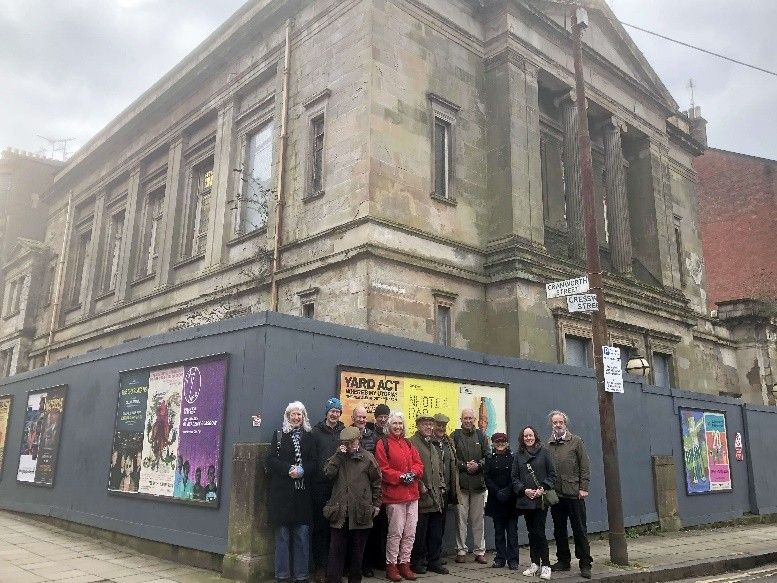
Following this we paid a visit to the former family home of William & Sophia Tulloch at 41 Athole Gardens. The Tulloch family lived here between 1884-1900, so this was the pleasant surroundings the young Tulloch family would have grown up in.
A few of the group also briefly visited Huntly Gardens, quite literally just round the corner from Athole Gardens, where John Taylor Tulloch would later reside with his own family during the 1920s & 1930s.
And finally
Having re-established contact with the church, a number of us now hope to attend the next annual service remembering our ancestors who founded the church. It should be an interesting experience.
This Necropolis Networks story may yet have more to reveal, but it seems to perfectly demonstrate the potential for discovering other family networks with fascinating tales lurking within the indexed burial records and monumental inscriptions.
My thanks are extended to those who quietly work away at this task.
Charles Bladen 1829-1872
An unusual surname cropped up in the Burial Register in 1872 when 43 years old Charles Bladen was buried in Compartment Epsilon. The 1871 census identified Charles Bladen, his wife Maria and several children as having been born in England and the 1861 census showed the family living in Stoke upon Trent and with birth places ranging from Birmingham, Warwickshire to Wolverhampton and Hanley both in Staffordshire. In both the 1861 and 1871 censuses Charles gave his occupation as ‘manager of iron works’.
A short obituary of him published by the Iron and Steel Institute provides basic details of his professional life. He was born in Wolverhampton in 1829 and started work at Thorneycroft’s Shrubbery Iron Works which his father managed.
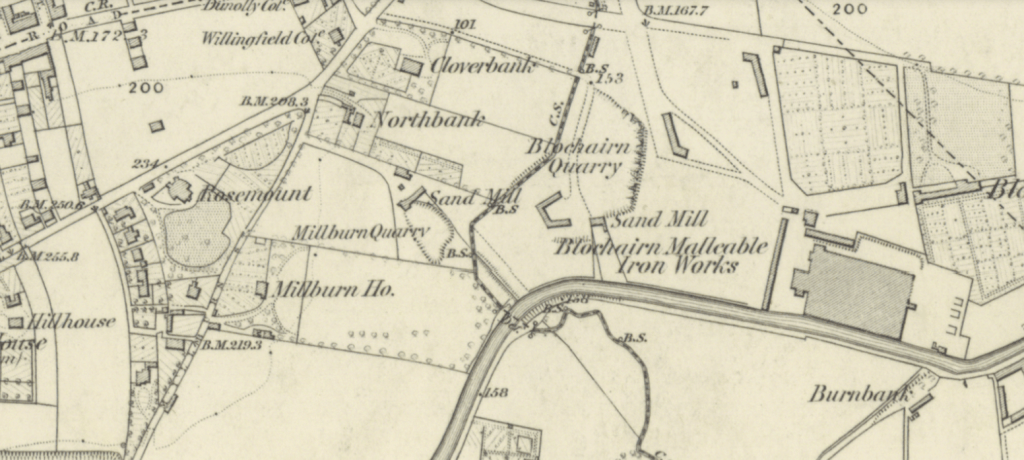
He became manager of the Shelton Bar Iron Works, Stoke on Trent c1854, moved to another management job at Jarrow and came to Glasgow to become manager of Blochairn Iron Works about 1867. At Blochairn he was responsible for overseeing a major extension of the iron works including 48 puddling furnaces, 16 heating furnaces, three plate mills, and a bar mill. He and his family lived first at Provan Mill until moving to Millburn House in 1870. He died of enteric fever at 135 Wellington Street on 11 October 1872 aged 42. As well as the Iron and Steel Institute he was a member of the Institution of Mechanical Engineers and the Cleveland Institution of Engineers.
It might be supposed that a family with such shallow roots in Glasgow would soon return south but that was not the case as the widowed Maria and her younger children could be found in Kinning Park in 1881 and may not have moved away until after the marriage of Alice Maria Bladen in 1890. The family then scattered. Maria, a son, and a daughter settled in New Zealand while another son ended up in Australia.
Catherine Bell
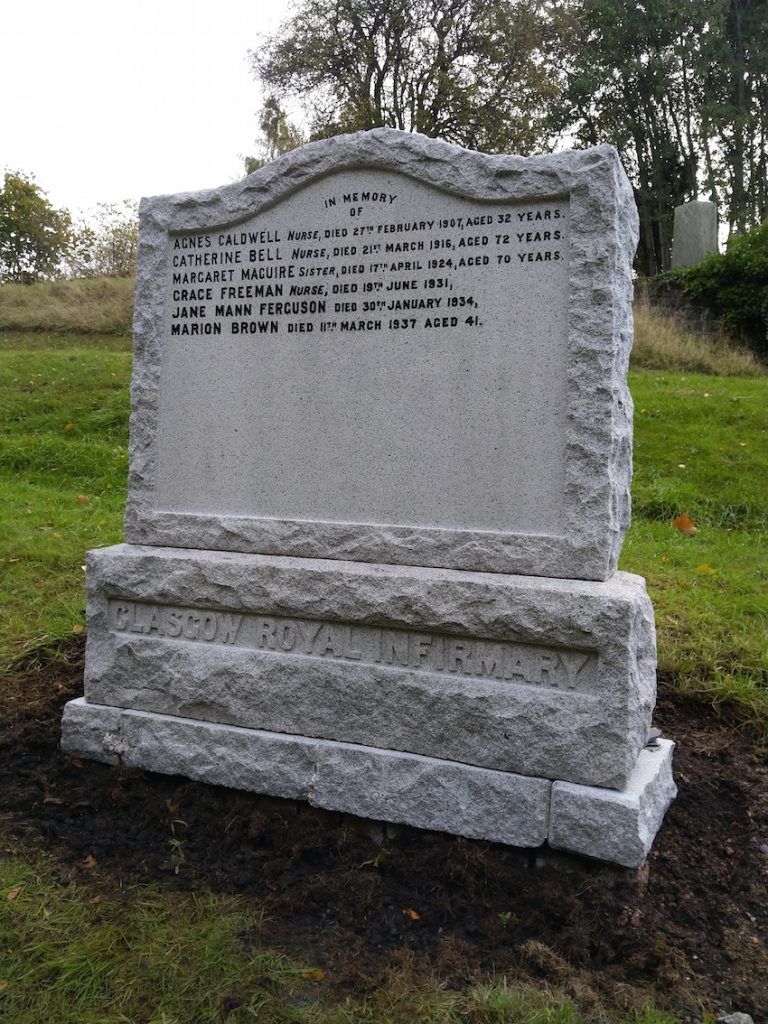
In 2021 Friends of Glasgow Necropolis arranged for the refurbishment of the nurses memorials in the Necropolis as a mark of gratitude for the hard work and sacrifices made by NHS staff during the COVID pandemic. It has recently come to my attention that the Royal College of Physicians and Surgeons of Glasgow holds a photograph of the funeral of one of the nurses named on the stone shown above.
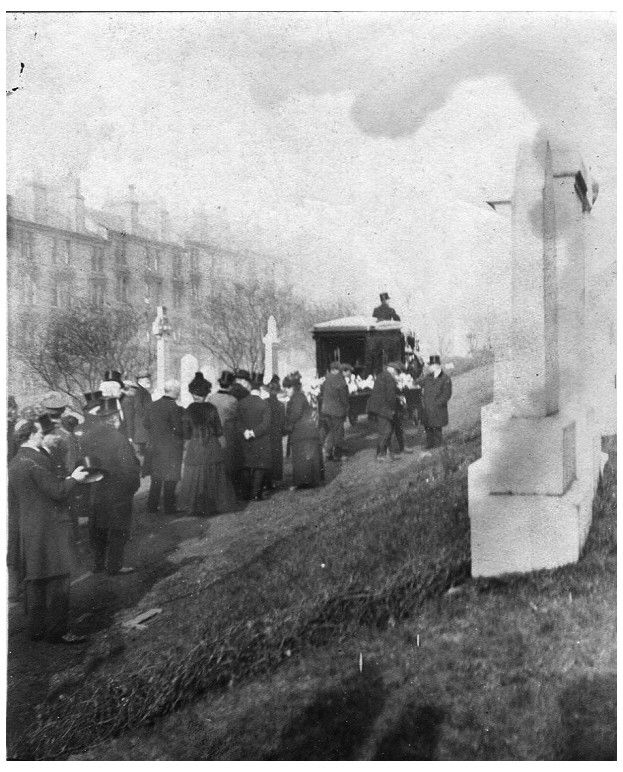
Catherine (Kate) Bell was 72 years old when she died in the Nurses Home attached to the Royal Infirmary on 21 March 1916. She can be identified as a nurse at the Royal infirmary from the 1871 census onwards, although she must have been there several years prior to 1871 (see below). No personal details are known of her but, unlike some of the other nurses, her death was registered by a family member (Annie B Bell, her niece) so the names of her parents are known. She was a daughter of John Bell, tailor and Jane Scott according to her niece and according to the 1871 census she was born in Magherafelt, co Londonderry.
At the time of her death she was believed to be the last of the nurses who worked with Lord Lister during his pioneering work on antiseptic surgery at the Royal Infirmary between 1861 and 1869.
George Milne and his burial plots in the Glasgow Necropolis
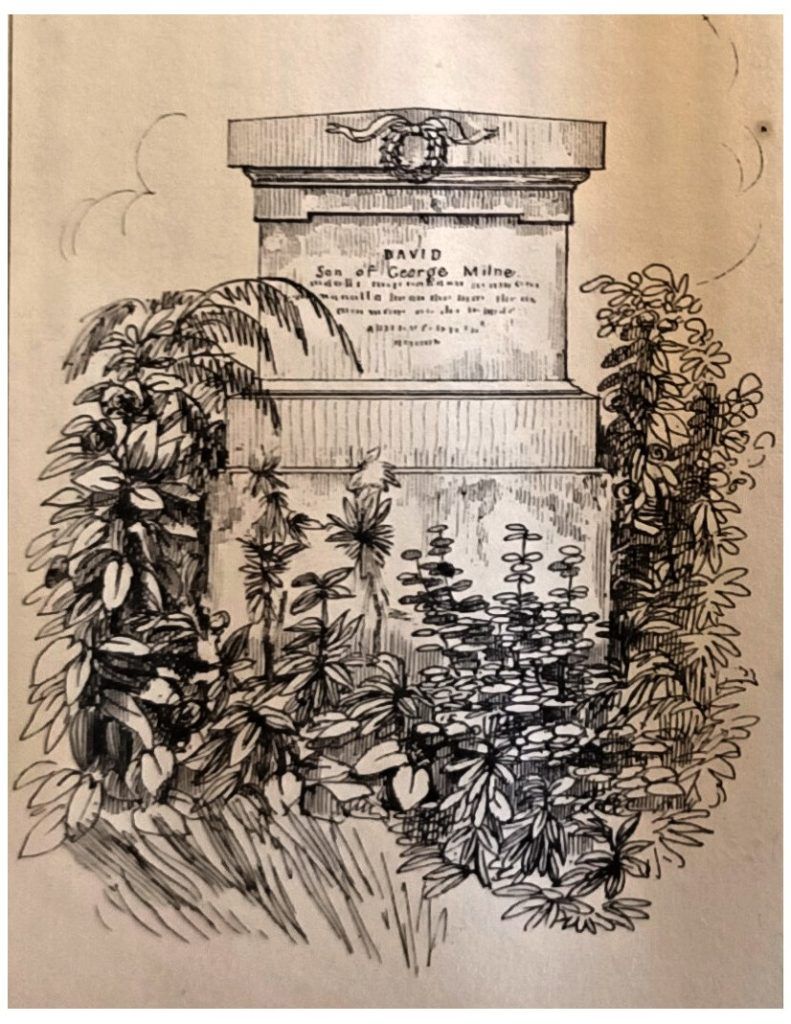
It is well known that the first two burials in the main Necropolis on 9 Feb 1833 and 4 April 1833 were of relatives of George Milne, the superintendent of the Necropolis, in Compartment Delta lair 1. The sale of 9 square yards at a cost of £9 9s to George Milne is recorded on 9 February, the day he buried his mother, Elizabeth Miles. Although four Milne burials took place between 1833 and 1837 the stone on the lair was erected by the Hutcheson family who purchased the plot from George sometime before 1849. It was a surprise to discover that there had originally been a stone on the lair in memory of David Milne, son of George, who was buried on 14 May 1833. The stone is described and illustrated in Laurence Hill’s pamphlet A companion to the Necropolis published in 1836. Hill tells us “The monument is from a design of Mr Hamilton, and was erected by Messrs D Hamilton & Son, at the expense of a gentleman who requested permission in that way to make some return to Mr Mylne for an instance of that attention with which he always meets the wishes of those requiring immediate use of the ground they may have purchased.”
In 1842 Milne was dismissed by the Merchants’ House but that was not the end of his connection with the Necropolis.
In 1857 George Blair published Biographical and descriptive sketches of the Glasgow Necropolis based on articles he had originally written for the Glasgow Gazette 1849-1851. In the article published on 15 June 1850 dealing with Compartments Eta, Zeta (old) and Theta there is a section not found in the subsequent book:
Still further back, occupying the remotest nook in this compartment, and finely sheltered beneath a clump of willows on the green acclivity behind, is a handsome structure, consisting of a tapering or obelisk-shaped column, and one of the oldest monuments in the Necropolis. The upper part is embellished with armorial bearings, like most of the monuments in Sweden and other northern countries, illustrated with this motto “Dat cura commodum,“ and the following inscription appears on the body of the pillar –
MARGARET STEVEN
wife of George Milne,
Superintendent of the
NECROPOLIS,
died 24th March, 1837,
aged 40 years.
Needless to say there is now no record of this monument but the Necropolis records show that George Milne bought 4 square yards at a cost of £4 4s on 9 May 1849 (Eta 105). The entry in the purchase book is scored out with the note “See Macintyre” added and Mcintyre burials start in Eta 105 in 1850.
******************************
Anyone who would like to help indexing the Burial Registers is very welcome to join us by contacting me at at research@glasgownecropolis.org