Compiled by Morag T Fyfe
The indexers have now reached 1864, and the number of records indexed in the last three months is as follows –
| October 2021 | 500 |
| November 2021 | 533 |
| December 2021 | 524 |
Our database of persons buried or commemorated in the Necropolis now stands at 41493 entries at the end of December 2021 of which 15708 entries represent persons buried in common ground with no grave marker.
George Coulson
The Glasgow Necropolis First World War Roll of Honour commemorates more than 160 casualties of the First World War but casualties from the Second Boer War (1899-1902) can also be found in the cemetery. There may be about a dozen casualties of that conflict buried or commemorated in the Necropolis awaiting further research. George Francis Coulson, BSc, CE who died at home in Ayrshire on 7th June 1901 from enteric fever is certainly one of them.
The reverses suffered by the British army in December 1899 led to the establishment of the Imperial Yeomanry (mounted infantry) to reinforce the regular army in South Africa. Volunteers willing to serve overseas for a fixed term of one year were sought from the home-based Yeomanry regiments and the Ayrshire and Lanarkshire Yeomanry jointly provided the men for the 17th (Ayrshire and Lanarkshire) Company of the 6th (Scottish) Battalion Imperial Yeomanry. George had served in the Ayrshire Yeomanry before enlisting as a trooper. Bearing in mind he was a university graduate and a civil engineer it is possible he had held a commission in the Ayrshire Yeomanry which he resigned in order to enlist for foreign service. He was certainly keen to enlist as he did so at Ayr on 19th January 1900 and arrived in South Africa on 23rd February 1900 as part of the first contingent of Imperial Yeomanry to be despatched. The 6th Battalion initially served in the Orange Free State but judging by the clasps George received on his campaign medal (Cape Colony, Orange Free State and Transvaal) it served in other parts of the country but did not take part in any major engagement. According to his death notice in the Daily Record George was invalided home in May 1901 and died the following month.
John Piercy Henderson
Research carried out on behalf of www.ourstoriesfalkirk.com on John Piercy Henderson a Falkirk industrialist soon revealed a different man to the “kind, affable and humane [gentleman] … ever ready with his advice and purse to assist the needy” described in his obituaries. The invaluable Legacies of British Slavery database showed JP Henderson inherited plantations in Jamaica on the death of his father in 1811 when Henderson was only five years old. On reaching his majority Henderson and his wife chose to reside at Port Henderson, Jamaica where several children were born to them between c1826 and c1834. Port Henderson had been established by his father and had a short life as a spa town patronised by the nearby inhabitants of Kingston. It has now been subsumed into the town of Portmore.
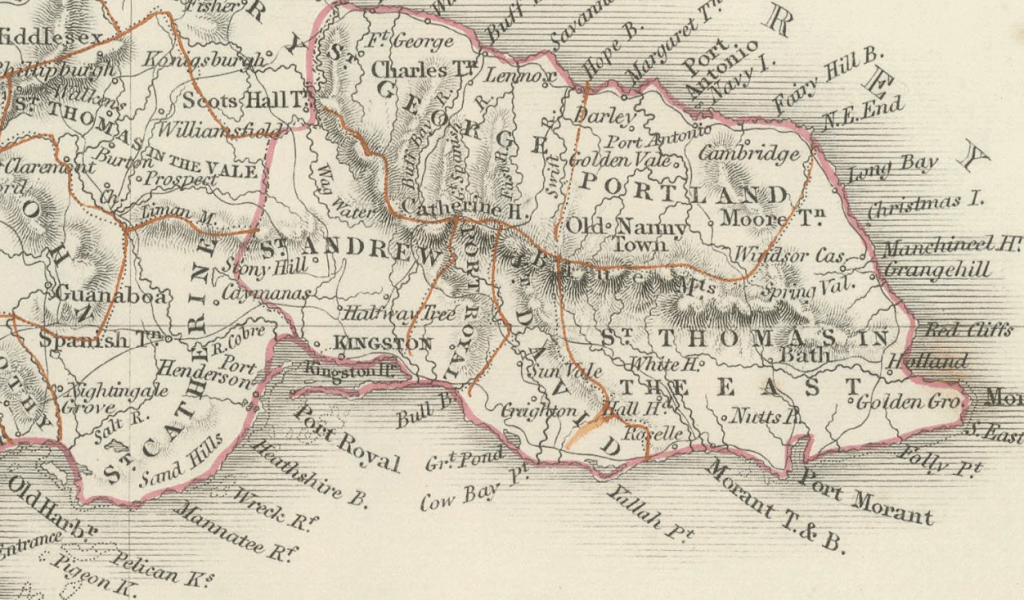
The reason for taking an interest in Henderson is that when he returned from Jamaica he resided in Glasgow for a few years (c1838-c1842) and purchased a lair in the Necropolis for future use. A son died in 1841 which may have been the trigger for the purchase although, in the event, the lair was not actually used.
Henderson soon moved to the Polmont area and went into business as a chemical manufacturer first at Bo’ness and then at Camelon. He bought Parkhill House, which still exists though converted to flats and then Summerford where he bought an estate and built a house and a chemical works.
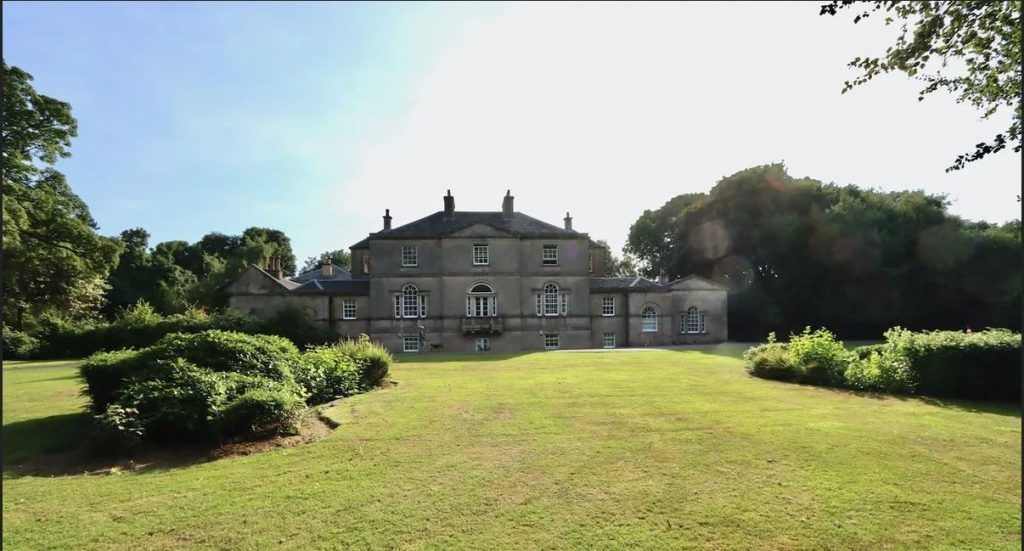
The lair in the Necropolis was used for the burials of two daughters after the family left Glasgow and they were joined by their father in December 1861. No further use was made of the lair although Henderson left a widow and large family behind.
Necropolis Networks
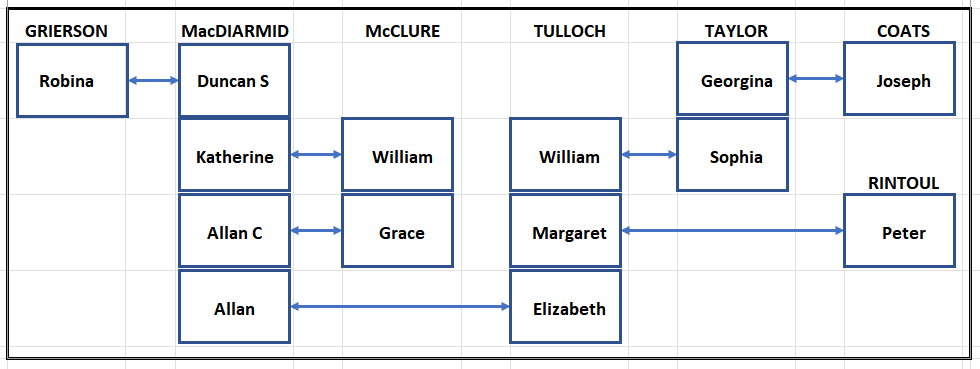
Recently some new profiles on our website have made me think about how different families buried in the Necropolis are linked to one another.
One example starting from John Taylor, senior (1792-1866) allows us to trace links between seven families in the Necropolis. John Taylor had thirteen children by two wives; his eldest child was born in 1815 and his youngest in 1860. John, junior (1815-1878) chose to buy a lair in compartment Gamma instead of sharing the family lair in compartment Epsilon. Two of John, senior’s daughters can also be found in the Necropolis with their husbands. Sophia Taylor (1851-1923) married William Tulloch in Glasgow in 1875 and almost fifty years later was buried in the Tulloch lair in compartment Epsilon. In 1879 Sophia’s sister Georgina (1852-1927) married Dr Joseph Coats who later became professor of pathology at the University of Glasgow. The Coats family lair can be found in compartment Primus.
Moving on to the Tullochs, an important marriage took place in Edinburgh in 1872 when William Tulloch’s sister Elizabeth married Allan Macdiarmid from Glasgow. This marriage resulted in William settling in Glasgow and joining his new brother-in-law in business. Both families, like the Taylors and Coats, were members of the Baptist Church and were amongst those who established Hillhead Baptist Church in 1883. One of William Tulloch and Sophia’s daughters, Margaret, married Peter Rintoul a chartered accountant in 1904 and both are commemorated on the gravestone on the Rintoul lair in compartment Epsilon.
Duncan Stewart/Stuart MacDiarmid the eldest son of Allan and Elizabeth MacDiarmid was born in 1874, studied law at the University of Glasgow and became an advocate. In 1908 he married Robina Grierson the youngest daughter of George Moncrieff Grierson and Allison Lyon Walker. Robina’s eldest brother was Lieut Gen Sir James Moncrieff Grierson who died on 17 August 1914 on a train in France on his way to take command of II Corps. At this stage in the War bodies were still allowed to be repatriated and his body was brought back to Glasgow for burial in the family grave in compartment Primus. Robina Grierson’s grand-parents, George Lyon Walkerand Jane Hope, also have a lair in the Necropolis in compartment Gamma.
Two of Duncan S MacDiarmid’s siblings married a son and daughter of James Howe McClure the Scottish rugby international whose family lair can be found in compartment Epsilon. Allan Campbell MacDiarmid (1880-1945) married Grace Buchanan McClure in 1910 in Hillhead. Allan joined Stewarts & Lloyds the steel tube manufacturers and finished up as chairman and managing director. In 1920 his sister Katherine S MacDiarmid (1878-1969) married William F C McClure who also worked for Stewarts & Lloyds and like Allan and Grace both couples moved south because of the brothers-in law’s work.
Although most of the marriages linking these families took place in Glasgow, many of the families were relative incomers to Glasgow. The Taylors were the most local having only moved from Paisley but the Tullochs came from Elgin via Edinburgh, the Griersons and MacDiarmids had Perthshire connections and the Walkers came from Fife.
Profiles can be found on our website for John Taylor, senior, John Taylor, junior, William Tulloch, Allan MacDiarmid, Joseph Coats, James Howe McClure and Lieut Gen Sir James Moncrieff Grierson.
John Blair and family
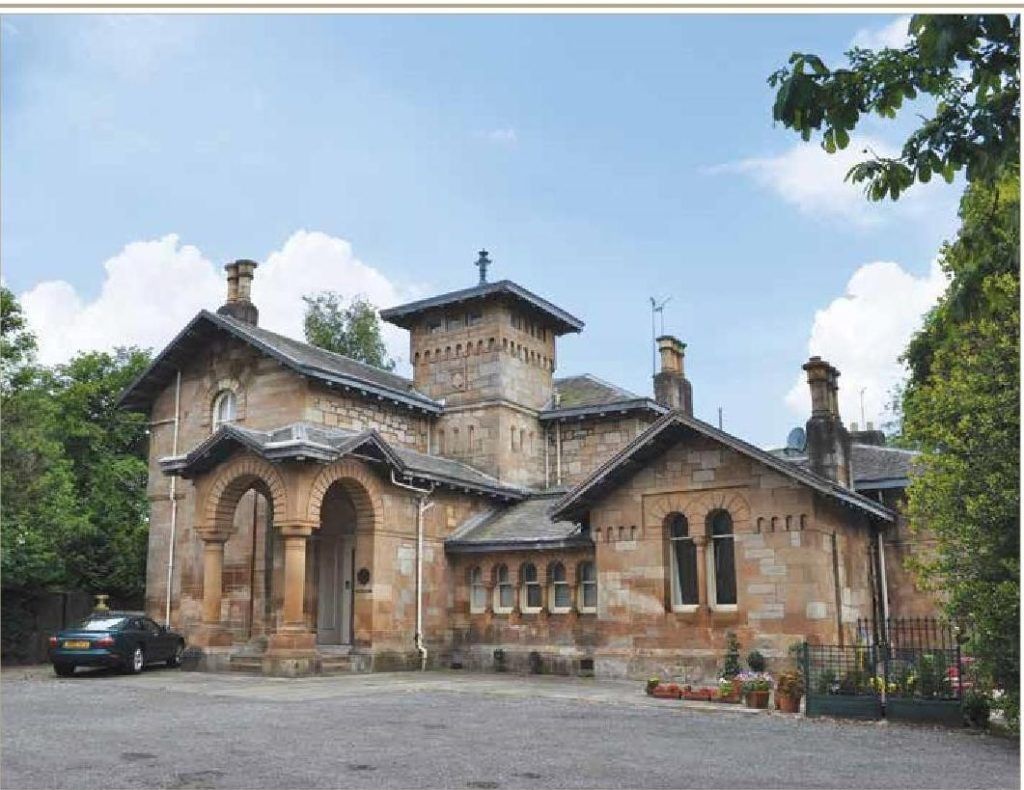
When an indexer came across the burial of young Agnes Blair on 16th December 1863 who had lived at Know, Pollokshields he immediately wondered if this was the Alexander Thomson house generally known as The Knowe in Albert Drive.
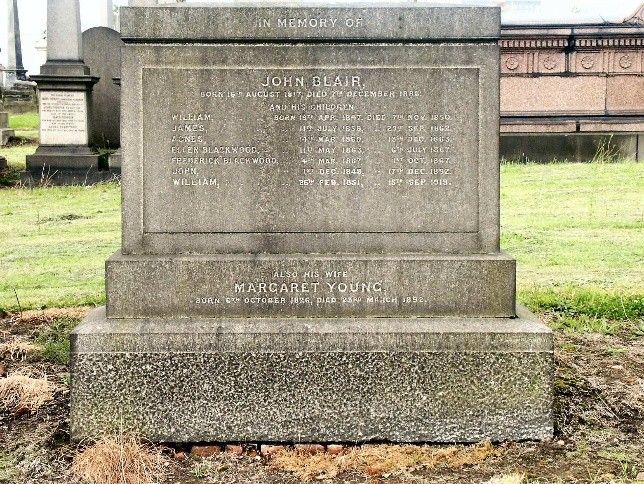
The Blair gravestone in compartment Epsilon gives details of Agnes’s family and confirms her father as John Blair. Censuses show this Blair family residing at the Knowe with Agnes listed as one of the children in 1861. Further censuses show the family as still there twenty years later and presumably until John Blair died in 1886.
The indexer thus correctly recognised Know as being the house designed by Alexander Thomson for John Blair, hat manufacturer, built in 1852, and further extended by Thomson in 1855.
Robert McCarey
Many of the army pensioners who appear in the burial registers served in Scottish regiments but Robert McCarey’s service record is more exotic. When he was buried in common ground on 30th October 1863 he was described as “late private, 2nd European Light Infantry East India Service”. He was aged 42 at his death and this fact together with his unusual occupation allowed him to be identified in the 1861 census as Robert McCorey, ‘pensioner East Indian’ boarding with Elizabeth McBride, a widow. From other evidence in the census entry it is likely this was his sister. In 1861 he was living at Graham Street, Calton but he died in the Royal Infirmary. Pension records survive for him and provide some personal details such as height (5ft 5 1/8 inch), colour of hair and eyes (dark brown, hazel). The only service details that can be gleaned are that he was discharged at his own request after 22years and 4.5 months service in 1860 with a pension of 1/- per day.
John Strang, Esq, LLD 1795-1863
For Friends of Glasgow Necropolis it would be very remiss to overlook the death and burial in the cemetery he helped to establish of John Strang, City Chamberlain of Glasgow. To him we are indebted for one of the most beautiful garden-cemeteries in Europe. In 1831 he published Necropolis Glasguensis which was very influential in persuading the Merchants House to convert the Fir Park to a garden-cemetery along the lines of Pere Lachaise in Paris. The Strang family had a family burial place in one of the churchyards but Strang wanted to be buried in the cemetery he had helped form and the Merchants House obliged with a plot for himself and his wife.
The entry in the burial register for 14th December 1863 describes him simply as John Strang, LLD and makes no mention of his connection to the Necropolis.
George Munro
Normally soldiers featured in Grave Matters are Chelsea Pensioners but this man is different. A stone in Epsilon commemorates “Major General GEORGE MUNRO who served for years at home and abroad in the H. M. 78th and 22nd Regiments and as Staff Officer in Aberdeen and Edinburgh. He died in Glasgow 12th December 1863 aged 68”. The description of him as a Staff Officer was intriguing, made more so by the discovery that his full title was Staff Officer of Pensioners which implied some sort of connection with military pensioners.
Starting at the beginning George Munro was born in Windsor in 1796, joined the 22nd Regiment of Foot as a 2nd Lieutenant in 1814 and progressed through the ranks until he was promoted to Captain on 10th July 1840 and placed on half-pay the same day. No details are known at present about his regimental service though as both regiments spent periods abroad Munro could have spent time in India or Mauritius. A year after going on half-pay Munro married Anne Abernethy Pirie daughter of Rev George Pirie of Slains and sister of Rev William R Pirie who became Principal of Aberdeen University. The couple settled in Old Machar just north of the city of Aberdeen and a son and daughter were born in quick succession.
At the end of the 1830s moves were afoot in the War Office to place Chelsea out-Pensioners under military control by bringing the payment of their pensions under a new organization controlled by the War Office instead of the Royal Hospital. In 1842-3 two Acts of Parliament formalized the new arrangements. The country was divided into districts (10 in Scotland) and a Staff Officer of Pensioners was placed in charge of each district. These men were responsible for supervising the pensioners in their district, paying out pensions, keeping a record of deaths and movement between districts and commanding companies of enrolled pensioners in support of the civil powers when required.
When Staff Officers of Pensioners were required in 1842 it seems likely that George Munro applied as by 1848 he was so described in Hart’s Army List of that year but unfortunately his district is not mentioned. One presumes it was Aberdeen as he was living there when the 1851 and 1861 censuses were taken. He may not have moved to Edinburgh until 1862 as a codicil added to his will in January 1863 was witnessed at Edinburgh. This was a period when promotion in the peace-time army was still by seniority and Munro continued to progress upwards until he was promoted to Major General on 1st May 1863.
New Profiles
The profiles on our website continue to grow by the addition of those for John Taylor, jnr, Lieut George Gordon and William Tulloch and family.
******************************
Anyone who would like to help indexing the Burial Registers is very welcome to join us by contacting me at research@glasgownecropolis.org