The Photographic and Stone Condition Survey of the 3,500 Monuments of the Glasgow Necropolis and the Omega Project
This special issue of Grave Matters marks the completion of the project to survey and record the monuments in Compartment Omega. It has been compiled as usual by Morag T Fyfe but with the additional help of Colin Campbell, Ruth Johnston and Michelle Craig.
The reason for the Photographic and Stone Condition Survey is to preserve, at least in photographs, what is left of the monuments of the Glasgow Necropolis. Over the years concern has grown about the condition of the monuments in the Necropolis. This survey ensures that all the monuments and features that remain will be recorded.
Between 2012 and 2019 the Friends of Glasgow Necropolis ran a project with the assistance of 12 students from the Nicolaus Copernicus University, Torun, Poland in partnership with Page\Park, Architects, and funded by the Erasmus programme to survey, and record the condition of the surviving monuments in the Glasgow Necropolis before they were lost to weathering and vandalism. Under this programme surveys of two thirds of the 22 compartments of the Glasgow Necropolis were completed.
With Erasmus funding no longer available, in 2019 the Friends obtained funding from the Scottish Graduate School for Arts & Humanities for a PhD student, Michelle Craig, to continue the survey and this brought the total of completed surveys to 15.
In 2021 the Friends applied to Glasgow City Heritage Trust (GCHT) for funding to allow the same surveyor, Michelle Craig, to tackle another compartment and Compartment Omega was chosen. Situated in a prime position on top of the Necropolis hill with the monuments of many prominent 19th century Glaswegians, Omega was the only compartment in the oldest part of the Necropolis which had not yet been surveyed.
The Omega Project
With Glasgow City Heritage Trust’s backing, Michelle started her survey of Omega in August 2022. The plan was to finish the project by May 2023, but it was extended by GCHT because of poor weather conditions during the period of the survey. By the project’s completion in summer 2023, 241 monuments were recorded, and a full survey created around it, including an assessment of the setting, location, and significance of the section. The survey also considered the condition of the monuments in some detail, both in individual records and in summary documentation included in the introductory section of the report. Since it was an outdoor project, Glasgow’s summer weather proved to a be problem – dry weather is needed to undertake the survey! Other obstacles encountered during the project included vegetation within the site itself, on occasion covering the stones included in the survey. This was solved with some time set aside for identifying and then clearing the affected monuments with permission from GCC and the dedication and care of FoGN volunteers.
The bid to Glasgow City Heritage Trust also entailed undertaking public engagement with a local school, St Denis’ Primary School, Dennistoun. In September 2022, Michelle took a P7 class from St Denis’ Primary School to the Necropolis. It was a wonderfully warm afternoon and the pupils enjoyed exploring the compartment, learning about the site, and chatting with each other about the symbolism and designs of the monuments. The class also participated in a brief survey of monuments in Omega to give them an insight into surveying work. We also ran a design competition which involved drawing a monument for Alexander Dennistoun (to whom there was once a memorial in Omega, but which is now no longer there). 13 entries were submitted to this competition. These entries showed the pupils had absorbed the information onsite and had a good idea about death and commemoration and the types of designs and motifs used in memorials. The competition was judged by Fiona Sinclair, Conservation Architect and Honorary member of the Friends of Glasgow Necropolis and Brian Johnston, Architect and Trustee of the Friends of Glasgow Necropolis. The whole class and winners with their received prizes were highlighted on St Denis’ social media. Through the whole process, the pupils increased their awareness of Victorian design, burial, the Necropolis, and of Dennistoun and its part of Glasgow’s history.
Another aspect of the bid was the publication of a leaflet on Omega that could be distributed to local groups. Research was undertaken on 30 people who are buried and/or commemorated in Compartment Omega and a leaflet which included 26 profiles was produced by the Friends and funded by Dennistoun Area Partnership. These were distributed to the school as well as now being available to visitors of the Glasgow Necropolis.
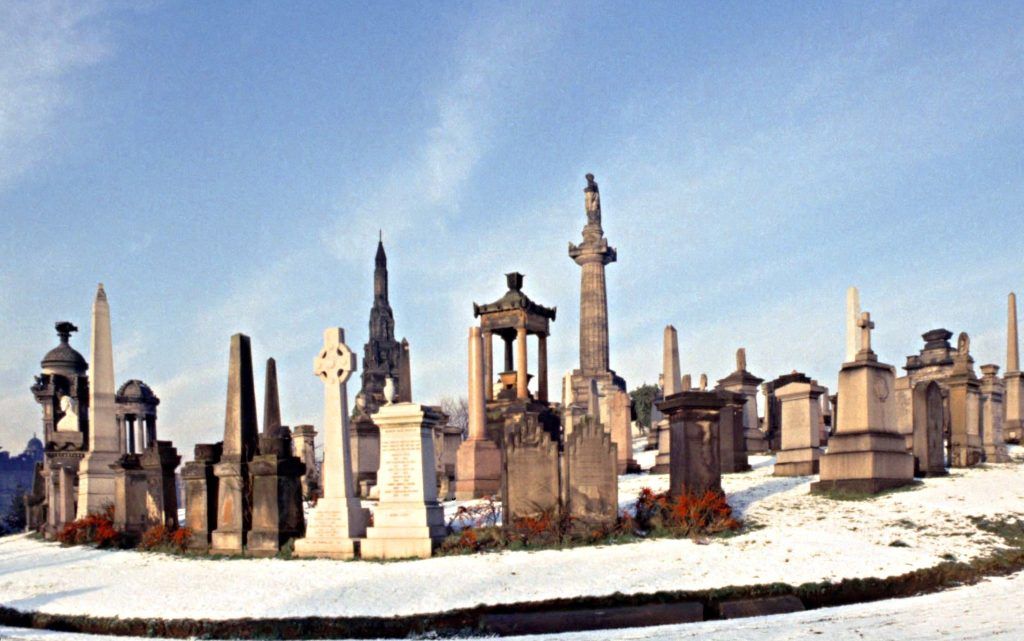
At the far left can be seen the bust surmounting Dugald Moore’s monument. Behind it is the top of the elaborate monument to John Henry Alexander. Moving right towards the centre of the picture is the Celtic cross of James Bell the printer and to its right is the stone of his partner Andrew Bain. The pair of stones on the other side of Bain are flat at present; they commemorate the Walker family and were erected in 1842. Beside them is a stone in memory of Catherine MacDonald who died in Rothesay in 1844. The left-hand obelisk near Dugald Moore commemorates John Burns, Fellow of the Faculty of Physicians and Surgeons, Glasgow and the other obelisk in the row is for the Downes family.
In the background is the monument to John Knox topped by his statue and the Gothic monument commemorating Rev Duncan Macfarlan, who is buried in Omega but whose monument stands across the path in Compartment Kappa.
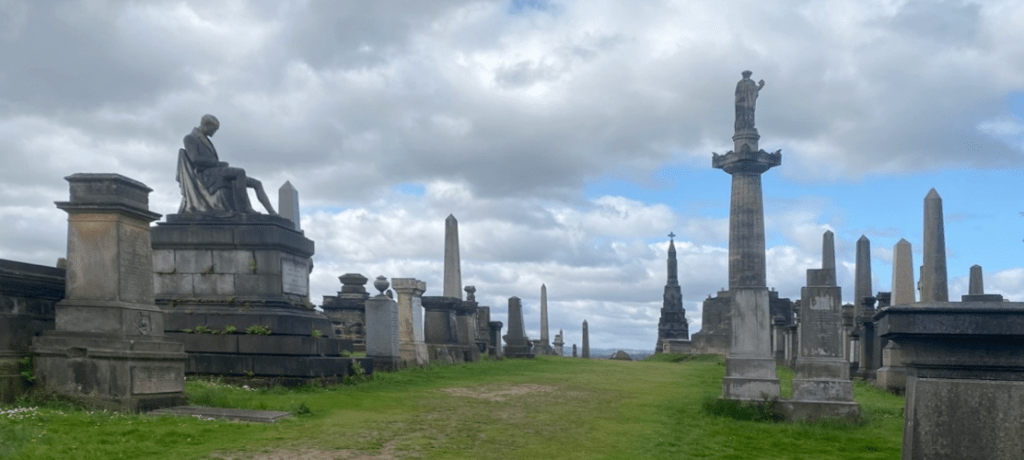
In 1833 four compartments in the Necropolis (Alpha, Beta, Gamma and Omega) were made available for burials. Alpha started on the bank of the Molendinar Burn and was the only one of the compartments to have common ground available. The other three compartments climbed the slopes of the Fir Park until Omega was reached at the top. Gamma, Beta and Omega offered lairs between 3 and 9 sq yds in general but larger areas could be purchased – 12 sq yds was purchased by John Tennant for his father Charles’ grave.
The first burial in Omega took place on 12 November 1833 but uptake of plots was slow. There were only two burials in 1834, three in 1835, none in 1836, five in 1837 and by the end of 1839 the total burials stood at twenty-two. Business picked up in the 1840s and by the end of that decade 170 persons had been buried there.
The middle-class nature of this compartment is shown by the occupations of the men buried there. Merchants made up the largest group followed by medical men, lawyers of various sorts, soldiers (including 7 who died during the First World War) and clergy. There was also a small but significant group connected to the book trade in its widest sense.
The term ‘merchant’ is rather vague and in most cases requires further investigation to find out what kind of merchant these men were. Robert Kettle was a cotton yarn merchant, Peter Aikman was a ship owner and broker but still described himself as a merchant and James Scott had been a merchant in Montreal, Canada.
The group of clergy represent many of the branches of the Protestant church in Scotland. As well as Robert Muter, noticed below, they include Rev William Black of the Barony Church, Rev John Eadie of Cambridge Street Church and Rev Thomas Brown of Free St John’s Church.
Two of the influential early booksellers of Glasgow are either buried or commemorated here – David Robertson and Thomas Atkinson, while James Bell and Andrew Bain who established the Glasgow printers of that name are also found here. Several generations of the Blackie family of well-known publishers have stones in Omega and Epsilon; two sons of the family lost their lives in the First World War and are commemorated on their parents’ stone (see below).
Amongst the medical men is William McGill, a son-in-law of Rev Robert Muter, and physician to the Glasgow Police for 43 years. Two Professors of Midwifery at the University of Glasgow, James and John Towers, were originally buried down the High Street in the College Burying Ground but now lie together in Omega.
The growing financial sector is represented by bank managers, insurance brokers and chartered accountants like Henry Brock, manager of the Clydesdale Bank. Among the lawyers can be found advocates, writers, a commissary clerk of Lanarkshire and the Bannatyne family now represented by the firm of Bannatyne Kirkwood France & Co.
Well known and frequently photographed monuments in the compartment include those to Charles Tennant of St Rollox, John Henry Alexander the theatrical impresario and Dugald Moore the poet.
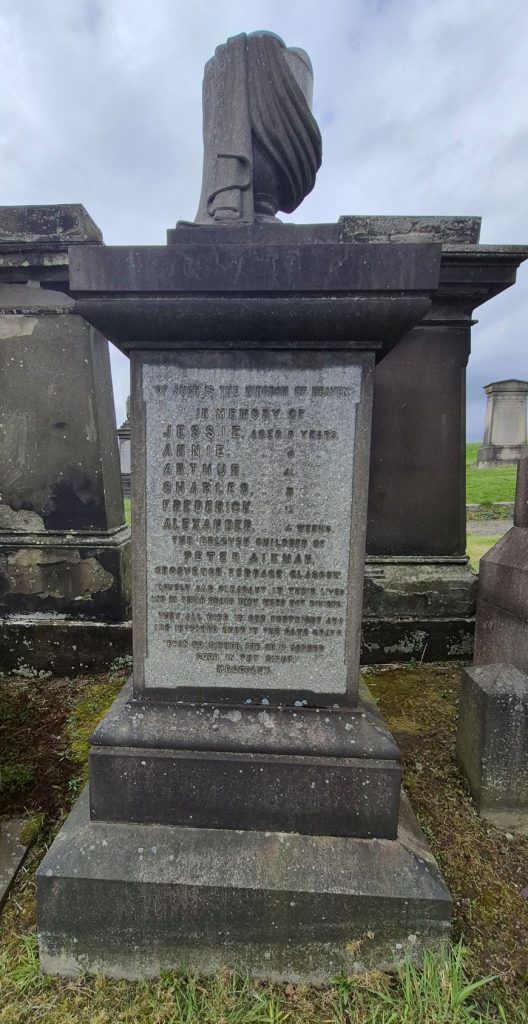
Peter Aikman and family
Visitors to Compartment Omega in the Necropolis may notice a standard gravestone that records the loss of six children in 1857.
Of such is the Kingdom of Heaven
In memory of
JESSIE aged 8 years
ANNIE aged 6 years
ARTHUR aged 4 ½ years
CHARLES aged 3 years
FREDERICK aged 1 ½ years
ALEXANDER aged 4 weeks
The beloved children of
PETER AIKMAN,
Grosvenor Terrace Glasgow.
“Lovely and pleasant in their lives
and in their death they were not divided.
They all died in one fortnight and
are interred here in the same grave.
Even so Father as it seemed
good in Thy sight
MDCCCLVII”.
The burial registers and other sources have allowed us to flesh out their story. Baby Alexander was the first to be buried, by his father, on 10 March 1857. Jessie, Annie and Frederick followed him six days later. The last two surviving children, Arthur and Charles, were buried together on 24 March. Peter Aikman organized the first two funerals but when it came to the third the boys were buried by their grandfather.
The deaths of so many children in such a short space of time warranted sympathetic comment in some of the local newspapers and it is from these notices that we learn that all the children died from whooping cough. On obtaining the death certificates of Annie and Jessie it turned out that their cause of death was more complicated than that reported in the newspapers. The official cause of death was ‘Rubeola followed by Pertussis and consequences from 29th January 1857’. Rubeola is measles as opposed to Rubella which is the less serious German measles. It seems that one of the side effects of Rubeola is to suppress the immune system and lay the patient open to other infections of which whooping cough is the most likely in the nineteenth century.
In addition to coping with the deaths of six children in 1857 Peter Aikman also had business worries. He and his uncle Thomson Aikman were partners in the firm P & T Aikman formed in 1841. The firm were ship owners and shipping agents, owning outright, or holding shares in, three ships built by Walter Hood & Co., Shipbuilders, Footdee, Aberdeen. In 1858 the partners became involved in two bankruptcies as creditors and in 1859 P & T Aikman themselves became bankrupt. By October 1859 the family home in Grosvenor Terrace had been sold.
A second panel on the monument records the death of Peter Aikman in London in 1862 and of his wife Janet A Cochran also in London in 1911. By 1861 Peter and Janet Aikman were living in Islington, London with three young daughters (Caroline, Elizabeth and Evelyn). Peter was still a ship broker. He died the following year aged only 41 and was buried at Christ Church, Forest Hill, Kent. By 1871 Janet had returned home to her mother and she and her daughters can be found at Kirktonfield House, Neilston. The family had moved to Partick by 1881 but by 1891 it has split with Elizabeth being married and living in Acton, Middlesex and the two remaining sisters living in Cathcart. Mother Janet is found in the census with Elizabeth in Acton that year, but it is not clear whether she is visiting or living there permanently. By 1901 Janet and her daughter Evelyn are back in Ealing, Caroline having married in the meantime, and it was in Ealing that Janet died in 1911. Evelyn had predeceased her dying in Edinburgh in 1907 and it may be because she died in Scotland that Evelyn was buried alongside her six older brothers and sisters in the grave in Compartment Omega in the Necropolis
The Blackie brothers
Five stones in the Necropolis commemorate various members of the family of Blackie the publishers. There are three scattered in Compartment Epsilon but the two senior stones can be found in Omega.
These mark the burial places of John Blackie, snr, d. 1874 founder of the business and his son Provost John Blackie, jnr d. 1873. On the deaths of John Blackie, jnr followed soon after by John Blackie, snr control of the business passed to John Blackie, jnr’s two younger brothers as John Blackie, jnr’s eldest son John James Blackie was only twenty-four at his grandfather’s death in 1874. John James and his younger brothers and their sons seem to have played little if any part in the family firm.
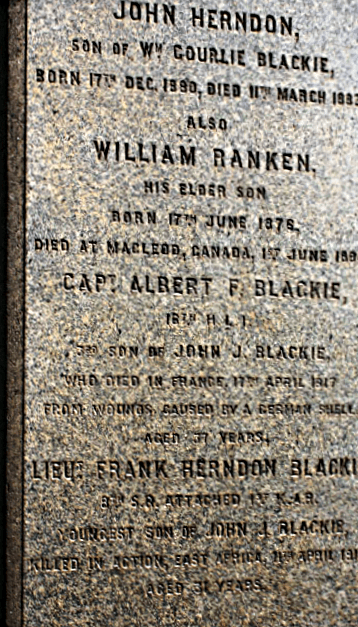
The distinguished story of Blackie & Son is well known so this note concerns two brothers, great grandsons of John Blackie, senior, who both lost their lives in the First World War. John James Blackie married Fanny Ferguson on 25 April 1876 in Glasgow. The couple had five sons and two daughters – Albert Ferguson was born in 1879 and Frank Herndon in 1886.
It might have been expected that when Albert joined the army in 1900, he
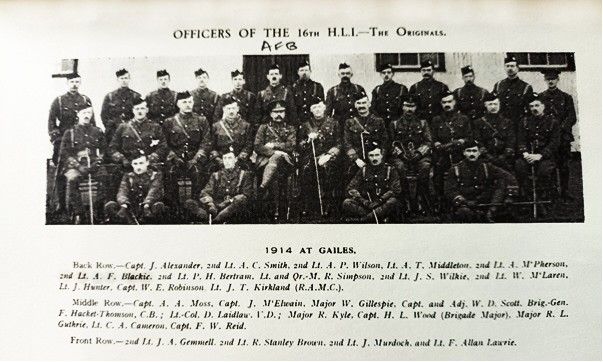
would have followed the conventional middle-class route and received a commission in his chosen regiment. Instead, Albert enlisted at Glasgow as a private in the Gordon Highlanders. He served for just over twelve years and left the army as a sergeant in October 1912. Six months later he sailed from Glasgow to St John, New Brunswick, Canada to join the Hudson Bay Company but he quickly returned to Glasgow in October 1914 only a month after war was declared and in November was gazetted a temporary 2nd Lieutenant in the 16th Battalion Highland Light Infantry.
After basic training at Gailes in Ayrshire, the Battalion set out for France and landed at Boulogne on 23 November 1915. Lieutenant Albert Blackie (as he then was) was one of them. They entered the Line at Thiepval Wood on the River Ancre on 8 December 1915.
The Battalion was action on the infamous 1st July 1916 at Thiepval on the Ancre and in November 1916 again on the Ancre.
In the Spring of 1917, the Germans were retreating. However, their resistance hardened around their prepared position on the Hindenburg Line, and there they stood to give battle. On 14 April 16th HLI were at St Quentin and were tasked to attack and capture the village of Fayet. This they duly accomplished. On the 15th of April while holding their new position they were heavily shelled in a German counterattack. The Battalion War Diary records that Captain A F Blackie was wounded in action. He died of his wounds on 17 April and was buried at Cayeux Military Cemetery.
Unlike his elder brother Frank Herndon Blackie did not choose a military career but instead became a clerk in Hodge & Smith, Chartered Accountants on Buchannan Street. However, he did have military interests and served for several years with the 9th Battalion Highland Light Infantry (Glasgow Highlanders) a Territorial battalion.
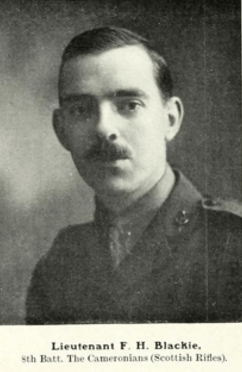
At the outbreak of war in 1914 members of the Territorial Force were called up but were not expected to serve abroad unless they volunteered. Frank did volunteer and reached France in 1914 a year before his elder brother. Like his brother in 1900 Frank had enlisted as a private but in September 1915 he received his commission as a 2nd Lieutenant in the 8th Cameronians (Scottish Rifles) and returned to the UK for officer training.
Towards the end of 1916 Frank answered a call for officers for the new battalions being raised in East Africa to fight the Germans there. He was transferred to the 3rd Battalion 1st Kings African Rifles (3/1KAR) and departed from London in November 1916 for Portuguese East Africa. The 3/1KAR was still recruiting when Frank joined in early 1917 and in May he was sent with a recruiting party to Kaliwata, Nyasaland where a German raiding party captured him. He remained a prisoner until he was rescued in November 1917 and re-joined his battalion. In April 1918 he was part of a detachment sent to capture a German outpost at Koriwa, Portuguese East Africa. There was a fierce fight, and the British forces withdrew leaving their dead and wounded behind. One of those killed was Frank who had been commanding a machine gun section. His body was not recovered, and he is commemorated on the Dar es Salam British and Indian Memorial in Tanzania. Both sons are also commemorated on the side of their parents’ gravestone in the Necropolis.
Moses S Buchanan (1796-1860)
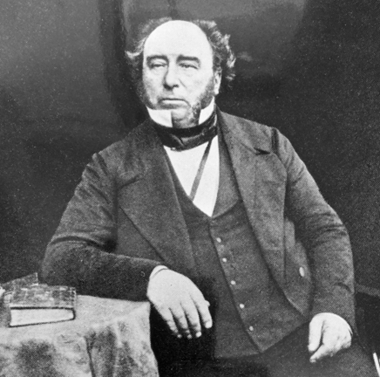
Moses Steven Buchanan, born in 1796, was the third son of George Buchanan a calenderer, of the firm George Buchanan and Sons and his wife Isabella Stevenson. Two of Moses’ brothers became partners in the family firm.
He however studied medicine at both Glasgow and Edinburgh Universities, qualified as MD at Edinburgh in 1816 and was admitted to the Faculty of Physicians and Surgeons of Glasgow in 1818. In 1846, at the age of 50, he had occasion to list his most important positions to date which included his current position as Professor of Anatomy at Anderson’s University, Member and Treasurer of the Faculty of Physicians and Surgeons [Glasgow], late surgeon and Lecturer on Clinical Surgery in the Royal Infirmary, consulting surgeon to the General Lying-in Hospital, member and councillor of the Medico-Chirurgical Society [Glasgow].
He had become a surgeon at Glasgow Royal Infirmary in 1830, was a lecturer in anatomy at the Portland Street Medical School between 1836 and 1841 and from 1841 until his death he was Professor of Anatomy at Anderson’s University. In 1846 he applied unsuccessfully for the Chair of Anatomy at the University of Edinburgh and furnished 28 testimonials from the great and the good of the Glasgow medical establishment in his support. However, Edinburgh’s loss was to be Glasgow’s gain as he went on to be a much sought after Lecturer and Surgeon in Glasgow. After his death, the Chair of Clinical Surgery at the University of Glasgow was founded in his honour and one of his sons George Buchanan (1827-1905) held the chair from 1874-1900.
In 1832 Moses published, “A History of the Glasgow Royal Infirmary 1787-1832” being a detailed account not only of the history of the hospital but also an analysis of its functions, structure, funding, medical statistics, patients’ diets and professional organisation. Some of his lectures were also published.
Moses Buchanan married Agnes Leechman on 12 December 1824 in Glasgow. The couple had ten children, seven of whom lived to adulthood and four of whom are buried with their father in Compartment Omega in the Glasgow Necropolis; the last two surviving daughters chose to buy a separate lair in Compartment Epsilon and be buried there. Agnes Leechman died in 1867 at Ventnor, Isle of Wight and is not buried in the Necropolis.
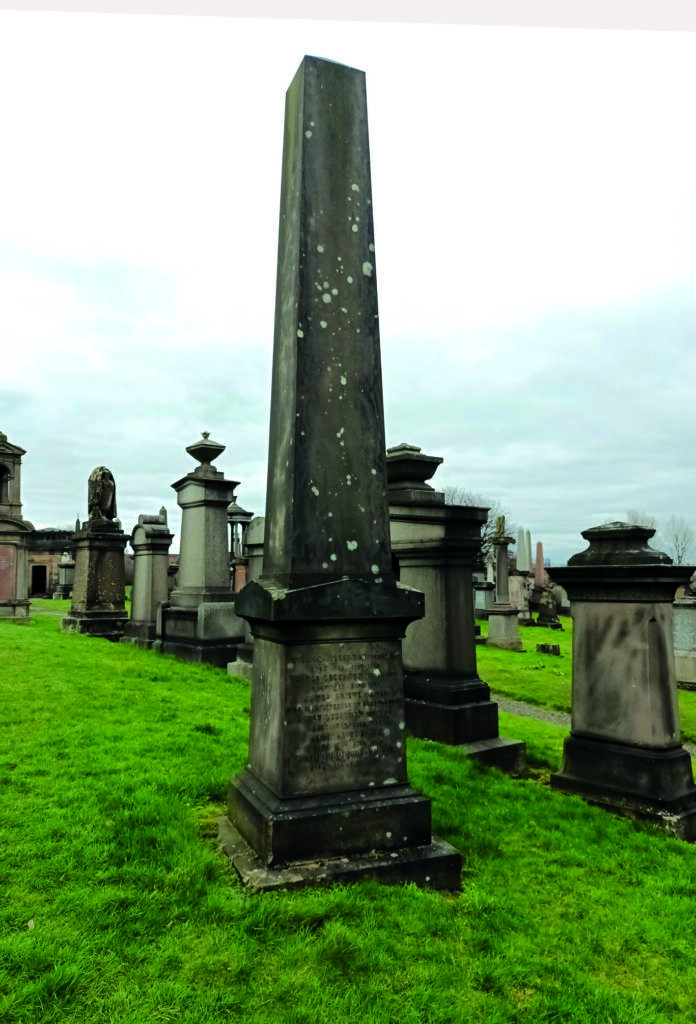
Moses S Buchanan died on 4 June 1860 at home, 14 Lynedoch Place, Glasgow and was buried in the Necropolis on 8 June.
Alexander Dennistoun (1790-1874)
Immediately to the east of the Necropolis lies the suburb of Dennistoun formed in the 1860s by Alexander Dennistoun of Golfhill.
Alexander was born on August 14, 1790, the eldest of eight children and the grandson of a farmer from Campsie, also Alexander. His father, James, a successful businessman and banker, bought the Golfhill property in 1802 and Alexander inherited it in 1835 on his death.
Alexander had the conventional education of the son of a well-off businessman in early nineteenth century Glasgow, being educated at the Grammar School of Glasgow (now Glasgow High School) and attended the University of Glasgow from 1803 to 1809.
He joined the family firm of J&A Dennistoun in 1815 (founded by his father and uncle) and from about 1820 was in New Orleans where the firm had established a branch to manage their interests in cotton. By 1822 he had returned to Britain and been placed in charge of the Liverpool office. He was admitted as a burgess and Guild Brethren of Glasgow on 24 March 1824, in right of his father.
On 12 March 1822 he married Eleanor Jane Thomson originally of Nassau, New Providence, Bahamas by licence at St Anne’s Church, Liverpool. Before Eleanor died in 1847, they had eight children, five boys and three girls, four of whom died young.
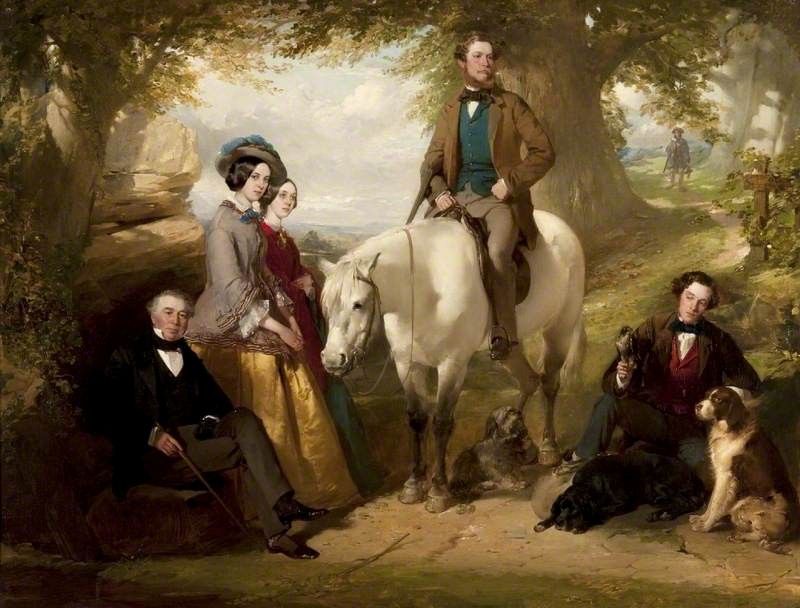
by Thomas Faed (1825-1900)
Photo credit: Glasgow Life Museums, CC BY-NC-ND
Alexander continued to expand his knowledge of the family business by spending four years at the Le Havre office, from where he and his family visited Paris in 1830 and found themselves caught up in the July Revolution of that year. Alexander and Eleanor returned to Glasgow in 1833 living initially at Germiston House until he inherited Golfhill House on his father’s death in 1835.
Once settled permanently in Glasgow Alexander began to play his part in the commercial and political life of the city. He became a director of the Union Bank of Scotland which had grown from the bank founded by his father and some colleagues in 1809 as the Glasgow Bank. He was MP for Dunbartonshire 1835 to 1837, but Parliamentary life did not agree with him and he did not stand again.
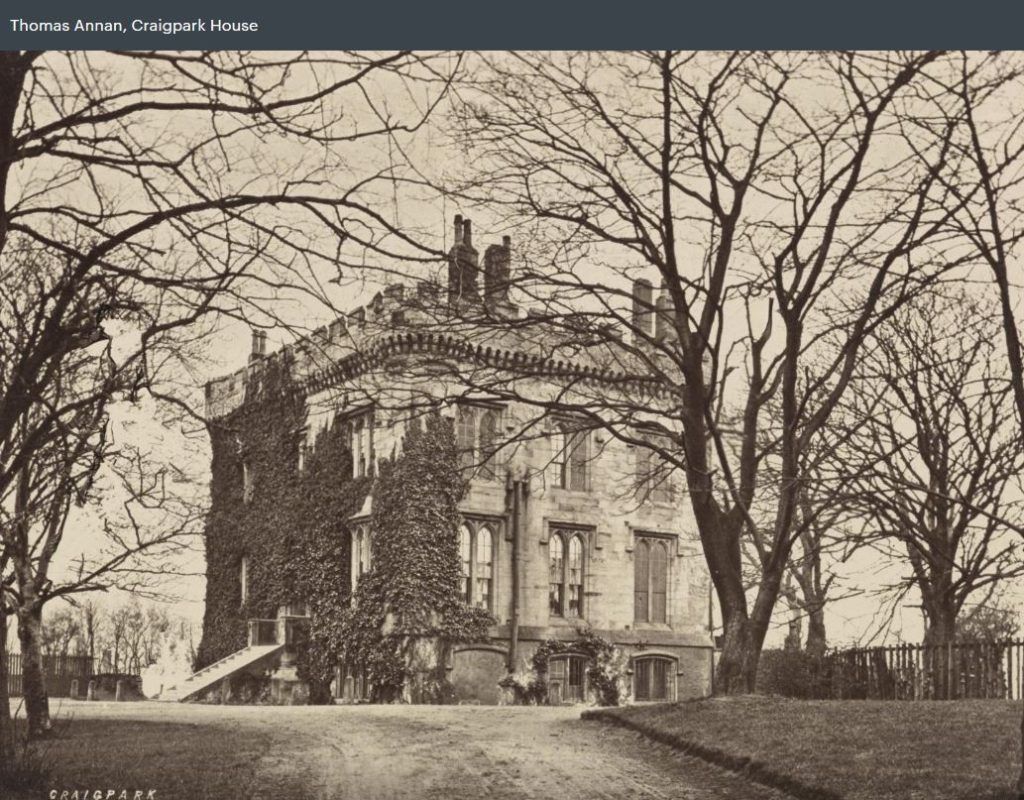
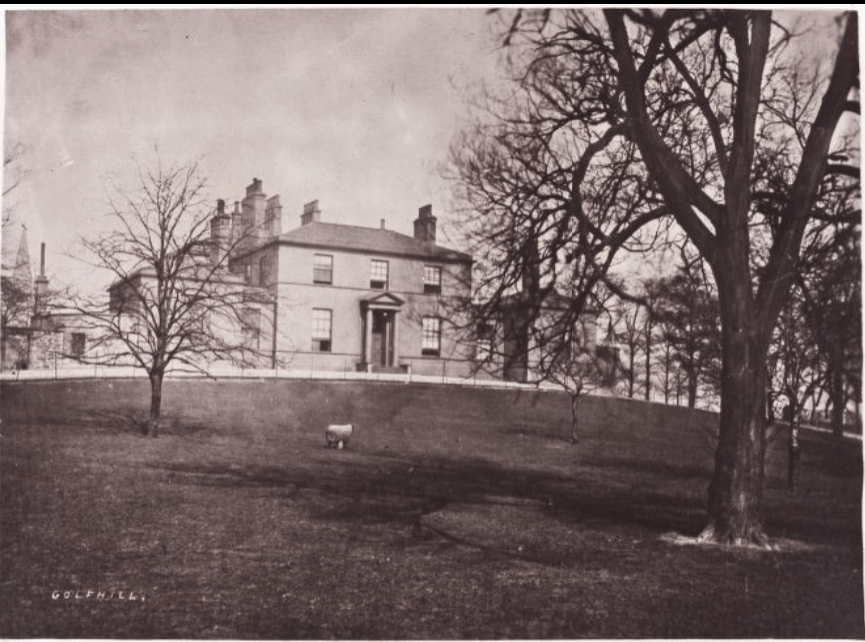
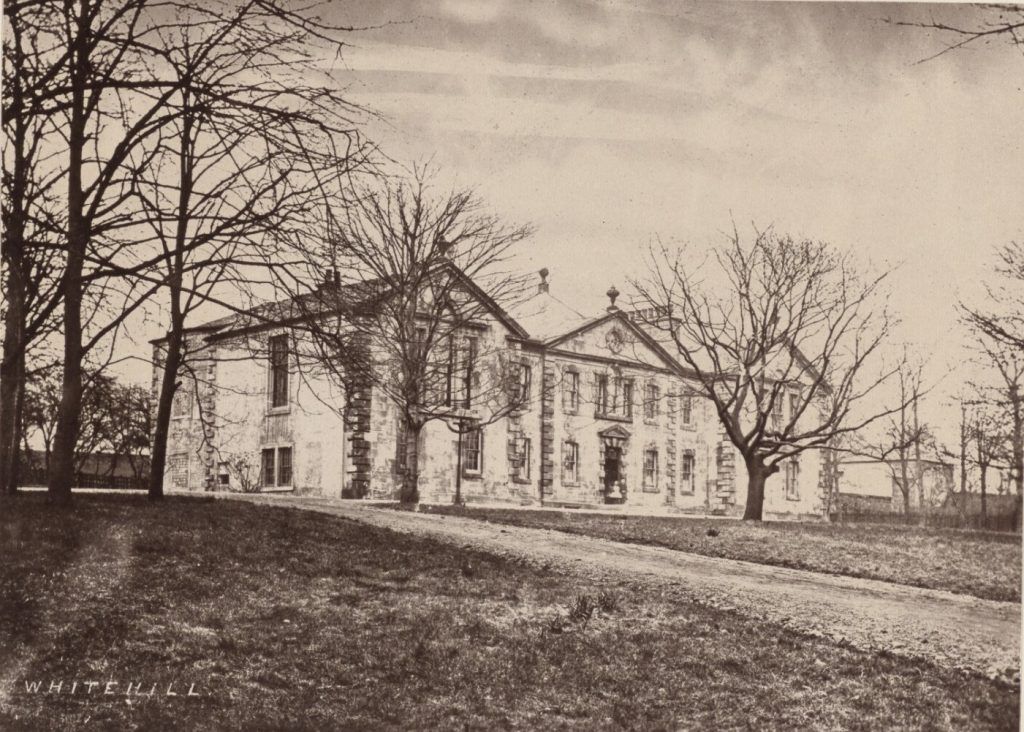
Alexander had begun, during the 1850’s, to acquire various parcels of land around Golfhill (Craigpark, Whitehill, Meadow Park, Broom Park, Annfield, Bellfield and Wester Craigs) as he had seen the potential in the growth of the City of Glasgow in that direction. Some of the estates named above will be familiar to readers as they were the residences of others buried in the Necropolis. By 1857 he had gathered together about 200 acres of land and announcements started to appear in newspapers intimating the intention to establish a new middle-class suburb of self-contained houses “in preference to the present system of common stairs and common flats”. The plans could be seen at the office of James Salmon, Esq., architect 145 St Vincent Street.
Alexander’s father James, and other members of the family are buried in the Ramshorn Churchyard but in 1847 Alexander purchased a plot in Compartment Omega on the death of his son Walter. The following year Mrs Eleanor Dennistoun was buried there and in the next hundred years seven more burials took place. Including Alexander himself who died at Lagarie, his villa on the Gareloch on 15 July 1874. The stone marking the burial place is missing so we have lost any additional names and information that might have been found on it.
Robert Kettle (1791-1852)
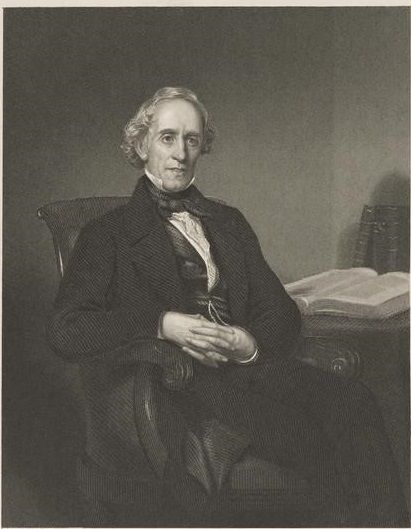
Robert Kettle was born in the village of Kintillo, parish of Dunbarney near Bridge of Earn, Perthshire on 18 December 1791. There seems to have been more than one family of Kettles in the parish at the time, but it has proved impossible to identify his parents. He must have had a sister as two nieces surnamed Geddes lived with him in Glasgow from at least 1841.
He seems to have been a studious and pious boy who would have liked to study for the ministry had his parents been able to support him financially. Instead, he was apprenticed to a weaver. At the end of his apprenticeship, he became a clerk in a firm in Perth for five or six years before moving to Glasgow in 1815 where he joined the firm of William Kelly and Co, cotton traders. In his early days in Glasgow, he rented a room in Balmanno Street for 2s 6d per week. He paid 5s for a ticket which allowed him to attend lectures at the Andersonian Institution for three months and was impressed by Dr Ure’s lecture, with demonstration, on coal gas.
Soon after settling in Glasgow Robert came under the influence of Dr Thomas Chalmers of the Tron Church. At first, he had to stand on the stairs or in a passage way to hear Chalmers preach as the church was so crowded. Through his attendance at the Tron, he became a deacon, and set up a Sunday School. He became a close friend of Thomas Chalmers and also of the Rev Edward Irving, Chalmers’ assistant and missionary in St John’s parish. In 1832 Robert left the established Church of Scotland and in 1834 he joined a Baptist congregation.
In 1829, he encountered some financial difficulties when William Kelly and Co. went bankrupt, but he overcame them to set up his own business as a cotton yarn merchant and eventually became very successful.
That same year a group of gentlemen including William Collins, the bookseller, were attempting to establish a temperance society. Robert Kettle did not join immediately but after an accident to him on a steamboat due, he was sure, to him having drunk too much toddy, he changed his mind. By July 1830 he was about to commit to the temperance movement and in December 1831 he became one of the treasurers of the Scottish Temperance Society; the following year he became secretary, a position he held until 1836.
The earliest temperance societies tended to focus on abstinence from distilled spirits which left the door open for consumption of wines and certain other alcoholic beverages. In 1832 the first attempts were made to form total abstinence societies. In 1836 the Glasgow Total Abstinence Society was formed – open to men and women alike. The third rule contained the following pledge: “I voluntarily promise to abstain altogether from Ale, Porter, Cyder, Wine, Ardent Spirits, and all other intoxicating liquors, (except as a Medicine, or in a Religious Ordinance); that I will neither give nor offer them to others; and, that I will discountenance all the causes and practices of intemperance.”
Robert does not seem to have been associated with the very early days of the total abstinence campaigns but in 1838 he became President of the Glasgow Abstinence Society a position he held until 1846. He also became President of the newly formed Scottish Temperance Union in 1838. The Scottish Temperance Union produced the Scottish Temperance Journal, from 1839 until 1847 and Robert very soon became its editor and a contributor. Due to holding these two presidencies he travelled and lectured widely in the west of Scotland promoting the benefits of abstinence.
The year after the Scottish Temperance Journal closed, he was elected President of the Scottish Temperance League and it was during this period that his portrait was commissioned from Daniel M’Nee. This shows a tall slim man with a thoughtful expression. His face was evidently scarred by small pox. He was always always most particular in his dress, not just in his portrait.
The last public meeting in which he took part was held in the City Hall, Glasgow on 10 February 1852 to promote the advantage of Savings’ Banks for the working classes. He attended church on 7 March as usual but felt he had a slight cold that evening. By Thursday 11th he was confined to bed and he died on 23 of March 1852. He was 61 years old. It was estimated that his funeral to Compartment Omega in the Necropolis on Monday 29 March was attended by some two thousand mourners.
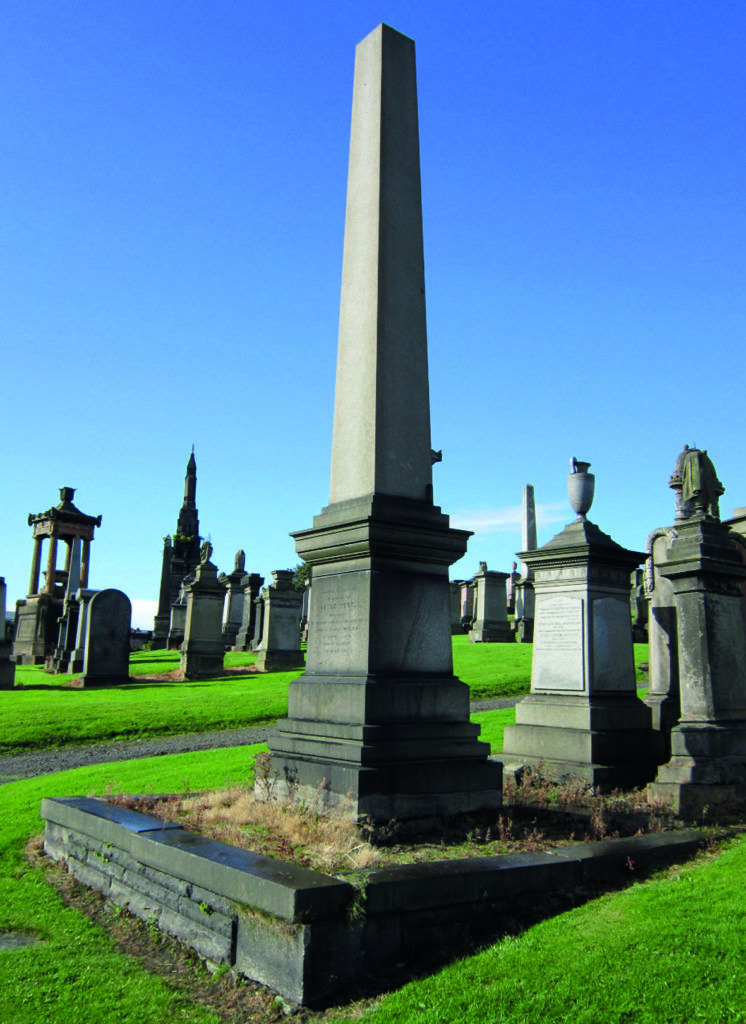
James Buchanan Mirrlees (1822-1903)
Born in Glasgow on 19 August 1822 to William Mirrlees, a saddler and Elizabeth Buchanan, James was their fourth child and one of at least eight children.
James almost certainly attended the Grammar School and he certainly matriculated at the University of Glasgow in 1838 but there is no record of him having graduated. On the other hand his son William Julius Mirrlees graduated BSc from the University in 1882.
His subsequent career was spent in mechanical engineering, specialising initially in the production of machinery for sugar processing in which Glasgow was becoming a world centre and later in the production of diesel engines.
In 1848 he joined the firm of P&W McOnie which after several name changes is best known as Mirrlees, Watson Company Ltd. By 1876, the company had grown to employ a workforce of around 800 and had one of the most fully equipped workshops in Britain at Scotland Street, Glasgow. The years 1878-1884 saw a boom in the sugar machinery manufacturing industry and saw the company produce 45,000 tons of machinery, worth about £1,500,000. Up to the year 1885 the output of the works consisted almost exclusively of machinery for the production, manufacture, and refining of sugar, of which they were the largest manufacturers in the country, and had a world-wide reputation.
In the later nineteenth century, the industry began to decline and the company turned their attention to other branches of engineering. In 1897 an agreement was signed whereby Dr Rudolf Diesel granted the company an exclusive licence for the manufacture and sale of diesel engines in Great Britain. Following this agreement, the first engine was completed in November 1897. This was the third diesel engine in the world. After initial problems, diesel engine manufacture took off, but J B Mirrlees had retired from the company in 1898 and it was his successors who developed this new line.
Away from business life, James was active in civic affairs being variously a town councillor (1862-1868) and Lord Dean of Guild of the Merchants House (1879-1881); he had obtained his Burgess Ticket in 1862 as a Hammerman as a younger son of his father. He was also a director of the Clydesdale Bank, and sat on the boards of commercial companies.
James married twice, firstly to Williamina Nicol Fleming in 1849; she died at Shandon Cottage, Gareloch in 1853 aged 26 leaving two daughters. She is commemorated on the gravestone in the Necropolis but is not buried there. Six years later James married Helen Gumprecht who outlived him dying in 1928. In all he had ten children, four boys and six girls.
He built an Italianate villa, Redlands House, on a plot of 24 acres on Great Western Road in 1870. In 1922 Redlands was converted to house the Glasgow Women’s Private Hospital which was looking for new premises. Later known as Redlands Hospital for Women it closed in 1978 and after a
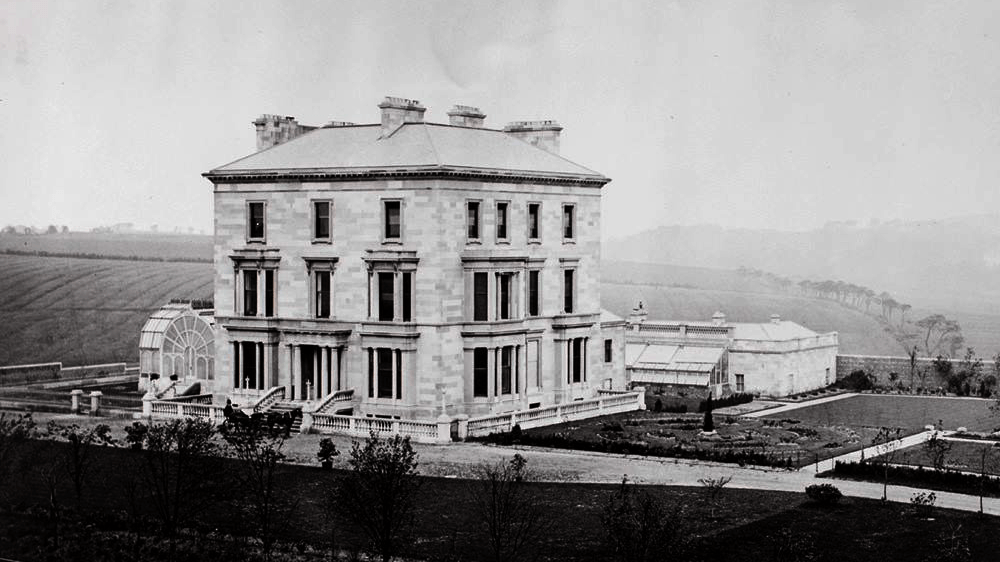
spell as an ambulance staff training centre, the house was converted into flats. James Buchanan Mirrlees died at Redlands House on 16 November 1903 and was buried in Compartment Omega in the Necropolis on 19 November. A son and a daughter who predeceased him are also buried there. The initial value of his estate was recorded as £165,607 6s 7d.
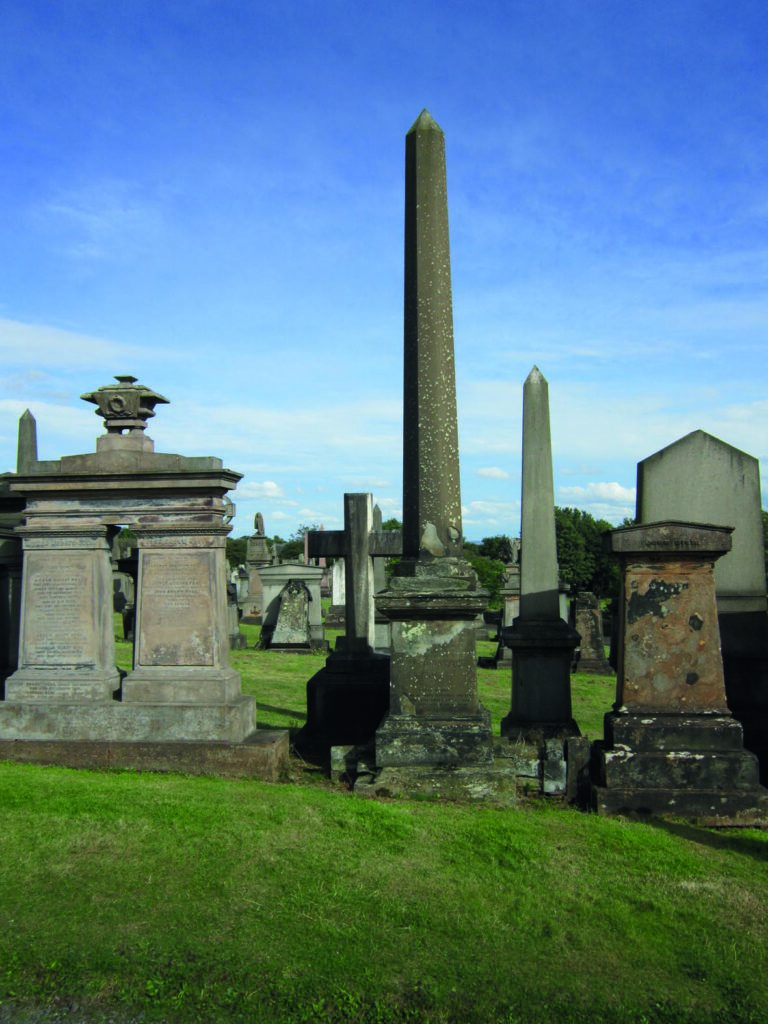
Rev Robert Muter (1771- 1842)
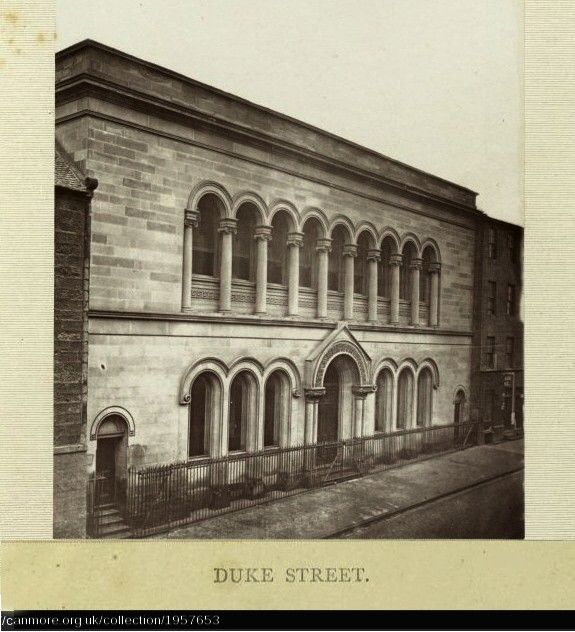
On the south east corner of Cathedral Square, close to the Necropolis stands the building that once housed Cathedral Square United Presbyterian Church (1880-1978) formerly the United Associate Church. This Anti-Burgher church was first established in 1747 when part of the congregation split from the Burgher Church in Shuttle Street. Before moving to Cathedral Square the congregation worshipped in a church in Duke Street and before that in a church on the same site but facing towards Havannah Street rather than Duke Street.
John Jamieson was the first minister to be ordained to this Seceder church in 1753 and he served alone until James Ramsay was appointed as junior minister in 1772. It was customary in these days for a second minster to be ordained to a charge to take some of the burden off the senior minister. On Jamieson’s death in 1793 Ramsay became the senior and only minister but difficulties soon arose, and the presbytery decided a junior minister should be appointed. In 1799 Robert Muter was licensed to preach in the Associate Church in Havannah Street but Ramsay strenuously objected to his appointment. A long controversy was to follow which ended in Ramsay’s resignation and Muter was ordained to the charge on 14 August 1800. The following year the congregation moved to a new building on Duke Street and it was there that Muter spent his ministry.
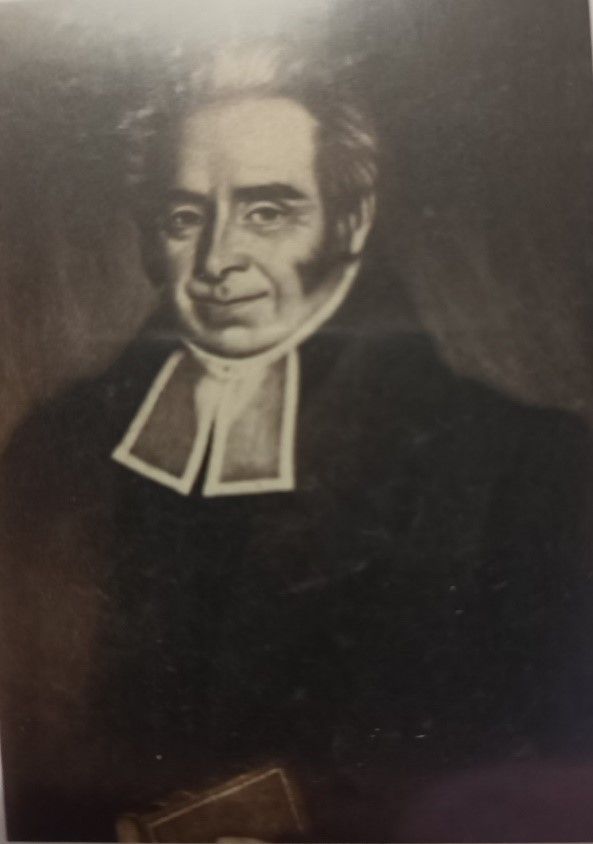
Robert Muter was born at Stonehouse, Lanarkshire to Thomas Muter and Margaret Denovan on 13 August 1771 and was ordained to his first and only charge one day after his twenty-ninth birthday. He was raised in the established Church of Scotland but joined the Secession in 1794.
In 1830 Rev Walter Duncan was ordained as junior colleague to Muter but he was deposed five years later and for two years Muter reigned supreme. In 1837 Muter received another junior colleague in the form of Hamilton M MacGill from Mauchline and this new minister proved very popular with the congregation. Disagreements within the congregation led to a falling out and in 1840 a large part of the congregation left with Mr MacGill to form a new congregation on Montrose Street which later moved to Woodlands Road. In the fullness of time Hamilton MacGill was buried in the lair of his wife’s family in Compartment Beta in the Necropolis. After MacGill’s departure Muter was again left as sole minister of Duke Street but not for long. In 1841 Rev John Graham and the congregation of Blackfriars Street Relief Church agreed to merge with the Duke Street congregation. This amalgamation did not last long as Robert Muter died on 5 May 1842 and was buried in Omega 1 in the Necropolis a week later.
Once Muter received the call to Glasgow and settled there he was able to consider marriage and in 1804 he married Janet Mitchell, a daughter of the Rev Andrew Mitchell of Beith which incidentally made him a brother-in-law to Dr John Mitchell of Wellington Street United Secession Church. Robert and Janet lived at 213 George Street for many years before they settled at Broompark on the north side of Duke Street. They had a family of at least ten children, mainly girls. Lilias Oswald Muter married Dr William McGill and is buried in another part of Omega with her husband. Alice Muter married William McLean and is buried in Epsilon. Sarah, Jessie and Ann also married but are buried in the family lair in Omega beside their father and mother. Janet Mitchell survived her husband almost twenty years dying in 1861 at Broompark.
James Scott and family
Readers may recall the loss of the car ferry Estonia during a storm in the Baltic in 1994 and the capsizing of the Herald of Free Enterprise off Zeebrugge in 1987 while those with particularly long memories may recall the loss of the Princess Victoria in the North Channel between Scotland and Northern Ireland in 1953. Just over 100 years before the loss of the Princess Victoria the SS Orion ran on to rocks off Port Patrick and sank with a substantial loss of life.
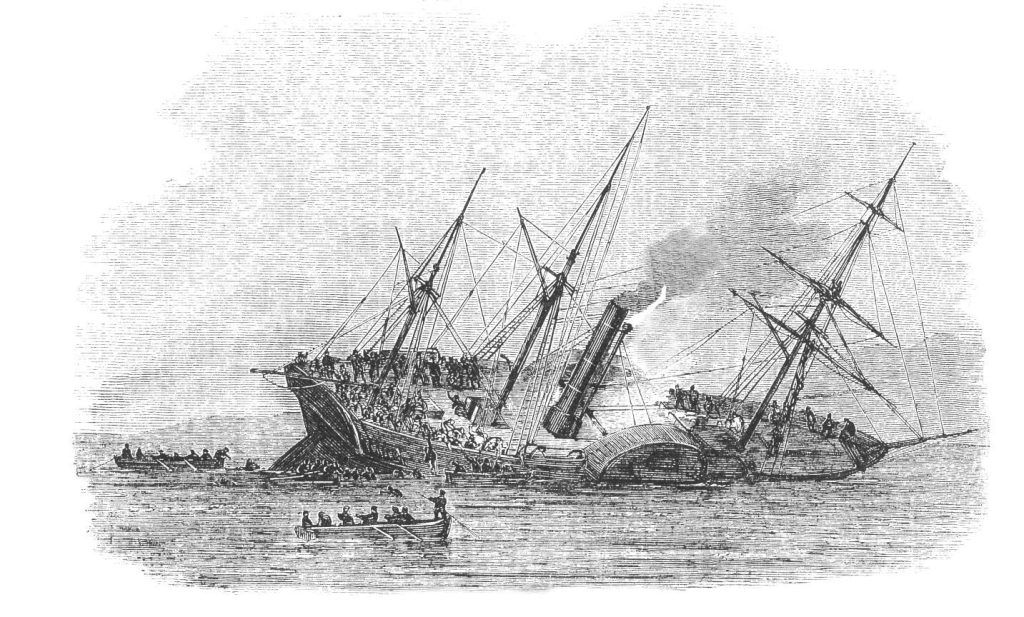
At 1.35am on Tuesday 18 June 1850, on a fine calm night, the Orion struck the Outer Ward Rock off Port Patrick resulting in a large gash in her hull which caused her to sink within fifteen minutes. It is not known exactly how many passengers were onboard as recording the number of passengers travelling was not compulsory at that date but it is estimated to have been between about one hundred and sixty and one hundred and eighty in total.
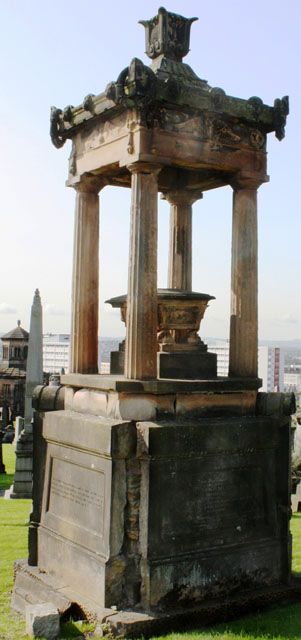
James Scott, his wife Lillias Ure and their only child Marion, and a widowed sister in law, Janet Ure, Mrs William Smith, had arrived in Liverpool by the Cunard steamer RMS Europa from New York a day or two previously and were continuing their journey to Glasgow. The two sisters had married their respective husbands in a double wedding in Glasgow on 12 April 1831 and seem to have spent most of their married lives in Canada as their husbands were both merchants based in Montreal. All four travellers were lost in the disaster and a stone in Compartment Omega commemorates them.
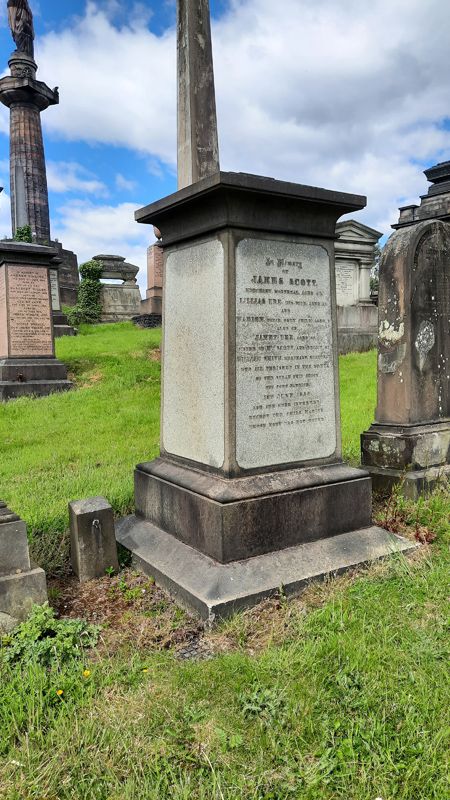
In memory
of
JAMES SCOTT
Merchant, Montreal, aged 55.
LILLIAS URE, his wife aged 46.
And
MARION, their only child, aged 7.
Also of
JANET URE, aged 40,
sister of Mrs SCOTT, and relict of
WILLIAM SMITH, Merchant, Montreal,
who all perished in the wreck
of the steam ship Orion,
off Port Patrick,
18th June 1850,
and are here interred
except the child MARION
whose body was not found.
According to newspaper reports James Scott’s body was found quickly and sent to Glasgow. Janet Smith, his sister in law’s body was found by a diver in the wreck at the foot of a companion stair and brought to Glasgow on Friday 21st on the SS Admiral. Both James and Janet were buried in the Necropolis on Tuesday 25th June one week after the tragedy. On Friday 9th August a female body, presumed to be that of Lillias Ure, was washed ashore at Ballywater near Dondghadee, Ireland and her funeral took place on 12 August. By this time fifty five bodies had been found. The same newspaper report that tells of the discovery of Lilias’s body also reported that a silver tea and coffee service belonging to the Scotts had been recovered. The inscription on the coffee pot said ‘Presented to Mr and Mrs Scott on their leaving Canada, by a few sincere friends’.
Omega Profiles
The following Omega profiles are already available on the FOGN website:
Major Norman McLeod Adam, MC
Captain Albert Ferguson Blackie
Lieutenant Frank Herndon Blackie
Fleet Surgeon Adrian Andrew Forrester
Agnes Gilmour nee Strang
Lieutenant George Wilson Graham
2nd Lieutenant Thomas Harvey
Rev Duncan MacFarlan, DD
Dugald Moore
The following profiles have been added since this newsletter was first published:
Peter Aikman and family
Lieutenant Douglas Alexander Bannatyne
Moses S Buchanan, MD
Dr John Burns
Alexander Dennistoun
Robert Kettle
Sir James Lumsden
William McGill, MD
James Buchanan Mirrlees
Rev Robert Muter, DD
James Reddie
David Robertson
The Scott family
Robert Stewart
Charles Tennant
Dr James Towers
Thomas Lennox Watson
Last but not least
Oblivious of all the extra work preparing this issue of Grave Matters the indexers have continued their work and now reached 1872. The number of records indexed in the last three months is as follows –
| October 2023 | 433 |
| November 2023 | 430 |
| December 2023 | 297 |
Our database of persons buried or commemorated in the Necropolis now stands at 49652 entries at the end of December 2023 of which 21691 entries represent persons buried in common ground with no grave marker.