Compiled by Morag T Fyfe
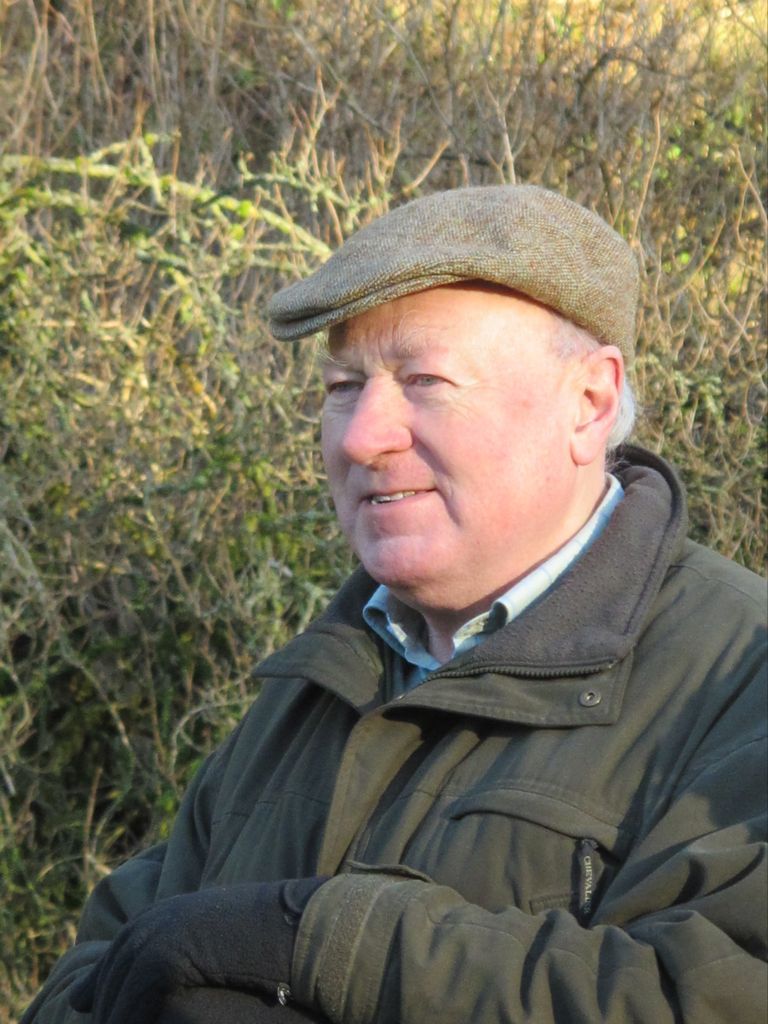
It is with great regret and sadness we have to announce that our well-loved Vice Chairman, and former Chair, Nigel Willis, passed away in September from Covid.
I know this will come as a great shock to many of you who knew Nigel personally or had been on his tours or had attended his PowerPoint presentation. You will remember him well as a gentle, humorous man, with a real strength of character and integrity.
Nigel was the foremost founder of the Friends established in 2005 and his earliest memories of the Glasgow Necropolis are from visiting the family memorials there as a child.
He put an astonishing amount of work and enthusiasm into the Friends of Glasgow Necropolis, from the establishment of the Charity and he worked tirelessly up until the past few weeks. He loved the outdoors and no matter the weather over the last 15 years has taken thousands of people on tours – he especially loved doing school tours. He also travelled long distances to give PowerPoint presentations all year round to many organisations.
He brought his charisma and enthusiasm to every meeting he attended and many of us still on the committee were there from the very first year. Many Charities do not last half as long but he brought to our Charity the knowledge that the work of the Friends of Glasgow Necropolis outweighs any individual personalities or opinions.
His appearance on the TV programme ‘Flog it’ will keep re-appearing and remind us of this very special man, the loss of whom will be felt for a very long time to come.
We were honoured to have known him and to have shared his passion and vision for the Glasgow Necropolis.
Ruth Johnston, Chairperson, and the Trustees of the Friends of Glasgow Necropolis
Quarterly Update
The indexers are still working hard, and the number of records indexed in the last three months is as follows –
| July 2021 | 480 |
| August 2021 | 530 |
| September 2021 | 461 |
Our database of persons buried or commemorated in the Necropolis has passed 40000 and now stands at 40262 entries to the end of September 2021. It is worth reflecting that 14720 (37%) of these entries represent persons buried in common ground with no grave marker.
John Campbell
The newspapers have been helpful, as usual, in providing details about people who would otherwise be anonymous names in the burial registers. The notice below identifies John Campbell who was buried in a common grave on 4th January 1862.
SUDDEN DEATH – Yesterday afternoon, a student, named John Campbell, 30 years of age, who resided at 284 High Street, was found, by No. 67 Constable, lying on his back in a dying state in a close at 66 High Street. He was immediately conveyed to the Central Police Office, and Dr. M’Gill sent for, but before his arrival life was extinct. Deceased was subject to fits, and was complaining before he left his lodgings in the morning.
Glasgow Herald Wednesday 1 January 1862
David Evans from Cardigan, Wales
Christmas 1861 would turn out to be a time that Ann Thomas would never forget since her husband David Evans died in Glasgow on 26th December and was buried in a common grave in the Necropolis on the 28th. A short account of his death appeared in the Glasgow Free Press on the day of his burial.
SUDDEN DEATH – On Thursday forenoon, a seaman, named David Evans, master of the schooner Willima, of Cardigan, presently lying at berth 28, north quay, expired suddenly on board his vessel. Dr. Milner was immediately sent for, and he is of opinion that death resulted from heart disease. Deceased, who was a native of Cardigan, was 28 years of age, and he has left a widow to lament his loss.
Glasgow Free Press – Saturday 28 December 1861
Curling Finzel Doddrell
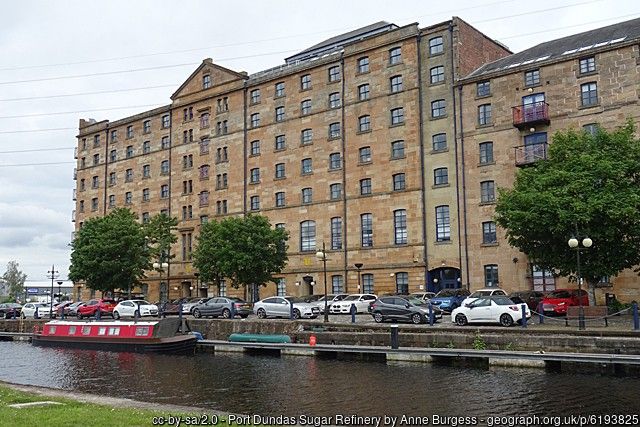
Sometimes a name jumps out of the burial registers, and you think ‘where did that come from?’ This happened when 4 months old Curling Finzel Doddrell was buried on 8th August 1862. The gravestone named his parents as Daniel Taylor Doddrell and Anna Maria Doddrell. Further investigation of this family has thrown light on the later history of sugar refining in Glasgow. Glasgow’s first sugarhouse, the Wester Sugarhouse, was built in 1667 at the corner of Bell Street and the Candleriggs and several more followed. In 1851 Patrick Robertson built a sugar refinery from scratch in Port Dundas and about 1853 it was taken over by the firm of Murdoch & Doddrell. There were two Doddrell brothers, Daniel Taylor and George John who had worked in Finzel’s sugar refinery in Bristol. The business prospered until the building was destroyed in a bad fire on 23rd January 1865. However, the present building at Port Dundas was erected and work resumed in July 1866. The company got into financial difficulties by 1869 and the brothers were declared bankrupt but that was not the end of their connection with sugar refining in Glasgow as George John, at least, was part of the Port-Dundas Sugar Refining Co which took over the refinery and resumed work in 1871. The company carried on until 1877 when sugar refining ceased in Glasgow. The 1866 building (below) is Category B Listed and now converted into flats.
Infant deaths
Now that addresses have been appearing in the burial registers since 1855 it is proving possible to tentatively identify families with young children who were born and died between two censuses and whose existence might otherwise be unknown. For example there seems to have been a family by the name of McDowall living at 28 Balmanno Street who buried three children between 1859 and 1862 – James (1y 4m) 1859, Mary (3y 6m) 1860 and William (11y) 1862. In 1855 Alexander Taylor (2y) of 13 Bell Street died and in 1859 Mary Holland Taylor (7m) of the same address died. Further along Bell Street a family by the name of Shee could be found at number 67. Catherine Shee (age unknown) died in 1858 and the following year Agnes Shee (5m) was buried.
The Glasgow Lying-In Hospital
Since 1857 there have been five burials from the Lying-In Hospital. Three of these were infants ranging in date from 1 day to 3 weeks. No ages are given for the other two (female) burials so they may have been adults.
The Glasgow Lying-In Hospital and Dispensary was founded in 1834 in Greyfriars Wynd. It moved to St Andrews Square in 1841 and in 1860 to the Rottenrow: it has been nicknamed The Rottenrow ever since. Completely new buildings were erected on the Rottenrow site in 1880/81 and a substantial extension added in 1908. These buildings had a complement of 108 beds and contained a large lecture theatre and an operating theatre for clinical teaching purposes.
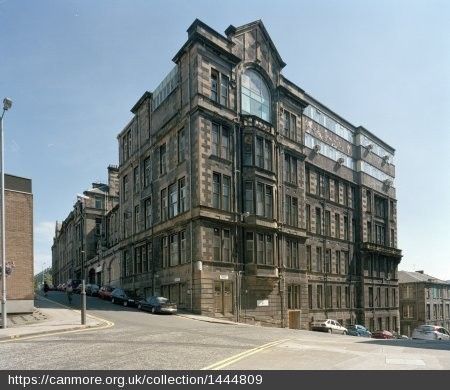
The title Glasgow Royal Maternity and Women’s Hospital was granted in 1914 and the present shorter version (Glasgow Royal Maternity Hospital) adopted in 1960. In 2001, Glasgow Royal Maternity moved to the Princess Royal building within the Glasgow Royal Infirmary.
Wee Willie Winkie
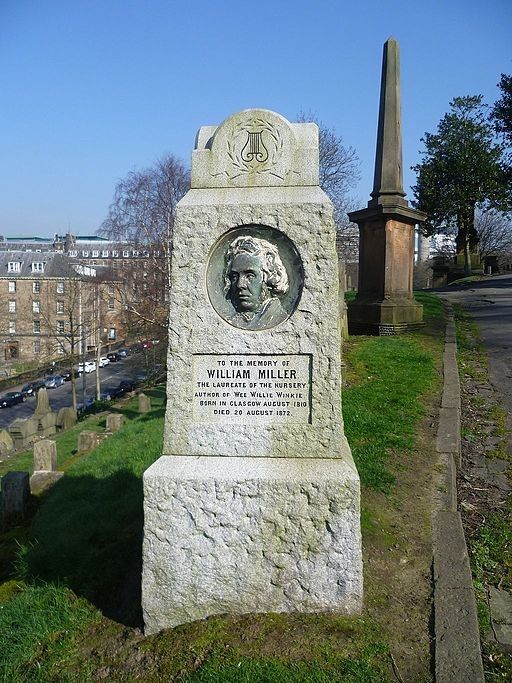
Visitors to the Necropolis will be familiar with the memorial to William Miller ‘The Laureate of the Nursery’ who composed the nursery rhyme Wee Willie Winkie. There is no William Winkie buried in the Necropolis but on 10th October 1862 John Winkie, a seventy-two-year-old carpet weaver of 60 Surrey Place, Glasgow was buried in a common grave. He left a thirty-six year old widow and a three year old daughter.
Fatal accident at Ayr Dock
There is no system of coroners’ inquests in Scotland unlike England, Wales and Northern Ireland. Accidental, unexpected, unexplained, sudden or suspicious deaths are investigated privately for the local crown agent, an official called the procurator fiscal.
Certain types of death are investigated further at Fatal Accident Inquiries (FAIs). They were introduced into Scotland by the Fatal Accidents Inquiry (Scotland) Act 1895. It provided for public inquiries by sheriff and jury, upon petition by the procurator fiscal, into fatal accidents occurring in industrial employment or occupations. It was amended in 1906 to include provisions for inquiries into any case of sudden or suspicious death in Scotland in which it appeared that an inquiry should be held.
The burial of a young man named Charles Wilson on 3rd May 1901 caught the attention of an indexer as he was described as ‘of Ayr Dock’. The unusual address was soon revealed to be the place of death and not the deceased’s residence. The report below describes how Charles and a second man lost their lives on 29th April.
TWO MEN KILLED AT AYR DOCK
A distressing accident, by which two men lost their lives, occurred at Ayr Harbour yesterday afternoon. Messrs John Wilson Co., ship riggers, Glasgow, were engaged renewing the gates at Ayr Dock, and were lifting out the old gates and putting in new ones by means of temporary shear-legs. They had successfully removed the old gate and put in the new one on the east or harbour side of the dock, and were engaged completing the erection of the shear-legs on the west or seaward side of the dock preparatory to removing the old gate on that side. Mr Charles Wilson, brother of one of the members of the firm, was superintending the work of erecting the shear-legs, and he and a rigger named Duncan M’Innes were on the top of the erection, which would be about thirty feet from the quay wall and about fifty feet above the surface of the water, and were engaged putting the finishing touches on the apparatus. At this time the steamer Dungoyn, which had discharged a cargo of timber, was leaving the dock to take in a cargo of coal, and was approaching the exit with a pretty strong following wind. The vessel, it appeared, could not have passed clear of the stays that crossed the channel, and the attention of the captain was called to the situation. He saw the danger and reversed his engines, but it was too late, and one of the stay ropes of the foremast struck and parted the first stay rope of the shear-legs. The erection immediately fell, and the men on the top of it were precipitated into the water. William Hannah, a coal trimmer engaged on a steamer in the basin, who saw the occurrence, jumped into the water, and swimming to the spot, was able to hold up Mr Wilson till help came, and both men were rescued in a boat. M’lnnes was dead when taken out, and Mr Wilson was terribly injured and bleeding from the face and head. He was removed by rail to Ayr County Hospital, and there he died shortly after being admitted. Both men must have struck the quay wall in falling or have been struck by the falling shear-legs, as death in each case was due to injuries of that nature and not to drowning.
Greenock Telegraph and Clyde Shipping Gazette – Tuesday 30 April 1901
This accident warranted a Fatal Accident Inquiry held on 5th June at Ayr before sheriff Campbell Shairp and a jury and subsequently reported in the Daily Record of 6th June 1901. The outcome was an episode of buck-passing between John M’Millan the deputy harbourmaster and Captain Saultry of the Dungoyn as to why the Dungoyn proceeded through the harbour without a pilot aboard. At the end the jury returned a formal verdict.
The Gentles brothers
In 2019 a representative of the CWGC got in touch with the Friends and we discovered that we had another WW1 casualty of whom we knew nothing. Compilation of the WW1 Roll of Honour had been based on names found on surviving gravestones but the Gentles lair in compartment Petra was unmarked. There is now a CWGC headstone marking the burial of Acting Serjeant Thomas Gentles, 5th Battalion Cameronians (Scottish Rifles) who died on 3rd January 1917 after being discharged from the army in May 1916 because of TB.
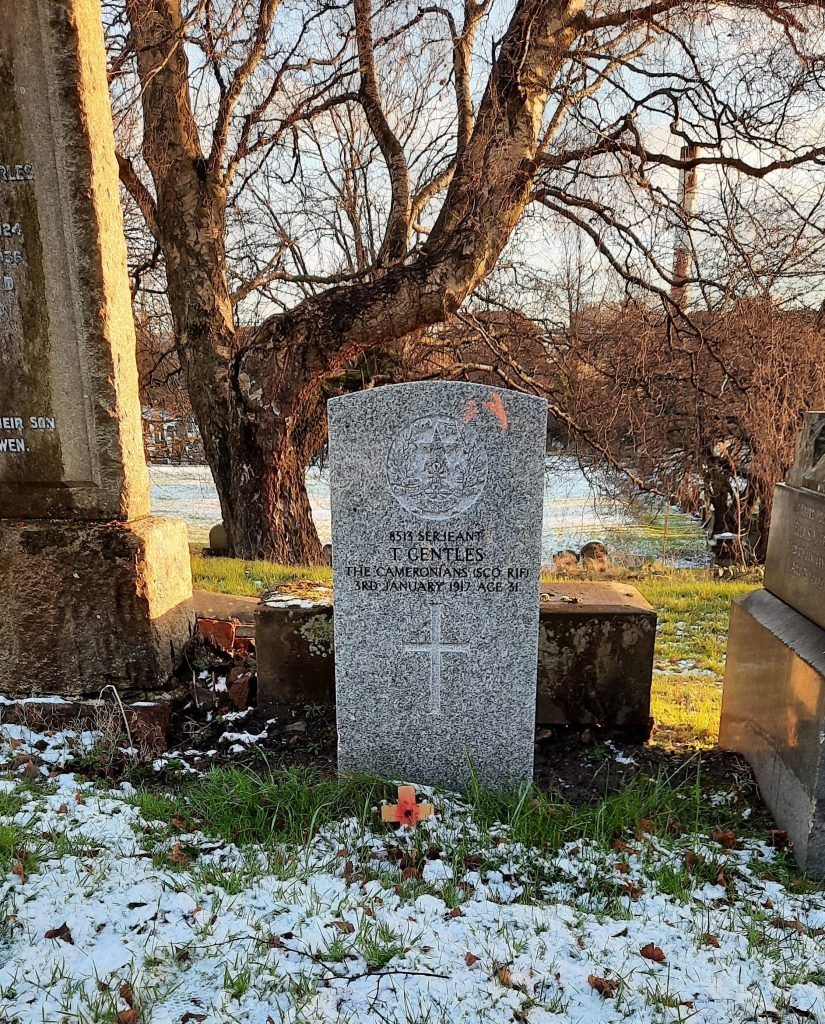
Thomas had two brothers who also enlisted in the Cameronians and were discharged due to poor health. Corporal Matthew P Gentles, the youngest brother, was discharged in July 1916 and died in April 1949. At the time of his death he was an employee of the Dunlop Rubber Company based in Inverness but died in Glasgow and was buried in the Necropolis in a new lair in compartment Quartus.
The eldest brother was William R Gentles who transferred from the Cameronians to the Machine Gun Corps. He was discharged in April 1917 on the grounds of melancholia and in July 1918 was found dead on the railway line about a mile south of West Kilbride Station. The following month his death certificate was amended to give the cause of death as ‘run over by passing train (supposed suicidal)’.
The family lair is in compartment Petra where four generations are buried but it seems that it became full and another lair was purchased in Quartus where Olga Mary, the brothers’ sister and Mary McCallum, their mother, were buried before being joined by Matthew in 1949.
A detailed article about the family can be found at https://arlingtonbathshistory.wordpress.com/2018/09/14/thomas-gentles-from-water-polo-to-war/
New Profiles
John Park Taylor has contributed a profile of his ancestor John Taylor, senior to our website. Short profiles for the cousins Alexander and Charles Craig and for James McLeish have also been added.
Margaret Franklin nee Smith
So far the address ‘Gypsy Tent, Wallace Place, Partick’ has only occurred once in the burial registers. This was the place of death of Margaret Franklin, aged 32, who was buried in compartment Sextus 365 on 5th November 1900. She died of complications after childbirth. In the next row to the west in the same compartment there is a stone which mentions Alice May Franklin the grand daughter of George Smith, who died in 1898 aged 2. George Smith is better known as the husband of Corlinda Lee, Queen of the Gypsies. Further investigation confirmed that Margaret Franklin was a daughter of Corlinda Lee and the wife of Trafalgar Franklin. Corlinda’s son Ernest is buried in the grave next to his mother’s and both are marked by fine stones but Margaret’s is unmarked and overlooked.
******************************
Anyone who would like to help indexing the Burial Registers is very welcome to join us by contacting me at research@glasgownecropolis.org