The indexers have reached 1894, and the number of records indexed in the last three months is as follows –
| Jan 2026 | 421 |
| Feb 2026 | 418 |
| Mar 2026 | 408 |
Our database of persons buried or commemorated in the Necropolis now stands at 53919 entries at the end of March 2026 of which 21869 entries represent persons buried in common ground with no grave marker.
James Hannan died 1888
On 13 August 1888 the Glasgow Herald published an obituary of James Hannan who had died on 19 August. This obituary (below) is a good place to start investigating James’s life.
DEATH OF MR JAMES HANNAN. — We regret to announce the death of Mr James Hannan, which took place on Friday at his residence, 17 Woodside Terrace. Mr Hannan was born in Anderston in 1805, and was a son of Mr Robert Hannan, the last surviving partner of the “Anderstown Brewerie Company.” At an early age he entered the firm of Henry Monteith & Co., of which he subsequently became a partner, taking an active part in the business for half a century. Acting on behalf of his uncle, Mr Henry Monteith, of Carstairs, Lord Provost, and then member of Parliament for the city, and in association with the late Mr Robert Lamond, writer, Mr Hannan had charge of many of the details of the great banquet given to Sir Robert Peel. Mr Hannan filled many prominent positions in the city, such as chairman of the Chamber of Commerce and Lord Dean of Guild. He was also for many years a member of the Town Council, and while in the Magistracy he with his friend Lord Provost Stewart and Mr Murray, of Monklands, devoted much time to the furtherance of the scheme for the introduction of water from Loch Katrine. As a philanthropist Mr Hannan was also well known, and held a position on the directorate of many local charitable societies. He was an ardent supporter of the Church of Scotland, and took a special interest in the smaller livings scheme of that body. Last year he was presented with a handsome casket and address from those associated with him in the management of the National Securities Savings Bank, of which institution he was the honorary and active chairman for no less than 27 years, during which period the deposits rose from a very small sum to considerably over two millions sterling. The Town Council acknowledged his many services to the public by appointing him to the honorary office of Bailie of Provan on the death of the late ex-Bailie Couper. Of his class-fellows in the old High School only two survive Mr Hannan, namely, Mr William McLean, of Plantation, and a clergyman of the Church of Scotland in Perthshire, Mr Hannan, as a worthy citizen, served his day and generation well, and he will be mourned by a large circle of friends.
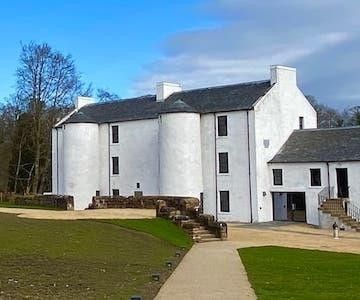
Henry Monteith & Co of which firm James Hannan became a partner owned the Blantyre Mill where David Livingstone was born and worked. In 1857 James was one of three trustees appointed by Livingstone to manage his affairs. This does not seem to have been only a formal appointment as a personal letter from Livingstone to James survives written “at sea” on the Pioneer on 15 Feb 1861 in which Livingstone presents his “very kind regards to Mrs Hannan & family”. At present this is all that is known of this link between the two men (see https://livingstoneonline.org)
In the public sphere James served as a town councillor, in the Chamber of Commerce (being chairman 1858-9) and rising to be Dean of Guild (1852-1853) of the Merchants House. When the Stewart Memorial Fountain was erected in 1872 in Kelvingrove Park to commemorate the efforts of Lord Provost Robert Stewart in bringing clean water from Loch Katrine to Glasgow Baillie Hannan’s coat of arms was one of those placed on the base of the fountain.
The obituary mentions Hannan’s long connection with the National Securities Savings Bank (an ancestor of the Trustee Savings Bank) and that he had been presented with a casket and address in 1887. That casket is still in existence being donated to the Trades House of Glasgow in 2024 along with Hannan’s Baillie’s medal.
(See www.tradeshouselibrary.org/uploads/4/7/7/2/47723681/heritage_newsletter_no_7b.pdf)
Although Hannan himself had no connections with the Trades House one of his descendants does and has given the casket to them.
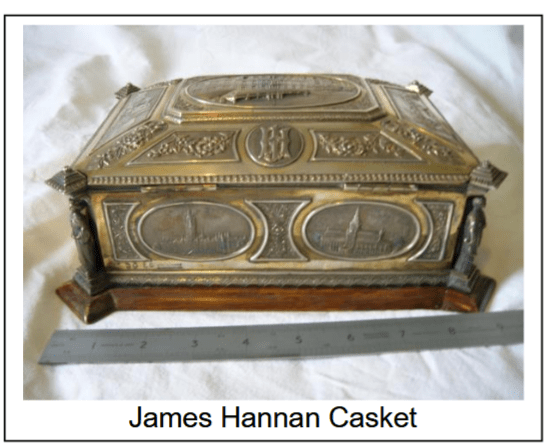
Image courtesy of the Trades House of Glasgow
The lair in Delta where James Hannan was buried had been bought by him more than 50 years previously for the burial of his first wife Agnes Wilson who died in 1836 from puerperal fever. Her baby son Alexander Wilson Hannan only survived 10 days. Later several children from James Hannan’s marriage to Janet Dalglish Paul were buried there before being joined by their mother and father.
Louis Kossuth Stevenson, died 1892 and family
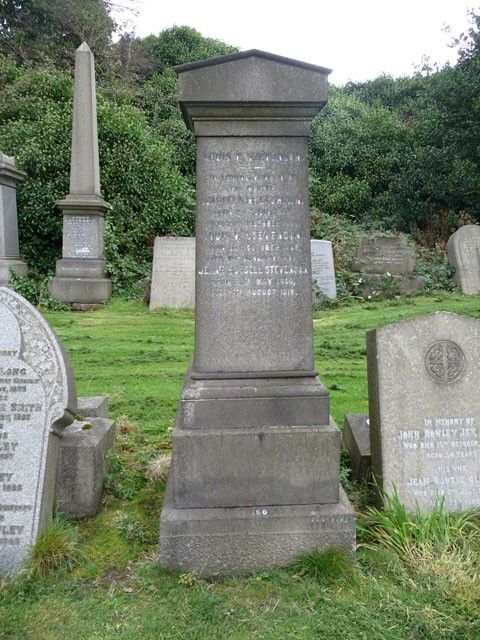
In 1886 Louis Stevenson buried his mother Isabella McLachlan in Compartment Primus in the Glasgow Necropolis and erected this simple gravestone. Louis himself died in 1892 and his sister Jeanie Russell Stevenson in 1918. These are the only burials in the lair and nowhere is there mention of Isabella McLachlan’s husband, father of her children.
The first interesting thing about this family is Louis’s unusual forenames. In the second half of the nineteenth century Lajos (Louis) Kossuth was known all over Europe as a Hungarian nationalist and revolutionary who became Governor-President of Hungary for a short time during the Hungarian Revolution of 1848-9. When the revolution was suppressed Kossuth fled to the Ottoman Empire and in 1851 to Britain. He spent some time making lecture tours of Britain and the United States drumming up support for a free Hungary. In 1856 he spent several weeks on a speaking tour of Scotland. As a result of this tour two baby boys were named after him. But there is no record on Scotland’s People of the birth of Louis Kossuth Stevenson in 1859.
The reason for Louis’ missing birth was revealed when the family was found in the 1871 census for Tradeston. This showed Isabella McLachlan and four children including Louis. The 3 eldest children had been born in Victoria, Australia and the youngest had been born at sea in 1862/3, presumably as the family returned to Scotland. No further child had been born after Allan Flores in 1862/3 and the reason for this became apparent when an advert was placed by Allan Stevenson in the Glasgow Herald of 28 August 1863.
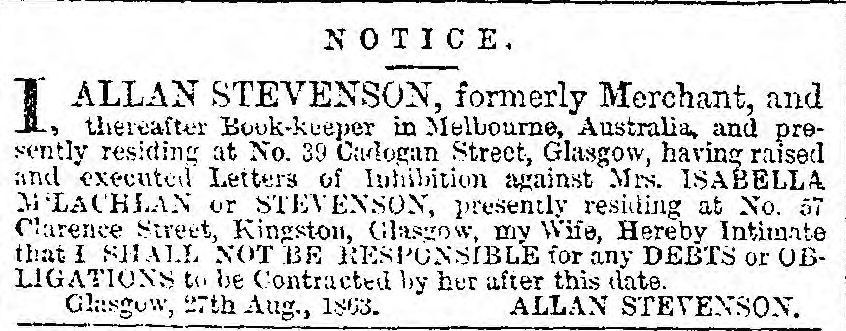
When Allan Stevenson died suddenly from cardiac disease in 1870 at the early age of 47 his death was registered by his brother in law Andrew McMillan who was married to his sister Jessie and not by his estranged wife Isabella.
According to the family gravestone Louis died on 18 January 1892 but his death certificate records that his body was found in the river Clyde at Berth 56 on 15 February and this is his official date of death. An entry in the Register of Corrected Entries records the result of a precognition as “Probably Drowning – Suicidal”. It may be a coincidence but Louis’s mother died on 23 December 1886 almost exactly five years previously.
Louis’s two younger brothers do not show up in Scottish records after 1881 and it might be assumed they had died. In 1881 Allan Flores was described as an apprentice seaman and it turned out he continued to follow this trade ending as mate on the SS Manapouri. He had returned to Australia at some unknown date, married in Melbourne in 1891 and died there the following year at the early age of 29. He left a young widow Henrietta Pye and a baby son named after him.
Let’s work backwards from the death of David Russell Stevenson on Guernsey in 1942. His parents are given as Allan Stevenson and Isabella McLucklan and he had been born 81 years previously in Melbourne, Australia. When the Germans arrived in Guernsey in 1940 David was already resident on the island and his ID card is a goldmine of information.
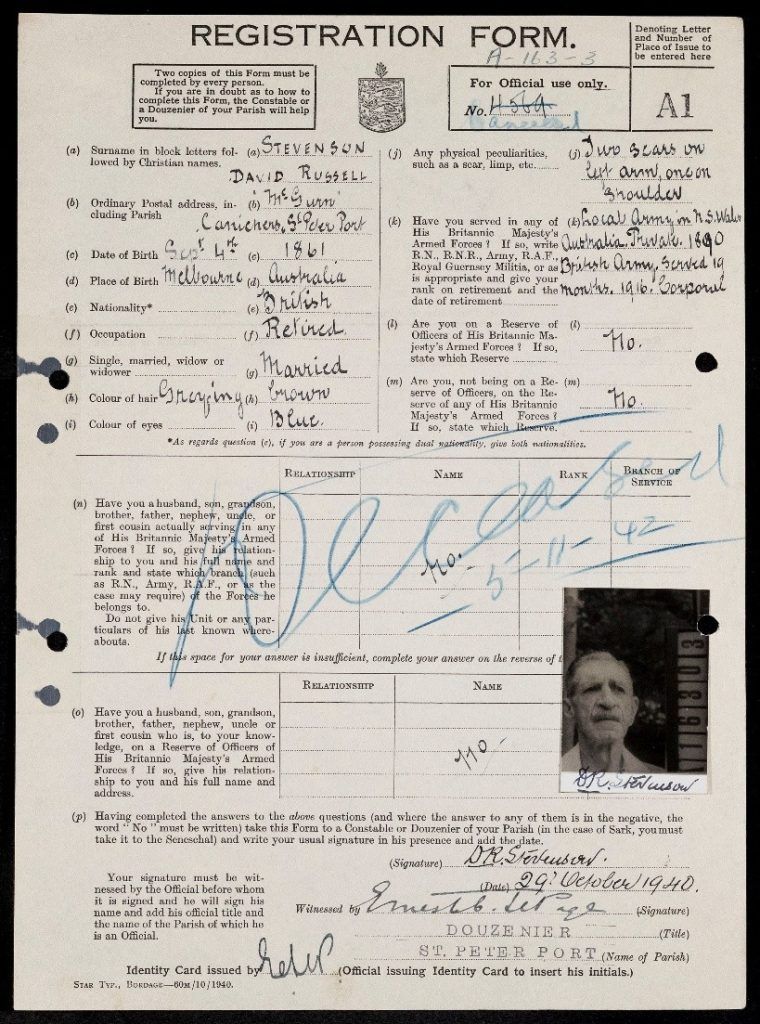
Most importantly it provided his date of birth in Melbourne as 4 Sept 1861. We also learn that he was married and had been in New South Wales in 1890 as a private in the ‘local army’ as it was described; he also served 19 months in the First World War when he must have been considerably over-age. David (and possibly Allan Flores) did not lose contact with the family left behind in Scotland as David appointed an attorney to deal with the estate of his sister Jeanie when she died in 1918 in Glasgow. Where was David at this time? Passenger lists suggest he was in South America, specifically Argentina and Paraguay. In 1898 he sailed from London to Buenos Ayres, in 1919 he is also found returning to Buenos Ayres from London and in 1927 Mr and Mrs D R Stevenson from Paraguay board a ship at La Plata, Argentina bound for England where they intend to settle permanently. In the passenger lists he is consistently described as a farmer, although by the time his occupation is recorded in Guernsey he is simply ‘retired’. There are hints in Australian sources that David was a member of the party of settlers led by William Lane from Australia to establish a settlement called New Australia in Paraguay, in the early 1890s. Lane soon left New Australia and moved on to found the Cosme Colony also in Paraguay. David seems to have followed him to Cosme and was still there in 1906.
Teachers of the Grammar School of Glasgow
The present High School of Glasgow claims 1124 as the date a ‘sang’ school was established at Glasgow Cathedral and therefore its own foundation. At the Reformation the school passed into the control of the magistrates of Glasgow and became the Town school, later known as the Grammar School and from 1834 as the High School. The reorganisation and modernisation of the early 1830s led to the introduction of new subjects and the abandonment of the practice of one master seeing his pupils through their whole four year course in the Grammar School.
Several of the 19th century masters and teachers of the school are buried in the Necropolis. Two were long standing masters in the Grammar School in the old tradition.
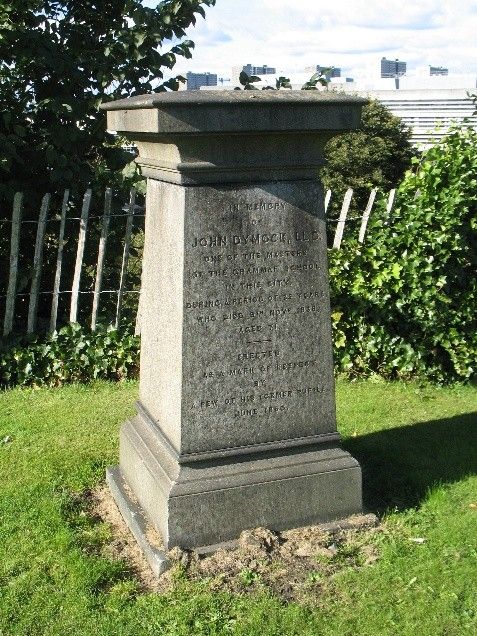
John Dymock, LLD (c1767-1838) taught between 1808 and 1834. Prior to his time in Glasgow he had been Rector of the Kelso Grammar School. He is the only one in this list who is not actually buried in the Necropolis. The lair in compartment Kappa was purchased a few years after his death by his son and the stone on the lair is one erected in his memory by some of his former pupils in 1860. Dymock was a scholar of some note and wrote or edited several books. In 1829 he was awarded the degree of LLD by Glasgow. University.
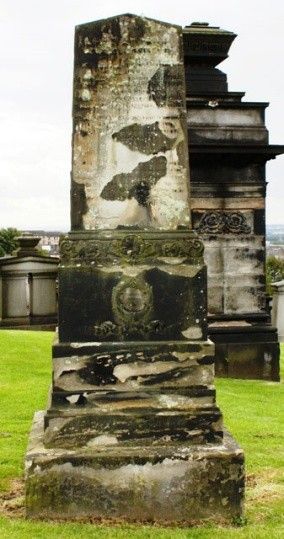
Robert Douie (1770-1853) was a contemporary of John Dymock and one of the masters of the Grammar School between 1809 and 1834. Born in Kinross, he was educated at the University of Edinburgh. Before coming to Glasgow in 1809 he was a master of the Grammar School of St Ninian’s, Stirling. His monument in compartment Omega is badly weathered and mostly illegible but there is a suggestion on it that it may have been erected by former pupils in 1854.
The third of the old guard of Grammar School masters was Adam Stevenson (1771-1841) whose family lair in Alpha is no longer marked by a stone. He was appointed in 1816 to teach writing and arithmetic and remained until his death in 1841.
The remaining masters all taught specific subjects in the reorganized High School after 1834.
James Bell taught English at the High School from 1859 until his death in 1879. His life and career is described in detail in this Profile so he will not be mentioned further.
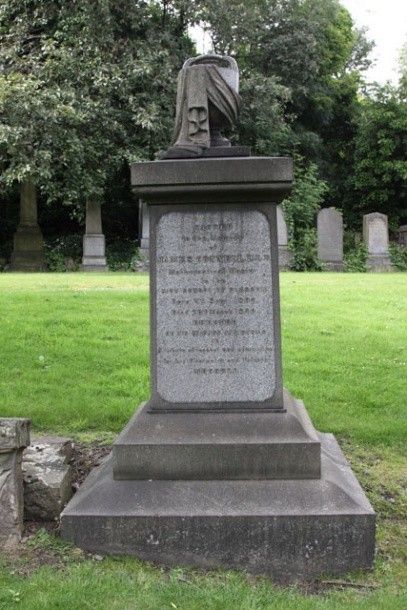
Like John Dymock, James Connell, LLD’s stone in compartment Theta was erected by some friends and former pupils. Born in 1804 he died from consumption in 1846 at the early age of 41 after serving as mathematical master at the High School since 1834. He seems to have taught in Kilmarnock and Irvine before arriving in Glasgow. His textbook The elements of the differential calculus was used in the High Scholl till the 1870s. A year before his death he received an honorary LLD from the University of Glasgow.
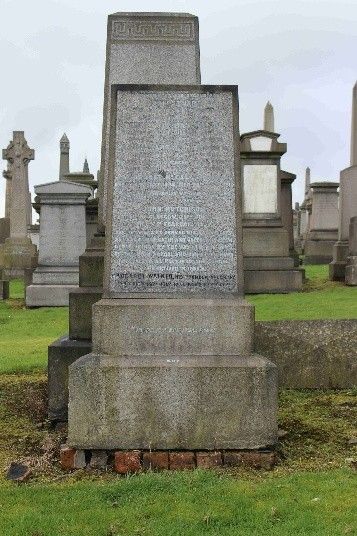
John Hutchison (1842-1924) was appointed a classics teacher in the High School in 1866. He was promoted to head Classical Master in 1901 and became Rector of the High School 1904-1909. The stone in Epsilon also commemorates his youngest son Captain William Ramsay Hutchison, Royal Scots Fusiliers who was killed on 22 March 1918.
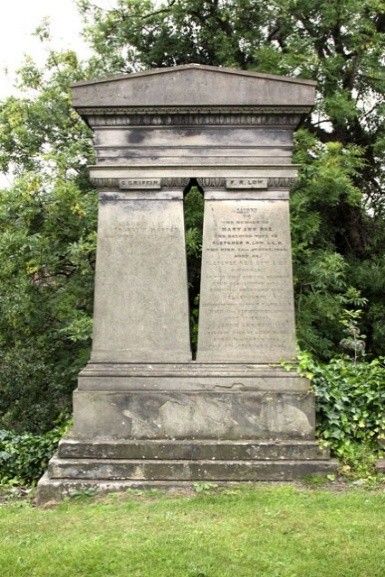
Fletcher Reid Low LLD (1800-1881) was born in Dundee to Glasgow parents. He was educated in Edinburgh, first at the High School and then the University. He joined the staff of the High School of Glasgow in 1839 from Linlithgow Grammar School and retired in 1866 as Senior Classical Master. His LLD was awarded in 1845.
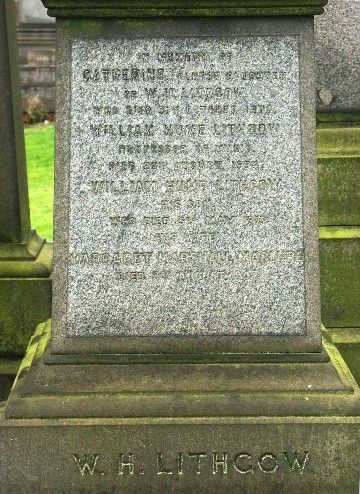
William Hume Lithgow (1805-1874) was a well-known and respected choir master in Glasgow. He seems to have been associated with the High School of Glasgow at some point in his career (possibly 1842-1874) but I suspect on a free-lance basis as I cannot find any mention of him in the official histories of the High School. He and his family are buried in compartment Epsilon.
Dugald John Bannatyne (1836-1894)
The roots of the Glasgow law firm now known as BKF & Co go back to 1785 and several generations of the Bannatyne family acted for individuals and firms through the nineteenth century. Many members of the family are buried in compartment Omega in the Glasgow Necropolis. One son of the family who tried to break away from the family business was Dugald John Bannatyne as this newspaper clipping relates. However he was gathered back into the fold and buried in the Necropolis on 28 February 1894.
THE LATE MR DUGALD J. BANNATYNE. — New York papers announce the death there on 3d inst. of Mr Dugald J. Bannatyne, a son of the late Mr Dugald Bannatyne, of the well-known firm of writers, Bannatynes, Kirkwood, & M’Jannet. Mr Dugald J. Bannatyne was born in 1836, and was educated partly in Glasgow and subsequently at Edinburgh University (with a view to becoming a lawyer). He afterwards served some time in his father’s office in Glasgow, but giving up the idea of becoming a lawyer, went out to America. He first went to Canada, living for some time in Montreal, and forming a large circle of friends, but never getting into a groove of activity that exactly suited his tastes. Somewhere about 1876 he removed to New York, and being extremely fond of horses and amateur horse-racing he purchased the well-known stock farm, “The Locusts,” situated near Long Branch, N.J., and devoted himself with zeal to the rearing of thoroughbreds. Some of his horses, notably Duffy and Milesian, achieved great success, and Mr Bannatyne himself acquired some fame as a gentleman rider. His devotion to sport, however, was of the good old-fashioned sort, which had nothing to do with betting, and it is said that he never wagered a dollar in his life. A misunderstanding with one of the racing associations led to him withdrawing his horses from the turf; and afterwards meeting with reverses, he disposed of his stud and farm, and resumed the practice of law in this city, the business he transacted being mainly on behalf of Scottish houses. Remaining a fervent Scotchman and loyal British subject to the last, he could not, of course, become a member of the American Bar; but he gave considerable attention to the study of American law, and was the author of a work of no little interest entitled, “American Institutions,” which was written from the standpoint of an impartial observer, and had a fairly good sale abroad. Mr Bannatyne was also a contributor to Blackwood’s Magazine on various American topics. He was never married. A sister of the deceased is the wife of Lord Watson.
British Daily Mail 20 February 1894
Lieutenant Charles H. B. Adams Wylie (1872-1900)
The Glasgow Necropolis commemorates the casualties of the First and Second World Wars in its Roll of Honour but many other military men are found in the Necropolis.
MILITARY FUNERAL AT GLASGOW.
The funeral took place at Glasgow yesterday of Lieutenant Charles H. B. Adams Wylie, of the Indian Medical Service, who died of enteric fever at Bloemfontein on 2d June. Lieutenant Wylie volunteered for special sanitary service at the front, and when he fell a victim to the enteric epidemic his body was accorded the honour of a double escort from the hospital to the station at Bloemfontein. The interment yesterday took place in Glasgow Necropolis with full military honours. The mourners assembled in the North British Station Hotel, where a funeral service was conducted by the Rev. D. A. Dowdney, M.A., Halford, Oxford. At the close of the service, the coffin was placed on a draped gun-carriage, drawn up outside the hotel. The coffin was covered with a Union Jack, brought from South Africa, and surmounted by a sword and khaki helmet. The escort accompanying the remains consisted of forty non-commissioned officers and men of the Royal Scottish Fusiliers, under Second-Lieutenant Leake, and a detachment of the Royal Artillery from Maryhill Barracks. The band of the Scottish Rifles, from Hamilton, were also present.
The Scotsman 20 July 1900
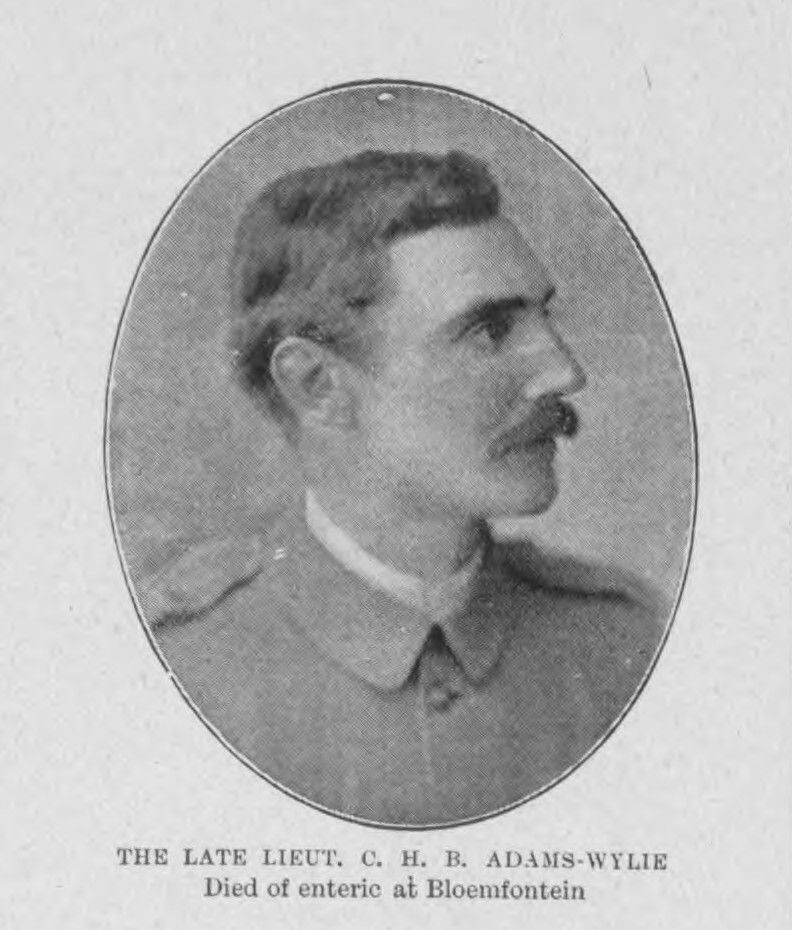
Charles Henry Benjamin Adams was born at Birmingham, England in 1870, studied medicine at the University of Edinburgh and subsequently at the Middlesex Hospital. Newly qualified he went to India and found himself at the General Plague Hospital in Pune (Poona) in 1897-98. Bubonic plague had reached India in 1896 and by 1897 was raging in Pune. In 1899 he returned to the UK to marry Lilian Oimara Wylie. Lilian (1878-1961) trained as a nurse at Edinburgh Royal Infirmary which may be where the couple met. She was the daughter of the late John Wylie of Wylie and Lochhead and, as a result of his marriage, Adams added Wylie to his surname. The couple returned to India where Adams Wylie was commissioned into the Indian Medical Service. They spent their time in Bombay vaccinating the poor against the plague until the start of the South African War when Wylie Adams volunteered as a sanitary worker at Bloemfontein and Lilian as a nurse in Capetown. Adams Wylie was buried in his father in law’s lair in the Glasgow Necropolis and his widow established the Adams Wylie Memorial Hospital for the poor of Bombay in 1902 in his memory.
John Duncan and family – continued
The story of this Duncan family is turning out to be a serial. I first mentioned them in Grave Matters 13 and subsequently in Grave Matters 27. Now a descendant of John Duncan and Agnes Erskine has contacted me from Australia and I can add more to the story.
In Grave Matters 27 I had managed to trace the family up to the 1861 census and confirmed the deaths of both parents within a month of each other in 1866. Thanks to new information I am now able to identify most of the surviving children in the 1871 census. John and Agnes married in Paisley in 1845 and their two eldest children were born there before the move to Glasgow. Some family obviously remained in Paisley as the youngest child, William Knox Duncan, is found living there with an aunt and uncle in both the 1871 and 1881 censuses. William seems to have remained in Paisley and his death is registered there in 1917.
Due to the early deaths of several children there was a gap of 12 years between William and his nearest sibling, Agnes, so she and her older brothers were all found working and in lodgings. Agnes, an 18 year old mill worker, had also found work and lodgings in Paisley. She married there and died in 1926. John and James Duncan were found boarding with the Rankine family in Glasgow. John gave his occupation as a plumber like his father before him and his younger brother described himself as a seaman. As a seaman James could easily have travelled far from Glasgow and no trace of him has been found after 1871. My Australian informant already knew quite a lot about Matthew, the eldest brother. They had placed Matthew in Cambusnethan, the parish in which Wishaw grew up. Matthew seems to have remained in north Lanarkshire where he married and died (in Shotts) in 1921.
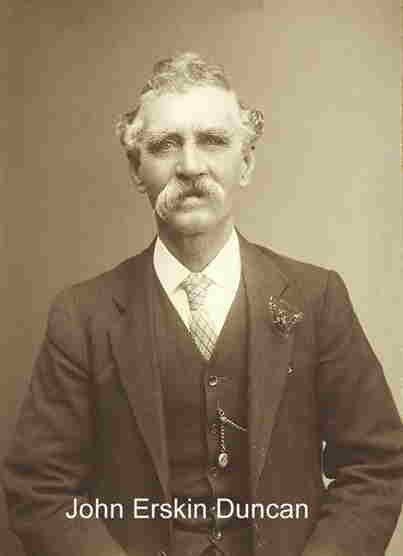
Image courtesy of Carol Duncan
The Australian connection is through John Duncan (1849-1935) who emigrated to Sydney in 1883 and was joined there in 1885 by his wife and children. John was a cooper and ship’s plumber working for Mort’s Dock and Engineering Company Limited in Balmain, Sydney. John Duncan, senior is referred to amongst his Australian descendants as John#1 and as the eldest son in each generation is named John they have now reached John#7.
New Profiles
Alexander MacKenzie (1813-1875)
The Alexander MacKenzie Monument in the Glasgow Necropolis
******************************
Anyone who would like to help indexing the Burial Registers is very welcome to join us by contacting me at at research@glasgownecropolis.org