The Alexander MacKenzie Monument in the Glasgow Necropolis
Its History and Restoration
By Gary Nisbet
Introduction
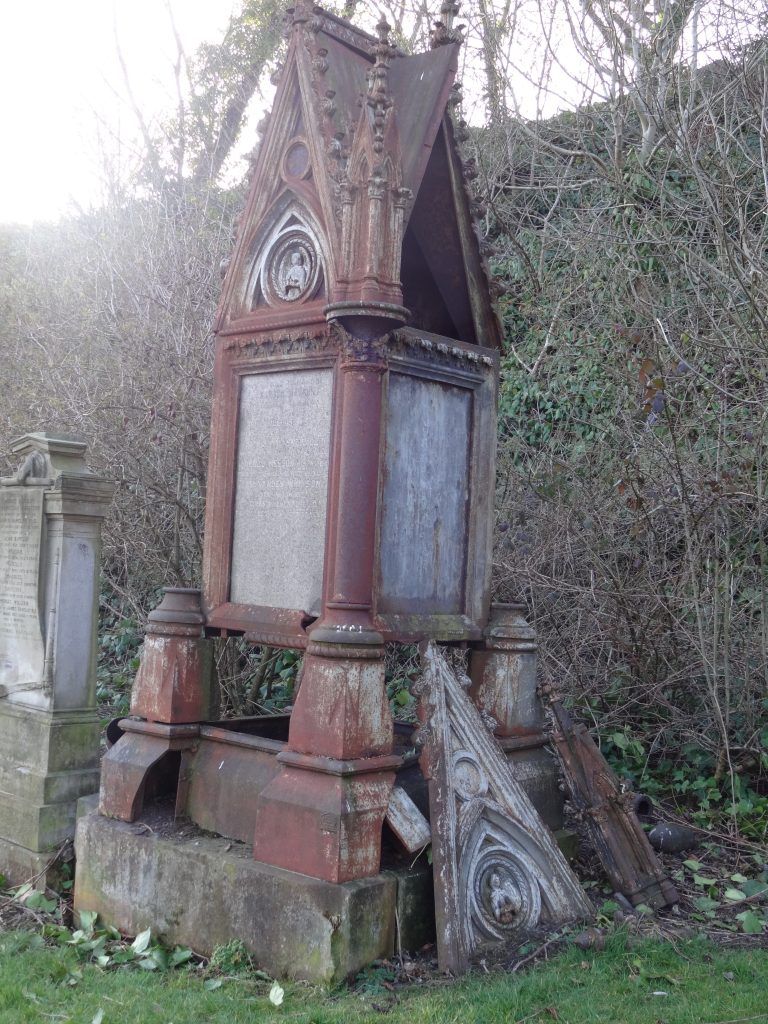
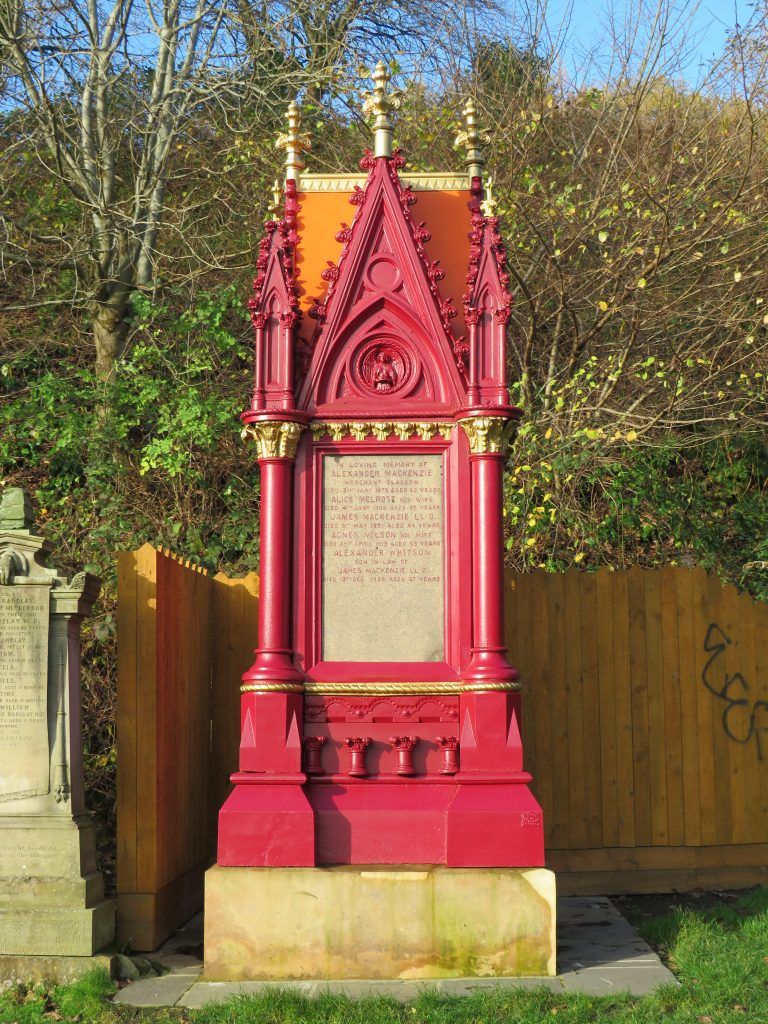
For many years there was an unsightly ruin in the Upsilon section of the Glasgow Necropolis. It was a cast iron monument that was falling to pieces and looked as if it would completely collapse if left to deteriorate any longer. It was the only cast iron monument to survive in the cemetery; all other monuments made in this material having disappeared long before they could be documented. These, however, were tiny compared to the one that survived them all and which now appeared to be about to join them in oblivion. This was the huge monument to Alexander MacKenzie (1813-1875) in Upsilon, lair 48, a Gothic tower which impressed by its dimensions and details even in its dilapidated state. And then, one day it disappeared, leaving behind only the square stone base that it stood upon, and the parts that had become detached from it strewn on the ground around it all cleared away as if it had never existed. It looked as if it had finally succumbed to old age and the safety concerns that it had presented while it was still there. However, having heeded these concerns and recognizing the historic importance of the monument, Glasgow City Council opted for its restoration, rather than destruction, and after seven years of absence, it was fully restored and reinstated on its stone base in 2025. It now presents one of the most spectacular sights in the Necropolis, with its once battered and shattered elements reassembled and coated in a new livery of vivid red, orange and gold paint.
To mark its return, we present an up-to-date, fully illustrated account of the monument’s history and restoration, which places it within the context of its time and reveals the connections which make it an object of great historic and cultural interest to the Necropolis and the city at large. In doing so we explore its links with its long-forgotten dedicatee and his recently discovered personal association with the makers of his monument, George Smith & Co.’s Sun Foundry, which was of the city’s greatest manufacturers of decorative cast iron work in the late 1800s, and whose other types of cast iron objects still survive in countless towns throughout the United Kingdom and across the world. The monument is a unique example of its type, innovative in its day for its use of cast iron, and remarkable today for its survival and rehabilitation. It is also the finest and most complete example of a large-scale Gothic monument in the Necropolis, and is an important landmark in the stylistic development of the cemetery’s architecture and sculpture. This article is based on an earlier Profile of Alexander MacKenzie published on the Friends of Glasgow Necropolis website, by James S. Mitchell, long before the monument’s restoration, and provides a conclusion to the process of documentation that he began for it. I am deeply indebted to James for making some of his information available for this present article. I am also indebted to Covanburn Contracts, and Megan Watson in particular, for the information they provided regarding their involvement in the monument’s restoration.
Alexander MacKenzie and the Sun Foundry
Alexander MacKenzie’s monument was erected soon after his death in 1875. Its inscription panel identifies him as a ‘merchant’ but does not specify what he traded in. According to the post office directories of the day, he had interests in two business connected with the decorative arts, the Sun Foundry being one, and the other was as a ‘manufacturer of art furniture.’ In the latter he was the owner of Alexander Mackenzie & Co., a long-forgotten firm specialising in producing wood products, such as parquet or wood mosaic flooring and venetian blinds, as well as being upholsterers, carvers and gilders, and carpet warehousemen and general house furnishers. This was his oldest and most profitable business concern. With its main office and showroom at 87 and 89 Buchanan Street, and a steam powered factory at 165 North Street to produce his clients’ orders, the firm was founded around 1842, when he was in partnership as McKenzie (sic) & Crawford at 89 Buchanan Street. It was almost lost in 1848 when a fire broke out in the building and would have engulfed it were it not for the prompt action taken to extinguish it. In later years, he and his son, Alexander junior, were the firm’s sole partners. As for his other main interest, he was a co-founder and financier of George Smith’s Sun Foundry, which was started in 1857 and became famous for its artistic products in cast iron. Highly successful and wealthy, Mackenzie was devoted to the foundry and was its main financier until it closed in 1899, through his financial assistance during economic crises and through the trust set up after his death to oversee his family’s interest in the firm. He was also a politician and became the city councillor for the Tenth Ward (Anderston and City) in 1873.
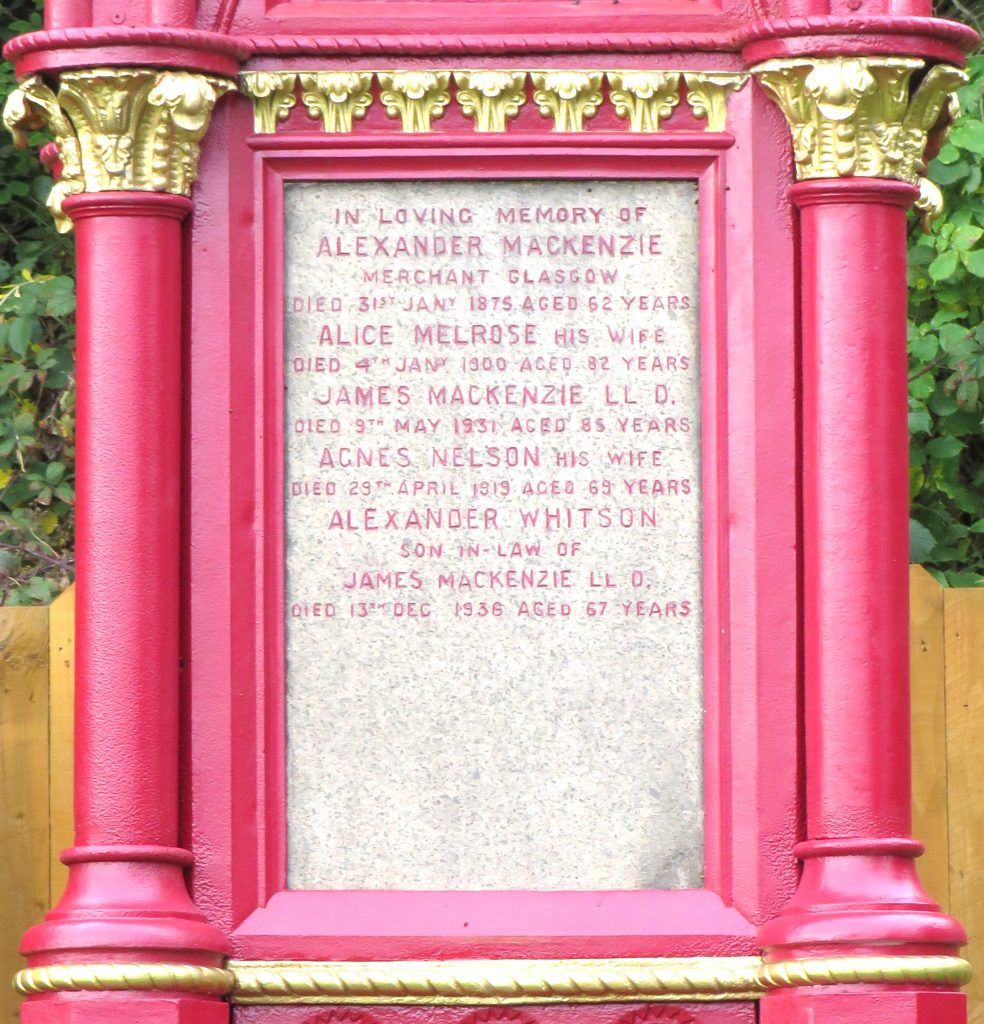
Mackenzie died on Sunday, 31 January 1875, aged 62 after a short illness, at his home at 8 Belhaven Terrace in Glasgow’s Great Western Road. His wife, Alice Melrose, also died at their home, but much later, on 4 January 1900, when she was 82. Their names are inscribed on the monument’s front panel, together with those of four other family members who were interred in the lair in subsequent years. These were his brother’s son, James Mackenzie, a lawyer by profession, who died aged 85, on 9 May 1931; his wife, Agnes Nelson, who died at her home, 3 Queen’s Gardens, Dowanhill, on 29 April 1919, aged 69; and their son-in-law, Alexander Whitson (also lawyer), who joined them on 13 December 1936. Whitson died in a nursing home in Glasgow at the age of 67 and appears to have been the last of the family interred under their splendid Gothic monument. Given that Alexander MacKenzie was a furniture maker, it might not be impertinent to notice that his monument does resemble somewhat an over-large and ornate wardrobe or cabinet.
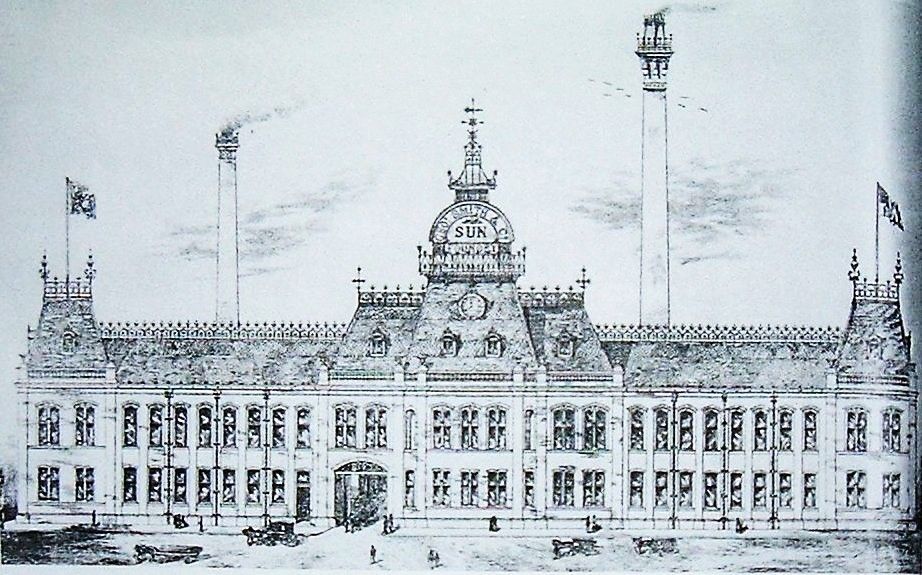
The monument was produced by George Smith & Co’s Sun Foundry in Townhead, in the north of Glasgow, which MacKenzie had co-founded with George Smith and other former employees of Walter Macfarlane’s Possilpark based Saracen Foundry in 1858. Originally based in Port Dundas, the Sun foundry moved to 280 Kennedy Street in 1870, where the façade of its newly built, grand headquarters was used to display many of the architectural castings that the foundry produced (illustrated above). Its address is usually noted as Parliamentary Road in its promotional material. Although the foundry buildings have long since been demolished, these types of castings can still be seen all over Glasgow, such as ornate railings, roof crestings, lamp standards and drain pipes, many of which, like MacKenzie’s monument itself, are inscribed with the foundry’s name as their maker. The firm advertised itself as ‘art metal workers, iron founders, bronze metalworkers, and sanitary engineers’ and had offices in most of the U.K.’s major cities, such as Edinburgh, Dublin and London. As fragile as its products as a business, the foundry narrowly survived the collapse of the City of Glasgow bank in 1878 and George Smith’s bankruptcy in 1886 with the assistance of MacKenzie’s money, and later relocated to Linwood, near Paisley, where it finally closed down in 1899.
Sun Foundry products:
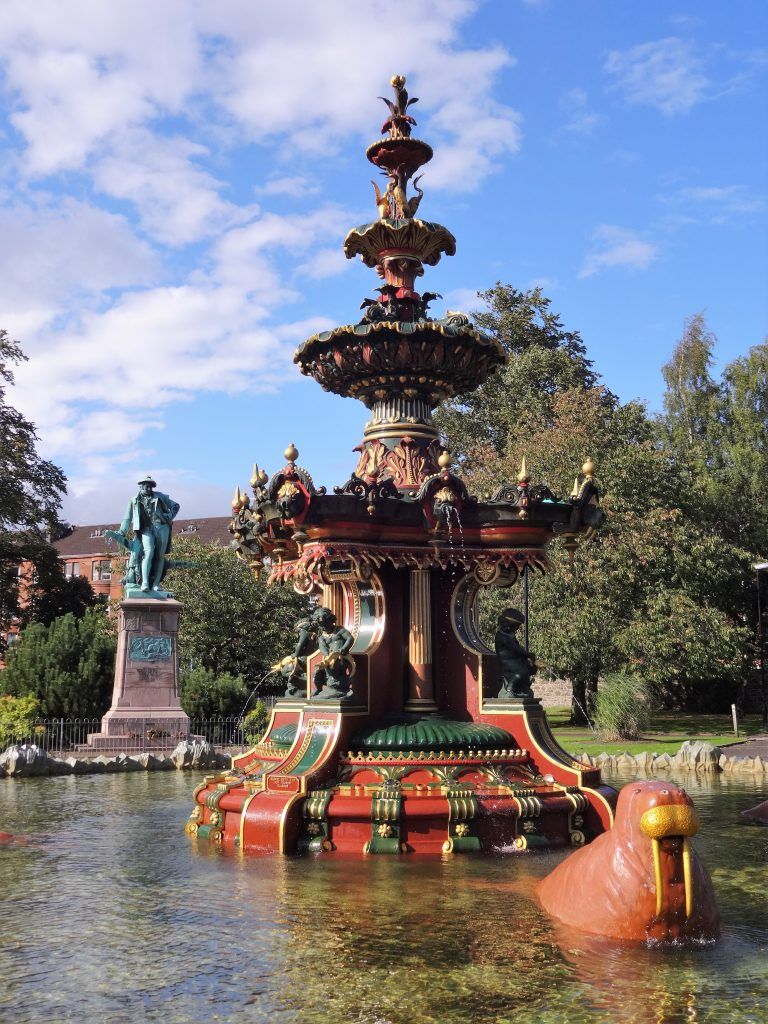
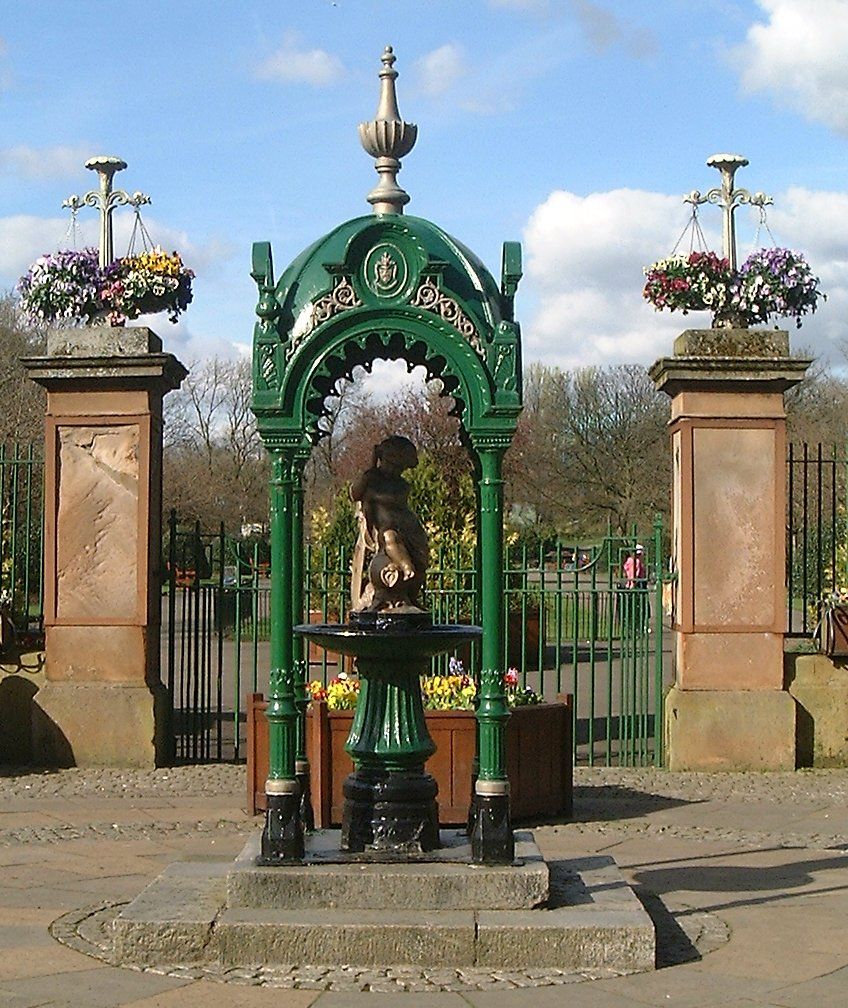
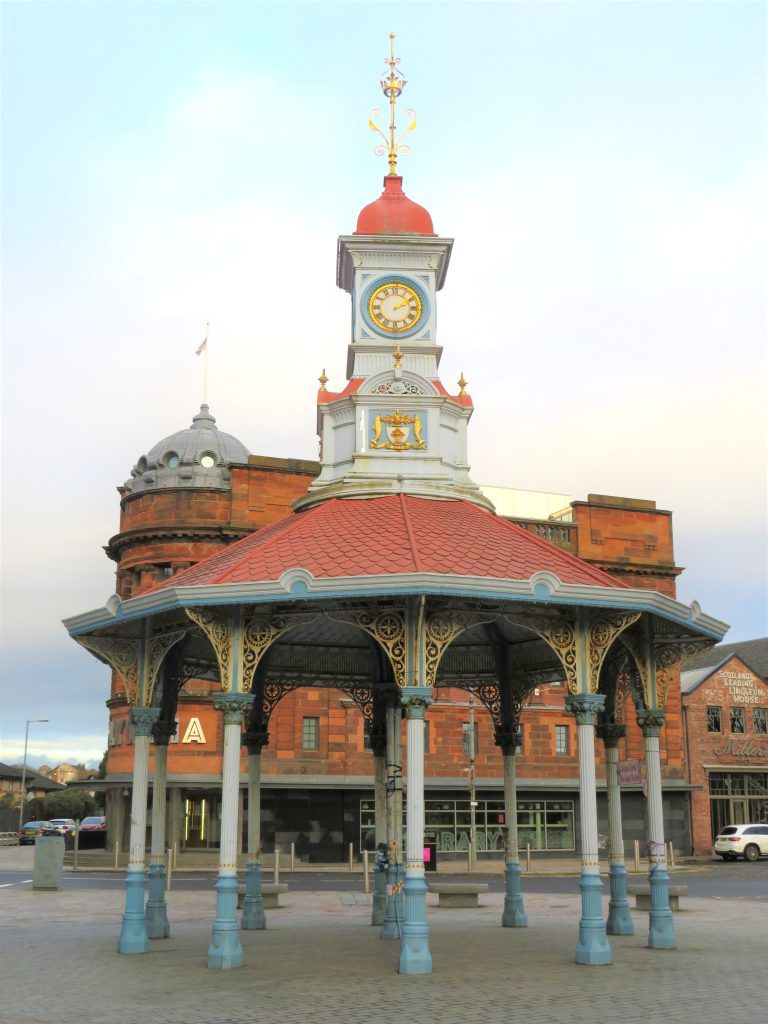
The foundry became famous for producing many of the distinctive, canopied drinking fountains that had appeared in Glasgow’s streets from 1858 onwards, and which would be reproduced all over the U.K., as well as other, larger-scale structures in Glasgow, such as the ornate canopied drinking fountain at the gates of Alexandra Park (c. 1870s-90s), the Bridgeton Cross Tramway Shelter (1875, known as the ‘Brigton Umbrella’), and the later and now long lost Gorbals Cross Clock Tower, which once stood at Gorbals Cross (1878, demolished 1929). They also produced the grand fountains in Fountain Gardens, Paisley (1868) and Dumfries High Street (1882), both of which have also recently been restored to their former glory. Due to the quality of its work and its international reputation, the foundry is recognised as one of the great names in Scotland’s industrial history; its surviving products now much sought after for preservation rather than destruction, and their rediscovery and restoration essential to our understanding of the complex cultural and aesthetic issues surrounding their creation when viewed from today’s cultural and historical perspectives.
Cast Iron Cemetery Monuments
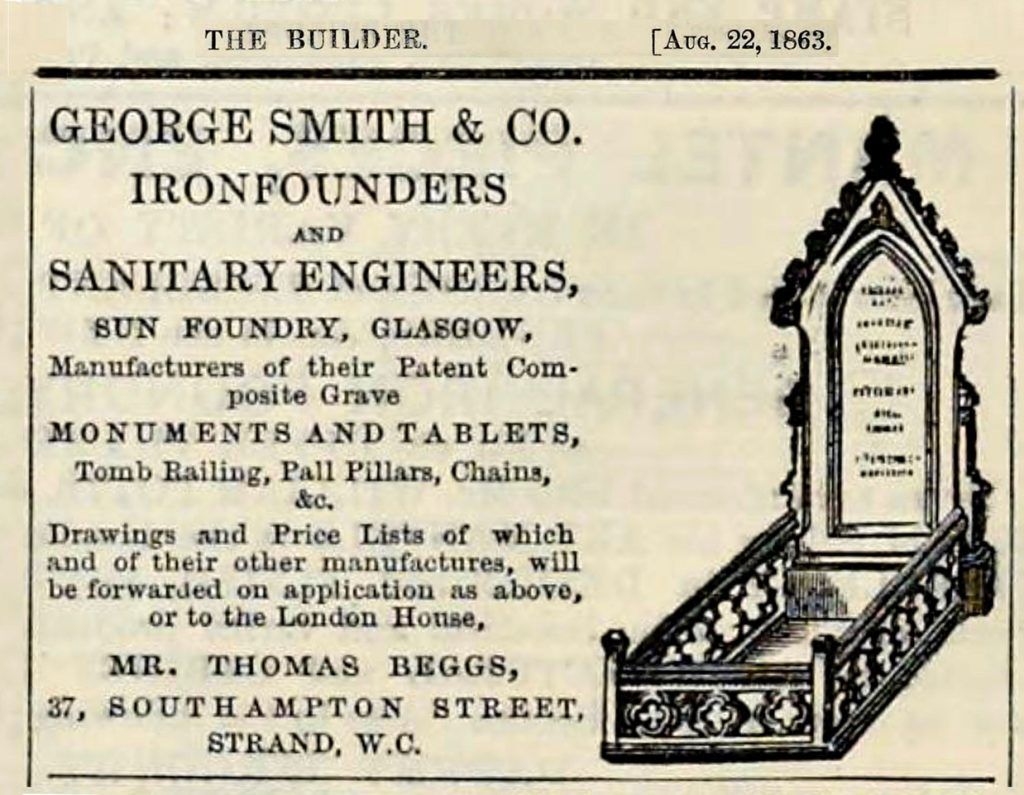
The Mackenzie monument allows us a glimpse into one side of the foundry activities that has generally been forgotten or overlooked, and that is its attempt to rival the city’s many long-established monumental sculptors as the makers of a new type of grave marker to challenge the supremacy of the more traditional marble, sandstone and granite employed by them. The city’s foundries would always be associated with its cemeteries, as they were the makers of the ornate iron screens or enclosures that surrounded their countless graves until they were all cleared away in the late 1900s, especially in the Necropolis, where there are now almost no examples left at all. Cast iron headstones, however, were a novelty. The Sun Foundry popularised the use of cast iron for mass-produced cemetery monuments in the 1860s, rekindling a short-lived fashion for them that had begun in the 1700s. These products ranged from small to large-scale monuments in a variety of designs, the most popular of which was a range of small, Gothic-style stele with stone or granite inscription panels enclosed within their framework. Many of these still survive in Scottish cemeteries but are generally always now in a badly rusted or ruinous condition, and are often anonymous due to the loss of their inscription panels through damage or their fading of their text from weathering. The stone panels themselves were usually supplied by local monumental sculptors, such as J. & G. Mossman, the most famous of them all in Glasgow, and who were quite aware themselves that cast iron monuments would never surpass stone and granite in popularity and durability; and that they were really just a passing fad rather than serious competition. In this they were correct, and it would appear that their popularity had run its course by in the mid-1890s.
Sun Foundry Cemetery Work:
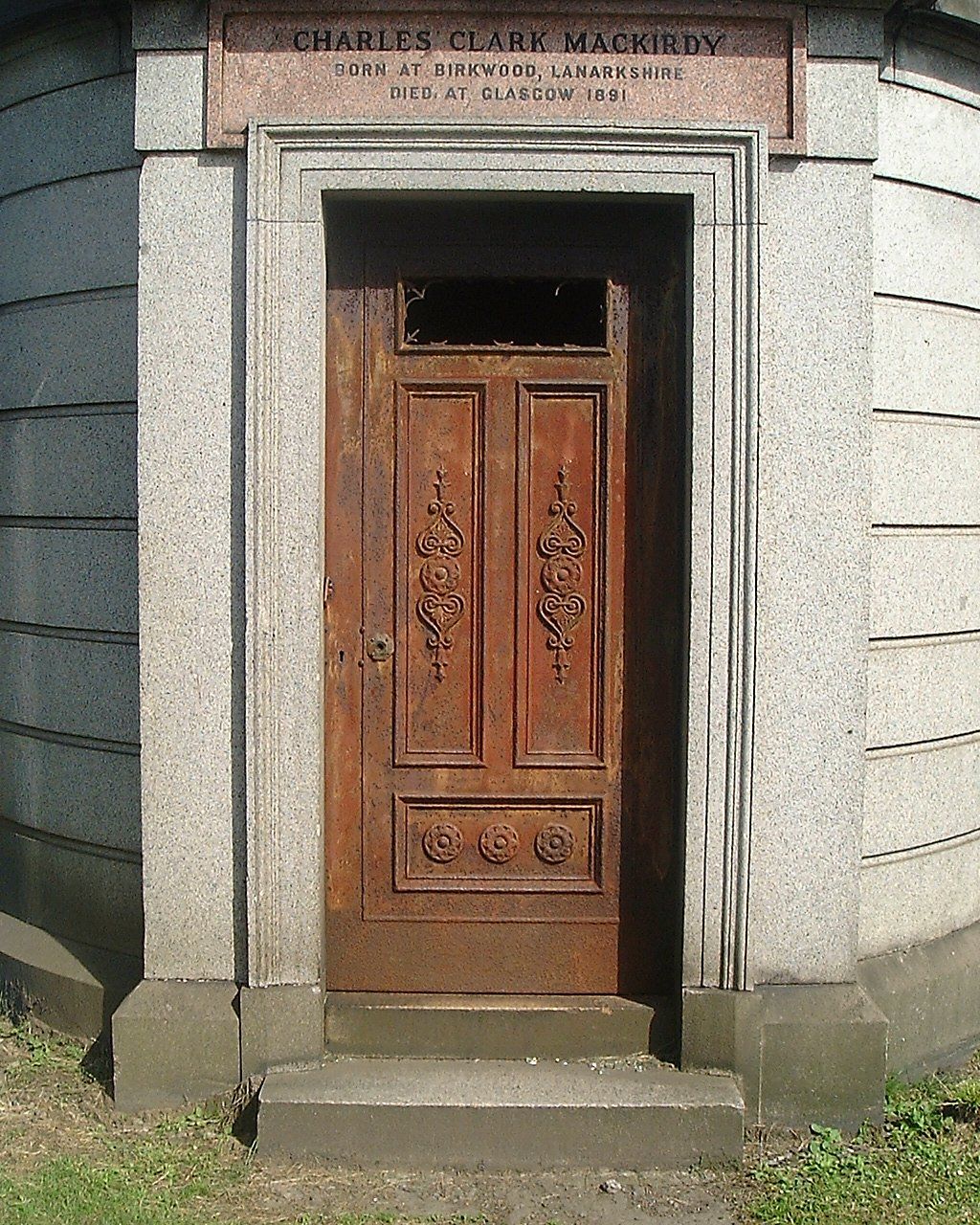
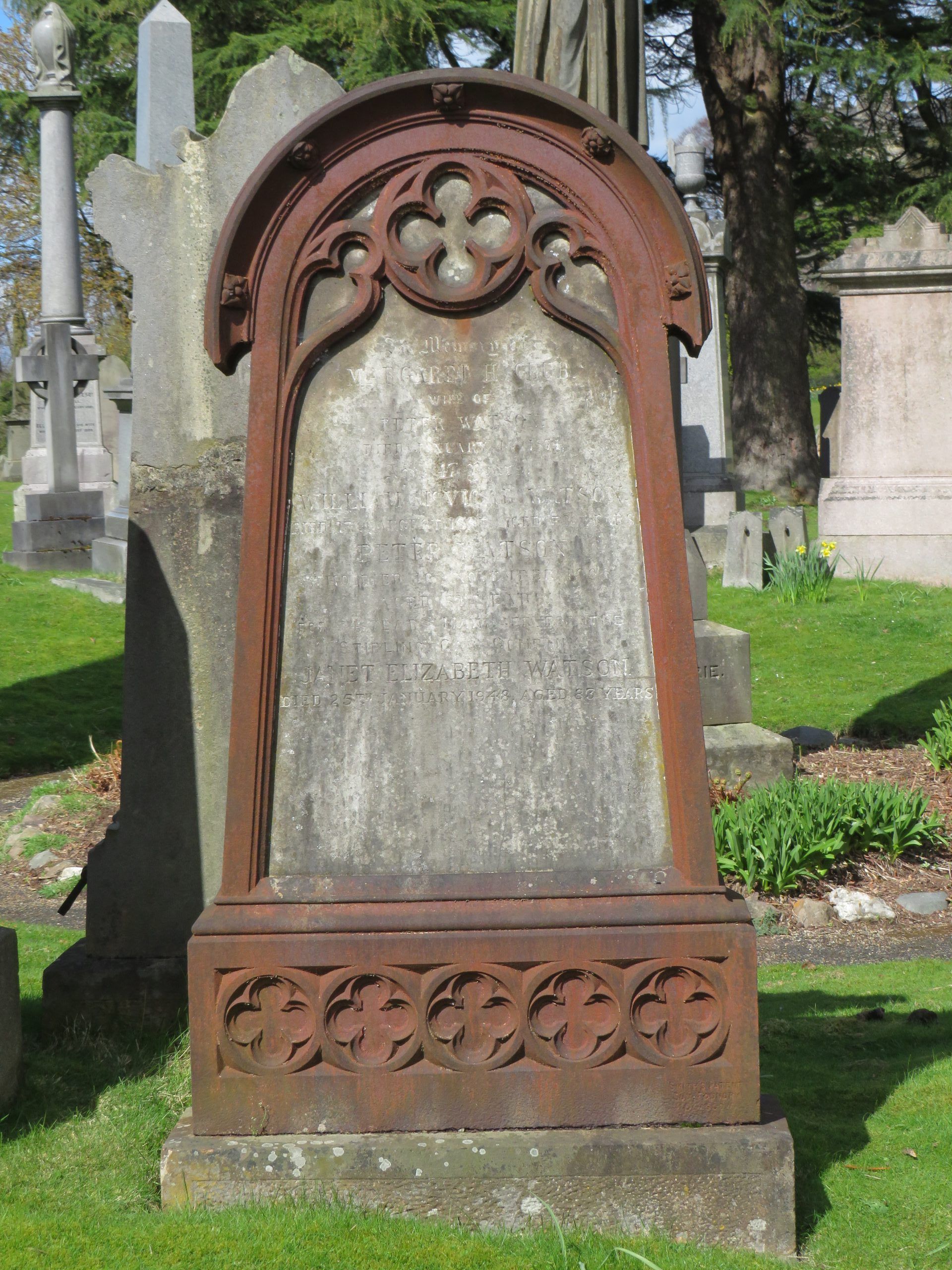
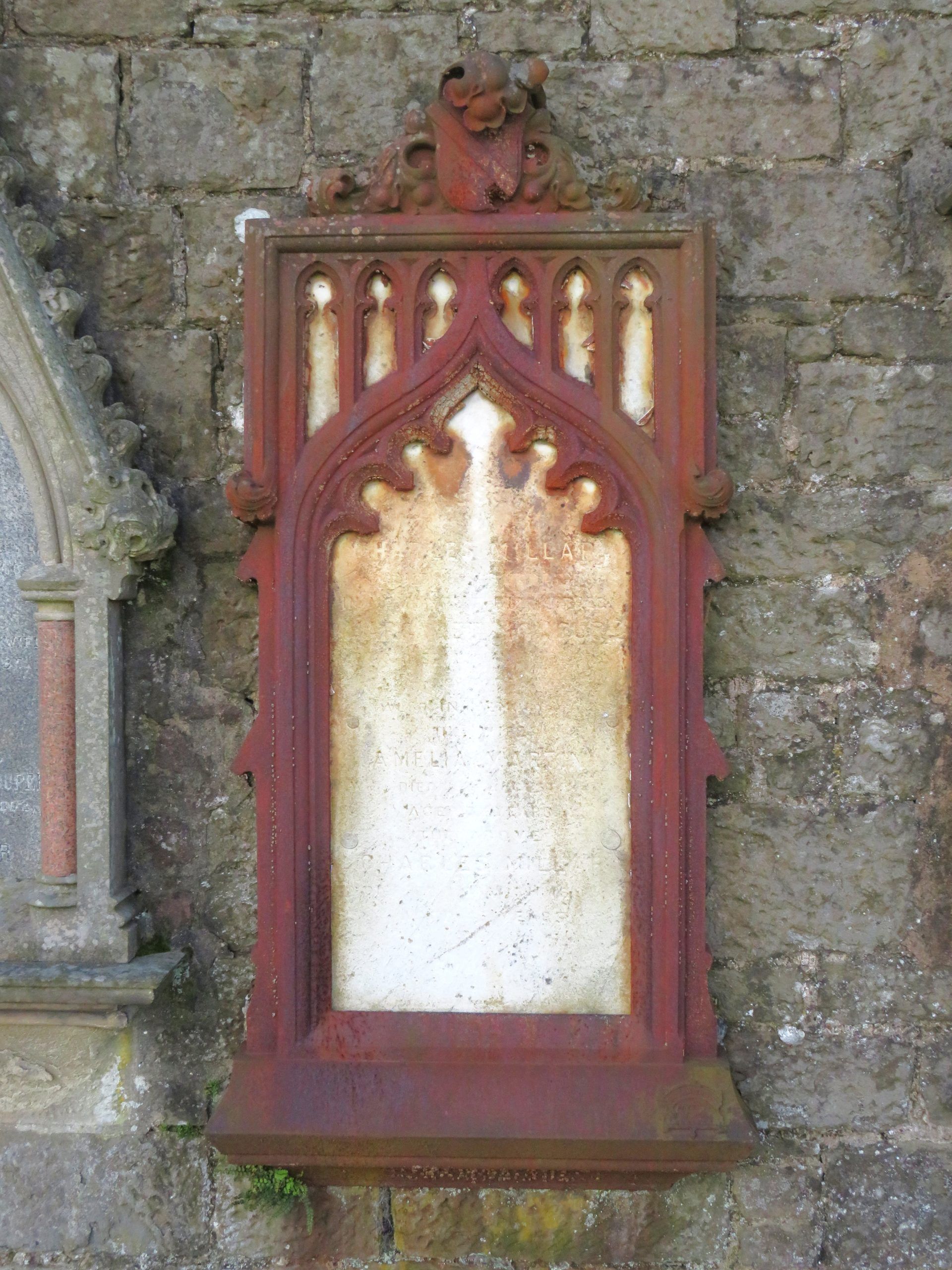
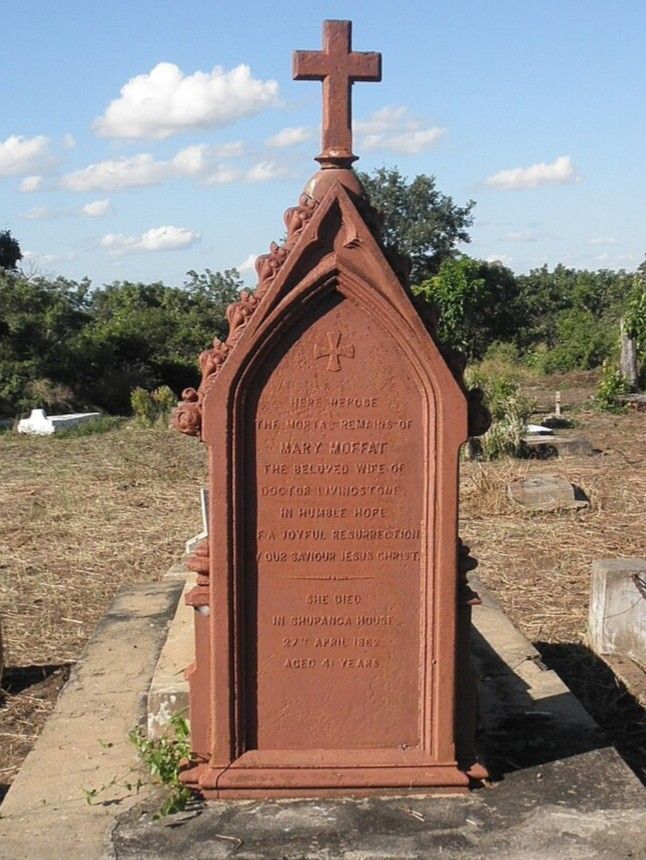
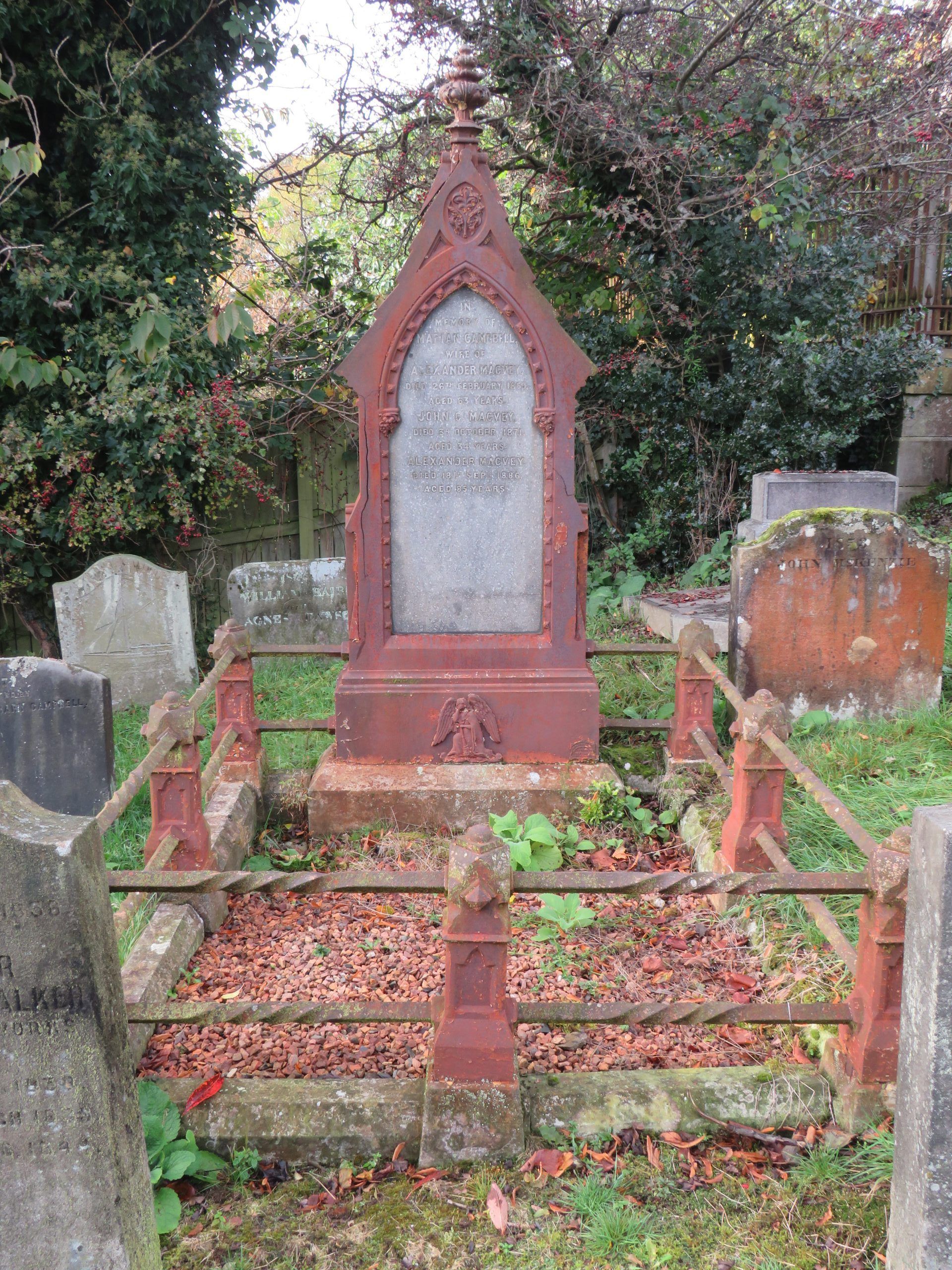
The earliest mention of these types of monuments in connection with the Necropolis dates from a press report in 1864, when one was erected in Woodside Cemetery in Paisley. The article noted that they were “now becoming pretty general in the Glasgow Necropolis and elsewhere”. One particularly interesting example ‘elsewhere’ is the monument over the grave of the explorer and missionary Mary Moffat Livingstone in Chupanga in Mozambique, which was personally ordered from the foundry by her husband Dr. David Livingstone, during a visit he made to its showroom in Glasgow in 1867. She had died of malaria in Chupanga in 1842, during her and her husband’s second Zambesi expedition. Illustrated below, the monument is a small, pointed Gothic stele, with the same type of crockets on its sloping upper half as those on the gables of the MacKenzie monument, although its finial was replaced with a Latin cross.
On a much larger scale, the foundry produced the design for the Alexander MacKenzie monument in the Necropolis, which could be described as colossal compared with the size of their other cemetery monuments.But even this was small compared with another, similar monument they produced for Sighthill Cemetery in Glasgow’s Springburn district. This was built by the Forrest family around the same time as MacKenzie’s monument in the mid-1870s (see discussion below). Another, more unusual example of the foundry’s cemetery structures is the iron and glass canopy enclosing the Wigton Martyrs’ Monument in Stirling’s Old Town Cemetery, which was added in 1867 by the Glasgow-based architect J.T. Rochead. Stirling also features some of the smaller, Gothic monuments produced by the Sun Foundry, and there is also a good selection of their wares in Larbert Old Church Burial Ground, the most notable example being the monument to Margaret Campbell, which is one of their finest surviving cemetery structures and compete with intricate ornament and its original grave enclosure (c. 1869).
An Unexpected Discovery
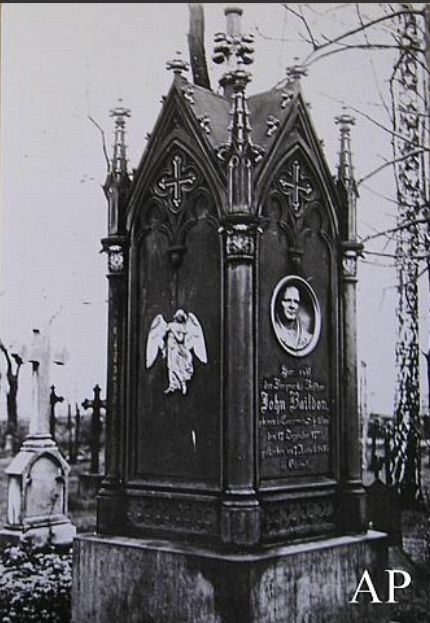
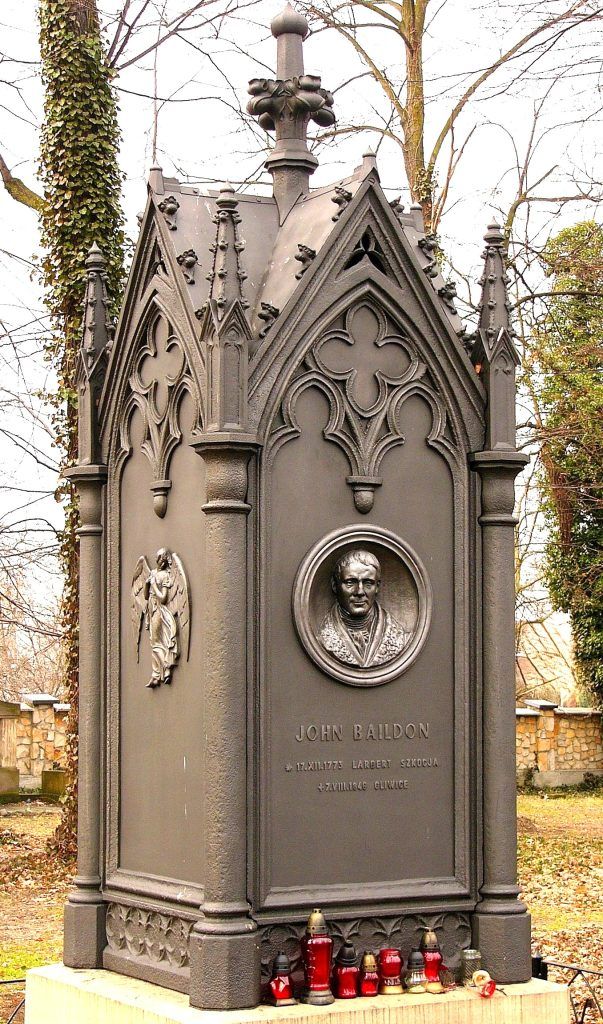
There is one cast iron cemetery monument outside Glasgow, however, that has only recently come to light and which might be one of the closest in form and style to the MacKenzie monument found so far, although it is a variation of it rather than an exact copy. There is also a strong chance that it was made by the Sun Foundry as well. This, surprisingly, is to be found in Poland rather than Scotland, although its roots are distinctly Scottish and, by an odd but perhaps significant coincidence, linked with Larbert and iron foundries and construction. Illustrated above, the monument commemorates John Baildon (1772-1846), the Larbert-born metallurgist and structural engineer, who is buried in the Hutniczy Cemetery in Gliwice in Poland (formerly Gleiwitz in Prussian Silesia). Baildon later built the first successful coke fuelled blast furnaces in Continental Europe and the Continent’s first cast iron bridge. Although attributed to the Gliwice iron foundry in recent years, the monument over his grave bears no maker’s name or construction date to confirm this attribution, and it appears have been based on Baildon’s connection with the foundry rather than any documentary evidence to confirm them as its makers.
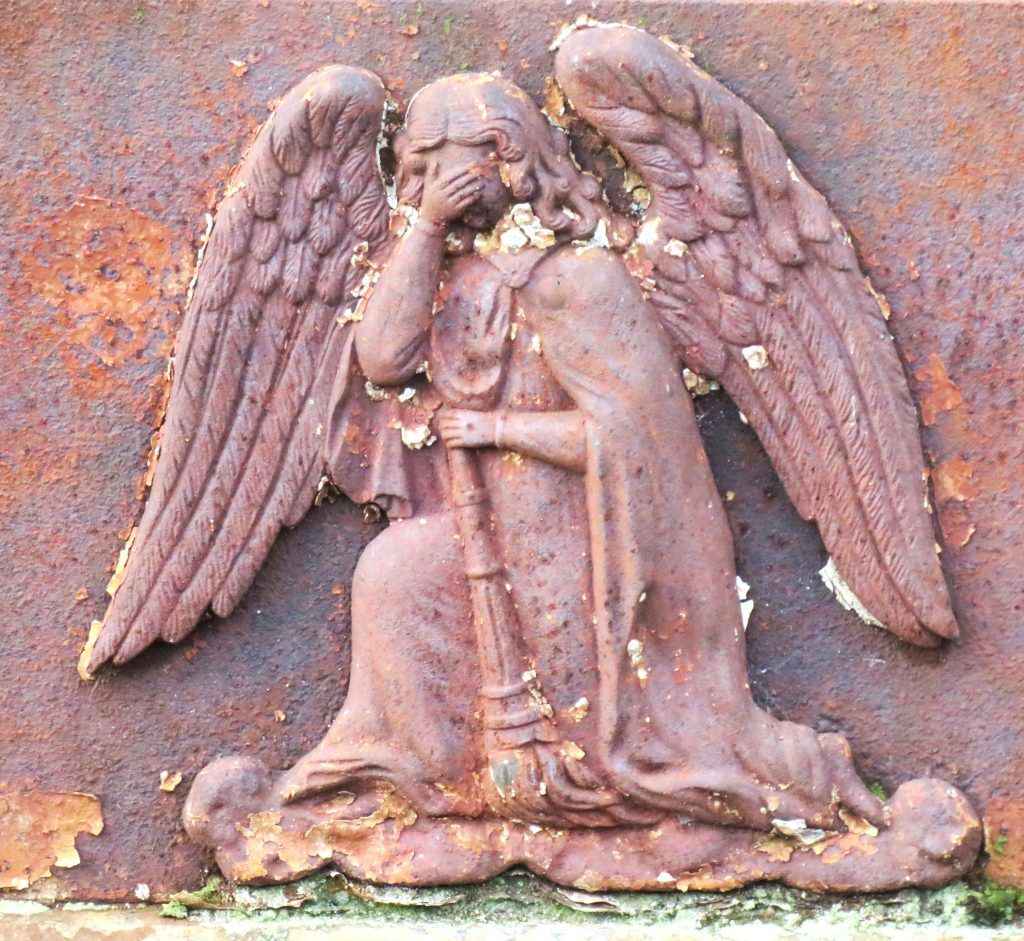
A Sun Foundry angel in Larbert
However, given Baildon’s links with Larbert, with its numerous Sun Foundry grave markers, and the Baildon monument’s striking resemblance to the MacKenzie monument in Glasgow, one can only wonder if the Baildon version was indeed made by the Sun Foundry and that it is a possible precursor to the MacKenzie monument, or contemporary with it. There appears to be no date for the Baildon monument’s manufacture or unveiling, but it certainly dates from after his death year, 1846. There is also a possibility that the monument’s sculpted portrait was modelled by D.W. Stevenson of Edinburgh, who produced many roundel portraits of this kind for cemetery and public monuments throughout his long career. It is typical of his work and, together with the frieze of quatrefoil motifs around the monument’s base, and the profusion of other Gothic details around its superstructure, including angel mouldings, all of which are typical of the Sun Foundry’s patterns, it is tempting to suggest that the monument’s true origins lie closer to Baildon’s birth place rather than his burial place.
The Baildon monument has also recently been rebuilt and is a modern, simplified copy of the original monument, which was badly damaged by in the 1920s and eventually scrapped. Now coated over all in grey paint, it appears to have been far more brightly presented in the past, with its ornamental details picked-out in light shades, as can be seen in the monochrome archive image of the monument reproduced above. The modern comparison shot of the MacKenzie monument also reveals that both monuments stand on very similar blond sandstone plinths, the Polish version having become sunk lower in the ground over time. Whilst the true identity of the monument’s makers will probably never be confirmed, it is, nevertheless, an intriguing object, and one for which an attribution to the Sun Foundry might be the most reliable so far. However, it is to Springburn in Glasgow that we must turn to find evidence of the one structure that is the most closely related to the MacKenzie monument in form and style that has ever been found.
A MacKenzie Double
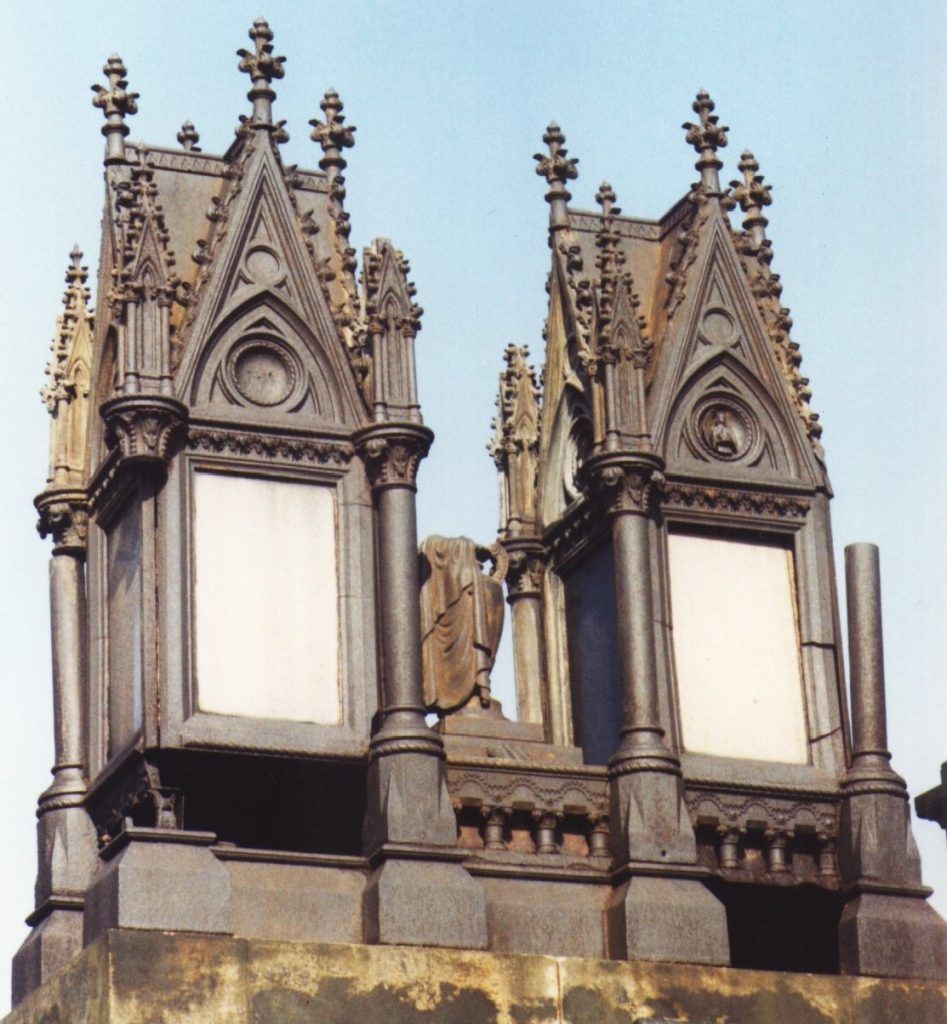
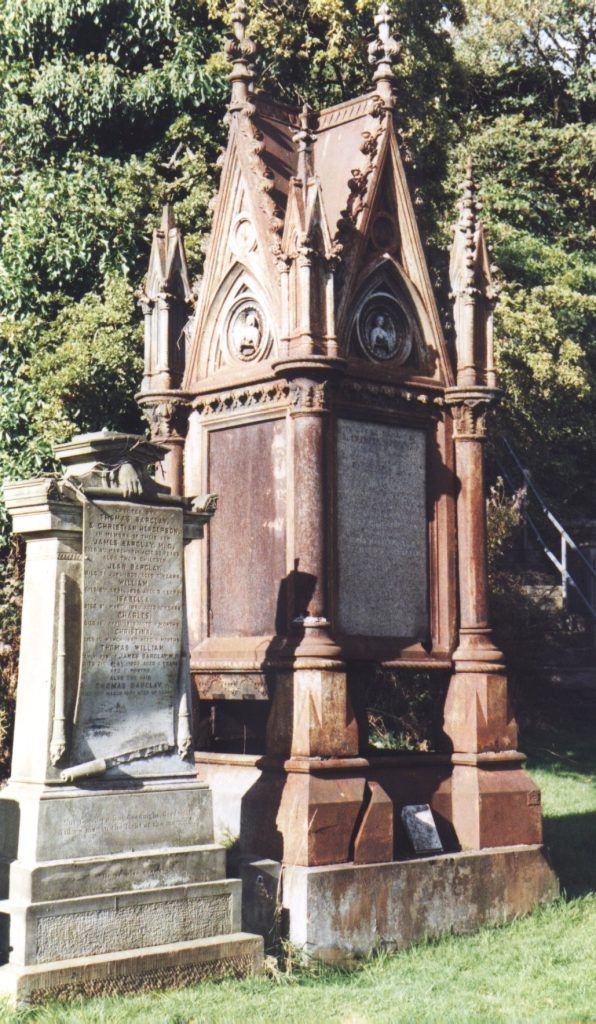
As already mentioned, the Mackenzie monument was not entirely unique, as there was also a much larger version of it built around the same time as it was for Sighthill Cemetery. This was commissioned by the Forrest family, about whom nothing is known. As can be seen in the images above, it is clear that both monuments were made from the same patterns, the most significant difference between them being their overall size and the manner in which they were used. The Forrest monument was double the size and comprised two versions of the MacKenzie monument linked together on a wide stone base and with a huge cast iron urn between them to separate them into single units, or pavilions. Unfortunately, the Forrest monument no-longer exists, having succumbed to the same issues of deterioration and public safety that had threatened the MacKenzie monument, and which resulted in its demolition a few decades ago.
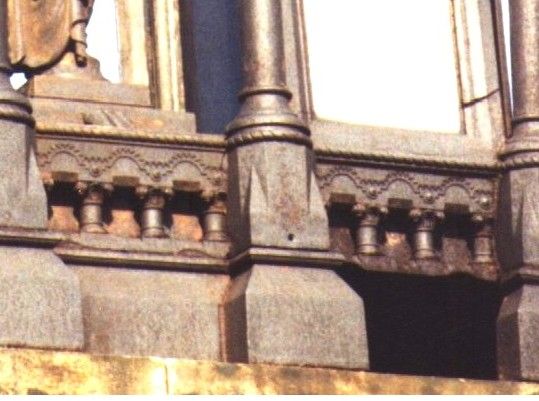
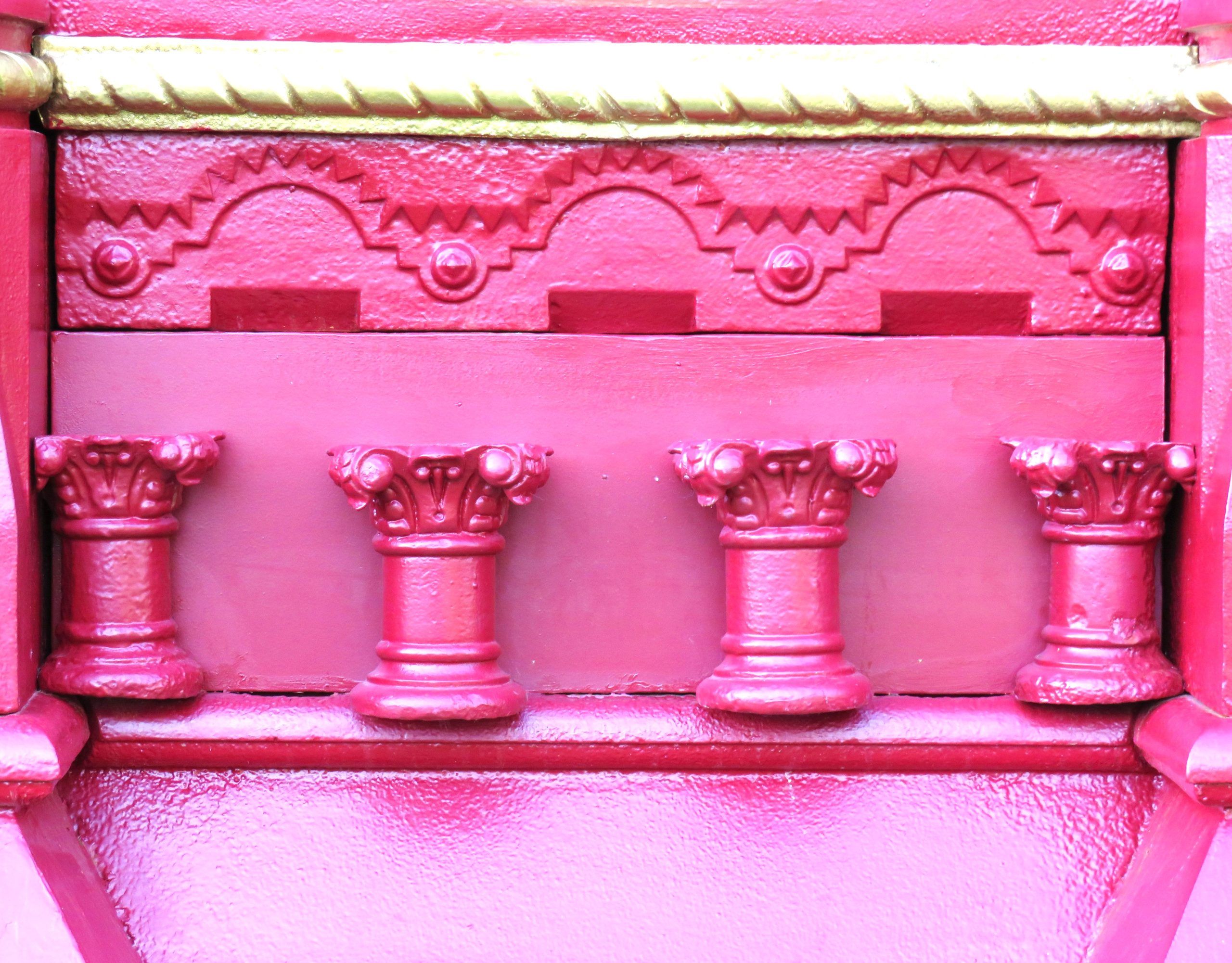
The photograph of the Forrest monument was taken by the author around 1985, by which time it was already falling apart and any thought of its restoration would have been inconceivable. One important detail that it managed to record before being lost was the arcade of dwarf columns and decoration that ran around the monument’s lower half and which were also a feature on the MacKenzie monument. As can be seen in the images below, the columns were in groups of four and placed directly below overhanging sections decorated with an undulating motif, rather than as they are now on the restored MacKenzie monument, where they are detached and no longer joined directly to the underside of the decorated section above it. There were three other gallery sections which have not been reproduced on the restored Mackenzie monument, although the wavy motif itself has been repeated. As a result of the Forrest monument’s disappearance, the MacKenzie monument now appears to be the only known surviving example of its type in the country.
The name of the designer of the Mackenzie monument is unfortunately not recorded, together with the other vital information required to piece is construction history together, such as its pattern number, cost and date of erecting, and its original livery. There are also no illustrations of this type of monument in the foundry’s surviving trade catalogues, which are the go-to primary sources for all illustrations and information on the firm’s products, large or small, decorative or utilitarian. This suggests perhaps that the design might not have been popular or retained for long among their repertoire of products, and it would seem from its non-existence elsewhere that the Mackenzie monument was the only example of its type to be built anywhere in this form.
Whilst it is tempting to attribute the design to J.T. Rochead as one important architect associated with the foundry’s products, there were other designers around, such as James Boucher, John Burnet and James Sellars, who also designed patterns for the Sun Foundry and others, such as Walter Macfarlane’s Saracen Foundry, and who might also have been responsible for designing the MacKenzie and Forrest monuments. There is also the possibility that it was designed by someone on the foundry’s own staff, and that could have been, for all we know, Alexander MacKenzie himself. However, it is sufficient to say that the origins of its general form and decoration had been known for centuries, in that it is based on Medieval ecclesiastical structures built in the Gothic style re-popularised in the mid-1800s by the English architects A.W.N. Pugin, Sir Charles Barry and Sir George Gilbert Scott. It was a style that never gained much popularity for public buildings in Glasgow, but was often employed for smaller structures like churches, houses and cemetery monuments.
The Gothic Style in the Glasgow Necropolis
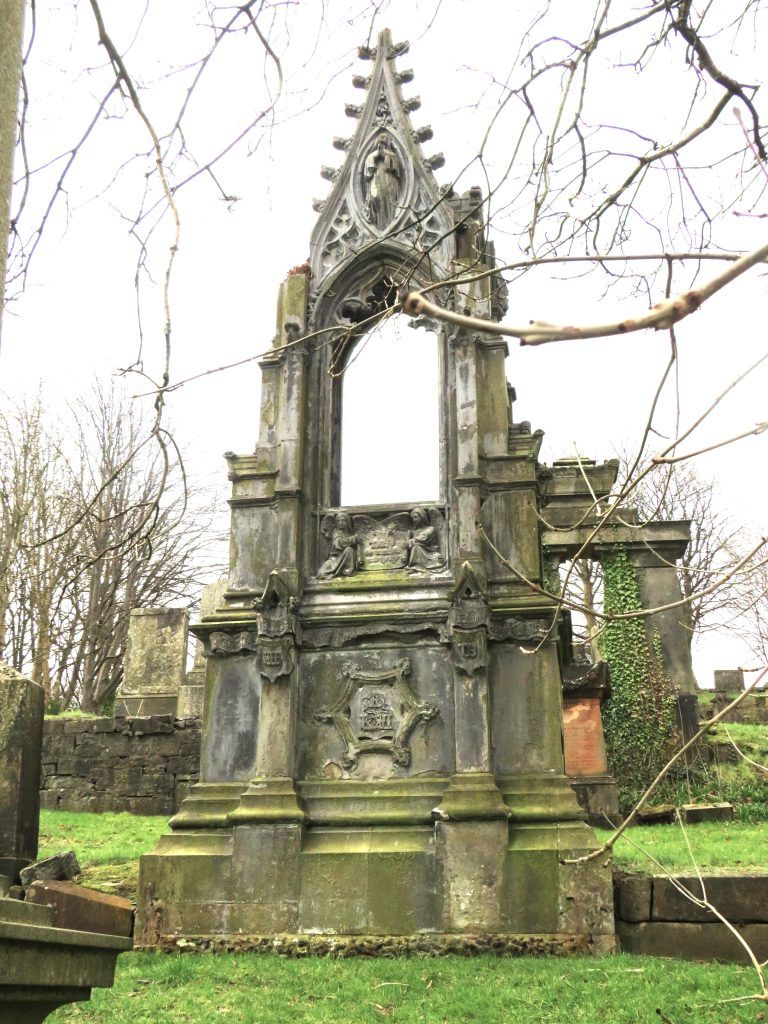
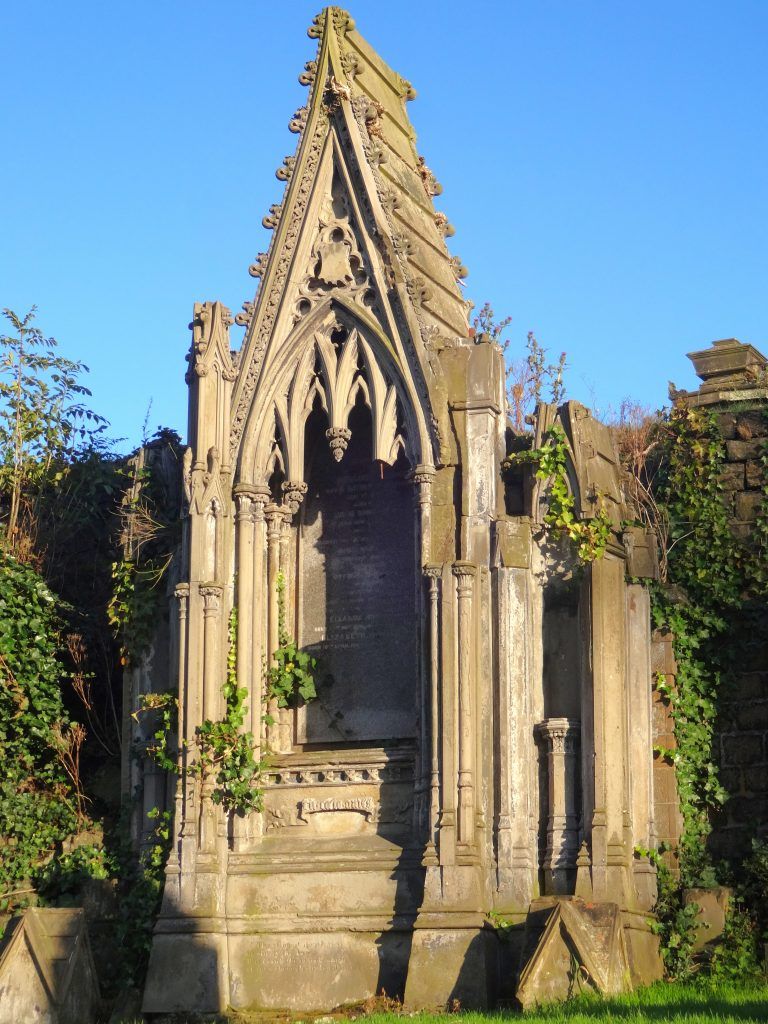
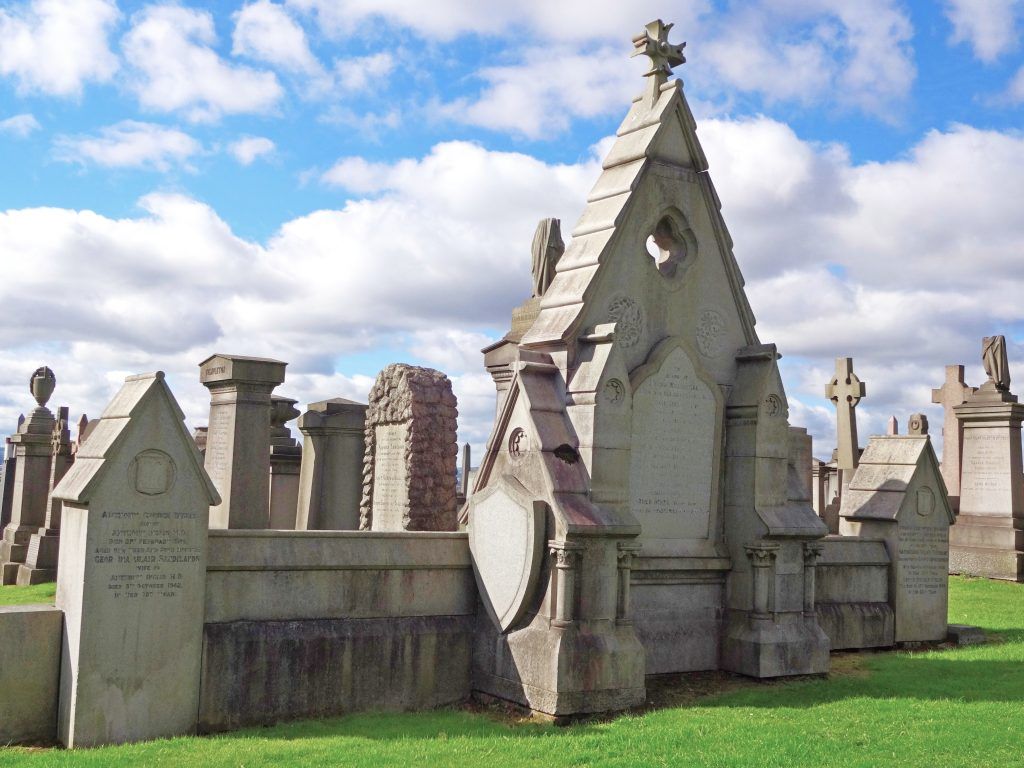
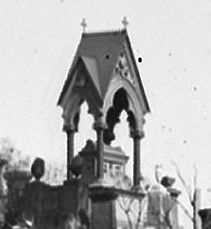
The majority of the monuments in the Necropolis are Classical, Renaissance or Celtic in style, with all the different variations of them in-between, but there are also many notable Gothic examples which tend to be overlooked today because of their dilapidated condition and lack of celebrity. Most of these predate MacKenzie’s monument and confirm that the style’s use for large-scale monuments had a relatively brief period of popularity between the 1840s and 1880s. The first important example is the Anne Lockhart monument in Delta, which was built in stone with a profusion of crocketed pinnacles and spires that are now sadly lost. Built in 1845, such was the scale and complexity of its Gothic design that it was discussed in the press and achieved its own fame as one of the cemetery’s earliest ‘must see’ monuments. Other major examples include the Margaret Montgomerie monument in Gamma, of 1847, which has also suffered serious damage and loss through time; and the Rev. William Black monument of 1857, in Omega, which lost its once splendidly painted Gothic canopy as a safety precaution in the 1870s. It would seem that the most vulnerable parts of these monuments were the crocketed spires and sculpted figures that adorned them, and their fate would also be shared by those on the MacKenzie monument, although with a more positive outcome.
The MacKenzie monument was a relatively late example of the Gothic style’s use in the Necropolis, and its metal fabric unusual for such a large, ornate structure. It contrasts sharply with the last of the large-scale Gothic monuments erected in the cemetery: the Hamish Inglis monument of c. 1883 in Epsilon, which was built in granite without any fancy and vulnerable embellishments. Perhaps one reason for the style’s lack of continuing popularity for large-scale monuments in the Necropolis was the fact that they were very expensive to produce and maintain, and the cost of employing noted architects, sculptors or foundries to design, carve or cast them being a niche activity that only the wealthiest patrons like Alexander MacKenzie could afford to pursue. The main reason for its lack of popularity, however, was the change in public taste for Gothic design in preference for the ‘classic’ styles that had previously dominated Scottish monumental sculpture, and the huge rise in demand for Celtic crosses carved in granite that grew from the 1860s onwards. By the time MacKenzie’s Gothic fantasy was built in the mid-1870s, the novelty of erecting unusual monuments of its kind was also no longer of any great interest to the press and public for its own sake, and it would seem that it was erected without anyone noticing or commenting on it.
A Close Encounter
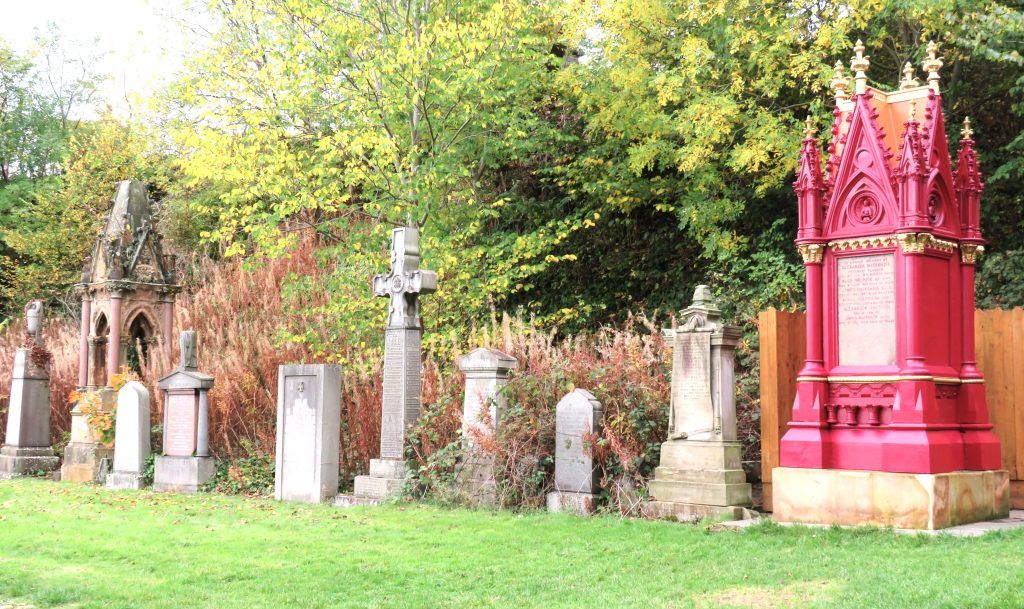
There is one Gothic monument in the cemetery, however, which has not been mentioned so far and which might be regarded as being not only the nearest in style and form to Mackenzie’s monument, but might also have had some influence on its choice of style and location. This is large-scale, stone structure that can be seen at the far left of the image above and which just happens to stand in the same row as MacKenzie’s, which is at the extreme right. With seven or so other monuments between them, the two Gothic towers appear to have been configured as elaborate bookends, as if by intent rather than coincidence. The stone monument was built around 1865, over the grave of Rosina Hunter, the wife of Thomas Dunlop of Dunlop, and possibly influenced the design of the Mackenzie monument produced in cast iron a decade later.
Comparison shots of the MacKenzie and Dunlop monuments:
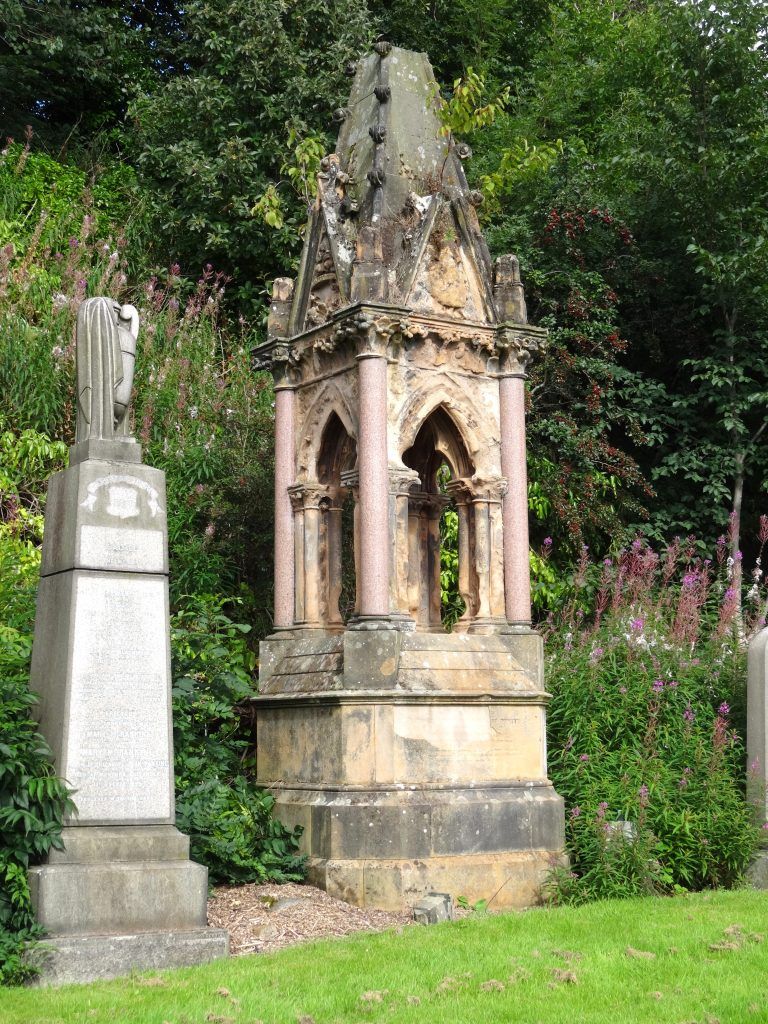
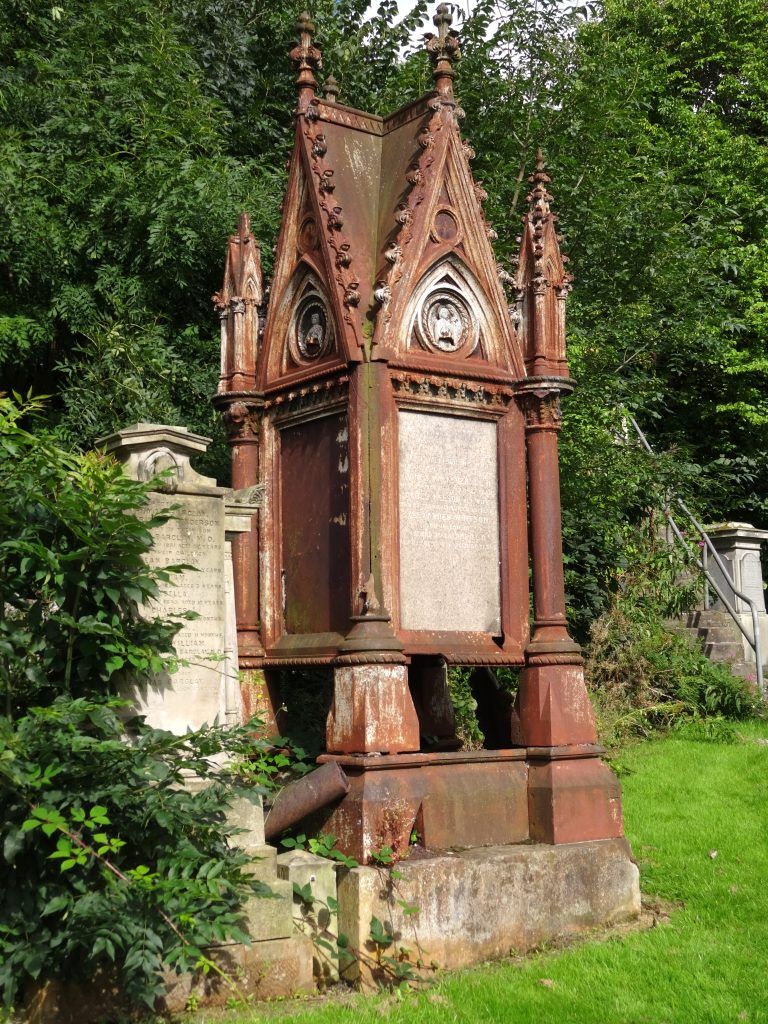
The similarities between the two monuments are striking when viewed from afar, but on closer inspection their differences are more obvious, such as the open sides of the stone-built monument, its more elaborate but now badly weathered carverwork, and the single spire that rises from its roof. Its similarities, of course, are in their shared style and basic architectural form, together with the extensive use of stiff-leaf moulding and sculpted gables. On the stone monument these contain heraldic shields, floral motifs and ribbons with Biblical quotes across them, rather than the single angels holding crowns modelled for MacKenzie’s monument. The most obvious difference between the monuments is in the material they were built from, with blonde sandstone and red granite used for one and cast iron for its near neighbour. In a way, the latter might be regarded as proof that, as MacKenzie and the Sun Foundry were always keen to inform their clients, anything architectural and ornate in stone could also be built in cast iron and be even more eye-catching. In this, the Mackenzie monument could also be regarded as a three-dimensional advert for their products, and no different in this sense from any of the other large or small-scale structures that carry their trade mark.
The Mackenzie Monument and its Restoration
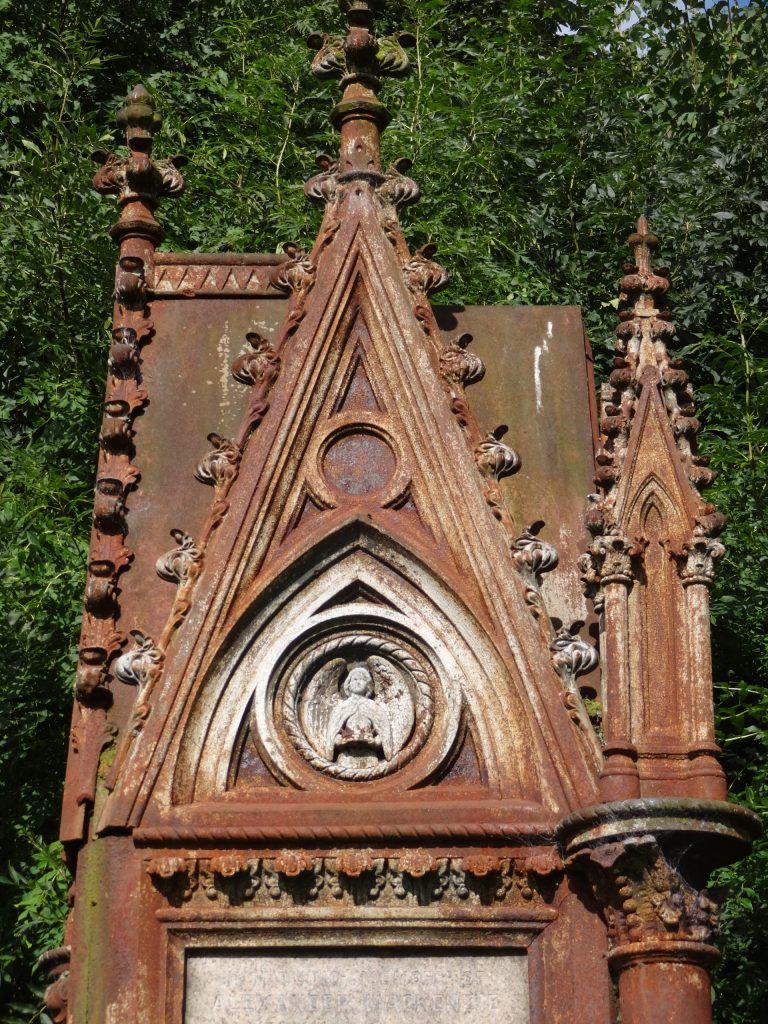
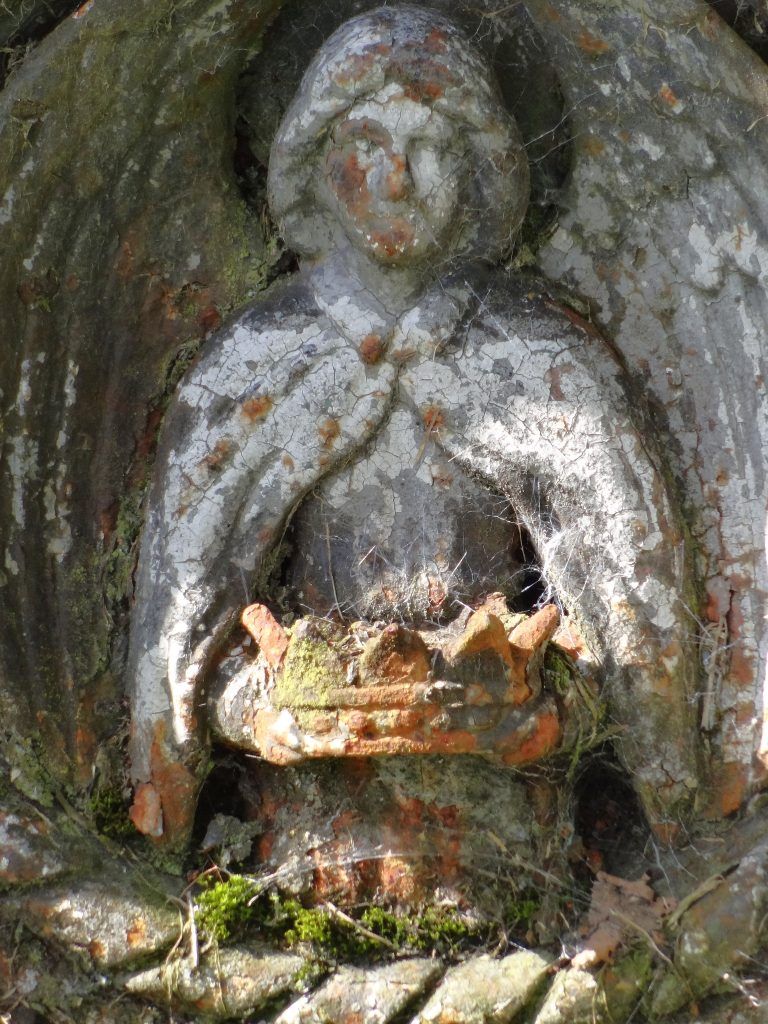
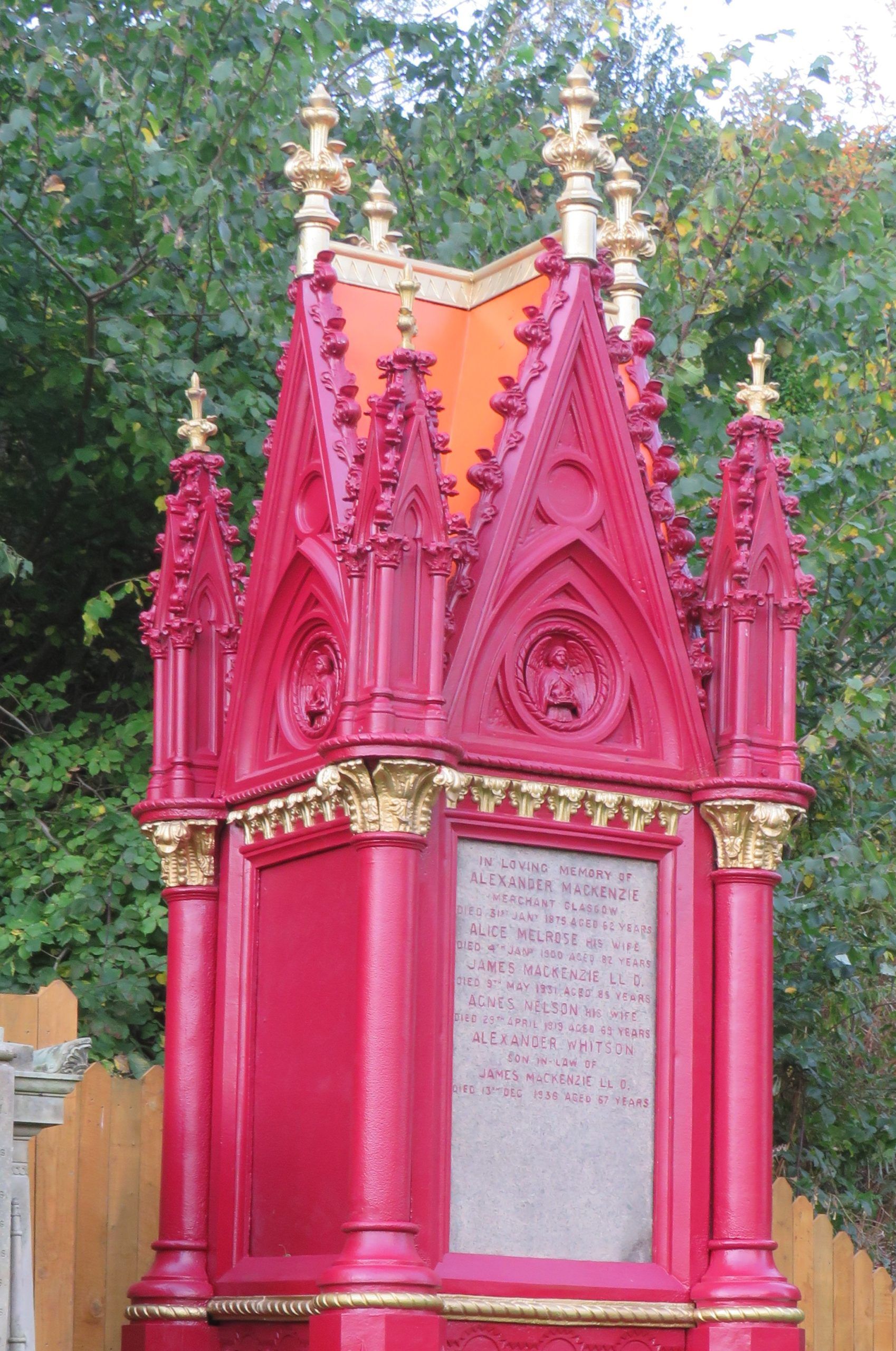
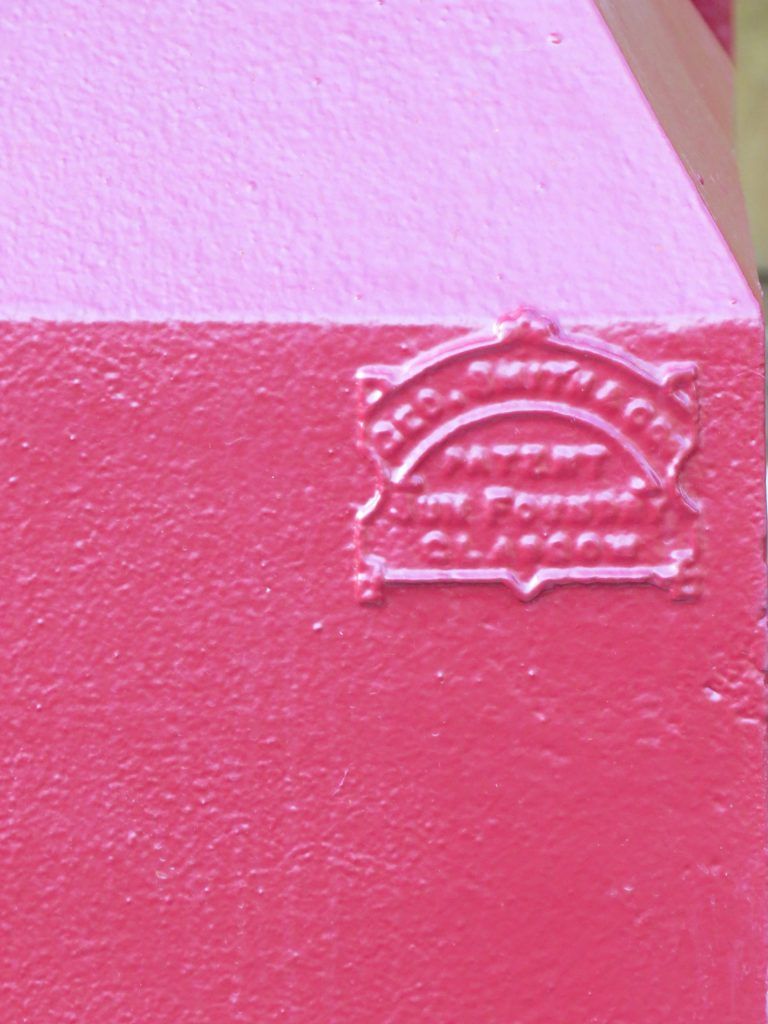
The MacKenzie monument itself is in the form of a Medieval reliquary, typical of the 1400s, which were built in cathedrals and churches to house a particularly sacred relic, such as part of the cross that Christ was crucified on, or a saint’s finger nail, and were generally highly ornate, often beneath a crocketed and gabled canopy supported on slender columns with stiff-leaf capitals, and adorned with carved angels or other religious motifs, just exactly as contrived for MacKenzie’s tomb in the Necropolis. It is square in plan and stands 4.2m tall, (around 14ft) with its four sides containing grey-granite inscription panels, only one of which survives on its front. These are enclosed by slender columns which support its crown-like, cruciform roof, which is fronted by pointed gables with flame-like crockets and finials. The gables contain the monument’s only sculptural details, which are the half-length angels holding a crown in the roundels at their centre. Other distinctive features include a row of dwarf columns below the inscription panel, a string course of rope moulding around the lower half of the monument, and a frieze of acanthus leaf which extends around its four sides above the inscription panels. At the lower left front corner is a small shield embossed with the name of the monument’s manufacturer:
Geo. Smith & Co. Patent. Sun Foundry Glasgow.
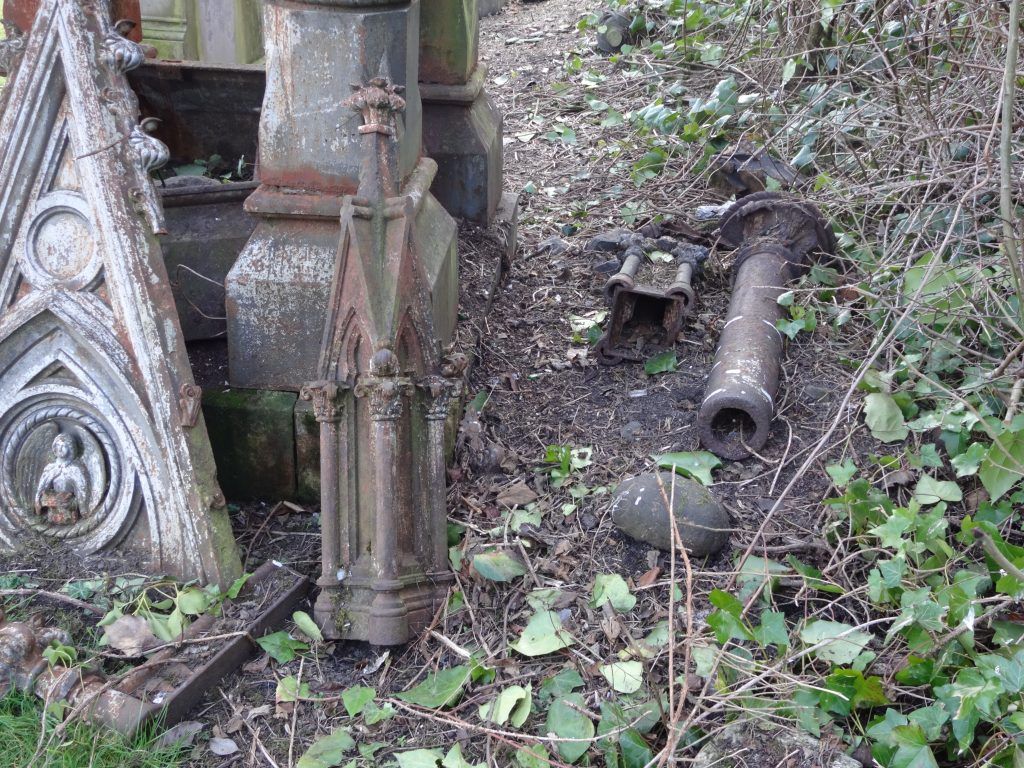
The monument’s slow decline into ruin and obscurity began long ago, further back in time than anyone alive today can probably remember, and it would appear that the monument itself had never caught the eye of a passing photographer or historian at any time before this, when it was completely intact. Its obscurity was also partly due to its remote location in a part of the cemetery that is well out of the way from the main sights and monuments that the Necropolis is better known for on its west side and upper levels, and where it had once stood virtually invisible amongst is neighbours and shrouded with ivy for generations. The only remarkable thing about it at that time was its ruinous condition, and this could only have had a negative effect on anyone who saw it. It was also never on most visitor’s itinerary as being amongst the cemetery’s ‘must see’ monuments, unlike the nearby monument to Alexander McCall designed by Charles Rennie Mackintosh, which would be their main reason for venturing down to this part of the cemetery in the first place. It was also a mere background feature to everyone else who might have had reason to pass by it, so effective had time and nature been in camouflaging it to blend in with everything else around it. By the time it was removed for restoration, its historic importance had also become forgotten and its cultural significance overlooked by most historians. It was not until fairly recently that anyone ‘official’ took any notice of the monument’s presence and parlous condition, and its rise from obscurity to rehabilitation on all counts became possible. It was a slow process but ultimately a triumph for all concerned with it.
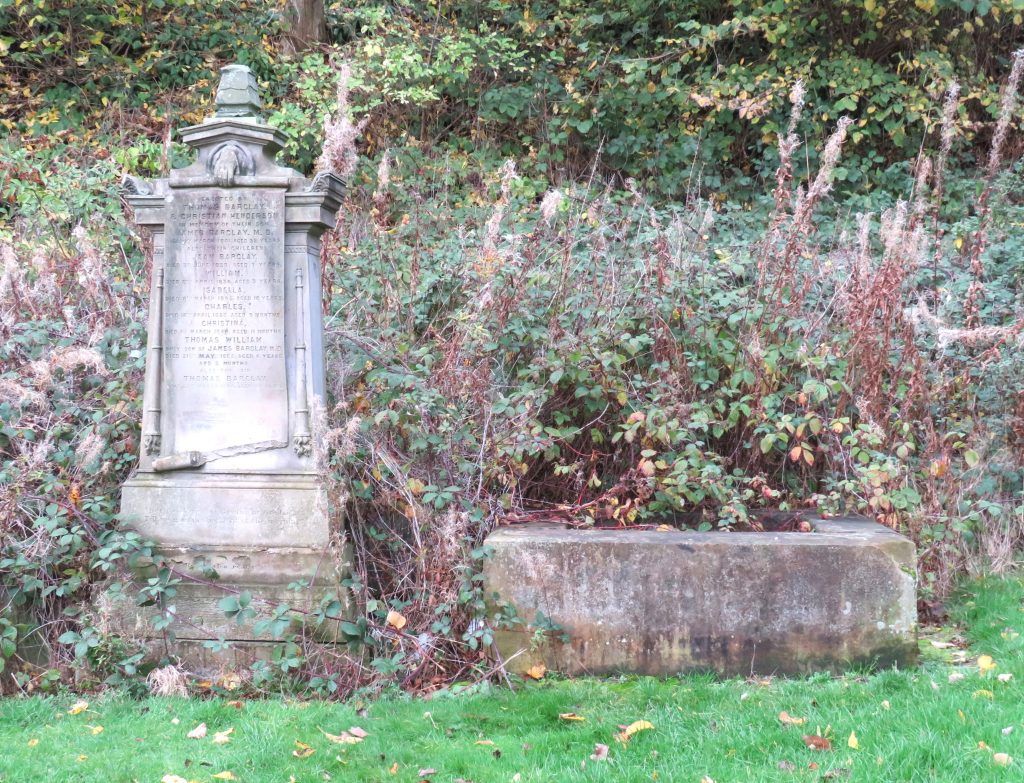
The MacKenzie monument was removed for restoration in September 2018. The contract for the job was awarded to Covanburn Contracts Ltd of East Kilbride, a specialist civil engineering, rail contractor and heritage conservation firm that had already been responsible for restoring a number of other structures in the Necropolis, including some of its mausoleums, as well as several public monuments and statues in Glasgow and other locations throughout Scotland.The restoration took seven years to complete, with a pause during the Covid era followed by a further delay whilst the Covanburn team and other parties involved with the restoration were catching up with other projects. The long lead times for the patterns for the missing castings also contributed to the lengthy timescale of the project.
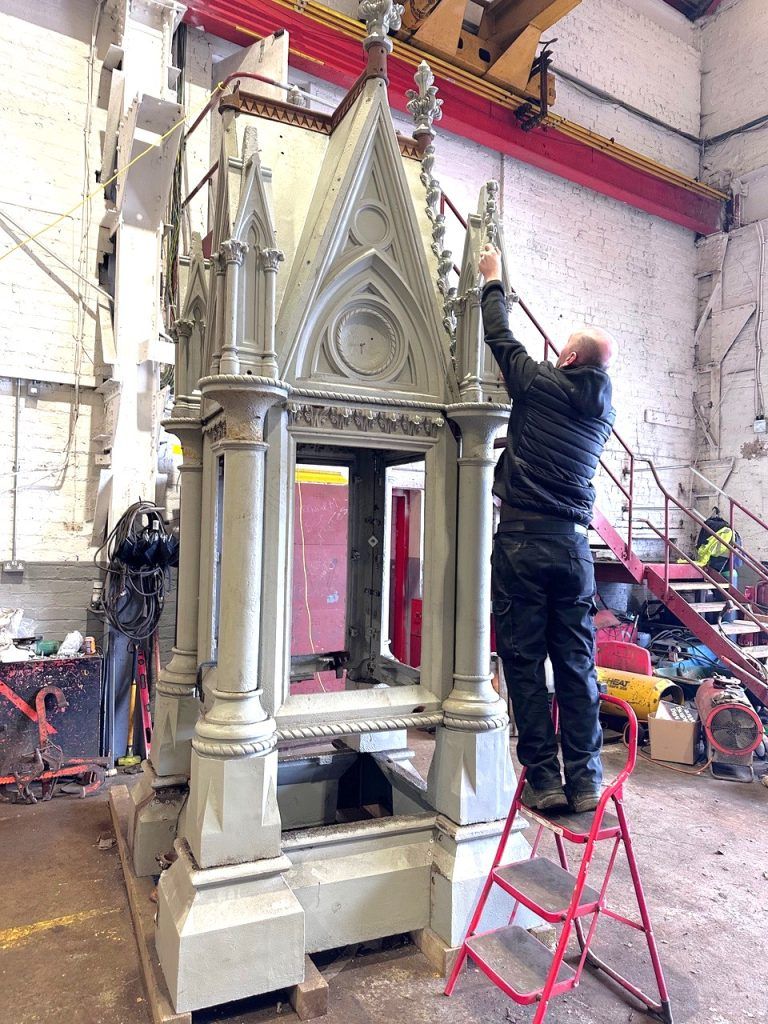
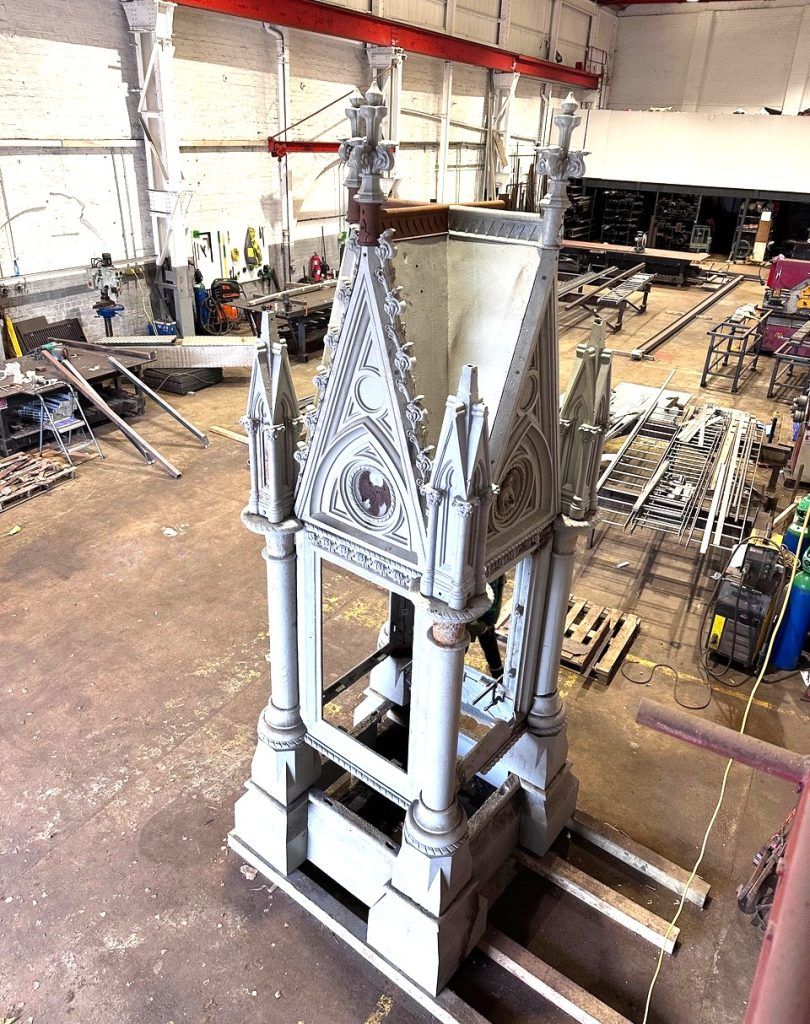
The MacKenzie Monument under restoration in Coatbridge. Images courtesy of Gordon R. Urquhart
The images above and below illustrate part of the restoration process, and were kindly donated for this article by Gordon R. Urquhart, who was involved in the project on behalf of Historic Environment Scotland. Taken in February 2025, they are a rare and fascinating record of the ‘behind the scenes’ activities in the restorers’ workshop in Coatbridge, and allow us to see the incredible transformation and extent of work necessary for bringing the monument back to its original condition. They also enable us to see the monument in a different livery, with its plain, grey undercoat providing an interesting comparison with the colour scheme that eventually replaced it at the project’s end.
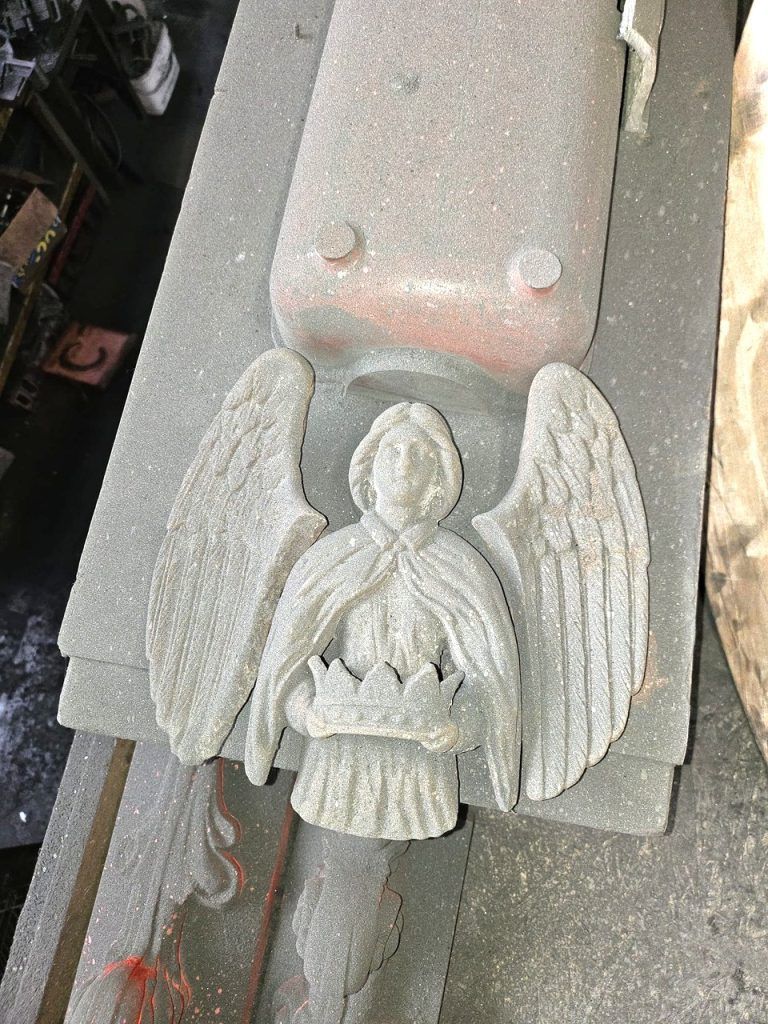
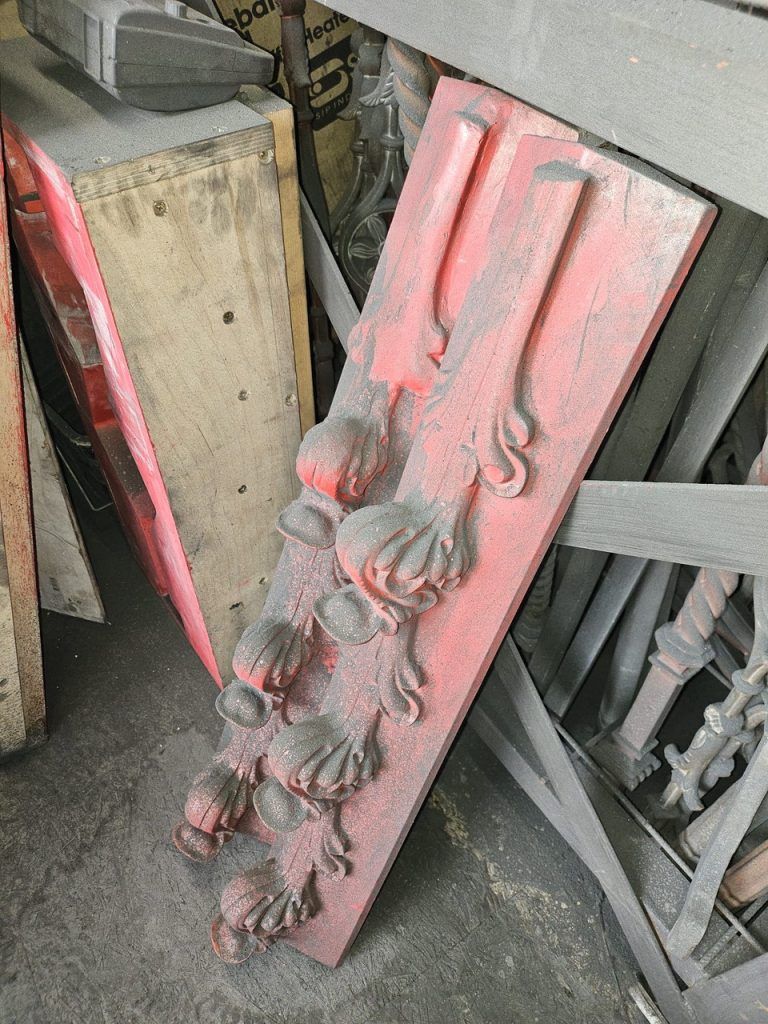
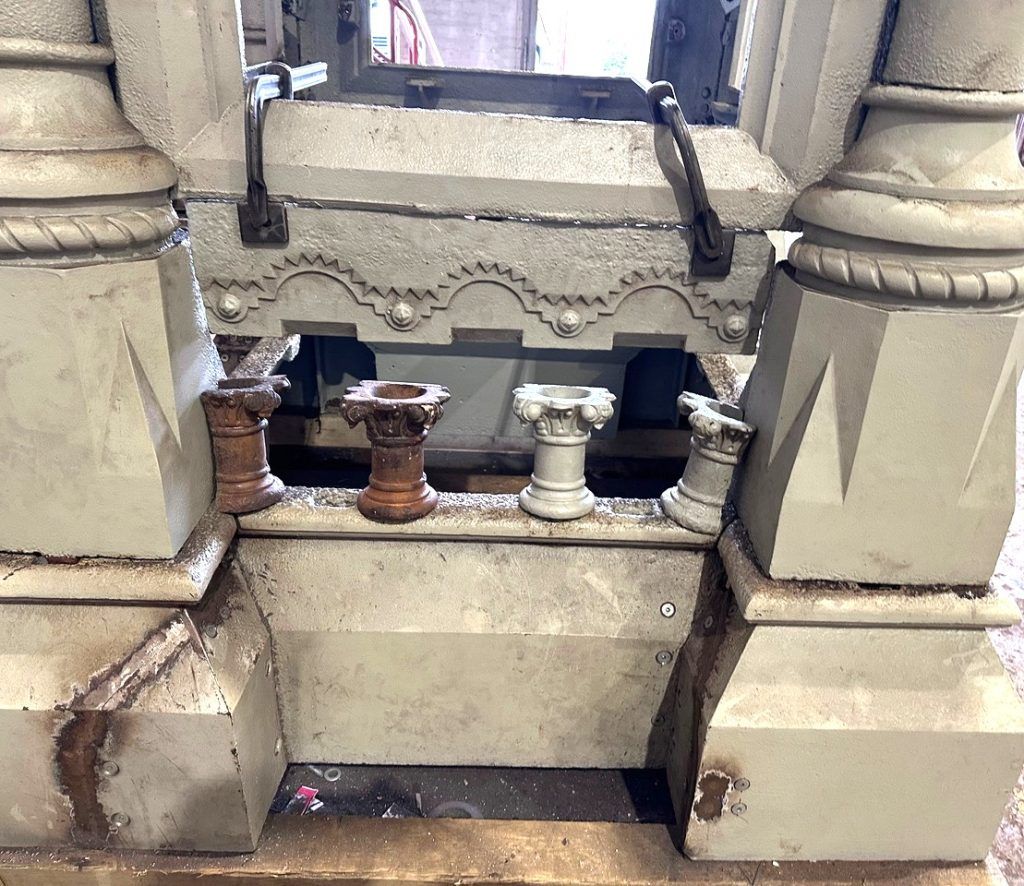
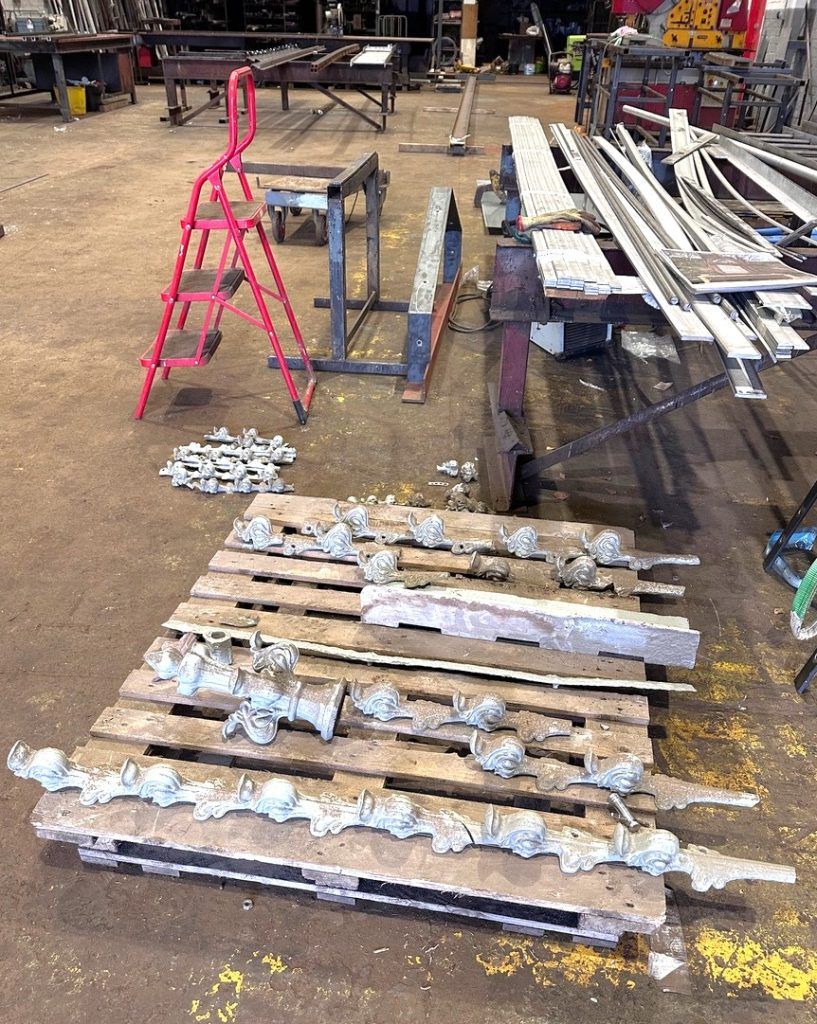
Details of The MacKenzie Monument’s parts under restoration in 2025. Images courtesy of Gordon R. Urquhart
Fortunately, most of the elements that had become detached from the main structure were lying on the ground around it and collecting them was an easy task which reduced the need for recasting and extra expenditure. After the monument was dismantled and removed to Covanburn’s facility in East Kilbride, its parts were stripped of their rust and the remains of its earlier paintwork, and its joints repaired and its missing parts replicated before their repainting and final reassembly in the Necropolis in September 2025. Its blond sandstone base was also given a clean before the monument was re-erected. At the same time, a pavement was laid around the base and a wooden fence erected at the rear and left side of the monument. These were installed to prevent the monument from being enveloped by the ivy and bushes that had previously covered it. Also involved in the restoration were Coatbridge Engineering in Coatbridge, and the Andrew Laing Foundry in Edinburgh, who put in extensive repairs and refurbishments to the monument over the project’s seven-year duration. Andrew Laing produced the casts, with Coatbridge Engineering fabricating and joining plates of the existing cast structure to the newly formed pieces. The entire project cost around £80,000.
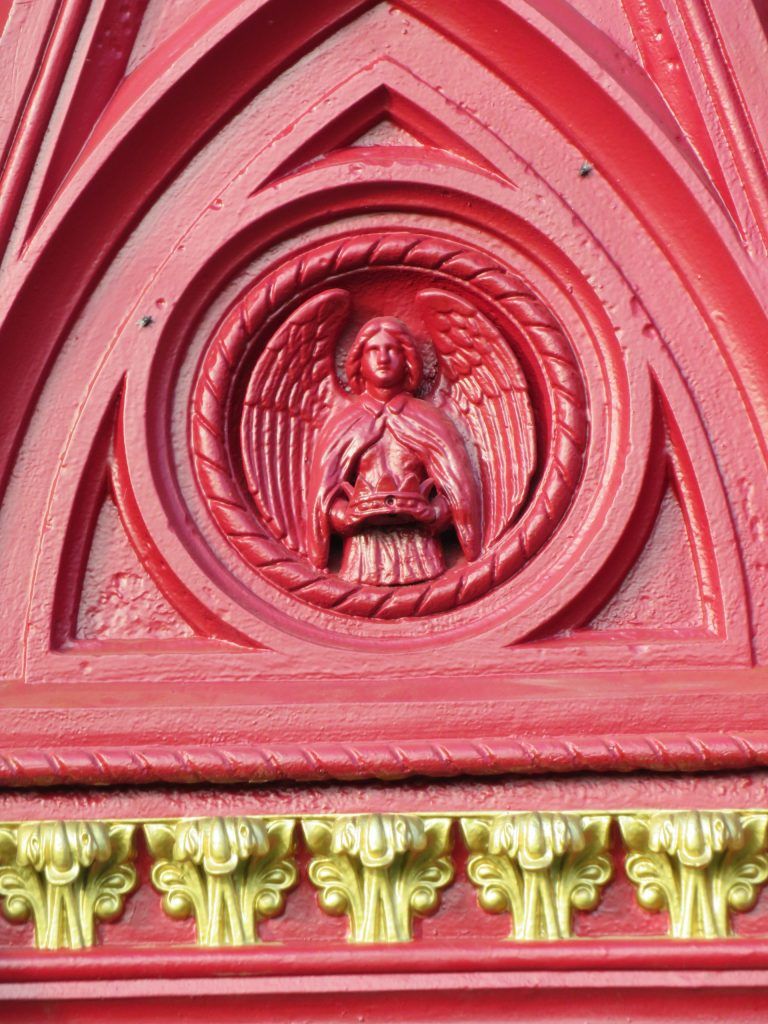
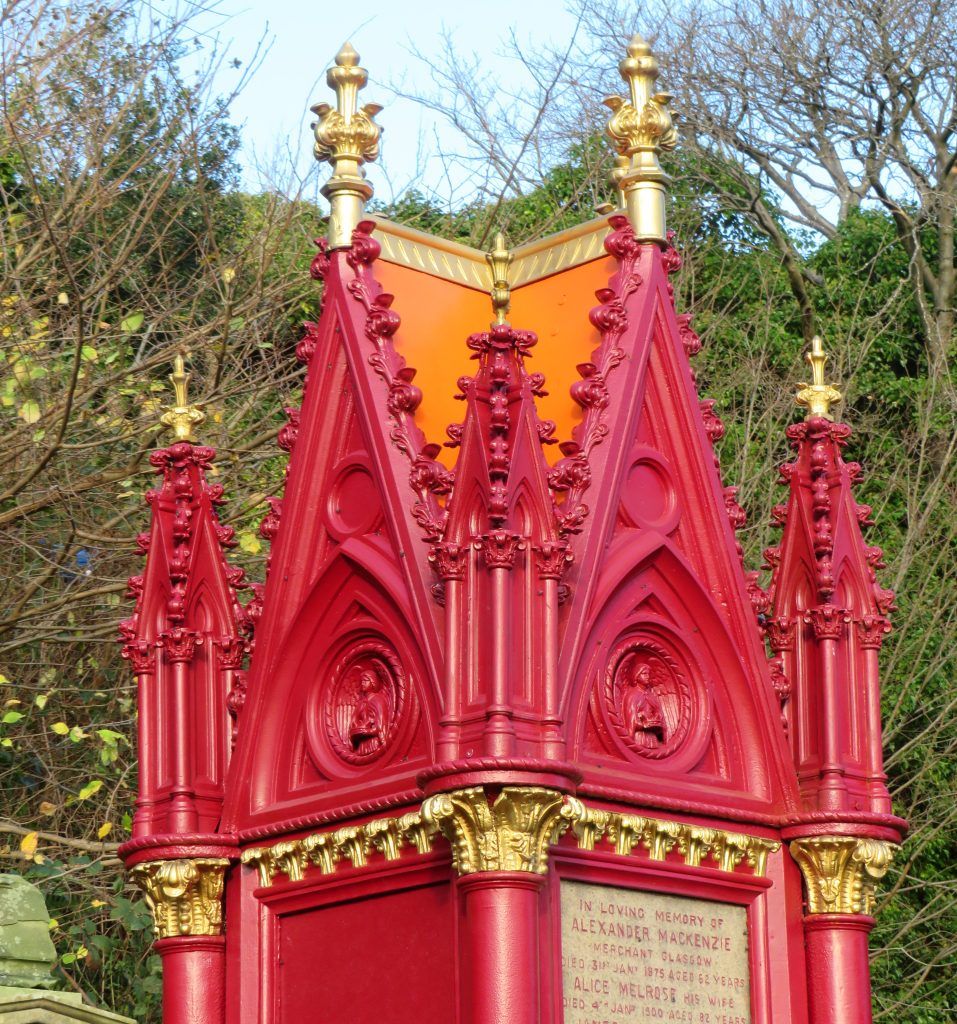
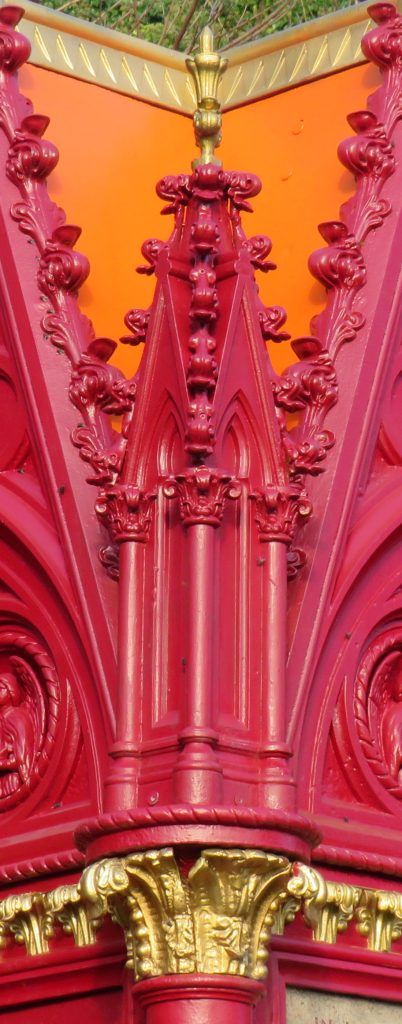
Details of the MacKenzie monument after its restoration in 2018-25
The Monument’s Colour Scheme
The monument’s bright and unusual, if not startling, paintwork will be a talking point for decades to come. This is not least because of the questions regarding authenticity that it will inevitably be raised by it, but also because its appearance is so surprising and extraordinary at the same time. The vivid, rather joyful livery we see today is a modern confection devised by architect Fiona Sinclair, rather than an attempt to recreate its original appearance. This follows a precedent already set by its restorers in the Necropolis, when they repainted the iron gates of the cemetery’s grand mausoleums in vivid blues and reds, rather than their original, bronze-green or black, despite much of their original paint still surviving. Virtually all of the MacKenzie monument’s paintwork had weathered away by the time of the restoration, exposing the bare metal to the rust that the paint was intended to protect it from. However, it is clear from images taken of it before its dismantling, that the monument had at one time been painted white, possibly all over. It was probably painted-over on several occasions, in whatever colours were deemed tasteful at the time. Whether the new colour scheme is entirely accurate or not is now academic, and an issue which can no longer be discussed with any certainty due to the lack of a description of how the monument looked when it was originally built. Whether the monument was painted white, black or bronze green, it would always have been eye-catching, and its new polychrome livery is undoubtedly a great improvement on the way it looked prior to its restoration.
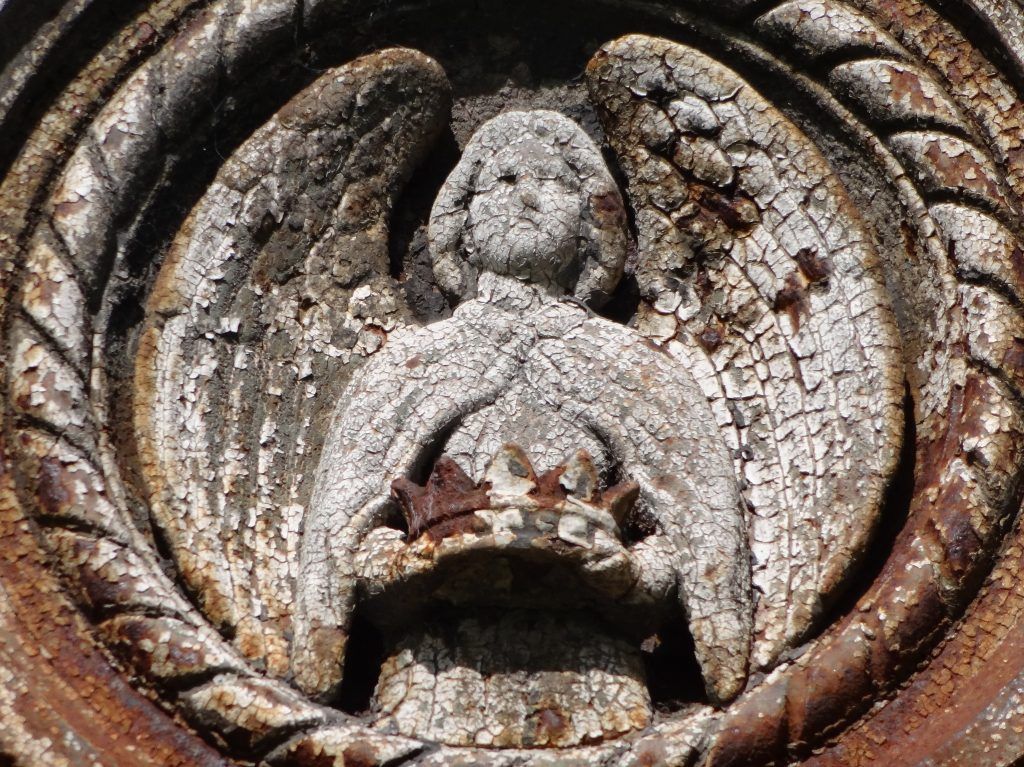
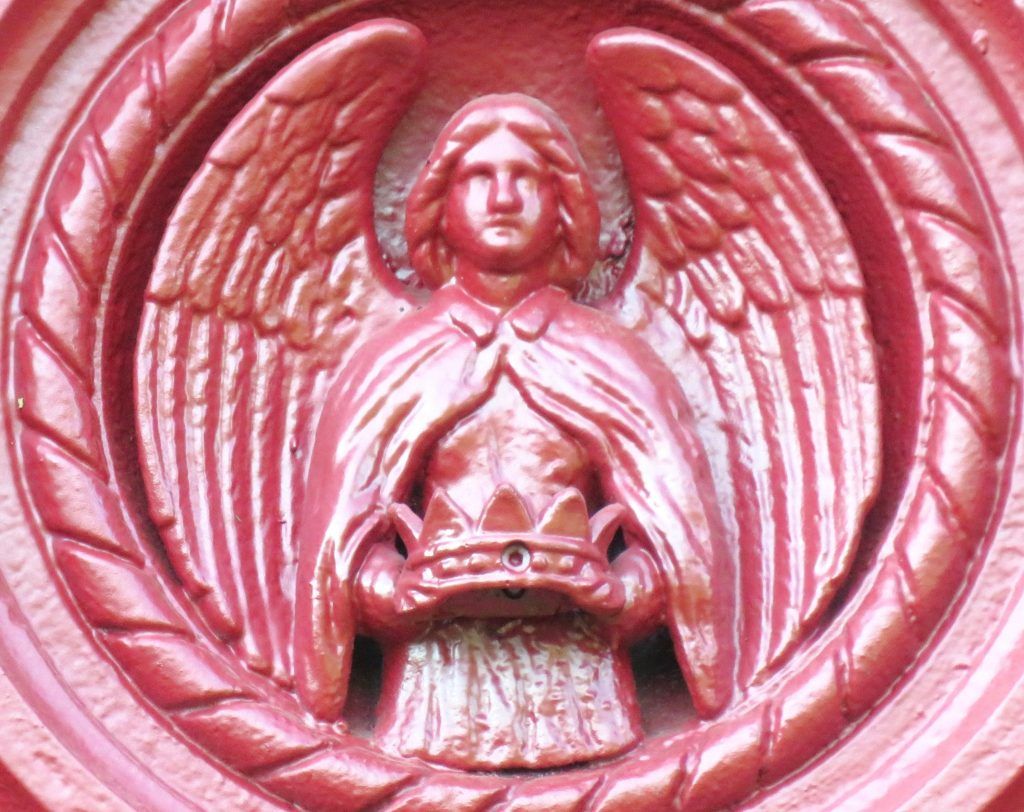
The MacKenzie monument appears now like a sparkling jewel, its brightness and beauty visible from afar and an irresistible enticement for anyone who catches a glimpse of it to investigate it further. It will now undoubtedly become one of the best-known and most visited monuments in the cemetery as its existence becomes more widely known in years to come. Those visitors will no-doubt notice the angels holding crowns in its gables, which honour the life and deeds of the person the monument commemorates. In a more modern context, the crowns could also be interpretated as the honours deserved by everyone who made its restoration possible: Covanburn Contracts, Glasgow City Council, and the Friends of Glasgow Necropolis.
Sources:
Glasgow Herald: Fire (MacKenzie & Crawford), 25 February 1848, p. 2.
Glasgow Herald: Deaths (Alexander MacKenzie), 1 February 1875, p. 1.
Glasgow Herald: Deaths (Alice Melrose MacKenzie), 1 February 1875, p. 1.
Glasgow Herald: Deaths (Agnes Nelson MacKenzie), 31 April 1919, p. 1.
Glasgow Herald: Deaths (James MacKenzie), 9 May 1931, p. 1.
Glasgow Herald: Deaths (Alexander Whitson), 14 December 1936, p. 1.
Soccerman321: File: Mary Moffat Gravestone. JPG – Wikimedia Commons.
Grab_von_John_Baildon (Gleiwitz)By Gliwi – Own work, CC BY-SA 3.0 pl, httpscommons.wikimedia.orgwindex.phpcurid=25561138.
Baildon Monument, Hutniczy Cemetery, Gliwice: Baildon.pdf.
Jimmy Black (1992): The Glasgow Graveyard Guide, Sighthill Cemetery, No. 15., p. 90.
Covanburn Contracts.
Morag T. Fyfe (Archivist, Friends of Glasgow Necropolis): Information regarding the MacKenzie family.
James S. Mitchell: Alexander Mackenzie – Glasgow Necropolis.
George Smith & Co (fl. 1858-1899), foundry, a biography.
Gordon R. Urquhart: Images of the MacKenzie Monument in restoration.
Dr. Richard Williams (2020): The Life and Work of John Baildon, the man who took British 18th century iron innovations to Prussia between 1793 and 1836., in The Journal for the History of Engineering and Technology 90 (1.), 18-25. (https://doi.org/10.1080/17581206.1797445.
All text, research and photographs (except those otherwise attributed) by Gary Nisbet. 2025.