Compiled by Morag T Fyfe
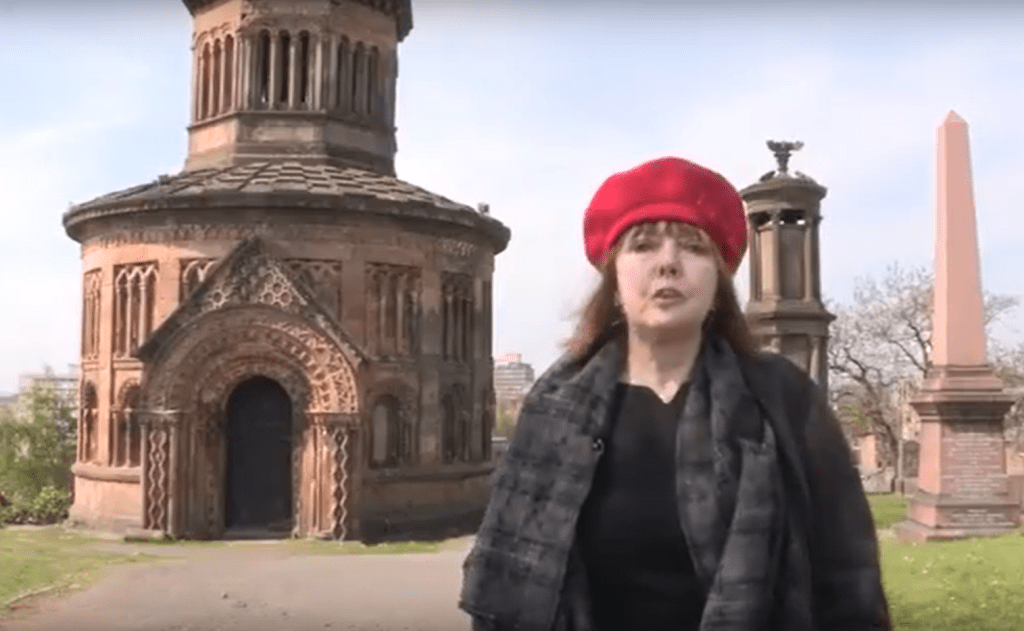
Ruth Johnston, an appreciation
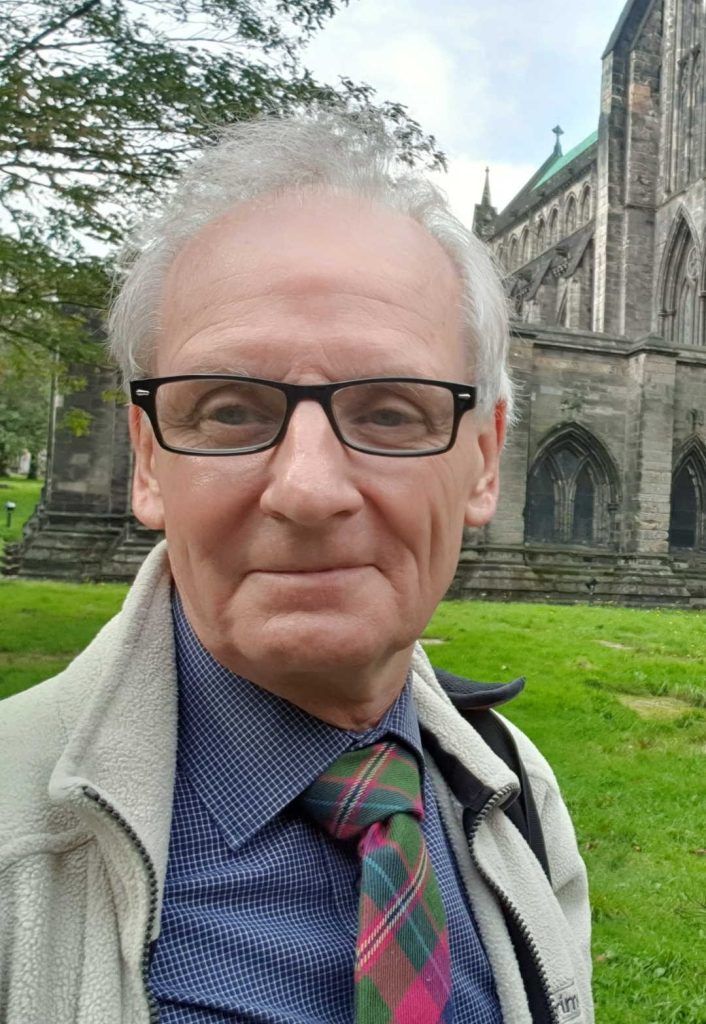
Since the inception of the Friends of Glasgow Necropolis back in June 2005, Ruth Johnston as one of the founder members, has worked tirelessly for the Glasgow Necropolis. Twelve years ago she took over from Nigel Willis as Chair of the Friends of Glasgow Necropolis.
During twenty years of dedicated service, she has worked incredibly hard in raising awareness of the Necropolis, educating the public on its historical and cultural significance in the story of Glasgow, and engaged with key stakeholders and the local community in the protection of the cemetery.
Ruth’s leading role on the conservation and restoration of the Necropolis has seen her involved in multiple fundraising initiatives, including giving talks, presentations, television appearances, and tours.
Amongst all of this, Ruth also found the time to become a published author on the Glasgow Necropolis, and her book Afterlives (now in its second edition), as well as her Walking Guide on the Glasgow Necropolis are much in demand both from our website and via our tours.
We are delighted that Ruth has confirmed she is intending to stay on the Committee, as we move forward into the next chapter of the Friends of the Glasgow Necropolis.
On behalf of all the Committee and the Members of the Friends of Glasgow Necropolis, we give our sincere thanks and appreciation to Ruth for everything she has done and achieved, and we look forward to carrying on the work and projects within the cemetery working in partnership with Glasgow City Council.
Ruth is succeeded by Annette Mullen, the former Vice Chair of the Friends and Colin Campbell has taken over as Vice Chair.
March Update
The indexers have reached 1882, and the number of records indexed in the last three months is as follows –
| Jan 2025 | 318 |
| Feb 2025 | 328 |
| March 2025 | 307 |
Our database of persons buried or commemorated in the Necropolis now stands at 52153 entries at the end of March 2025 of which 21858 entries represent persons buried in common ground with no grave marker.
An Old Glasgow Family
In the Glasgow Herald of 24 December 1894 the following notice appeared.
An Old Glasgow Family – Our obituary on Saturday contained an intimation of the death at Crosshill of Mrs [Christina] Auchinvole, a lady who was the last direct representative of one of the oldest of our Glasgow families. Mrs Auchinvole was the daughter of Mr William Miller of Springfield, a man well known in his day, who was one of the pioneers of the important industry of turkey red dyeing, and the names of whose ancestors appear on the burgess roll of the city for a period of over 200 years. They were the proprietors of the ground lying immediately to the north of the Molendinar and extending from the site of the old Barony Church to Duke Street. Latterly the property got broken up and divided among different branches of the family, and the last portion of land in their possession was sold about 20 years ago by Mr Auchinvole, a son of the lady now deceased, to the Improvement Trustees to enable them to complete John Knox Street and to carry out the extensive improvement which has since been effected at Cathedral Square.
This article introduces a large inter-related family of at least 46 Millers, Auchinvoles and Faries. Their gravestones stand next to one another in Compartment Kappa. William Miller, Christina’s father, founded the Springfield Print and Dye Works in Dalmarnock in 1826 adjoining the Glasgow Water Works. The dye works had fallen into disuse by 1912 but the site continued in use for other industrial purposes. In 2009 and 2010 an extensive open area archaeological excavation took place in preparation for the construction of the 2014 Commonwealth Games Athletes Village.
Robert Greenlees (1820-1894) and his daughter Georgina Wylie (1849-1932)
In Grave Matters 30 I told the story of Jane Cowan Wyper who lost her life while on holiday on the Isle of Sark. Jane was one of a small number of female members of the Royal Society of Watercolour Painters in Scotland and was entitled to add RSW after her name. Several other persons buried in the Necropolis were also members of the RSW including Robert Greenlees and his daughter Georgina. Robert Greenlees was associated with the Glasgow School of Art for many years starting as a pupil teacher and becoming headmaster from 1863 to 1881. He was a founder member of the Glasgow Art Club (established 1867) and an early member of the West of Scotland Academy (fl 1841-1879). As a landscape painter he worked in oils and water colour and was also a stained glass artist. In 1883 his portrait was painted by William McTaggart
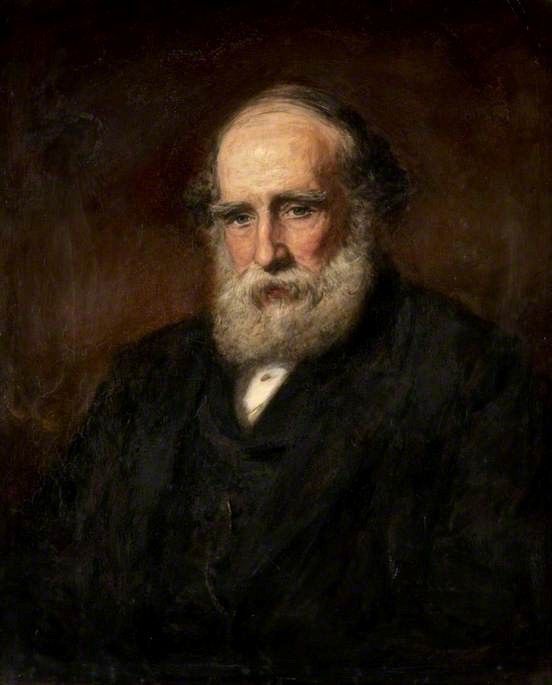
Image credit: Glasgow Life Museums (CC BY-NC-ND)
After studying at the GSA Georgina Mossman Wylie, nee Greenlees was one of the first two female teachers there from 1874 until her resignation in 1881. She was one of the first two female members of the RSW when it was formed in 1878 and she also helped found the Glasgow Society of Lady Artists in 1883. She married Graham Kinloch Wylie in 1885 and long out-lived him dying in London in 1932. She and her husband and father are all buried in Compartment Petra in the Necropolis.
Christian Rethwisch (1836-1879)
Benjamin Hermann Christian Rethwisch was born to Johann Christian Rethwisch and his wife Magdalena Dorothea Elisabeth Fehling on 5 Sep 1836 at Lubeck, Germany. By 1861 Christian (as he was normally known in Glasgow) can be found boarding with Jessie Duncan and her family in Carnarvon Street, near Woodlands Road. Jessie was married to a merchant marine ship’s captain who was not at home on census night. She had a family of four sons in her care, accommodated two boarders and had one live-in servant. As well as Christian who was a mercantile clerk John Gowland, a coffee, fruit and spice merchant boarded with her. Ten years later Christian, by now a commission merchant, was still unmarried and still boarding with a family. This time his landlady was Catherine Leitch, a widow who lived at 292 St Vincent Street. At some time before 1865 Christian had gone into partnership with Theodore Hertz as merchants and commission merchants. This partnership was dissolved by mutual consent on 30 December 1871 and Theodore Hertz died in May 1872 aged 53 (he is not buried in the Necropolis). Christian seems to have continued in business under the name of Theodore Hertz & Co according to his obituary and was doing sufficiently well to move out of lodgings in 1877/8 and acquired his own home in Woodside Crescent. He seems to have enjoyed a busy social life as he is found listed in newspapers as being amongst the audience at certain events, contributing to good causes
He died very suddenly early on Wednesday 1 October 1879 and was buried in the Necropolis on the 4th in Compartment Quartus. In spite of having no family in Glasgow a modest granite stone marks his grave.
James Hamilton and Jane Ponton (buried 1877)
According to a Hamilton gravestone in Compartment Zeta the two earliest deaths recorded occurred in 1871 and 1872 and one would assume burial took place within a few days of death. It turned out that both James and his wife Jane were not buried there until 1877. The Burial Register records that both corpses were brought from St David’s Churchyard, the Ramshorn. Referring to the Burial Register for the Ramshorn James is recorded as having died at Ascog Bank, Bute on 20 June 1871 and been buried in Patrick Hamilton’s lair in the Ramshorn churchyard on 27June. A hearse with four horses was provided by the funeral undertakers, Wylie & Lochhead. Almost exactly a year later Jane Ponton, who died on 4 July 1872, followed her husband to the grave on 17 July. She was also conveyed to her grave in a hearse and four horses provided by Wylie & Lochhead. Investigation of other burials in the Necropolis lair showed that 3 adult children of the couple had also lived and died at Ascog Bank between 1892 and 1916. Census records confirmed the family as being there from 1841 onwards and Fowler’s Commercial Directory of the Lower Ward of Renfrewshire for 1836-37 showed James Hamilton, tobacconist living there in 1836-7. Ascog Bank is a Category B Listed Building (https://britishlistedbuildings.co.uk/200344730-ascog-bank-bute-kingarth) and it is said that the house was designed by the Glasgow architect David Hamilton c1833. One wonders whether James Hamilton, tobacconist commissioned the house as he is living there by 1836. David Hamilton assisted by his son James, was closely connected with the Necropolis designing its entrance gates and gate piers, the Bridge of Sighs and the Egyptian Vaults.
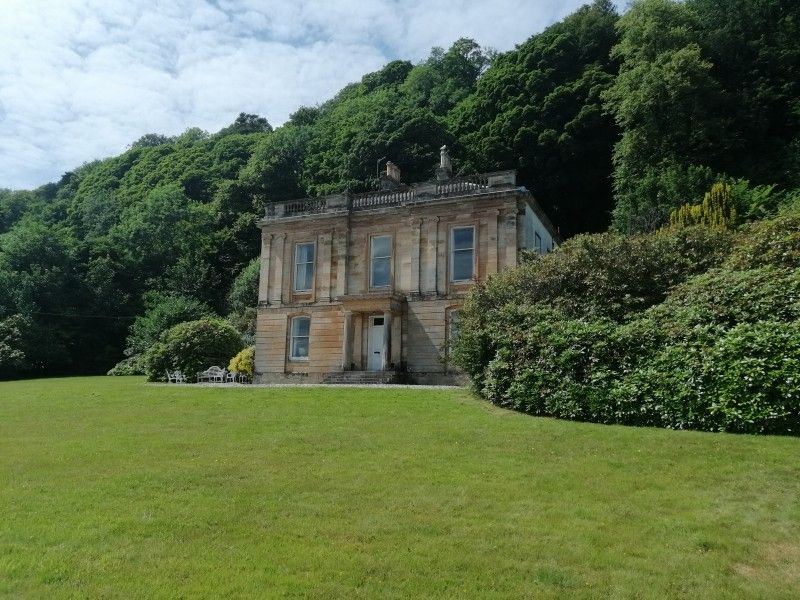
The family lair in the Ramshorn had been purchased by Patrick Hamilton, merchant and tobacconist, in 1819. Patrick, who died about 1826, and his spouse Hamilton Leg(g)at were the parents of James Hamilton born/christened 12 April 1790, died 1871.
A Crematorium for the Glasgow Necropolis
From the 1920s onward the Necropolis account of the Merchants House always showed a loss as the income from the sale of lairs did not cover the running costs of the Necropolis. Just before the Second World War the Directors of the House wondered whether they should consider erecting a crematorium in the grounds to generate more income. The costs of the project and the occurrence of the Second World War stopped this going any further but in 1950 the project was revived and a Provisional Order of Parliament was obtained for the erection of a crematorium. A sub-committee of the House took the plans forward until in 1952 the idea was again given up.
At this time there was no public crematorium in Glasgow, indeed Maryhill Crematorium run by a private company had a monopoly of all cremations in Glasgow. The 1950s was the start of a period of expansion for building crematoria and Lanarkshire County Council built the Lanarkshire Crematorium at Daldowie (outside Glasgow at the time but not now) in 1955.
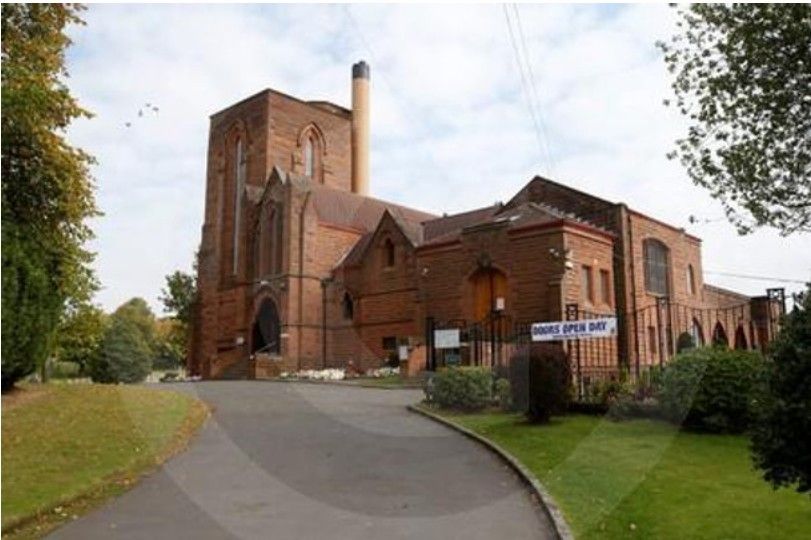
Two years later a private crematorium opened at Craigton and Glasgow Corporation finally caught up with the trend in 1962 when the Linn Crematorium (below) opened.
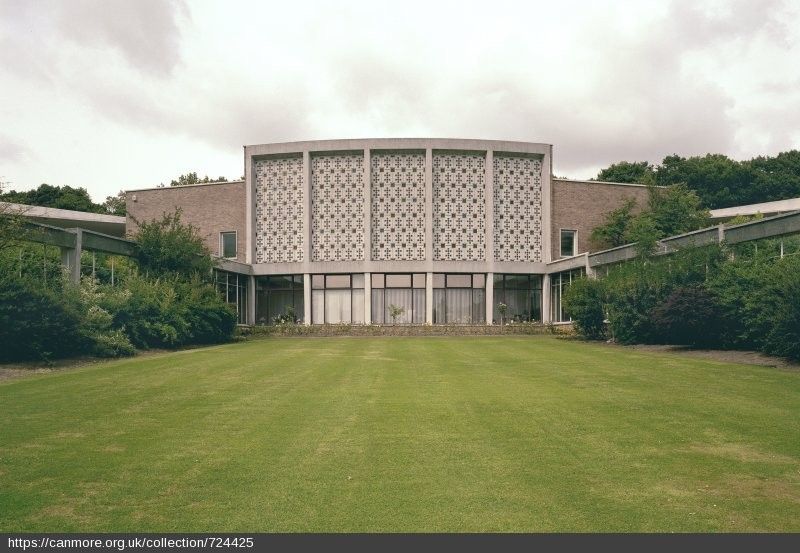
Things could have been very different if the Merchants House had looked favourably on an approach from the Scottish Cremation Society in 1891 to purchase ground for a crematorium in the Necropolis. Instead the Western Cemetery Company came to an agreement with the Scottish Cremation Society to sell them a plot suitable for a crematorium, chapel and columbarium. The agreement with the Western Necropolis was reported at the Cremation Society’s AGM in 1893 and in 1895 Maryhill Crematorium (below) opened for business, the first crematorium in Scotland and only the third in the UK after Woking and Manchester.
The McCall sisters
The burial of two teenage girls with the same surname on 31 July 1879 immediately aroused interest. They turned out to be Margaret Eleanor (18) and Eliza Mona McCall (16) daughters of James and Eliza Mona McCall of 6 St Johns Terrace, Hillhead, Glasgow. Both girls drowned in the Gareloch on Saturday 26 July 1879.
By Monday 28 July the accident was being widely reported in the newspapers and although details vary it is possible to make a reasonable reconstruction of what happened. This was the end of the Glasgow Fair holiday and it is obvious that the family had taken a house at Faslane for the holiday renting Lennox Bank from Mr John M’Farlane. This house still exists, or at least there is still a house on the site, but it is now within Faslane Naval Base. The house sits only a short distance above a sandy bay and the girls were in the habit of enjoying sea bathing. On the morning of the 26th it was low tide and they had to walk out a distance to reach the water. One of the girls unexpectedly stepped into deeper water, was quickly out of her depth and in danger of being swept away. Her sister went to her aid and both girls were swept away and drowned.
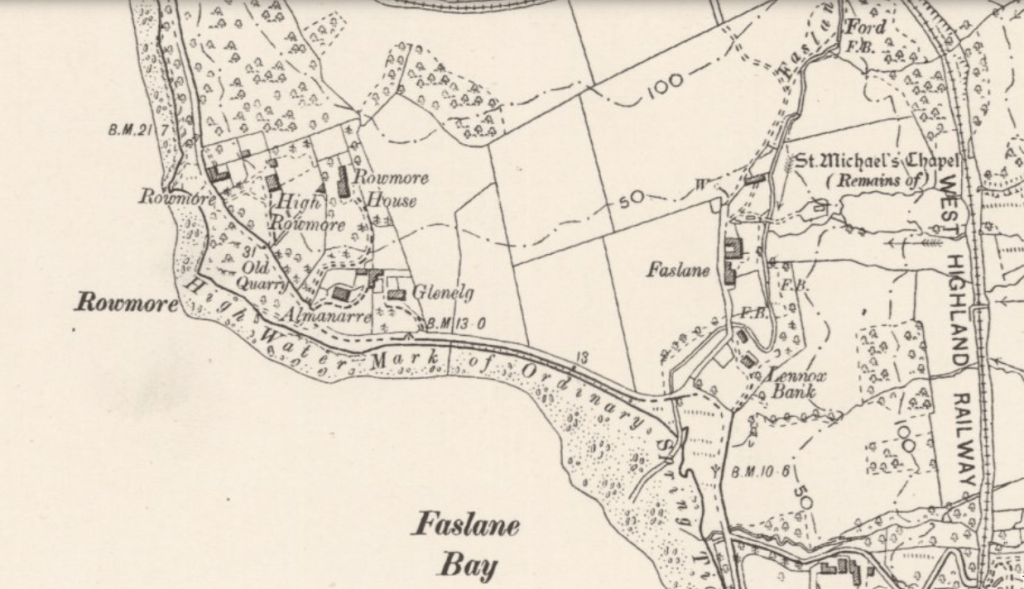
The main discrepancies in the accounts relate to rescue attempts. Some report that the alarm was raised by servants on the hillside who saw what was happening; others claim that James McCall himself was on the beach and tried to save his daughters and had to be rescued in turn by a policeman. Some reports mention a nurse/governess as being present and it is possible to suggest she was named Agnes Andison/Anderson. From the 1871 census until that of 1901 Agnes Andison/Anderson is found in the household generally described as a nurse. She probably joined the household in 1870 when Grace Anne McCall was born.
Margaret and Eliza’s parents were cousins who married in 1859. The family lair in Compartment Omega was originally purchased for the burial of James McCall, snr, a wine merchant like his son, in 1853.
William Ker buried 2 August 1912
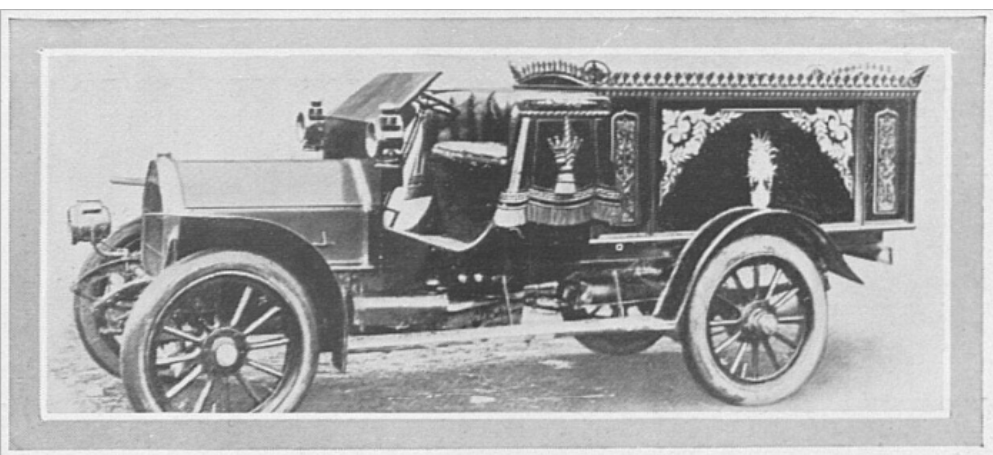
2 August 1912 marked a first for the Necropolis when William Ker’s burial featured a motor hearse and motor coaches only. We know about this because it was sufficiently noteworthy for it to be recorded in the comments column in the Burial Register. It is not known whether the hearse used was similar to this 1910 model below. Nor is it known whether Wylie Lochhead were the owners of the vehicle as seems likely.

Chair of Friends of Glasgow Necropolis
Vice chair of Friends of Glasgow Necropolis
New profiles
Fireman Ian McMillan
Cheapside Street [fire] Disaster
******************************
Anyone who would like to help indexing the Burial Registers is very welcome to join us by contacting me at at research@glasgownecropolis.org