Compiled by Morag T Fyfe
The last few months have been tough for everyone and this was reflected by the fact that family matters forced one indexer to stop indexing for us and another retired after three years hard work. Thanks go to Thia and Donna for their contributions and a welcome to Katie and Lynne who have joined us.
The current indexers continue to make progress and the number of records indexed in the last three months is as follows –
| January 2021 | 763 |
| February/March 2021 | 1161 |
Our database of persons buried or commemorated in the Necropolis now stands at 37688 entries at the end of March 2021.
Glasgow Necropolis Tour App
This year has been really difficult for everyone and The Friends of Glasgow Necropolis have been unable to take our usual guided Tours of the Necropolis due to Covid. This situation is likely to last a little longer and the realisation and availability of this new mobile app has been one of the real pluses.
We have guides and books of course and sales of these have increased enormously during Covid. However not everyone is well prepared for a visit to the Glasgow Necropolis and having this mobile app available for all to download at the site will ensure that the visitors will not only have a better experience but also will bring in donations for our essential conservation and restoration work within this extraordinary cemetery.
This project has been made possible by one of our committee members, Billy Wallace, Department of Computer and Information Sciences from the University of Strathclyde, suggesting this Project to his students, Gregor McIntyre and Tom Latham.
The previous involvement and research by Gregor with our guides and members of the public pre Covid was used by Tom to progress and complete the work. The app is particularly suitable for tourists with limited time to explore the Necropolis and/or unable to book a tour with one of our guides for whatever reason. The app, Glasgow Necropolis Tour, can be downloaded from both Apple and Google Stores free. However once downloaded, to be able to take the tour, you are directed to the Donate page on our website where you pay to continue with the tour instead of the Stores receiving a portion of the funds.
We are absolutely delighted with the result and most grateful to Gregor and Tom. Their enthusiasm and stated extra motivation in working with a Charity making a real difference in the real world was clear. They have both received Guardian Angel Certificates as a token of our gratitude and we wish them every success going forward.
Ruth Johnston, Chair FOGN
Jane Paterson Craig or Ritchie
In 1844 Marion Paterson’s husband Alexander Craig died and left her with a four year old daughter and a two year old son. Alexander Craig owned the Tradeston Grain Mills and by the later 1860s the mills had passed into the possession of another Glasgow family also buried in the Necropolis (https://www.glasgownecropolis.org/profiles/muir-family-and-friends/). Alexander, the son died in 1850 aged seven. In March 1859 Jane Paterson Craig, the couple’s only surviving child, turned nineteen and on the 28th April 1859 she married Lieutenant John Ritchie of the Bombay Artillery;. The marriage took place in Rutherglen and the most likely reason seems to be that she was married at the home of her uncle Adam Paterson of Springhall House, Rutherglen. John Ritchie must have had some leave due him as it was not until December that year that the couple set off for India. Jane only got as far as Malta where she died on 7th December 1859. Her body was returned to Glasgow and she was buried alongside her father and brother on 30th December in compartment Sigma. Her mother lived on for another twenty four years before dying in 1883. John Ritchie remarried sometime in the 1860s, had a family by his second wife and finished his career as a Major-General, dying in 1919.
Adam Paterson of Springhall House and his family are also buried in the Necropolis just along the row from his sister Marion Paterson and her family. Both monuments are similar in design with a definite family resemblance. On the left (below) is the monument to Alexander Craig and Marion Paterson and on the right is that to Adam Paterson and his family.
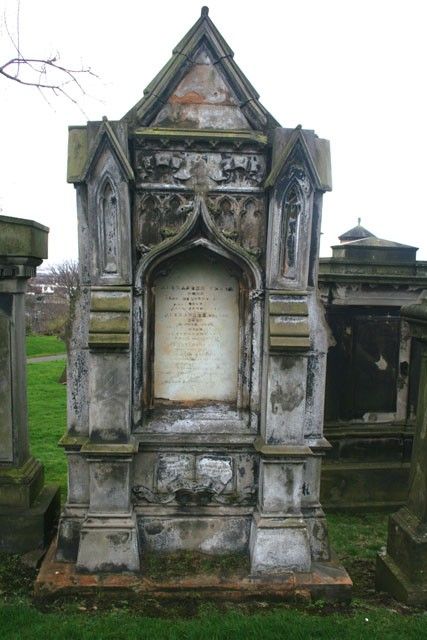
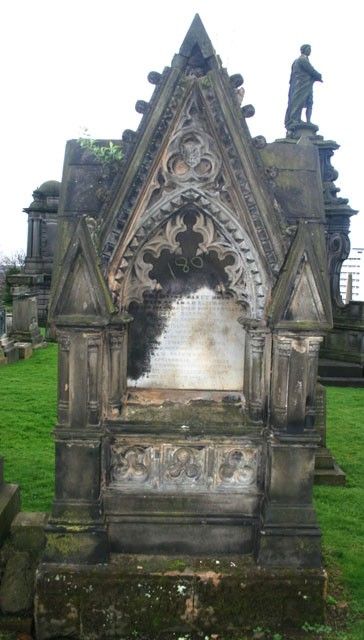
The example of Jane Paterson Craig shows we have reached a point in the burial registers where it becoming slightly more common for the bodies of deceased Glaswegians who have died abroad to be brought back to Glasgow for burial. Obviously this is expensive and not widespread. The Rev Dr William Black had died in Florence in January 1851 and his body was brought back for burial in the Necropolis on 10th March.
Robert Gunn, proprietor of the North British Daily Mail
In November 1859 the death of Robert Gunn, who had been ill for three years with a lung infection, took place near Lisbon where he was planning to escape the Scottish winter. His body was brought home and buried in the Necropolis a month later. Robert Gunn had been connected with newspapers all his adult life and during that time he and his brother in law established the General Advertiser of Dublin and, in 1848, he became the acting, then full, proprietor of the North British Daily Mail, the first daily Scottish newspaper. This newspaper lasted till 1901 when it merged with the Daily Record. Two days after Gunn’s death in Portugal his son John George died at the family home in Glasgow and became the first burial in the new family grave in compartment Epsilon. It is not known whether Mrs Isabella Gunn had accompanied her husband to Portugal and was present at his deathbed or whether she remained in Glasgow with their family and had the sad task of burying her son in November before burying her husband a month later.
John Baird, architect
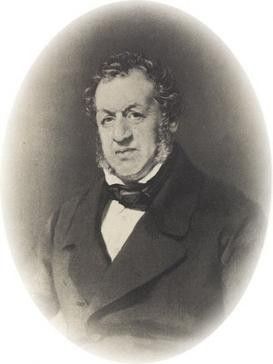
In 1831, a competition was announced by the Merchants House for the design of the new cemetery planned on the Fir Park. Sixteen designs were entered and five prizes awarded but instead of proceeding with the winning design the House commissioned David Hamilton and John Baird (Primus) to produce one amalgamated design from the five winners. At this time Baird was at the start of a distinguished architectural career, mainly in Glasgow (http://www.scottisharchitects.org.uk/architect_full.php?id=100093). His main work in the Necropolis is the monument to James Ewing of Strathleven (died 1853). Baird purchased a lair in the Necropolis where he was buried in December 1859. The family has a modest stone in compartment Sigma which commemorates the architect, his wife and one daughter along with a possible aunt of his wife. There are another two burials in the grave who are not named on the stone; they are possibly a brother named George and Baird’s step-mother Ann Inglis but more research would be needed to confirm this.
Isabella Jackson or Dewar
The death of Mrs James Dewar at Gourock on 12th March 1859, after a short illness, was intimated in the Greenock Advertiser of 15th March. It is a very brief uninformative notice, as some are. Isabella was a young woman of between 25 and 29 when she died, based on various records of her death and burial. She was buried in her parent’s grave in compartment Omega on the 17th March. Most unexpectedly this notice appeared in the Greenock Advertiser for 24th March:
The medical report of the examination of the body of the late Mrs Dewar, of Gourock, ordered, as in all cases of sudden death, by the Procurator-Fiscal of the county, proves that her death had not been caused by violence. We have had handed to us the certificate given by two professional gentlemen who were, immediately on her decease, called upon by her husband and relatives to examine the body. It is in these terms:-
We hereby certify that Isabella Jackson or Dewar died, as ascertained by post mortem examination, from natural causes, and that her husband and relatives had given their consent and sanction to her body being opened before the Fiscal had interfered.
John Mackenzie, Surgeon, etc
Wm Davidson, MD
Gourock, 19th March 1859
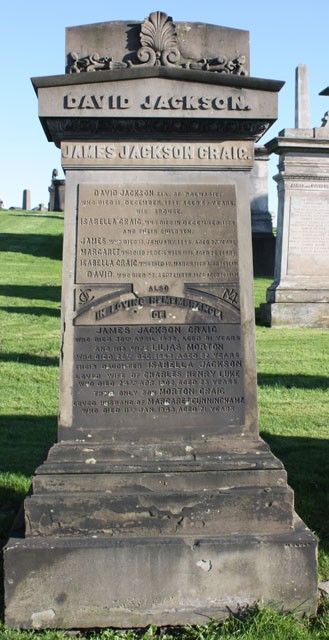
On looking at a picture of the Jackson gravestone in the Necropolis it looks as though the original inscription was replaced at some time and a new stone slab inserted into the original stone. The top half of the inscription commemorates David Jackson, his wife Isabella Craig and four children. Isabella Dewar, nee Jackson is named as Isabella Craig on the stone and her marriage to James Dewar is nowhere acknowledged. The lower half of the inscription is in memory of James Jackson Craig and his family and his relation to the Jacksons of the upper half is unclear. Matters are complicated by the fact that Isabella Dewar is named after her mother Isabella Craig but it is not clear how James Jackson Craig is related to Isabella Craig. There are faint hints on the internet that James Jackson Craig is a son of Isabella Jackson or Dewar by a first marriage to a Robert Craig but this may be a complete red herring and needs investigation by an interested family member. This suggestion may help to explain why Isabella is named on the stone as Isabella Craig if her putative son James Jackson Craig was responsible for renewing the inscription. Incidentally James Jackson Craig is the second architect to be mentioned in this issue of Grave Matters. www.scottisharchitects.org.uk/architect_full.php?id=200280
William Mathewson
In compartment Delta there is a lair belonging to the Mathison / Mathieson / Mathewson family. No stone survives so it is not known what form of the surname the family chose to be known by. In November 1859 forty one year old William Mathewson was buried in the grave. Nothing further is known about William except for his address – Inkerman, Abbey Parish, Renfrewshire. Inkerman was a series of miners’ rows established in 1858 to house ironstone miners. It was located to the west of Paisley and its site is now covered by the A737. As its name suggests it was named in honour of the British victory at the Battle of Inkerman in the Crimean War. Nearby settlements were named Balaklava and Redan for similar reasons.
Lieutenant Walter MacPherson
Walter MacPherson was one of at least ten children of James MacPherson, surgeon dentist, and Mary Anne Hart. Born on 13th July 1831 he was the second eldest of five boys. The entry in the burial register in May 1860 gives no home address but records him as having ”died at sea”. All is made clear by a brief notice of his death in the Dublin Evening Mail and other newspapers which state that he died aboard SS Olympus, off Liverpool. The death intimation and the gravestone also tell us that he was a lieutenant in the 27th Regiment, the Inniskillings.
The first question that arises is what was he doing on the Olympus? The depot of the 27th Foot was at Buttevant, Co. Cork at this time so the first thought was that he was travelling between there and the family home in Glasgow. However the Olympus was a new screw steamer of 1794 gross tons launched earlier in 1860 and intended for the Mediterranean trade. In fact in June 1860, just after Walter’s death, the Olympus proceeded from Liverpool to Queenstown (Cobh) to embark troops for Malta. At the time of Walter’s death the 27th Foot were stationed in India where they had played a part in suppressing the Indian Mutiny of 1857-9, for which Walter was awarded the Indian Mutiny Medal.
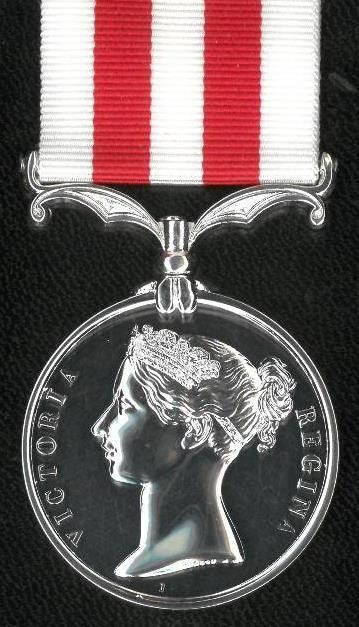
It wasn’t customary for troops to travel via Suez at this time and in 1854 when the 27th had gone out to India they had taken the traditional route round the Cape of Good Hope. Is it possible that Walter was returning home from India on leave and, travelling privately, took the fastest route home? If so, he didn’t make it, dying as he did at sea off Liverpool.
Peter Sawers of Craigengall
The Greenock Advertiser of 6th December 1859 announced the death of Peter Sawers, Esq of Craigengall at Netherkirkton House on the 27th November. He was buried in compartment Gamma on the 2nd December aged 90 (his death registration says 86). He was quickly identified as a bleacher in Neilston Parish having been there since at least 1847.
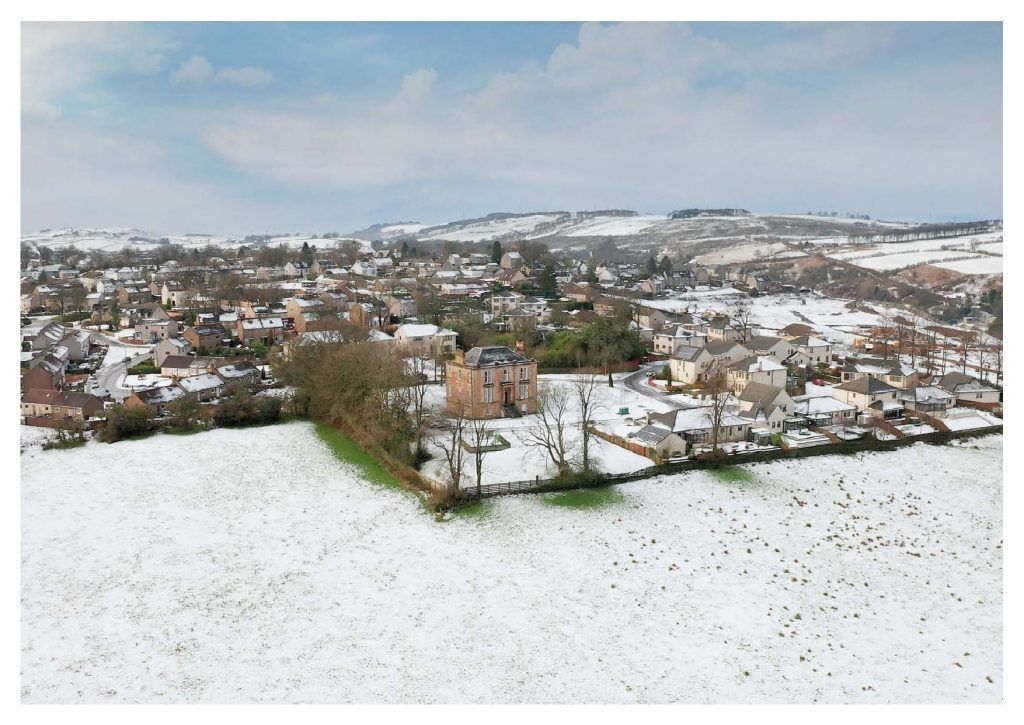
Sawers is described as “of Craigengall” so he had some sort of landed estate. It turned out that Craigengall was not in Neilston Parish but in that of Torphichen, West Lothian. According to the Ordnance Survey Name Books of 1855-59 (West Lothian volume 56) Sawers owned six farms in the parish including Craigengall itself and a row of cottages all situated within a mile of Craigengall.
Sawers died unmarried and his estate went to various nephews and nieces generating several years of litigation. Nieces can be found at Newhouse, Torphichen until the 1890s. A most unexpected discovery from Sawer’s will was the existence of his three illegitimate children. Nothing is known about them except their names – Robert Gordon Sawers, John Stevenson Sawers and Isabella McFarlane Sawers.
West Hillhouse Farm, New House Farm, Wester Wheatacre Cottages, Easter Wheatacre Farm, Over Hillhouse Farm, East Hillhouse Farm.
New Profiles
A number of new profiles have been added to the website. In no particular order they are:
- Catherine Lang,
- Robert Easton Aitken,
- Professor Joseph Coats,
- Sir Allan Arthur,
- Charles Chalmers Bryce,
- James Howe McClure,
- James George Walker,
- Alexander Woodrow
******************************
Anyone who would like to help indexing the Burial Registers is very welcome to join us by contacting me at research@glasgownecropolis.org