Compiled by Morag T Fyfe
The indexers have now reached 1870, and the number of records indexed in the last three months is as follows –
| July 2023 | 398 |
| August 2023 | 425 |
| September 2023 | 405 |
Our database of persons buried or commemorated in the Necropolis now stands at 48861 entries at the end of September 2023 of which 21306 entries represent persons buried in common ground with no grave marker.
To my surprise this issue of Grave Matters has turned out to be dealing mainly with persons buried in common ground. These people have no gravestone to mark their burial, leave behind no family portraits or documents, leave minimal traces in official records, seldom appear in newspapers and when they do so it is usually for the wrong reasons.
Identifying families buried in common ground
Harriet Saxon, daughter of Josiah Saxon & Phoebe Stratton married William Greig, gent at St Pancras Church, London on 5 July 1843 by license. They were both of full age. Her father who was in the cotton business as a dealer or merchant had died in 1838.
Harriet, aged 30, was buried on 9th May 1846 after giving birth to William Saxon Greig. She was buried privately in common ground in compartment Iota by her husband who gave his occupation as stockbroker. William Saxon Greig was also buried privately in common ground in compartment Iota fourteen months later on 24th July 1847. He had been suffering from dysentery.
Nothing further is known about William Greig.
On 30 April 1846 Daniel McKay, aged 45 and a Sheriff Officer, was buried privately in common ground in Compartment Iota. He was followed to the grave on 5 July 1846 by his 7 month old daughter Mary who was buried like her father privately in common ground in Compartment Iota. Both father and daughter died of ‘decline’ which may or may not mean tuberculosis but suggests some sort of wasting disease.
Daniel McKay is probably the man of that name working as a Burgh Officer listed in the 1841 census and living in Skinners Close, Briggate with his wife and family. His widow, Euphemia Mathieson, and surviving children can be traced in the 1851 and 1861 censuses. Euphemia died on 13 October 1862 at 28 Jamaica Street and the date of death and address allowed me to identify Euphemia’s burial on 15 October 1862 in common ground in Compartment Petra.
Once addresses become common in the Burial Register from 1854 onwards it becomes possible to use these to suggest possible family groups although no relational details are provided by then in the Burial Register. One such family is the Allans of 5 Catherine Street, Anderston. Four children living at this address were buried in various plots in common ground between 1861 and 1868. Two of the children (Grace and George) died as infants but their sisters Elizabeth and Isabella both lived more than eleven years so appear in a census, that for 1861. This census confirmed the residence of George and Catherine Allan with five children in the household and two lodgers. George Allan and three children were still living at Catherine Street in 1871 but George was a widower. Will Catherine’s burial be found in the Burial Register between 1870 where the indexers are working and the date of the 1871 census?
George Addis and family
Addis/Addes is an unusual surname in Glasgow and there are six burials in common ground for that name. Three are still born children of George Addis (1857, 1859, 1861) with no address given and the other three all lived at 83 Drygate between 1858 and 1861 with no parental details supplied. Richard Dixon Addes was buried 20 April 1858 aged 3 years 6 months and his presumed brother William, 3 months, followed on 8 May 1858. The deaths index on Scotlands People shows both boys to have a mother with the maiden name of Inglis and purchasing Richard’s certificate confirmed the Drygate address, gave his mother’s full name as Margaret Inglis and showed his cause of death as smallpox. It seems possible that William’s death so soon after his brother’s was also due to smallpox. On 13 August 1861 Jessie Buchanan Addis of 83 Drygate was buried only a month after her mother had had another still born child buried on 16 July. The earliest burial, a still birth in 1857, took place in common ground in Compartment Theta while the other five burials were in Compartment Eta.
George showed up on the 1851 census living with his family at 33 Havannah Street and working as a bottler in a brewery. By the 1861 census George Addis can be found with his wife Margaret but no children in the household. George was a 28 year old labourer in a slate yard. This census suggests 1833 as the year of birth for George and 1822 for Margaret. A marriage for George Addes and Margaret Inglis was found on Scotlands People for 30 December 1853 in Glasgow making George about 20 when he married and Margaret about 31. George and Margaret were still alive in 1871 when they can be found visiting Ingles relatives also living in Drygate.
Clergymen in common ground
There are some elaborate monuments in the Necropolis erected by Glasgow congregations in memory of their ministers. It might come as a surprise that five clergymen were buried in common ground between 1835 and 1841. For three of these men the only information we have about them comes from the Burial Register as detailed below while John Eadie and Donald McLean are dealt with elsewhere in this issue.
The earliest burial is that of the Rev David Jordan aged 58 who succumbed to paralysis and was buried on 21 September 1835. In the Burial Register his occupation was given as ‘City Missioner, Original Burgher’ and he was buried by the Rev Findlay Stewart, Original Burgher minister at Pollokshaws. Findlay Stewart served in Pollokshaws for thirty-five years until his death in 1841. He is listed amongst the ministers in Annals and Statistics of the Original Secession Church by Rev David Scott, 1886 but David Jordan is not, which is a puzzle.
On 16 December 1837 the father of James Douglas buried his son in common ground in Compartment Alpha. James was chaplain to the Royal Infirmary and died from typhus fever. He was 28 years old and may only have taken up his position a short time previously as he only appears once in a Post Office Directory, that for 1837-38. His father is not named in the Burial Register and James Douglas is too common a name to allow this one to be identified.
Rev George McKeand, our third clergyman, was elderly by the time he died from apoplexy aged 64. Nothing has been found about his career or family and, unlike David Jordan and James Douglas, no occupation has been entered in the relevant column of the Burial Register. Nor is it known who James Fernie was who arranged George’s funeral on 16 May 1839.
Rev Donald McLean
In October 1839 the Rev Donald Maclean, disgraced former minister of the parish of Small Isles, was travelling from Glasgow to Greenock preparatory to taking ship for Australia. Sources vary slightly but agree he died on the 6 October either in Glasgow or on board ship between Glasgow and Greenock. Two days later he was buried in common ground in Compartment Alpha of the Necropolis looking over the Molendinar Burn to the Cathedral. He was 45 years old and the Burial Register records his cause of death as dropsy. The Fasti Ecclesiae Scoticanae is the main source for his life supplemented by newspaper references.
Donald Maclean was born on Rhum in 1793, educated at King’s College, Aberdeen, ordained as missionary in Rhum and Canna in September 1818 and appointed to the Parish of Small Isles in November 1818. This parish comprised the four islands of Eigg, Canna, Muck and Rum and the minister of the parish was based on Eigg. The account of the parish in the Second Statistical Account was written in 1836 by Donald Maclean. By then he had developed an alcohol problem and after complaints to the presbytery he was deposed for intemperance in 1838.
He married Isabella Maclean in 1822 and had at least six children. It might be assumed that the family continued on their way to Australia after Donald’s death but that does not seem to be so. A family of five McLean brothers and sisters whose names, ages and birth places match those of Donald’s family are found living at 4 Oxford Street Laurieston, Gorbals in 1851. In 1858 Allan McLean the eldest surviving son of Donald and Isabella McLean died at Hayburn Place, Partick and his death certificate gives his place of burial as the Necropolis. This is very likely the same Allan McLean living with his brother and sisters in Laurieston in 1851.
Previously a comparison of entries in the Necropolis database had linked the burial of Donald Maclean in common ground in Compartment Alpha with a damaged gravestone in compartment Lambda which commemorated the Rev Do…. Maclean, minister of the … Small Isles who died at G… …. Oct 1839.
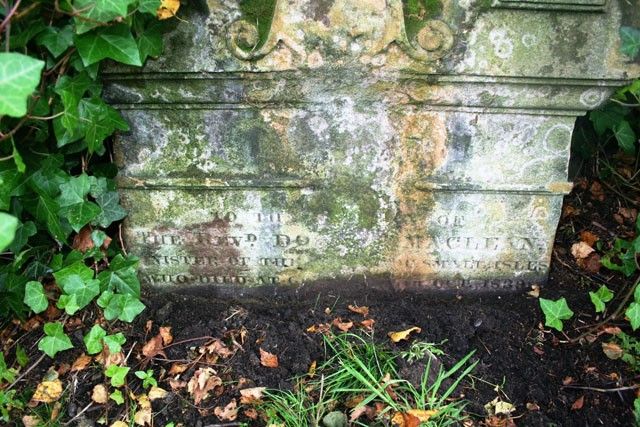
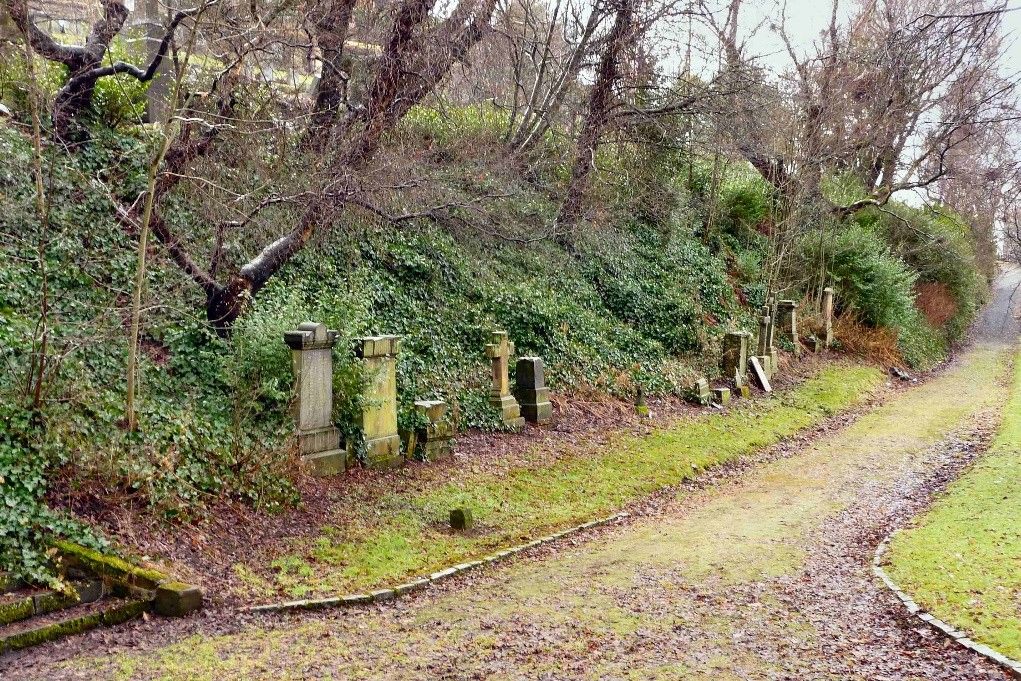
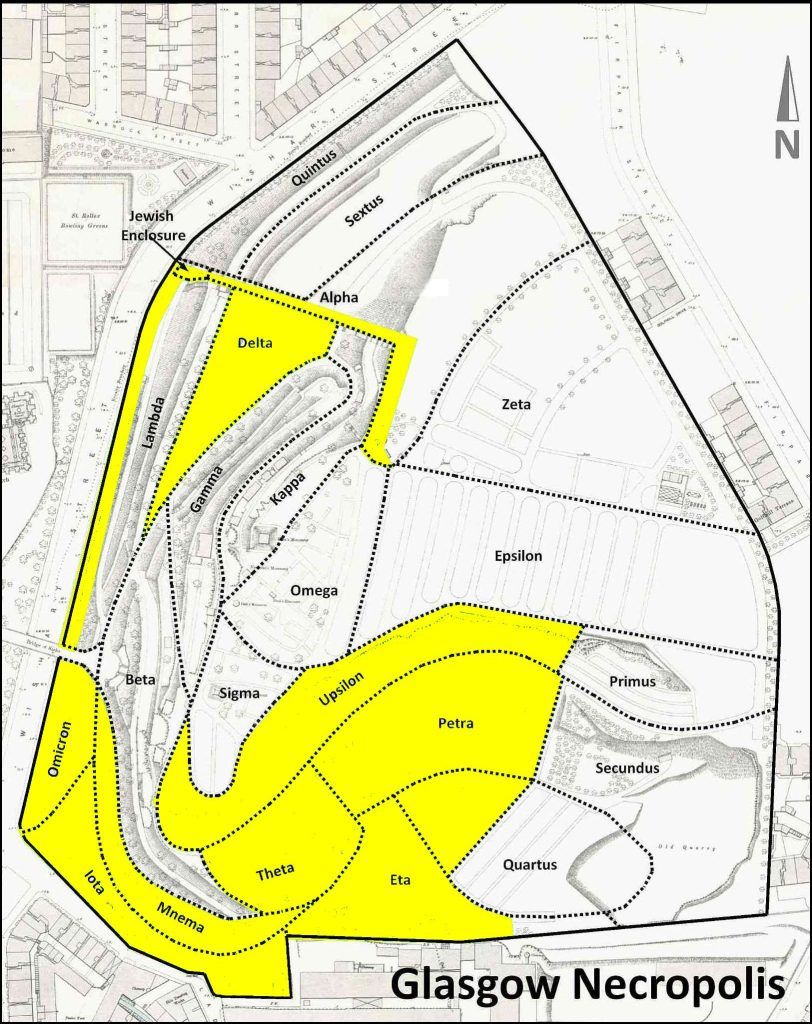
The stretch of Alpha from the Bridge of sighs to the Jewish Enclosure seems to be the only part of the compartment available for common graves as the rest of the compartment is occupied by gravestones. When the Necropolis was laid out the Molendinar Burn was still open and, in fact, the mill pond for the Subdean Mill bordered this stretch of the Necropolis from the Bridge of Sighs to the Jewish Enclosure. Due to the piping of the Molendinar and subsequent construction of Wishart Street there has been a lot of landscaping in the area and one wonders how badly affected the common graves were.
I wonder, although I have no evidence for it, whether the location of the gravestone for Donald Maclean was deliberately chosen to be as close to his burial place across the path as possible.
Rev John Eddie/Eadie (c1770-1841)
This John Eddie should not be confused with Rev John Eadie (1810-1876) who was minister of Cambridge Street Church and Lansdowne Church for a total of 40 years and is buried on the top of the Necropolis hill in Compartment Omega.
According to Rev David Scott’s Annals and statistics of the Original Secession Church till … 1852 ‘John Eadie [was] licensed by Glasgow Presbytery [on] 13 April 1824 [but] after a time gave up preaching, and betook himself to a mercantile profession’. From 1823 to 1841 the Glasgow Post Office Directories list Rev John Eadie as a teacher of languages and resident in College Street or close by. This is likely the same man, J. Eadie, who is found as a teacher in Gallowgate between 1812 and 1822. It would be interesting to know why John Eadie, at the age of about 54 chose to become a minister in the Original Secession Church.
Rev John Eddie died from dysentery in 1841 and was buried in common ground in Compartment Iota on 22 November. His wife Robina Crawford died in 1844, aged 60, and was buried on 4 March also in common ground in Compartment Eta.
William Earl
When William Earl was buried in common ground on 14 May 1869 his place of abode was given as the Central Police Office, then in South Albion Street. The address was intriguing and seemed worth pursuing. The British Newspaper Archive threw up several hits for the death of William Earl at the Central Police Office the fullest of which was that found in the Paisley Herald and Advertiser Saturday 15 May 1869.
FATAL ACCIDENT TO A POLICEMAN. – At about 5.30a.m. on Tuesday, William Earl, 39 years of age, a night constable, was found at the foot of the stair in close No. 9 Miller Street, Glasgow, insensible, and taken to the Central Police Office. It was at first thought that the man was drunk, but when he did not recover at 6.30a.m. Dr M’Gill was sent for. He examined the man, and found he was suffering from a fracture of the skull. It was therefore deemed inadvisable to send him to the Infirmary, and he was taken to one of the rooms in the Police Office and attended to. The poor fellow remained in an unconscious state till about six o’clock on Tuesday night, and then expired. It is supposed that he had accidentally fallen when descending the stairs. He leaves a wife and two children.
That seemed straight forward and a copy of his death certificate gave the name of his wife as Elizabeth Douglas. Things became more complicated when it turned out that William and Elizabeth had only been married for two years and that William was a widower 13 years older than his bride. This suggested that the children mentioned in the newspaper report could be children by his first wife and not by Elizabeth. William and Elizabeth were living at 29 College Street when they married and this address immediately identified an Earl burial in 1865 as likely being connected to William. There was no age given for Christina Earl in the Burial Register so it was not clear whether she was a daughter or spouse. As neither the Burial Register recording her burial on 25 September 1865, nor the index to deaths on Scotlands People gave her age her full death certificate was needed to show she was 30 when she died. Further investigation found the marriage of William Earl and Christina Tinsley in Maybole in 1856 and the births of three children there. The latest birth was in 1862 suggesting the family did not move to Glasgow till after that. Young Christina was dead by then but Robert (born 1862) was definitely alive in 1869 and Elizabeth (born 1862) may have been.
Unfortunately the family has proved most elusive in the censuses with the exception of 1841 when William is found living with his parents in Maybole and working as a cotton handloom weaver. He was still a weaver when he married Christine in 1856 but was a police constable by the time he buried her in 1865. One final wrinkle is that Elizabeth Douglas made a complete mess of registering her husband’s death in 1869. Both William’s marriage certificates give his parents as Robert Earl and Elizabeth Yarr but Elizabeth confused William with his father and his first wife with his mother resulting in his parents being recorded as William Earl and Elizabeth Tinsley.
The Gary Nisbet Necropolis Collection
Recently the Friends of Glasgow Necropolis received a very generous donation of research material. Gary Nisbet has given us copies of all his research on sculptors, monumental masons and architects connected to the Necropolis along with copies of all the photographs he has taken over the years. This material will be a valuable supplement to the stone surveys that the Friends have commissioned and will also feed into future research. His most recent work concerning the Necropolis is a study (as yet unpublished) of portraits found on Necropolis monuments entitled Face to face: the sculpted portraits in the Glasgow Necropolis. He was also responsible for researching and writing the profile of Francois Foucart Professor of Fencing and Gymnastics at the Andersonian University (now University of Strathclyde) on our website. In connection with this he is now promoting the erection of a plaque to Foucart in the Strathclyde Sport building of the University of Strathclyde.
For many years Gary has run a very successful website covering all aspects of sculpture in the city of Glasgow (www.glasgowsculpture.com). He has also contributed to Public Sculpture of Glasgow, by Ray McKenzie, 2002 and to Sculpture in Glasgow – An Illustrated Handbook, by Ray McKenzie, 1999.
Iron grave markers
There is one well known cast iron monument in the Glasgow Necropolis, that to Alexander Mackenzie in Compartment Upsilon (below).
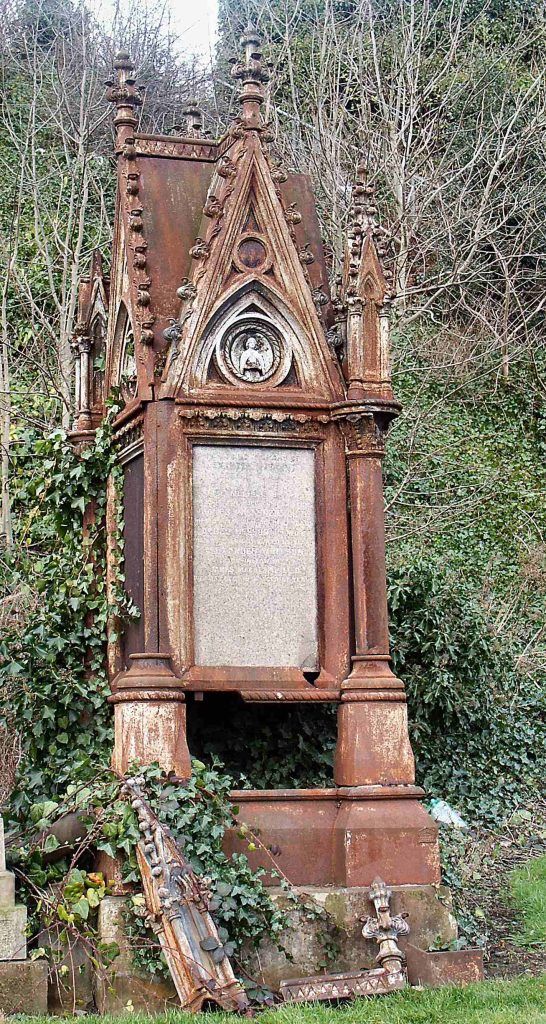
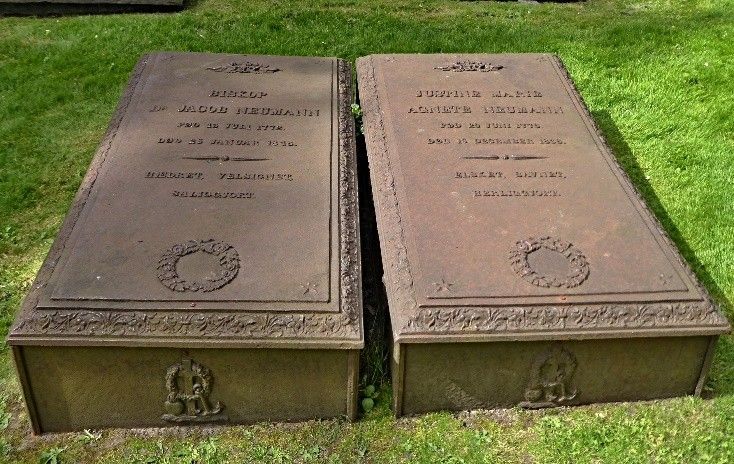
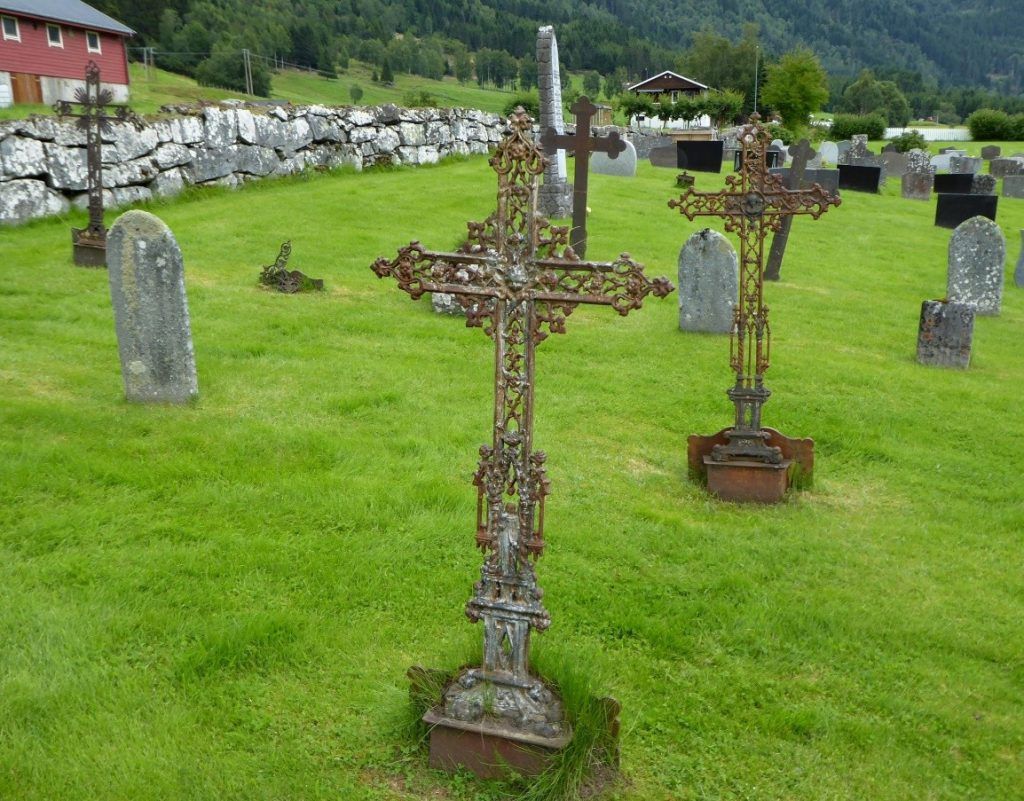
On a recent trip to western Norway during which I visited a few burial grounds I discovered that there was also a tradition of iron grave markers in Norway. There seemed to be two styles, ledger ‘stones’ as found in the graveyard of Mariakirken, Bergen
and vertical crosses as found at Bergen and also in the graveyard at Loen, Nordfjord (below).
******************************
Anyone who would like to help indexing the Burial Registers is very welcome to join us by contacting me at research@glasgownecropolis.org