Golf and the Doleman Family
Golf was a Scottish affair with little English interest until the middle of the 19thc. Between 1832 and 1892 Musselburgh became established as the main centre for manufacture, golf journalism, innovation and play supported by skilled club and ball makers and caddies.
William Doleman (Snr), (1807-1887) a Musselburgh tailor-turned-publican and his wife Catherine (Katie) Hamilton had seven children. The first-born son John was followed by three daughters, Agnes (Ann), Janet and Margaret then three more sons. These four sons were notable contributors to the game of Golf both in Scotland and England for over 70 years.
In October 1838 the Musselburgh Golf Club appointed William Doleman Snr as Attendant and in 1841 as Keeper of the Green.
The Doleman brothers
The four sons in chronological order were John, Alexander, William, and Francis Doleman. We are starting with William, the third son, as he is buried in the Glasgow Necropolis marked with a memorial stone erected by The Glasgow Golf Club.
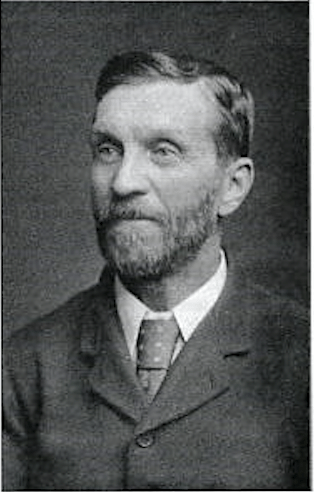
Third son William (Willie) Doleman (16 September 1839 – 8 July 1918) Buried in the Glasgow Necropolis in Compartment Quartus.
We are indebted to his great grandson, James McLean Doleman, for his family information and to Mungo Park whose great grandfather played golf against William and has recently published a book, ‘Musselburgh, Cradle of Golf’.
According to the above sources, William is known in Canada as “The Father of Canadian Golf” and is the first recorded and named golfer, as reported by a journalist, who saw him ‘hit a few balls on the ‘Cove Fields.’ practicing his golf on the Plains of Abraham, in Quebec in 1859 aged 21.
William played in the Amateur Championship and Open Championship most years from 1865 until 1884 and his best finish was third in 1872 at Prestwick when the Championship Cup (Claret Jug) was played for the first time. He was a regular competitor in the Amateur Championship from its foundation in 1885, making his last appearance at Royal Devon in 1912 at the age of 73.
In 1912 Willie was a member and secretary of Glasgow Golf Club, at Killermont, while living at 20 West Graham Street, and then at 132 Cambridge Street, Glasgow.
He was married to Annie Young who died in 1932 and was buried with him.
“A Veteran Golfer – Death of Mr. William Doleman”. The Glasgow Herald. 9 July 1918. p. 3.
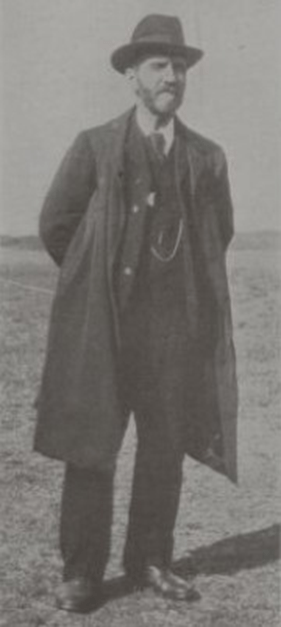
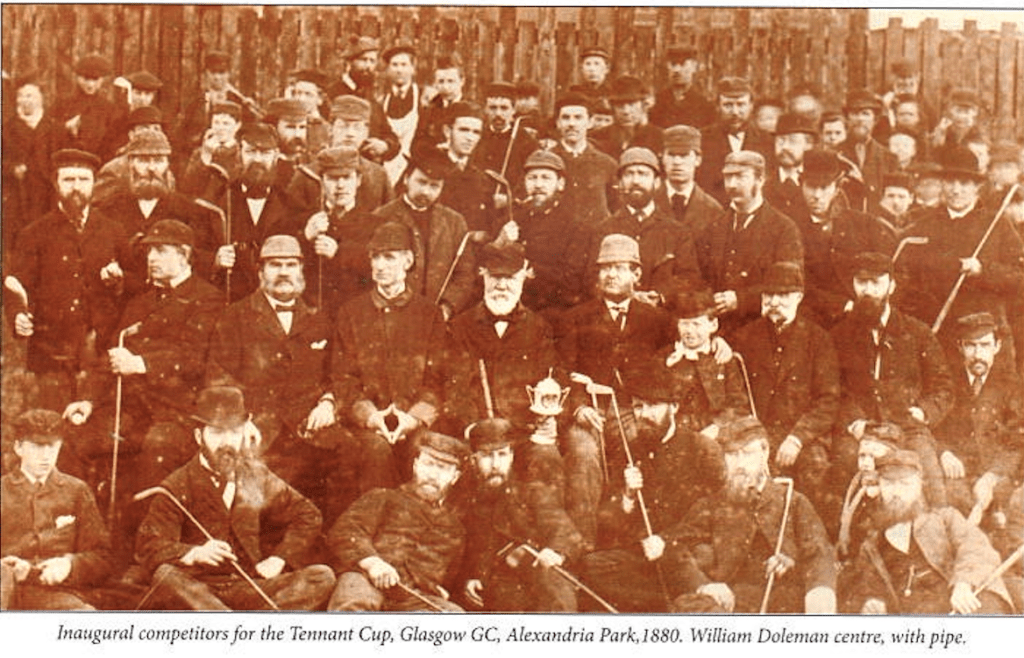
This is Alexandra Park which does have a golf course!! Now not maintained well by GCC
*Glasgow Golf Club. 1st course at Glasgow Green 1787 to ?, 2nd course at Queens Park 1870 to 1874, 3rd course at Alexandra Park (Still in use) 1874 to 1895, 4th course at Blackhill 1895 to 1904, Present site at Killermont since 1904
While the club was at Alexandra Park, on 27th March 1880, they initiated the Tennant Cup, which is still played and is probably the second oldest amateur stroke-play competition after the Standard Life medal at Leven. Today the initial qualifying rounds are at Glasgow Gailes with the final round at Killermont. (https://www.scottishgolfhistory.org/oldest-golf-clubs-societies/1787-glasgow-golf-club/)
THE HEADSTONE DESIGNED BY HENDERSON Thanks to Gary Nisbet for his research,
Andrew Graham (known as Graham) Henderson was born in 1882 in Auckland, New Zealand. He served his apprenticeship with Macwhannell & Rogerson from July 1898 to September 1903 , attending classes at Glasgow School of Art and joined the practice of Honeyman Keppie & Mackintosh in April 1904.
In his early days as assistant to Honeyman, Keppie & Mackintosh he worked on the Oval Room in the Ingram Street tearooms, being responsible for the interior, including the designs for the carpets and furnishings.
During the First World War Henderson served as an officer in the Glasgow Highlanders and was severely wounded, losing the use of his right hand. On his return to Glasgow, he resumed his architectural career with Keppie after teaching himself to draw and write with his left hand and formally filled Mackintosh’s vacant post as Keppie’s partner in 1919. Despite losing the use of his right arm, Henderson still enjoyed golf in his spare time. He died on 21 November 1963, survived by his wife, whom he married on 3 June 1919 and his daughter.
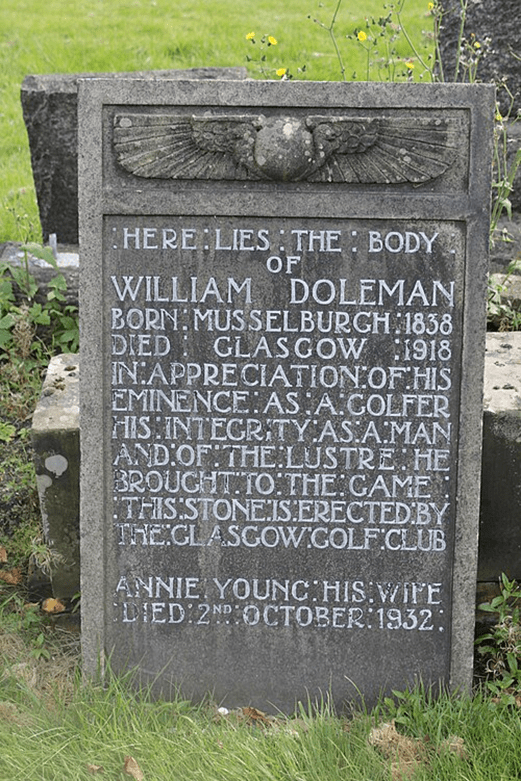
It is perhaps his interest in Golf which led him around this time to become the designer of the monument to William Doleman in the Necropolis. It’s an odd combination of the carved ancient Egyptian Uraeus, the winged globe, and the quaint, old English ‘Here Lies The Body of’ introduction to its dedicatory text. This would seem to be a rather unusual way of commemorating a 20th century sportsman. On Christian headstones the Uraeus usually represents the ascent of the soul to heaven, whereas the globe here is possibly meant to represent one of Doleman’s golf balls. It is often mistaken for that. The monument itself is a small stele, carved in granite possibly by J. & G. Mossman, and is currently separated from its base stone.
THE OTHER SONS
First son John Doleman (1826-1916)
John was born in premises on Musselburgh links and joined his father as a tailor. In 1839, his father had given up tailoring altogether and was the Race Stand Attendant looking after the golfers’ ‘boxes’, the forerunner of lockers. Of the four brothers John was the only one who never entered an Open. In 1864 John travelled south to Nottinghamshire and took his clubs for ‘the then apparently daft-like amusement of knocking a small ball about’ in the Meadows and founded the Bullwell Golf Course now the Nottingham Golf Club. He returned to Edinburgh and in 1900 he was working from 36 Wright’s Houses, Bruntsfield while residing at 12 Viewforth, Morningside, Edinburgh. He died in 1916 and is buried in St Michael’s Church Inveresk.
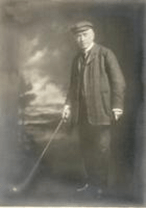
Second Son Alexander Doleman (1836-1914)
Alexander Hamilton Doleman was a journalist, writer and teacher and among the first amateurs to enter the Open Championship. The 1861 census lists A.H. Doleman living with his parents in the Commercial Inn, 7 High Street, Musselburgh. In 1858 he left for Blackpool where he founded a school. Known as the “Father of Fylde Golf” Alexander was a schoolmaster and local JP and also gave the world the phrase “Par for the course.” He was a member of Blackpool North Shore Golf Club, a pioneer of golf in England, founder of golf at Lytham and St Annes and one of the first club captains. Like his brother in Nottinghamshire he was presented with his portrait by the sportsmen in the Midlands. Known as A. H. Doleman he played for the original Open Championship belt on one occasion and tied for ninth place in the 1870 Open Championship at Prestwick. He died in 1914 aged 78.
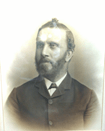
Fourth son Frank (1848-1929)
Francis ‘Frank’ Doleman lived at 11, High Street, Musselburgh where he made golf clubs. Frank entered the 1870 Open Championship and finished in fourteenth place. Frank was the first professional at Fortress and Rosemarkie Golf Club. In 1869, he went to London and Frank ‘Private’ Doleman was appointed professional at Royal Wimbledon Golf Club 1864-69. When he was not working on the Butts as a marker he was hired by the Club three days a week. In Match 1869 the Committee decided to apply to the Commanding Officer for permission to employ Frank Doleman as club maker and instructor to the Club for the winter months at eighteen shillings a week. The Commanding Officer was Lord Elcho son of the Earl of Wemyss who would have been familiar with the Doleman brothers at Musselburgh. Frank returned to Edinburgh in 1872 and was a member of Bruntsfield Allied Golf Club. The following year he moved back to Bruntsfield Links, Edinburgh and in 1871 he returned to Musselburgh and was manager of D. McEwan & Son from 1880 until 1896 when he took over the whole business himself. Frank lived at 6, Glen Street, Edinburgh and in 1900 he moved to 12, Viewforth. Morningside, Edinburgh. There is a fine example of Frank Doleman’s clubmaking in the Museum of Edinburgh in the Canongate with a clubhead made in 1884 from oak salvaged from a building demolished in the High Street, Edinburgh. When Frank died in 1929 his wife Violet Doleman continued to own the property until 1935.