The indexers have reached 1909, and the number of records indexed in the last three months is as follows –
| July 2026 | 301 |
| August 2026 | 200 |
| Septembe 2026 | 332 |
Our database of persons buried or commemorated in the Necropolis now stands at 54,683 entries at the end of September 2026 of which 21869 entries represent persons buried in common ground with no grave marker.
Richard S Cunliff, d. 1879 and his son James L Cunliffe d. 1896
by Stephanie Brady and Sharon King
Richard Stedman Cunliffe was one of the foremost industrialists of Victorian Scotland. In 1834, together with his cousin and business partner Charles Randolph, he founded Randolph & Co. in Glasgow’s Tradeston district.
While Randolph concentrated on engineering, Richard directed the commercial and financial affairs of the rapidly expanding business. The company entered a new era in 1852 when the gifted engineer John Elder joined the partnership, becoming Randolph, Elder & Co. Their pioneering development of the marine compound steam engine dramatically reduced coal consumption and revolutionised steam navigation across the globe. The business ultimately evolved into the Fairfield Shipbuilding and Engineering Company, which became one of the largest and most renowned shipbuilding firms in the world. Richard died at Carlton House, Stirling, on 8 January 1879 and is buried in Glasgow Necropolis, Sigma 44 together with his mother Margaret Stedman and his wives Agnes Malloch and Euphemia Lang.
James Lumsden Cunliffe was the only child of Richard Stedman Cunliffe and Agnes Margaret Malloch. His father, Richard, was born in Leipzig, Germany, on 20 October
1804, while his mother, Agnes, was born in Paisley on 25 September 1812. They married in the Gorbals, Glasgow, on 7 April 1838. Agnes died in 1856, after which Richard married Euphemia M Lang in 1862 and went on to have a further ten children.
Following in his father’s footsteps, James established himself within the Clyde shipbuilding industry. During the 1870s he entered into partnership with the marine engineer David J. Dunlop to form the shipbuilding and engineering firm Cunliffe & Dunlop. Operating from the Inch Yard at Port Glasgow, the company built iron and steel steamships, passenger vessels and specialised cargo ships.
James also demonstrated an inventive mind. In 1878 a notice appeared in the Commissioners of Patents Journal recording an application for an invention entitled “Improvements in valves for the air pumps of steam engines.” The invention, communicated to him by James Richard Thomson of Callao, Peru, reflected the international exchange of engineering ideas that characterised the period.
After retiring from the partnership in 1881, James concentrated on his interests as a shipowner. He removed to Aberdeenshire and became an owner of steam trawlers operating from Aberdeen. David J. Dunlop continued operating the Port Glasgow yard under the name of D J Dunlop & Co until his death in 1911, during which time the business constructed more than one hundred vessels. The firm later became known as Dunlop, Bremner & Co and was finally bought by Lithgows Ltd and closed in 1926.
James’s personal life was marked by both happiness and considerable tragedy. He married three times.
His first marriage was to Eleanor Bowes Brown of Kilmarnock on 21 June 1865 at Govan, Glasgow. Sadly, Eleanor died less than a year later on 1 March 1866, aged only twenty-two.
On 25 May 1869 James married Jane Margaret Malloch at Paisley Abbey. Together they had three sons. Their eldest, Richard Stedman Cunliffe, was born in Glasgow on 23 March 1870 and, according to the 1891 census, was a twenty-one-year-old student of agriculture before later emigrating to Canada. Their second son, William Malloch Cunliffe, was born at Port Glasgow on 11 December 1872. By 1891 he was serving as an apprentice steam engineer and also eventually settled in Canada.
Their youngest son, Percy Barton Cunliffe, was born at Port Glasgow on 9 June 1874. A student of agriculture in the 1891 census, Percy later emigrated to the United States.
Tragedy struck again when Jane died on 29 March 1876 at the Côte d’Azur in France, aged just thirty-four. Although her cause of death is not recorded here, it is possible she had travelled there in the hope that the region’s mild climate would aid her recovery from tuberculosis, for which the Riviera had become a well-known destination for convalescence during the Victorian period.
It may only be a coincidence that in 1881 the widowed James was employing a housekeeper named Mary Clarke and that in 1886 when he married for a third time his bride was named Mary Clarke. Mary Clarke the housekeeper was born in Ayr c1840 according to the 1881 census and James’s new wife had been born in Ayr on 19 January 1839. Mary survived her husband by more than twenty years, dying on 14 January 1917 aged seventy-six. All three of James’s wives are buried alongside him in Compartment Epsilon in Glasgow Necropolis.
By the time of his death, James had become a prosperous shipowner. He died in Aberdeen on 15 February 1896 while residing at Mavisbank, Banchory-Ternan. His estate, confirmed at Stonehaven on 15 June 1896, was valued at £13,428 14s. 8d.— equivalent to approximately £2.3 million today—reflecting the success he had achieved through a lifetime in Scotland’s shipbuilding industry.
Sources: Ancestry.com
https://www.gracesguide.co.uk/Richard_Stedman_Cunliff
https://.www.gwsfhs.org.uk/surname/cunliff
https://.www.glasgowwestaddress.co.uk/1888_Book/Fairfield_Shipbuilding_&_Eng ineering_Co_Ltd.htm
https://en.wikipedia.org/wiki/Fairfield_Shipbuilding_and_Engineering_Company
Robert Laing McGregor, died 1896
by Stephanie Brady and Sharon King
Robert Laing McGregor (known as Roy) was born in 1892 in Glasgow, the youngest child of William McGregor, a saddler originally from Greenock (born 1853), and Janet Dalgleish McGregor, born in Glasgow in 1854. The couple had married in Kinning Park in 1881 and established their home at 85 John Knox Street, Glasgow, where they were living at the time of the 1891 census.
Robert was one of five children. His elder siblings were John (born 1883), Thomas (born 1886), William (born 1888), and his sister Janet (born 1890). The family lived in a densely populated urban area of Glasgow during a period of rapid industrial expansion, where street traffic and horse-drawn transport formed a constant part of daily life.
Tragically, Robert’s life was cut short in early childhood. On 4 April 1896, while just three and a half years old, he was fatally injured in a road accident on John Knox Street. Contemporary reports describe how a hansom cab struck the child, causing severe injuries including fractures of the ribs and extensive damage to the lungs, kidneys, and liver.
The incident was widely reported in the Glasgow press. The North British Daily Mail recorded that the cab driver, Alexander McGibbon, was alleged to have been travelling at speed after transporting passengers from an international football match. Witnesses reported that after the collision the cab continued on its way before police were alerted and the driver was later arrested in Gourlay Street.
McGibbon was subsequently tried at the Glasgow Sheriff Criminal Court. The Glasgow Herald reported that during proceedings the evidence was contradictory, with no conclusive identification of the driver or his cab. The defence argued that discrepancies in witness descriptions suggested another vehicle may have been involved. After a five-hour trial, the jury returned a majority verdict of “not proven,” and McGibbon was discharged.
Buried in Sextus 151 on 8th April Robert was eventually joined there by his father in 1927.
Firemen buried (or not) in Glasgow Necropolis
Some readers will be familiar with the memorial in Compartment Epsilon in the Glasgow Necropolis to the victims of the Cheapside Street fire in 1960 and the Kilbirnie Street fire in 1972.
They may not realise that there is a group of more modest memorials erected by the Corporation of the City of Glasgow to five firemen who lost their lives in fires in 1898 and 1899 and to four who were killed in 1927.
On 7th January 1898 a fire broke out in the premises of W & R Hatrick & Co, wholesale and export chemists and druggists at 152-170 Renfield Street. Four men died fighting the fire. They were James Hastie, foreman at the Central Fire Station, College Street, John Battersby, first class fireman also from the Central Fire Station,
David Smith and Charles Orr, both second class firemen from the Northern
Division. All four men were married. They were buried in compartment Sextus in the Necropolis on the 11th January under identical headstones which each said “Erected by the Corporation of the City of Glasgow In Memory of XXX who was killed in the execution of his duty at the fire in Renfield Street on the 7th January 1898”.
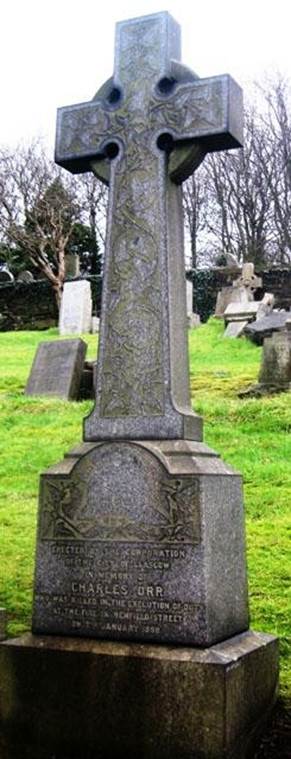
Headstone on the grave of Charles Orr.
The fire was widely reported in the newspapers of the time; see, for example, the Glasgow Herald 8th January 1898 page 8.
The following year Robert Forrest, fireman, lost his life at Dalquharran Pit, Ayrshire. He was stationed at the Central Fire Station in College Street and was ordered to take a hose to Dalquharran Colliery, Dailly where a fire had broken out. He caught the 11:15 train on Friday 20th October 1899 and after delivering the hose was persuaded to stay and help fight the fire. He went underground with a party but became unwell. Although he was immediately brought to the surface he died from the effects of choke damp (carbon dioxide). He was buried close to the graves of the four men who died in 1898 under an identical headstone.
It should be noted that in all five cases described above the lairs must have been given to the families of the deceased because other burials occurred in them later although no other names are found on the stones.
In December 1927 a fire occurred which cost four firemen their lives. The fire broke out on Christmas Eve in Graham Square, off Gallowgate. James Conn, Harry W. M’Kellar, David Jeffrey, and Morrison Dunbar, all from Central Division, were killed when some of the floors of the building collapsed. It took several days to recover their bodies and all four men were buried together in one grave in compartment Sextus on 30th December (below). In this case there have been no further family burials in the grave.
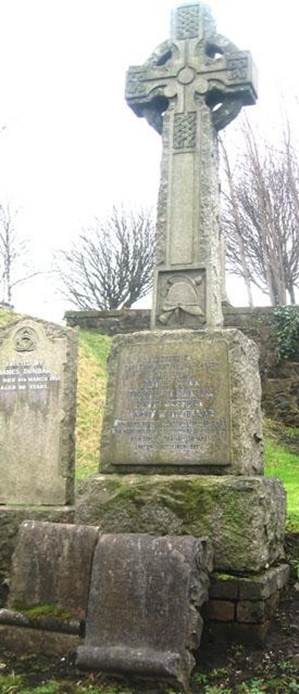
Note the fireman’s helmet on the stone.
Although the Fire Brigade memorial in Epsilon is regarded primarily as the memorial for the Cheapside Street and the Kilbirnie Street fires it also commemorates five firemen killed in the line of duty but buried elsewhere.
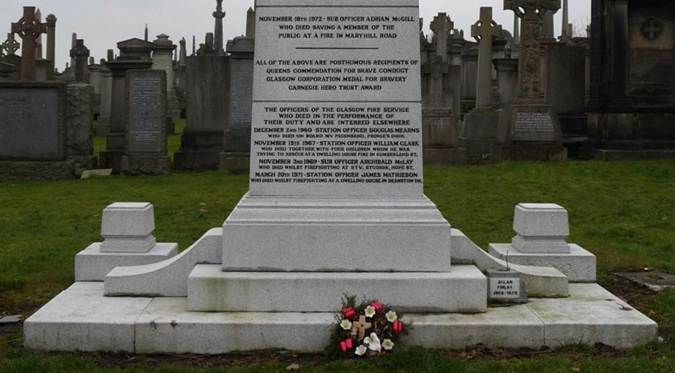
Their names can be found on the back of the memorial. They are:
Station Officer Douglas Mearns died on 2 December 1960, aged 45 fighting a fire on board MV Pagensand in Princes Dock and buried in Craigton Cemetery.
Station Officer William Clark died on 15 November 1967 from a heart attack, aged 47. He died together with four children [Catherine, John, James and Margaret Coyle] whom he was trying to rescue at a dwelling house fire in 10 Cumberland St and cremated at the Linn Crematorium
Sub Officer Archibald McLay died on3 November 1969, aged 35 whilst firefighting at STV Studios Hope St and buried in the Western Necropolis.
Station Officer James Mathieson diedon20 March 1971 from a heart attack, aged 43 whilst firefighting at a dwelling house in Deanston Dr. His place of burial is unknown at present.
Sub Officer Adrian McGill diedon 18 November 1972, aged 34 saving a member of the public at a fire in Maryhill Road. He is buried in St Conval’s Cemetery, Barrhead
David Dow, Died 1892
by Stephanie Brady and Sharon King
David Dow was born on 29 January 1842 in the Gorbals district of Glasgow, the son of David Dow, an accountant, and Margaret Laidlaw Dow, a teacher of painting. His parents had married in Glasgow in 1835 and raised their family during a period of rapid industrial growth in the city.
David grew up with three siblings. His eldest brother, James, born in 1838, became a law clerk; his younger brother, John, born in 1840, worked in the cotton-spinning industry; and his sister, Margaret, born in 1850, was employed as a lace design assistant. The occupations of the Dow family reflect the diverse professional and industrial opportunities available in Victorian Glasgow.
Unlike his brothers, David pursued a creative profession, establishing himself as a photographer. Photography was still a relatively new occupation during the mid-nineteenth century, requiring both artistic ability and technical expertise. Over the years, he lived at a number of addresses across Glasgow’s west end and surrounding districts, including Willowbank Street, Kelvin Drive, Cowan Street in Hillhead, Bothwell Place, Ruthven Street in Kelvinside, McCowan Place on Dumbarton Road, North Street, and finally Sandbank Buildings on Clyde Street, Partick.
By the autumn of 1889, however, David’s health had deteriorated significantly. On 4 October 1889 an application for poor relief was submitted to the Parish of Govan Combination on his behalf.
Then aged forty-seven and unmarried, he was described as being wholly disabled, with his condition recorded as “supposed insanity.” Both of his parents had already died, and it was his sister, Margaret, who applied for his admission to an asylum, reflecting the difficult circumstances faced by families caring for relatives with severe mental illness in the Victorian era.
Following examination, David was certified insane, with responsibility for his care assigned to the Parish of Govan. On 5 October 1889 he was admitted to Kirklands Asylum, Bothwell. The 1891 census records him there as a forty-eight-year-old photographer and patient.
After approximately two and a half years of treatment, he was discharged on 5 April 1892, his condition having been officially recorded as recovered. David collapsed and died in the Central Station, Glasgow on the afternoon of 8 April 1892 as reported in the Glasgow Daily Mail of the following day:
Sudden Death at the Central Railway Station, – Yesterday afternoon David Dow, 48 years of age, a photographer, who resided at 5 Alberta Terrace, Byers Road died suddenly at the Central Railway Station. Mr Dow was about to take a train for Fallside, and while walking along the platform he dropped down and expired in a few minutes. Heart disease is supposed to be the cause of death.
It appears he may have been making his way to the asylum, at the time of his death, as Fallside station is near to Kirklands Asylum.
It seems David’s parents were members of Wellington Street UP Church before it moved to University Avenue as he was interred in Compartment Alpha, lair 85.28. Alpha 85 is a large plot bought by Wellington Street UP Church to receive the remains of former members of the congregation exhumed from the crypt before the demolition of the original church. Alpha 85 is subdivided into more than 100 subplots. Six much decayed adult coffins from Wellington Street Crypt are recorded as being placed in 85.28 before the burial of his mother Margaret Dow in 1886 and his own burial in 1892. No stone marks the location of the grave.
Source: Mitchell Library Archives
Andrew Miller Dairon, Died 1894
by Stephanie Brady and Sharon King
Andrew Miller Dairon was born in Glasgow in 1838, the eldest son of James Dairon, a prominent ornamental plasterer and respected amateur geologist, and Catherine Falconer. He grew up within a large and industrious family whose name became closely associated with the development of Victorian Glasgow, particularly the emerging suburb of Dennistoun.
Following in his father’s footsteps, Andrew trained as an ornamental plasterer, joining the successful family business. His father, James Dairon, was one of Glasgow’s best known master plasterers, employing dozens of craftsmen and apprentices. In 1861 James built Fern Villa on Wester Craig Street, recognised as the first house constructed in Dennistoun, an area that would become one of Glasgow’s most desirable residential districts.
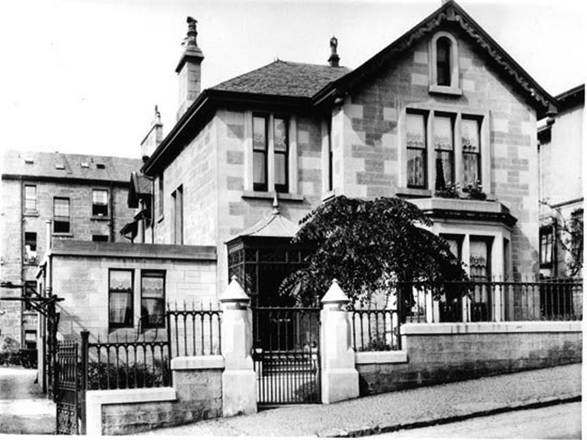
Fern Villa – Source Dennistoun Conservation Society
On Christmas Eve, 24 December 1875, Andrew married Jane Bulloch at
Rutherglen. Their happiness was tragically short-lived. Their only child, Jane Bulloch Dairon, was born on 15 October 1876 at 50 Dunchattan Street, Dennistoun. Just six days later, on 21 October 1876, Jane died, leaving Andrew a widower with a newborn daughter. He returned to his parents’ home at Whitehill Street, where his family helped care for the infant. Sadly, tragedy struck again when little Jane died on 17 April 1878, before reaching her second birthday.
The Dairon family enjoyed a reputation that extended well beyond the building trade. Andrew’s father, James Dairon, combined his successful business career with a lifelong passion for geology. A Fellow of the Geological Society of Glasgow, he became recognised as one of Scotland’s leading authorities on Silurian graptolites, publishing numerous scientific papers and creating detailed teaching models admired for both their scientific accuracy and artistic craftsmanship. His extensive fossil collection, comprising many thousands of specimens, was presented to Glasgow Museums in 1902 by his daughter Catherine Fleming.
The collection was regarded as one of the most significant contributions to the city’s palaeontological collections and played an important role in documenting the geology of Scotland’s Southern Uplands. James worked closely with the pioneering geologist Professor Charles Lapworth, whose research transformed the understanding of Scotland’s complex geological structure.
Andrew also witnessed significant events within his own family. His brother David emigrated to Canada before 1871, where he established himself as a plasterer, mason, and later a landowner in British Columbia. David is credited with constructing the marble staircase in Vancouver’s old Carnegie Library and later became a respected pioneer in the Maple Ridge area, donating land for the first church in Yennadon.
When Andrew’s father, James, died on 30 November 1891, he left an estate valued at £13,292 8s 4d—equivalent to approximately £2.2 million today. The administration of the estate became the subject of lengthy litigation after several members of the family challenged the trust deed, alleging it unfairly favoured sons, Edward and David Dairon and their descendants.
After years of legal proceedings, the Court of Session ultimately rejected the claims, upheld the validity of the deed, and ordered the unsuccessful challengers to pay the legal costs.
Andrew Miller Dairon is buried with his father James and brother James in Compartment Quintus lair 26. His mother Catherine Falconer and sister Helen are buried in the adjacent grave Quintus 27.
Source(s): https://mapleridgemuseum.org/david-dairon-family/
Dennistoun Conservation Society
John Robertson, died 1894
By Stephanie Bradie and Sharon King
John Robertson was born in the Perthshire village of Dunning in 1819, the son of John Robertson, a respected schoolmaster, and his wife, Euphemia Miller. Raised in an educated household, John embarked on a career in banking, beginning as a bank clerk.
On 7 August 1851, John married Emma Newton at Christ Church in New Mill, Yorkshire. Emma, born on 15 June 1827 at Stagwood Hill, Yorkshire, was the daughter of Isaac Parker Newton, a landowner, and Hannah Maria Dunn. Following their marriage, Emma left her Yorkshire home and moved north to Glasgow to begina new life with her husband.
By the time of the 1861 census, the couple had established themselves at 16 Lansdowne Crescent in Glasgow’s fashionable West End. John’s career had progressed, and he was employed as a bank teller. A decade later, they had moved to 47 Queen Street, reflecting another chapter in their lives together.
Although John and Emma had no children, they built a comfortable and cultured life in Glasgow. They eventually settled at 5 Athole Gardens in the West End, where they became members of the Glasgow Fine Art Institute. Their shared appreciation for the arts formed an important part of their lives and reflected their place within Glasgow’s growing cultural community.
In the summer of 1884, Emma returned to Yorkshire, where she died on 24 August at the home of her sister, Margaret, at Moorcroft House, Wooldale. She was laid to rest three days later in the churchyard of Christ Church, New Mill, the place where she and John had exchanged their wedding vows thirty-three years earlier.
Although buried in Yorkshire, Emma is also commemorated in Glasgow. Her name is inscribed on the side of the Robertson family obelisk in Epsilon 530, a lasting memorial to the couple’s life together.
John continued to live at 5 Athole Gardens until his death on 19 December 1894, aged seventy-six.
Having no direct heirs, he left a legacy that reflected the interests he and Emma had shared throughout their marriage. In his will, he bequeathed to the City of Glasgow Galleries a painting by the French artist Paul Constant Soyer (see below image), ensuring that their love of art would continue to enrich the city long after they were gone.
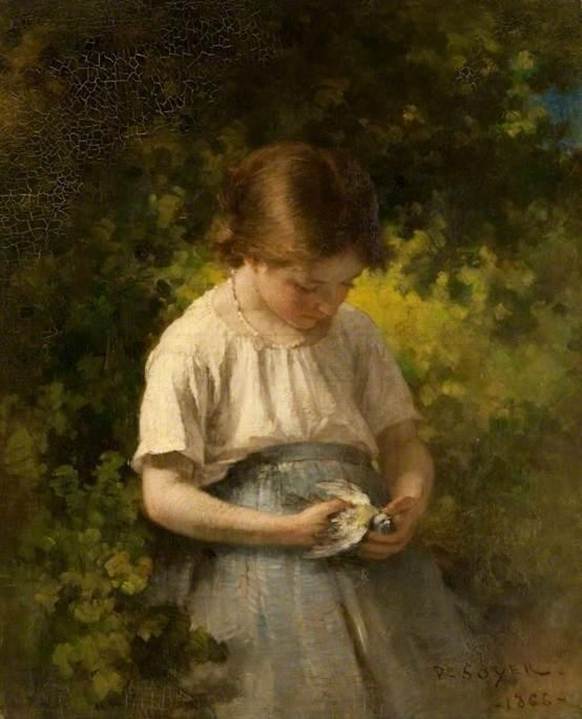
The dead bird
Image credit – Glasgow Life Museums
Sources
Art UK – https://artuk.org/discover/artists/soyer-paul-constant-18231903
British Newspaper Archive – Glasgow Herald 08/03/1895
Harriet and Joseph Agnew
by Stephanie Brady and Sharon King
Joseph Agnew (c. 1833–1920) and Harriet Collins (c1833-1914) married on 9 January 1861 in the Gorbals. Joseph practised as a surgeon dentist from premises in Bath Street and the couple lived in several parts of Glasgow, including Crosshill and later Partick.
Harriet’s greatest historical significance lies in her role as a founding member of the Glasgow Society of Lady Artists in 1882, and of which she became the third President around 1886.
She painted primarily still-life subjects, especially flowers. One of her best-known paintings was Wallflowers, exhibited in 1881. Contemporary reviewers praised it as being “remarkably true in colour,” suggesting she had a strong reputation for careful observation and colour work. In 1882 she exhibited a painting of chrysanthemums at the Glasgow Institute of Fine Arts exhibition.
Although she never became as famous as later members of the Glasgow School, she was well respected among Glasgow’s professional women artists.
At that time, women artists had very limited opportunities to exhibit their work or join professional art organisations. Harriet was among the small group of women who created a society specifically to support female artists through exhibitions, life classes, and professional networking.
The Society was struggling financially in its early years, and Harriet helped guide it through that difficult period. Contemporary recollections describe her encouraging members to increase subscriptions and expand exhibitions rather than allow the organisation to fail.
The Glasgow Society of Lady Artists became one of the most influential organisations for women artists in Britain. It eventually acquired its own clubhouse at 5 Blythswood Square, considered the first residential club in Scotland run by and for women artists. The Society continued, with later changes of name, into the modern Glasgow Society of Women Artists.
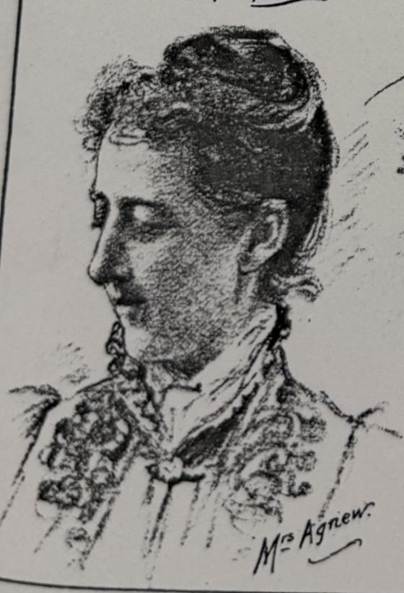
The Baillie cartoon supplement 11 December 1895. Mitchell Library 891004/r – Press Cuttings
Harriet died on 17 November 1914 at 3 Eglinton Drive, Glasgow. Her death certificate records heart failure as the cause of death. She was about 78 years old. In 1878 an interesting article appeared in the British Medical Journey regarding Joseph Agnew, when his apprentice James Bryce alleged Joseph carried out mesmeric (hypnotic) experiments on him at his Crosshill home during 1877–78. Mesmerism attracted interest from some doctors and dentists of the period, who believed altered mental states might reduce pain or reveal psychological phenomena before chemical anaesthetics became commonplace.
Sequel to Magnetic Experiments
An action of an unusual character has been commenced in the Court of Session, Edinburgh, at the instance of James A Bryce, a minor residing in Glasgow, against Joseph Agnew, surgeon-dentist, concluding for £500 and expenses. The pursuer was in the defender’s employment, as apprentice, from November 1876 to February 1878, his hours being from 9am to 5pm. He frequently went also in the evening and assisted the defender in extra work. On many of these occasions, the defender induced the boy to allow himself to become the subject of experiments in magnetism. These experiments, so far as visible and known to the pursuer, consisted in placing large magnets in front of, behind and above the head and they were also connected to his head by magnetic chains. Besides these, there were also rods of magnetised iron placed about the room, and the pursuer was made to hold himself in such as position as to allow himself to fall under the influence of magnetism. These experiments, and others of a similar nature, were carried on for several days running in January and February 1878 and frequently for about two hours a time. The defender told the pursuer not to tell anyone of them, particularly his parents. During the progress of these experiments, and in consequence of them, the mind of the pursuer became seriously affected, and, about the end of February, he became insane. His physical health was also thereby greatly injured and he had not yet recovered either mental or physical health. Before the experiments began, his health was excellent. These experiments were, it was submitted, dangerous to health and not within the line of the defenders profession or the purpose for which the pursuer was serving him. The defender stated that he was interested in the subject of magnetic sleep, and that the experiments he had made on the pursuer, never lasted more than a quarter of an hour, and had no result, the pursuer having not being on any occasion under the influence of magnetism. No apparatus was used, except magnets hung by a string from wooden supports. He admitted the boy had become insane; but stated he had only recently become aware of the fact that, before entering his service, the boy had shown signs of mental derangement. The case comes on for trial later. British Medical Journal – 7th September 1878 p382
Joseph eventually paid James Bryce £538.
Joseph died in February 1920 aged 88 leaving his entire estate to a Miss Alice Johnson of 1 Newton Terrace.
Harriet and Joseph are both buried in a lair (Epsilon 530) belonging to John Robertson but are not commemorated on the stone. Given their artistic interests the two couples seem to have been close friends as the Robertsons are found in the 1881 census visiting the Agnews at their (holiday?) home in Largs.
New Profiles
Sergeant Christopher S McGregor
James and Robert Lillie
John Wright