The indexers have reached 1888, and the number of records indexed in the last three months is as follows –
| July 2025 | 304 |
| Aug 2025 | 343 |
| Sept 2025 | 375 |
Our database of persons buried or commemorated in the Necropolis now stands at 53004 entries at the end of September 2025 of which 21858 entries represent persons buried in common ground with no grave marker.
Joseph Gardiner died 1886
STARTLINGLY SUDDEN DEATH OF A GLASGOW TOWN COUNCILLOR
It with regret that we (Glasgow Herald) have this morning to record the death Councillor Joseph Gardiner, which took place in the Trades Hall last night. A meeting of the Tailors’ Incorporation was held in the lesser hall for the purpose of electing a member of the Master Court and an auditor in room of the late Mr J. Stewart. Mr Gardiner was elected a member of the Master Court and was thereafter appointed auditor. In taking his seat Mr Gardiner, in a few graceful remarks thanked the brethren for having elected him to these offices. It was the third time, he said, that he had been chosen as a member of the Master Court, and he hoped to be able to perform the duties allotted to him to the satisfaction of all concerned. He had scarcely resumed his seat when he was observed to lean forward, and the gentlemen who sat next him just heard the whisper, “What is it?” when the shaking of the hands and the paleness of the countenance warned those present that something was wrong. Mr Gardiner fell gently forward into the arms of his friends, and within five minutes he had passed away. Medical aid was at once sought, and Dr Findlay, of George Street, was speedily in attendance. He was followed by Dr Carmichael, but their services were of no avail. The sad event caused considerable sensation, and the business of the meeting was at once brought to a close. Information was sent to Mrs Gardiner and the other members the family by Deacon Imrie, Mr W. C. Coghill, and Treasurer Waddel, and the body was in the course of the evening removed to the family residence, Westbourne House, Great Western Road. The deceased gentleman, who was 69 years age, has been for many years a prominent merchant in the city.
It is nearly 46 years since he commenced business, and though the firm has borne several designations, he was the principal and moving spirit in it. By his enterprising yet careful and cautious methods he gradually built up the large concern which is now known as that of Messrs Gardiner & Co., tailors and outfitters. and contractors for the army, volunteers, and police, having its headquarters at 131 St Vincent Street, Glasgow, with establishments in Argyll Street, Glasgow, and in London. It is between 30 and 40 years since Mr Gardiner joined the Tailors’ Incorporation, and as he said himself a few minutes before his death, he had just been elected for the third time a member of the Master Court. Although a capital business man, it is only within recent years that he has taken an active part in public affairs. On the retirement, in November, 1883, of the late Bailie Mowat from the representation of the Seventh Ward in the Town Council, Mr Gardiner was asked to become a candidate, and though opposed by Mr David M’Clure he was returned at the head of the poll He was appointed a member of the Bazaar, Gas, Statute Labour, Health, and Watching and Lighting Committees, and in all of these he gave valuable assistance. As a member of the Juvenile Delinquency Board his advice was eagerly sought, and he was always willing to do all in his power to help forward the particular work which the Board had to discharge. In the Town Council he did not often take part in the public debates, but chose rather to devote his energies to the quieter but more useful work of the committee-room. Mr Gardiner leaves a widow, five sons, and one daughter to mourn his loss.
Glasgow Herald 27 May 1886
Alexander Stewart died 1870
Over the course of the Necropolis’s history it is only natural that errors should have crept into the records kept. Some are easily spotted by comparing the information on the stones with that found in the Burial Registers but others are more subtle. It was only by chance that I spotted a ‘problem’ with lair 189 in Compartment Eta. This is one of the lairs purchased by the Royal Infirmary for the burial of their staff. In 2021 the Friends of Glasgow Necropolis refurbished the nurses’ stones to show their gratitude for the work of NHS staff during the COVID pandemic.
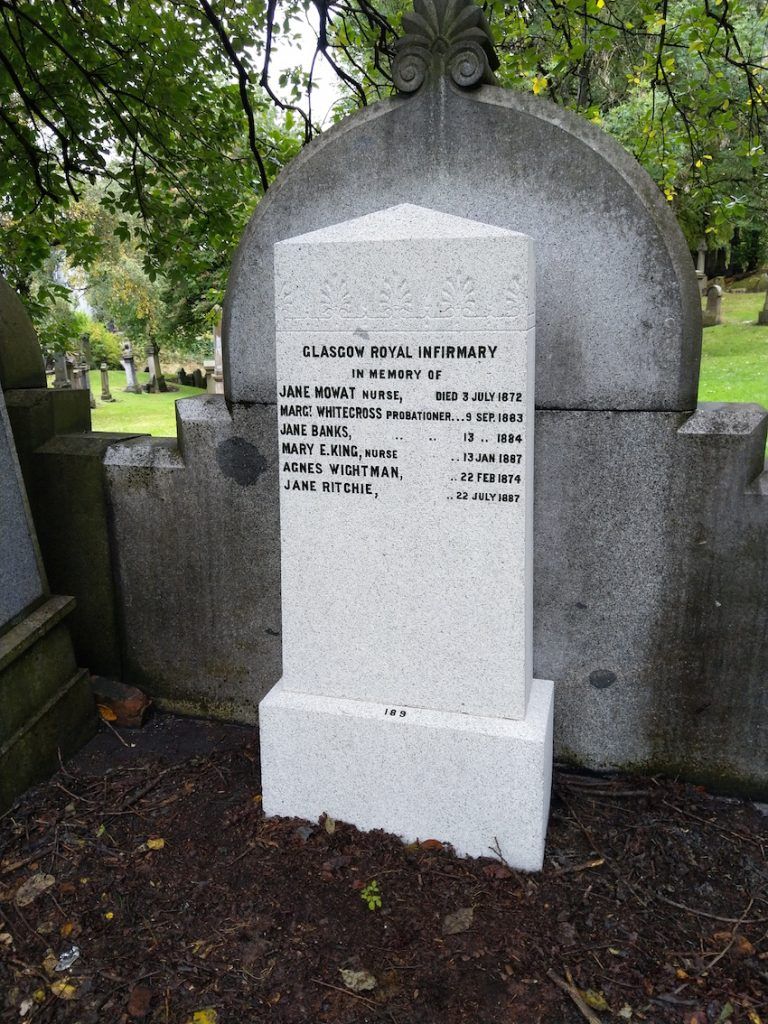
There are five names on the stone implying five burials but there may be a sixth burial if the entry in the Burial Register for Alexander Stewart in 1870 is correct. There can be no doubt that the entry for 3 October says that Alexander Stewart, aged 40 years, of the Royal Infirmary was buried in Eta 189; the ink is black and the handwriting is clear. The date of each burial should be recorded in the Index to the Burial Registers against the lair in which the burial took place, but in Alexander’s case there is no entry against Eta 189. Either Alexander was buried in Eta 189 and the clerk forgot to make an entry in the Index or Alexander is buried elsewhere in the Necropolis and the location of Eta 189 found in the burial Register is wrong. Alexander Stewart and his wife, Helen Grant, lived at 12 John Knox Street near the Infirmary but Alexander died in the Infirmary after suffering typhus fever for eleven days. The occupation on his death certificate described him as a porter (pensioner) and I wonder if it is just possible that he was a porter in the Royal Infirmary which might account for his burial in an Infirmary lair. Pure speculation!
Persons aged 90 or over buried or commemorated in the Glasgow Necropolis
A comment from an indexer who found the burial of a 97 years old woman in the Necropolis led me to make a survey of how many people of 90 years or over are buried or, at least, commemorated on a stone in the Necropolis. A search of the database found 449 records for 335 females and 114 males. This figure could increase as the indexing of the burial registers continues.
The oldest person so far is Hugh Loudon (Primus 109) who died in Albuquerque on 23 Jan 1965 and was buried in the Necropolis on 21 May 1965. His age is given as 107 years. Another 6 persons aged 100 years or over died between 1863-2004. Jessie Pringle (Sextus 44), daughter of William Pringle and Mary Jane Mowat born in Dennistoun in 1878 died a hundred years later in 1978. She lost her father at the age of 26 when he was drowned at sea (see Grave Matters 24 for an account of his death).
The oldest woman found is Isobel A Smellie (Quartus 200-201), wife of Alexander Glen who died on 5 April 2004 aged 103. We do not have access to such an up to date burial register so cannot confirm whether she is actually buried there. There is no such doubt about the next oldest woman Janes Gibson (22 May 1785 to 25 November 1887). Her family burial plot was in the Ramshorn but by the time she died she was buried with two married sisters in a Fleming grave in Compartment Sigma.
296 of the sample were born before 1855 and 153 in 1855 or later. 1855 is a very important year in Scottish genealogy as it marks the start of civil registration and, in particular in this case, the registration of births. Birth certificates ought to be available for the 153 people born since 1855 which could be used to substantiate their claimed age at death. Prior to 1855 one is forced to rely on the incomplete records of baptisms found in the OPRs or family records. 46 gravestones give dates of birth (at least a year) as in the case of Jane Gibson, above. A lack of birth records always means that many of the recorded ages are suspect.
Using the ages found on the gravestones or in the burial register the year of birth can be estimated by simple subtraction. The earliest birth was in 1739 – James Willison, farmer who was buried in common ground in 1837 aged 98.
Hugh Grant’s Glasgow ancestors
This story is another example of related families found in the Necropolis. It starts with Hugh Fulton who married Janet Strachan at Carmunnock in 1819. By 1823 the couple had moved to Glasgow where Hugh first appears in the Glasgow directory for that year as a grocer at 47 High Street. We learn from the 1841 census that the couple had seven children living with them at 93 High Street, Glasgow. Hugh was aged about 50 that year and is very likely the Hugh Fulton, provision merchant, High Street Glasgow who died in 1844 aged 53 years. By 1851 when the census was taken again Janet Strachan described herself as a widow. Janet survived Hugh for more than 40 years and didn’t die until 1893. Hugh Fulton was a grocer in 1841 and the family seems to have prospered after his death as his son, David, was able to afford to purchase lair 308 in Compartment Epsilon in 1883 to bury his son David, jnr. Father David followed his son to the grave later that year and Janet Strachan joined them in 1893.
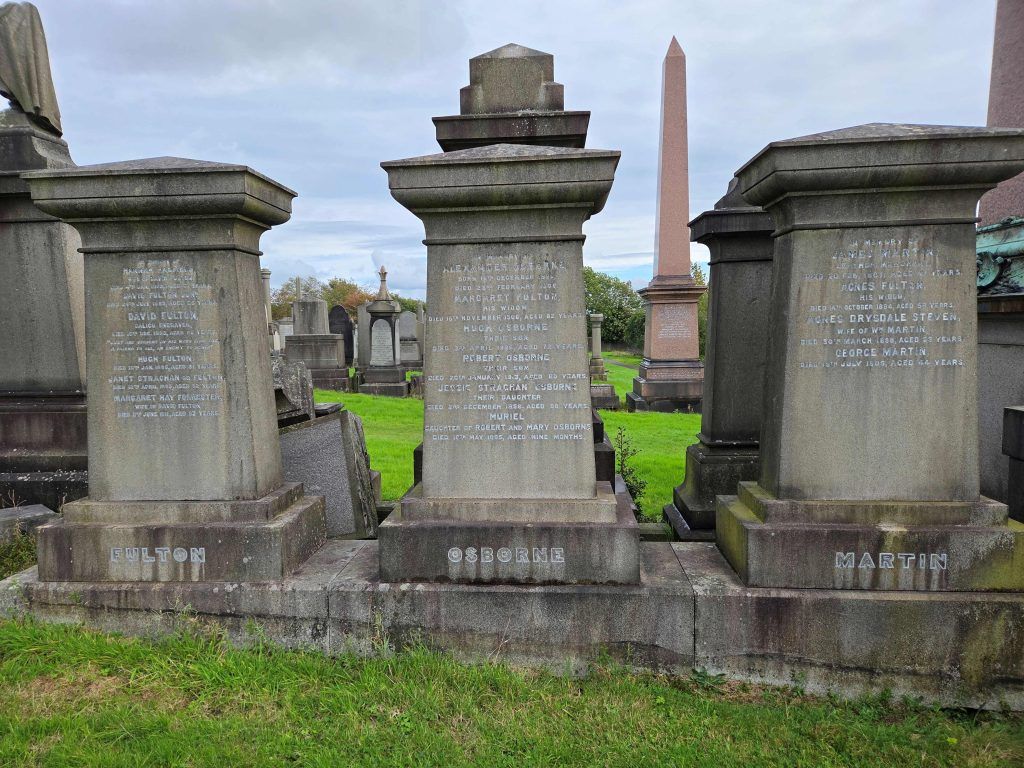
The central stone commemorates Margaret Fulton and Alexander Osborne who play no part in this story.
One of Hugh and Janet’s daughters, named Agnes Fulton, married James Martin in 1856. James was the proprietor of Martin Leather Merchants established in 1830 in Gallowgate, Glasgow. Their warehouse was at 63 Brunswick Street, Glasgow. In 1850s the business expanded and opened works at Albion Leather Works, London Road, Bridgeton, Glasgow. After his death, his sons William and James continued operating the business as W & J Martin Tanners, Curriers and Leather Merchants. Like her mother Agnes was widowed early when James died, aged 46, in 1869 leaving her with seven children. Lair 306 in Compartment Epsilon was obviously bought on James’s death and later accommodated Agnes, their son George and daughter in law Agnes D Steven the first wife of William Martin the eldest son of the family.
A third family who owned a lair in the Necropolis was that of Alexander Robertson and Jessie Hamilton. They purchased lairs 1 & 2 in Compartment Sextus and were buried in 1908 and 1904 respectively. Alexander Robertson was a much respected physician in Glasgow. The only daughter of the couple was named Isabella Hamilton Robertson after her maternal grandmother as was common practice at this time.
When Isabella Robertson and William Martin married in 1898 it was a second marriage for each of them. William had lost his first wife, Agnes, in 1895 and buried her in his parents’ lair Epsilon 306, and Isabella’s first husband, Frederick T Humble died in 1891. Isabella and William married at Glasgow in 1898 and had one child, Jessie H Martin in 1900. Once Jessie H Martin’s Robertson grandparents died and were buried in the Necropolis 1904-1908 the multiple links with the Necropolis and with Glasgow were broken. William and Isabella Martin moved to Kilcreggan and were buried there while Jessie moved even further away dying in Inverness in 1990. She married Col James Murray Grant and was the grandmother of Hugh John Mungo Grant born at Hammersmith Hospital 9 September 1960 and better known as the actor Hugh Grant.
With thanks to Katie Marshall who did most of the work for this story.
Private Robert Anderson died 1864
SOLDIER’S FUNERAL – On Tuesday afternoon the remains of Robert Anderson, a private in the 92d Highlanders, were consigned to their last resting place in the Necropolis. This being the first funeral connected with this favourite regiment since its arrival in the city, the mournful procession, as it passed along the streets, excited great interest. Between 2 and 3 o’clock the coffin having been placed in a hearse at the Infantry Barracks the procession, comprising several companies of the regiment, proceeded along Gallowgate Street to the Cross, and then wended its way up High Street to the place of interment, the pipers of the regiment and the flute band, with muffled drums, the while playing plaintive airs alternately. Throughout the whole line of march to the burying ground, the procession was followed by a large crowd of spectators, who seemed to take a melancholy interest in the proceedings. On reaching the Necropolis, the coffin containing the remains of the deceased was taken out of the hearse and was borne to the grave, where it was consigned. After devotional exercises had been engaged in, a firing party were told off, when three volleys were fired over the grave of the young soldier, after which the men were formed in marching order and returned to the Barracks. The deceased, who was a native of Paisley was cut down by fever at the early age of eighteen.
Paisley Herald and Renfrewshire Advertiser 30 July 1864
Robert Anderson was buried in common ground in Compartment Petra.
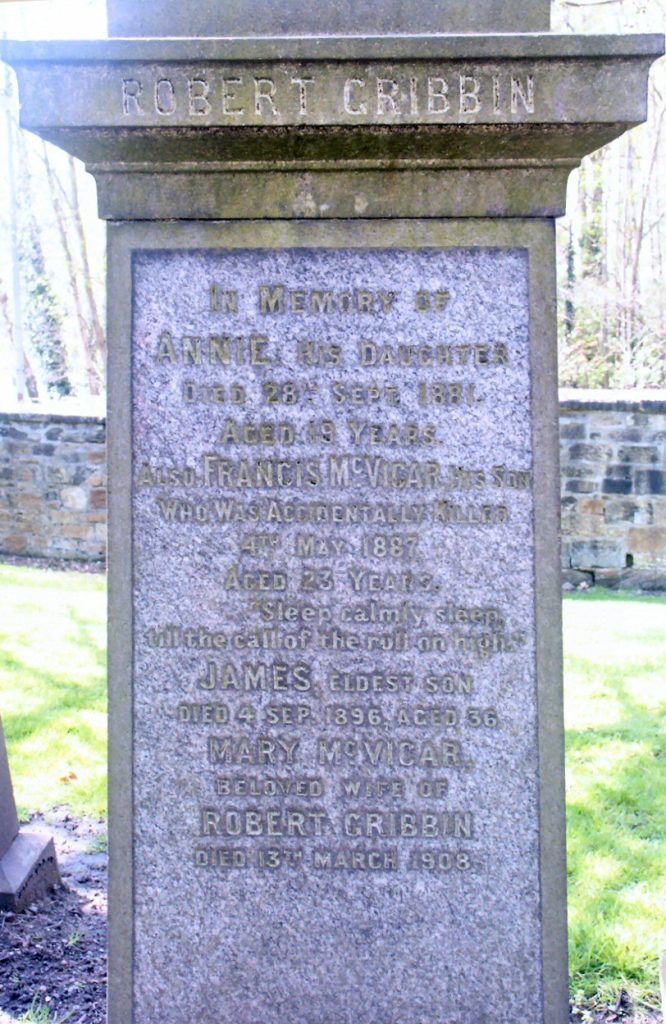
Francis M Gribbin, died 1887
FATAL ACCIDENT IN A SHIPYARD – Francis M’Vicar Gribbin, fitter, residing at 106 South Street, Whiteinch, was fatally injured in the shipbuilding yard of Messrs Aitken & Mansel, yesterday. He was at work on a vessel in course of construction, and was in the act of shifting a heavy plank which lay over the hatchway, when the plank went through, carrying Gribbin with it into the hold, by which he sustained very bad injuries to his head and back. He was first carried home on a stretcher, and then by the doctor’s order removed to the Western Infirmary, where he died shortly after admission.
North British Daily Mail 5 May 1887
******************************
Anyone who would like to help indexing the Burial Registers is very welcome to join us by contacting me at at research@glasgownecropolis.org