The indexers have reached 1884, and the number of records indexed in the last three months is as follows –
| April 2025 | 356 |
| May 2025 | 300 |
| June 2025 | 333 |
Our database of persons buried or commemorated in the Necropolis now stands at 52586 entries at the end of June 2025 of which 21858 entries represent persons buried in common ground with no grave marker.
20th Anniversary of the founding of the Friends of Glasgow Necropolis
Twenty years later we celebrate that tenacity of spirit and the continued ambition of FoGN, which now includes a Committee of fourteen, ten Tour Guides, all of whom are volunteers, supported by a Membership numbering just over 140 from across the world.
The objectives of FoGN remain as per our Constitution, advancing public understanding and enjoyment of the Glasgow Necropolis, and working with Glasgow City Council to conserve and develop the Glasgow Necropolis for the benefit and amenity of the public.
Over the 20 years, sadly the Glasgow Necropolis has suffered from natural decay, vandalism and under-investment, but the Friends of Glasgow Necropolis have worked tirelessly to raise awareness and much needed funds to deliver our priorities and schedule of activities. These are divided into short, medium and long term actions, and aim to promote the Glasgow Necropolis as a cultural resource for both the people of Glasgow and for the many national and international visitors who come to experience this historical gem.
Some of the positive outcomes achieved to date include:
- The restoration of the Edington Gates at the entrance to the Glasgow Necropolis -Thanks to an anonymous donation of £14,000 by one of our members, in 2011 we undertook the restoration of the Edington Gates, which are the oldest cast iron gates in Glasgow.
- The Photographic and Stone Condition Survey (PSCS) – This project commenced in 2012 to record the present condition of the existing gravestones. It is now two thirds complete, and we hope to continue this work when funding permits.
- The restoration of the Buchanan Sisters Mausoleum – To further support the £6,000 that had been already raised from donations from Tours, Open Day Events, PowerPoint Presentations to organisations and bespoke tours, we launched a Public Appeal in 2011 to raise the first phase of monies needed for the restoration of the mausoleum, £20,000 was raised and the work completed in full in 2013.
- The restoration of the Monteath Mausoleum – This is a phased project with phase one to repair two sections of roof, install leaded glass in 24 windows, and repair the original door. Fund raising started in 2012, and to date we have raised almost £90,000 towards the restoration costs. However we do have the challenge of 20% VAT on repairs and how this can be funded.
- Indexing of the Burial Records – This started in 2017 and is hoped for completion in 2027- 8. It will supplement the information found on the headstones and identify people buried in the cemetery without any grave marker and result in a database of c55,000 persons buried or commemorated in the Glasgow Necropolis.
- The First and Second World Wars. A Roll of Honour for WW1 with biographies and location maps of graves was produced for the website and then as a leaflet leading to a Remembrance Day Tour starting from 2018/19. Family monuments to the casualties have been re-erected. A Second World War Roll of Honour will be added in 2025.
- Nurses of the Glasgow Royal Infirmary Headstones – In 2021 in grateful appreciation of the work and commitment of those who gave so much during the Covid pandemic, the Friends of Glasgow Necropolis, arranged to have three headstones of nurses of the Glasgow Royal Infirmary buried in the Glasgow Necropolis refurbished.
- Wildflower Border Strips to mark areas of unmarked graves – This started in 2022 with Compartment Eta, and was followed in April 2025 by compartment Iota. More are planned as funding permits.
- Ivy Clearance – This started 2022 and is ongoing.
- Tertius Project – This new project started 2024, and phase one, recording architectural material dumped in Compartment Tertius as part of our PSCS (see above), was carried out by students from the archaeology department of Glasgow University. Their report which included the recording, analysis and assessment of the monumental and stone fragments found is now complete, and we are working through the findings.
To celebrate our anniversary special tours round the Glasgow Necropolis were taken by our Patron, Sandy Stoddart the King’s Sculptor in Ordinary in Scotland, and Garry Nisbet, our Cemetery Historian and Sculpture Consultant.
We still have much to do and challenges to overcome. We wish to record our grateful appreciation for the leadership of our previous Chairpersons, Nigel Willis, an inspiration to us all, and who we so sadly lost in 2021, and Ruth Johnston who has dedicated 20 years of her life to the Friends of Glasgow Necropolis. We are ready for new opportunities to take the work of the Friends of Glasgow Necropolis forward, including the re-erection of headstones in Omega & Sigma, and much more. Thank you for being there for the last 20 years and we look forward with hope and conviction to many more years to come.
Annette Mullen, Chair, Friends of Glasgow Necropolis
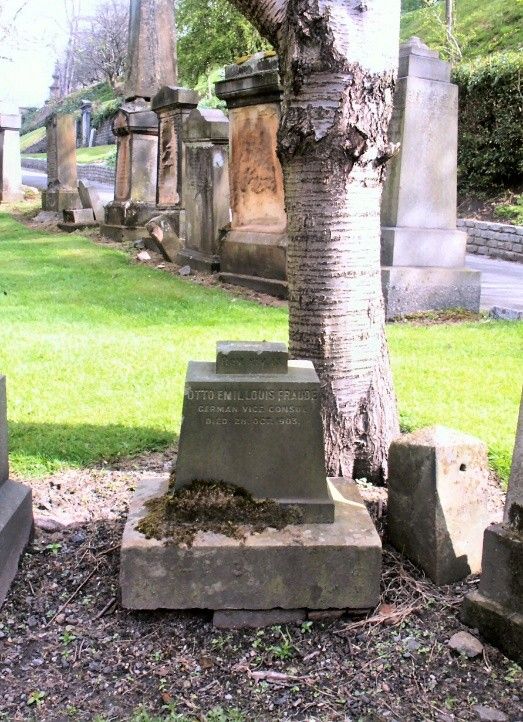
Otto Emil Louis Froude d. 1903
It must have come as a shock to Agnes Baillie Froude, born in Glasgow in 1866 to Scottish parents when she had to apply to the British government for a Certificate of Naturalisation due to her German nationality in 1915. It seems she must have taken German nationality when she married Otto Froude in 1888.
Otto Emil Louis Froude/Fraude (born Germany c1852) and his younger brother Ulrich Max probably arrived in Glasgow shortly before Ulrich’s death in Glasgow in November 1880. Otto has been found in the 1881 census lodging with the Cameron family at 134 Buccleuch Street and was probably living at 296 Bath Street the previous year when his brother died there. In 1881 Otto was employed as a secretary in the German Consulate in Glasgow and was earning enough to allow him to buy a lair for his brother in Compartment Iota in the Necropolis though it doesn’t look as though his funds ran to the purchase of a headstone. Otto continued at the German Consulate and by 1888 was sufficiently established to marry. His bride was Agnes Baillie Proudfoot, daughter of John Proudfoot and his wife Agnes Gardner, fourteen years his junior. The couple had one child, a son Otto William Froude born in 1889 in Uddingston. In 1898 Otto was appointed Chancellor of the German Consulate in Glasgow with the title of Vice-Consul. In 1903 tragedy struck the small family when, on Wednesday 28 October, Otto was found dead in Hughenden Road with a revolver in one hand and a bullet hole in his forehead. There was no doubt about the cause of death but no satisfactory reason was revealed in the newspapers – he “had been somewhat peculiar in his manner of late”. Naturally the news was widely covered in the newspapers. Despite this embarrassment Agnes remained in Glasgow until sometime after 1921 after which she moved south to be nearer her son. Otto William had qualified as an electrical engineer and was settled in the Birmingham area by 1918. In 1957 he also died in odd circumstances, expiring in a dentist’s chair while having his last tooth extracted under anaesthetic.
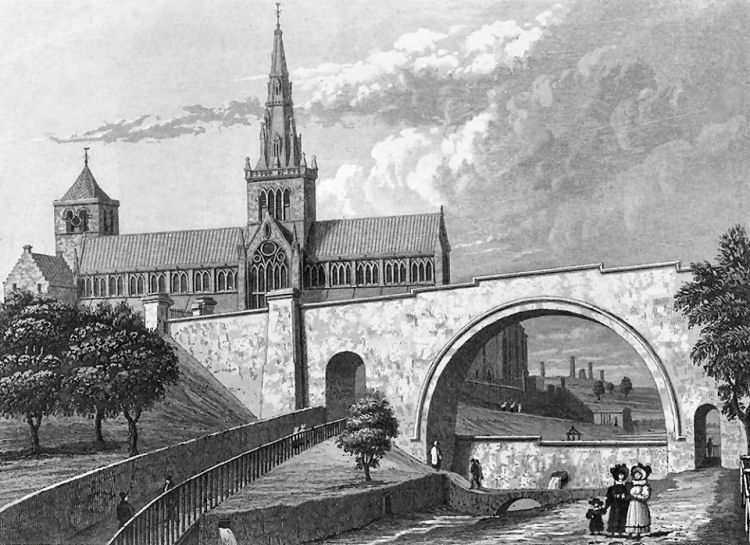
The Molendinar Burn
Visitors to the Necropolis may be aware that the Bridge of Sighs by which they enter was built to span the Molendinar Burn. What they probably don’t realise is that, when the bridge was built, the dam of the mill pond for the Subdean Mill sat immediately underneath. The mill pond thus formed stretched from the bridge upstream as far as the Jews Burial Ground.
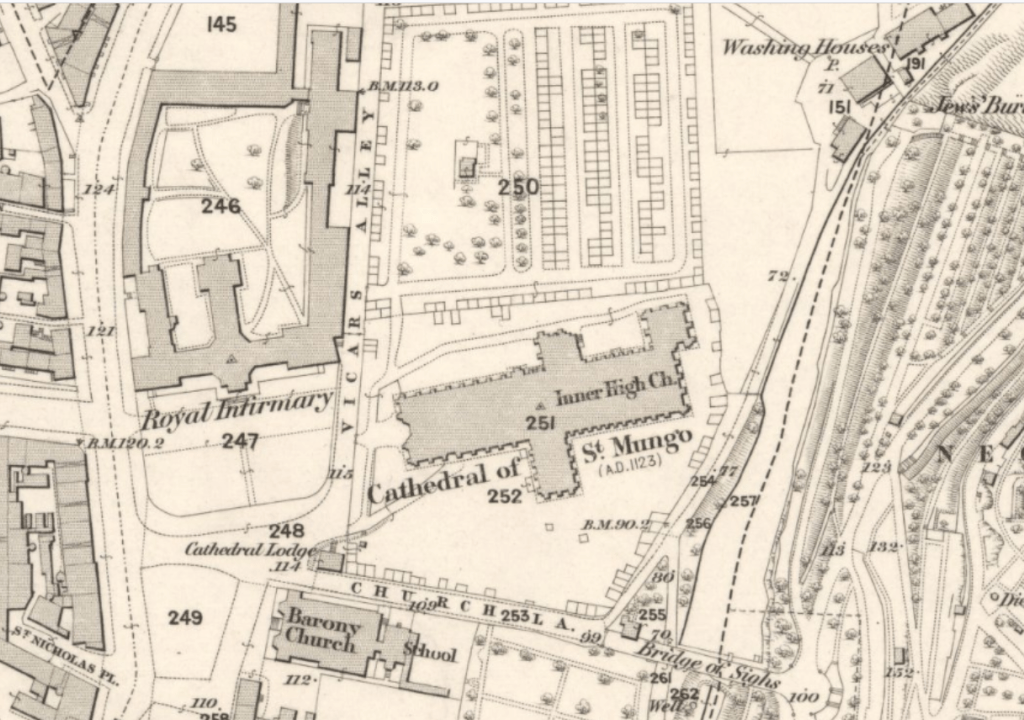
On the west side of the Molendinar stood the Glasgow Royal Infirmary built in 1794. In 1828-9 wards devoted to the care of fever patients were built at the north east corner of the site and connected to the Molendinar by a sewer. The 25 inch to a mile map of Glasgow (below) shows the fever wards running north/south immediately to the left of the word Alley and the Bridge of Sighs at bottom right with the mill pond running north from it.
Cleland says in his Annals of Glasgow that the first sewers in Glasgow were not built until 1798 and by 1816 about 4 ½ miles had been completed. He even lists all the streets where they had been built. It is very noticeable when studying his list that not all the sewers join each other and many seem to run for a distance and then simply stop – where does their contents go? The effluent from the sewer from the Infirmary fever wards which discharged into the Molendinar must have been trapped by the mill pond dam resulting in an appalling stench – quite a contrast to the ‘hygienic’ garden cemetery on the east side of the Molendinar. An article in the Glasgow Daily Herald of 26 Oct 1871 about the Molendinar says the mill pond had been drained by then exposing a thick mass of black-coloured mud at the base. By 1875 a sewer had been constructed, the ravine was being filled in and the ground level raised using debris produced from the easing of the gradient of the steepest part of the High Street. Once Wishart Street was built the Directors of the Merchants’ House planned to erect an ornamental iron fence along the boundary with the new street.
William Brown died 1897
There is a stone in Compartment Primus commemorating William Brown and his wife Susan Robertson. It turned out William was the only person buried in the grave although he left quite a large family. The entry in the Burial Register under 6 April 1897 which described him as dying in the Clydesdale Bank, St Vincent Place, Glasgow was sufficiently suggestive to warrant a search of Glasgow newspapers around that date.

The most detailed notice of his death, almost a mini obituary, appeared in The Scotsman on 3 April 1897 and is worth quoting in full:
Mr William Brown, assistant manager of the Clydesdale Bank, died yesterday morning with painful suddenness in the head offices, St Vincent Place, Glasgow. It was observed on his arrival about half-past nine that he was somewhat flushed, and in reply to a question he remarked that he had been hurrying, as he was late. Five minutes later Mr Brown fell from his chair to the floor in an unconscious state, and death ensued almost immediately from failure of the heart. Mr Brown, who was sixty-eight years of age, was a native of Aberdeenshire, and began his career in the City of Glasgow Bank. He became a teller, and subsequently he was agent at the Western branch. About forty years ago he entered the service of the Clydesdale Bank as assistant manager, and with two short breaks he continued in that position till he died. For two years he was connected with the Glasgow office of a Liverpool Bank, and for a short time he was a member of a London firm of bill-brokers. Mr Brown was the official with whom the customers of the Clydesdale Bank came closely into contact , and by them as well as by the members of the staff he was highly esteemed for his unfailing urbanity and his quiet, genial and kindly disposition .He had been a widower for many years, and is survived by a grown-up family, which comprises three sons, one of whom is an advocate, another a stockbroker in London, and a third in the service of the Royal Bank in Glasgow. Mr Brown was a member of the Park Parish Church.
Bearing in mind he is said to have been with the Clydesdale Bank for about 40 years (since c1857) it is rather a puzzle that he and his family were living in Richmond, Surrey in 1871 and in 1881 they can be found on Earl’s Court Road, London. The youngest child, Charles, had been born in Scotland c1869 so the family must have moved to Richmond between then and 1871. Susan Robertson, Mrs Brown was buried in Willsden Cemetery after her death on 19 June 1882 which confirms that the Browns were in London 1881-2. They were still in London when Anne Buchanan Brown, one of several daughters, married John George Chrystal at Holy Trinity, Westminster in 1884. It is impossible to be sure but it seems unlikely that the family had been resident continuously in London since c1871 considering William Brown’s long service with the Clydesdale Bank. The obituary, above, only mentions 3 sons but 5 are known from the censuses and 3 daughters.
John Ewing Walker died 1875
The following obituary from the Glasgow Herald forms a suitable starting point for a note about John E Walker.
The Late Mr John E Walker.-The remains of Mr John E. Walker, who died on Thursday last at Dhalling Mohr, Kirn, will be interred today in the Glasgow Necropolis. Mr Walker, who at his death was 54 years of age, had been ailing for only about eight days, a sharp attack of influenza, combined with derangement of the liver, proving fatal. The family name has long been before the public in connection with the omnibus service of the city. Mr Walker’s father, in the old coaching days, was proprietor of the Tontine Hotel, and of the mail service between Glasgow and London, Liverpool, Aberdeen, Edinburgh, Ayr, and Paisley […].
For many years Mr John E. Walker carried on his father’s business, to which he succeeded on the death of his sire. Like his father, he was a man of great enterprise and business capacity, and was largely instrumental in developing the omnibus system of Glasgow. He continued in this business, greatly esteemed by his friends and respected by his servants, until the formation of the Tramway Company, when private proprietors were compensated for abandoning the service of the public.
In 1869 Mr Walker became proprietor of the Kelvinside Estates, extending to 80 acres, and in 1873 he purchased from the late Sir George Campbell the lands of Gilshochill, forming an area of 70acres. Two years ago he became the owner of Dhalling Mohr at Kirn, where he has since resided. Besides his city connections, Mr Walker, for upwards of 20 years, held the farms of Cawder Cuilt, Crossvegot, and Sandyflat, in the districts of Maryhill and Milngavie. He was predeceased a year ago by his wife, but his loss is mourned by six children.
Glasgow Herald (Glasgow, Scotland), Tuesday, September 7, 1875.
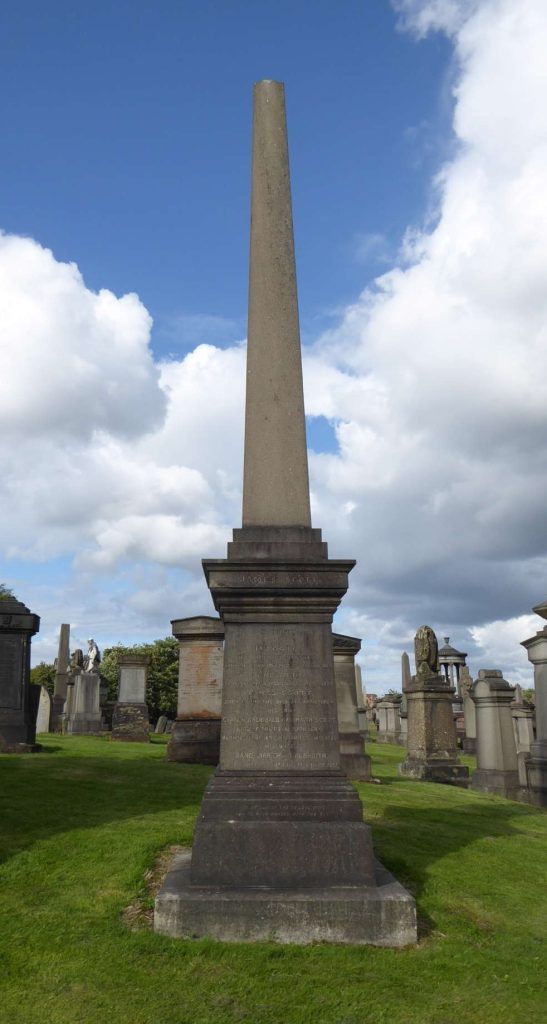
The stone in compartment Omega marking the family grave is blank except for the name of the owner of the lair, James Walker. This is most misleading as twelve members of the Walker family were buried here between 1851 and 1881. As well as his parents, James Walker and Jane Ewing, and two siblings, John E Walker buried some of his young children in the lair.
When Walker bought Dhalling Mohr in 1873 he decided to wind-up his businesses. In 1874 adverts appeared in the Scottish and Irish newspapers announcing the sale of all the plant relating to his Funeral Undertaker’s and Carriage-Hirer’s business, his Coachworks and his Funeral business. The plant was very extensive and gives a good picture of what a successful undertaker and carriage hirer needed to fulfil his business – hearses, mourning coaches broughams, gigs, etc, and about 160 horses including black ones for funeral work and greys for marriage work and state processions. When Walker died in 1875 he left estate in Scotland worth £29,417 18s 11d and £4,115 15s 2d in Ireland making a grand total of £33,533 14s 1d. At a conservative estimate this figure represents a value of over £3m today.
William James Notman d. 1881
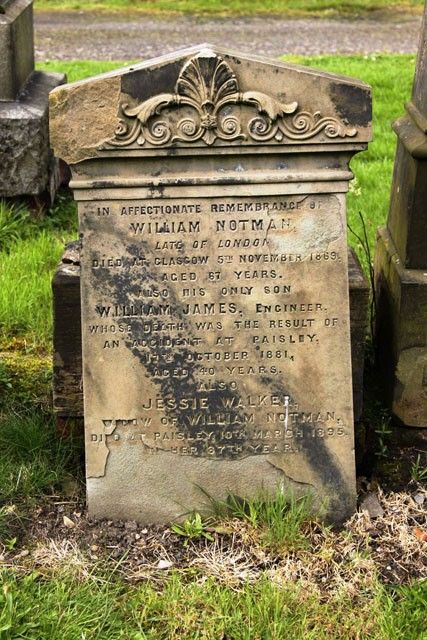
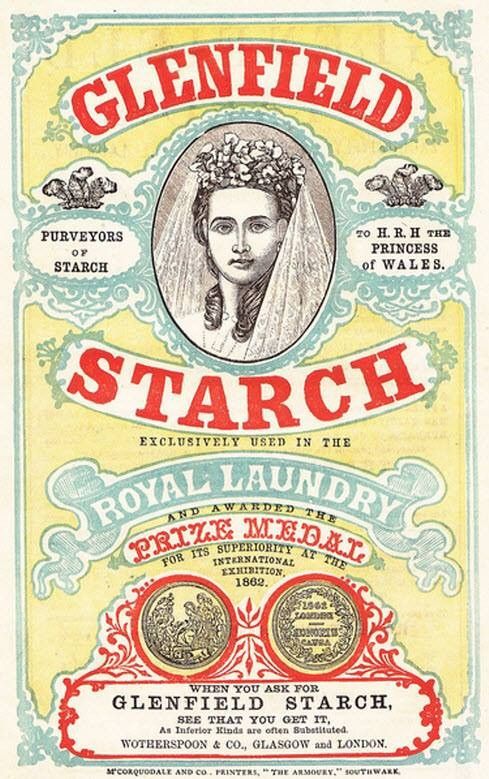
This stone commemorates William Notman from London, his wife Jessie Walker and their only son William James “whose death was the result of an accident at Paisley”. William James died on 17 October 1881 aged 40. His death occurred at the Glenfield Starch Works and the North British Mail of Wednesday 19 October carried a useful account which served as a starting point for further investigation:
A very sad and fatal accident has occurred at the Glenfield Starch Works in Paisley, resulting in the death of Mr W. J. Notman, the manager of the maize department there. On Monday about noon, Mr Notman was engaged in his department in connection with the shifting and labelling of a number of sacks of grain, and on stepping backwards the skirts of a long white linen cloth coat which he wore came against an upright revolving shaft. The shaft instantly caught the coat tails, and for several minutes Mr Notman was whirled round the shaft at a terrific speed before the engines could be stopped. He was then extricated, and it was found one of his legs was broken, and that he was otherwise severely injured about the body. The services of Drs Fraser and Holms were obtained, and Mr Notman was afterwards conveyed to his residence at Park Terrace, Underwood, where, despite all that medical aid could do, he succumbed to his injuries on Monday night shortly after none o’clock.
The first trace of William James, his parents and sisters in Scotland is in the 1861 census for Kirkintilloch where the family is found at Rosland Cottage. Father William and his 3 children were all born in London but Mrs Notman hailed from Fodderty, Ross and Cromarty. Both father and son gave their occupations as railway clerks. Ten years later there is quite a change in William James’s circumstances as he now lives at Ashfield House, Dunblane with his widowed mother and unmarried sisters and gives his occupation as a mechanical engineer and manager of a bleachfield. J & J Pullar had constructed Ashfield Mill for bleaching, dyeing and printing operations and a workers’ village from 1865 onwards so William James may have been its first manager. In 1872 William James gave his place of residence as Paisley when he married Alice Schofield at St Luke’s, Kentish New Town in September of that year. William James had obtained a position as manager at Brown & Polson’s Royal Starch Works, Paisley which he left in March 1876 after 4 1/2 years for a new job in London. This move is confirmed by the fact his two daughters were born at Sittingbourne, Kent in the later 1870s. However by 1881 he had returned to Paisley to become manager of the Glenfield Starch Works in Paisley. His widow, Alice, outlived him by more than 50 years not dying until 1934. Alice is buried in Woodside Cemetery, Paisley not in the Necropolis. A poignant footnote to the story of William and Alice Notman is that Alice gave birth to a still born daughter 5 days after her husband’s death. It may seem macabre to the 21st century mind but the birth was publicly announced in newspapers.
James Scott died 1884
Regular readers may be aware that the Profiles section of our website contain a number of biographies of occupants of the Necropolis. The best Profiles contain original research but sometimes it hardly seems worth spending time and energy researching and writing a profile when information about the subject can be readily found in various sources online.
The life of James Scott who died suddenly at his office on 24 April 1884 and was buried in Compartment Omega on 28 April is a case in point. His death was widely reported with detailed obituaries in newspapers as the following from the Glasgow Herald of 25 April 1884 illustrates.
DEATH OF MR JAMES SCOTT
We regret to have to intimate the sudden death of Mr James Scott, formerly of Kelly, and one of the number of old Glasgow merchants who in their day have so largely contributed to the commercial prosperity of the city. The sad event took place in the office of the Clippens Oil Company, Bothwell Street. Mr Scott, who resided at No. 1 Woodside Place, attended at the office of the company as usual yesterday morning, but in the course of the forenoon he was suddenly seized with illness, and shortly afterwards expired. He had reached the age of 74 years, and his life had been one of unbroken activity.
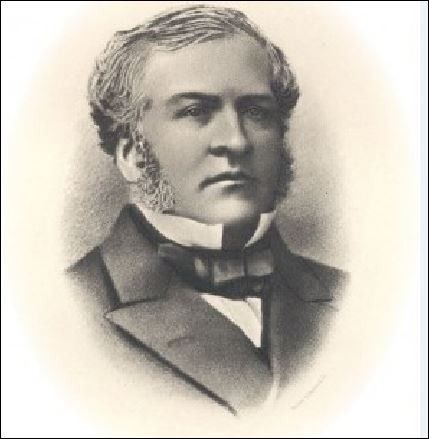
James Scott was a native of Glasgow. He went into business at an early age, and his industry and intelligence were such that in his nineteenth year he became a partner in the firm of James Black & Co., calico printers. The senior partner of the firm, by the way, was the father of Lady Alison. It was an extremely successful business that of James Black & Co. Mr Scott went into it with characteristic energy, and in the opinion of experts did more at that time to develop calico printing than any one of his contemporaries. After a good many years devoted to this special industry, he went into another. In company with his brother, William Scott, he acquired a spinning and weaving mill in the eastern district of the city and here again commercial enterprise resulted in the concern becoming the largest of the kind in Scotland. But his career was not wholly without its shadows. During the troubles incident to the American War he became involved in the failure of Messrs Collie, and was obliged to compound with his creditors. Nothing daunted, he set to work again, and, on a Christmas morning some years afterwards, his creditors received from Mr Scott a cheque for the full amount due. About 10 years ago he originated the Clippens Shale Oil Company; and two years since, probably feeling that his life was nearing its close, he turned the business into a Limited Liability Company. Besides carrying through these various undertakings, Mr Scott was a large holder of heritable property. About 1850 he purchased the estate of Kelly, Wemyss Bay, and took a prominent part in promoting the Wemyss Bay Railway.
His public career was very much briefer, but not less notable, than his mercantile life. Many years ago he became a member of the Town Council of Glasgow, carrying into the conduct of public affairs the far-seeing shrewdness and decision which characterised his action in private matters. He was not long a member of Council, yet he achieved a great deal in short time. Glasgow was then in a transition state-emerging from the modest commercial town into the colossal city which it has since become. There were members of Council who failed to see that this significant change was going on, and who still preserved, in respect to local legislation, the narrow spirit of the town. Their faltering timidity was, however, counterbalanced by the decision of Mr Scott, who in clearness and breadth of outlook was far in advance of his time. As deputy- chairman of the Clyde Trust, he helped forward several of the most important undertakings of that day. ln his capacity as a Town Councillor, he strongly advised the purchase of the ground since known as the West-End Park for the use of the citizens. The project was regarded as too daring even for the community. In these circumstances Mr Scott bought it himself and held it until the authorities came to see what. was for the public advantage. Similarly, for the general good, he built at his own expense the bridge connecting Bothwell Street with the west end of St Vincent Street, and thus forming the easiest line of access between Gordon Street and the west. As we have said, Mr Scott did not long remain in public life. He was an influential man, and did important work in his day, but the Town Council, we can readily believe, had few attractions for him. Essentially a man who decided promptly and executed vigorously, and who was rather impatient of speechmaking, he probably felt himself out of his element in the Town Council of Glasgow, and so he left it, and again devoted himself to his private concerns. He was vice-chairman of the Vale of Clyde Tramways Company, but in strictly public matters he had taken no active part for many years. We have indicated, in what has been said, some of the distinguishing qualities of Mr Scott, to which it may only be added that he was a man of singularly generous disposition. His death is mourned by his widow and a grown-up family.
James Scott has a detailed entry in Memoirs and portraits of one hundred Glasgow men who have died during the last thirty years and in their lives did much to make the city what it now is published by James MacLehose in 1886.
There is an article about him at https://www.wemyssbay.net/history/james-scott-calico-printer-and-oil-pioneer because he owned the estate of Kelly at Wemyss Bay for a time.
In May 2022 the Glasgow Museums Art Donors Group published a blog about some members of the wider Scott family. Robert McNeil Ker donated an oil painting of his grandmother Mrs. Scott, Wife of James Scott of Kelly by John Graham-Gilbert to Glasgow Corporation in 1946 (https://glasgowmuseumsartdonors.co.uk/2022/05/ )
The Museum of the Scottish Shale Oil Industry has information about Clippens Shale Oil Co (https://scottishshale.co.uk/organisations/scottish-oil-companies/clippens-shale-oil-co/ ) in various parts of its site.
******************************
Anyone who would like to help indexing the Burial Registers is very welcome to join us by contacting me at at research@glasgownecropolis.org