Compiled by Morag T Fyfe
The indexers are working through 1877, and the number of records indexed in the last three months is as follows –
| July 2024 | 286 |
| August 2024 | 320 |
| September 2024 | 300 |
Our database of persons buried or commemorated in the Necropolis now stands at 51298 entries at the end of September 2024 of which 21306 entries represent persons buried in common ground with no grave marker.
James Cloggie died 1875
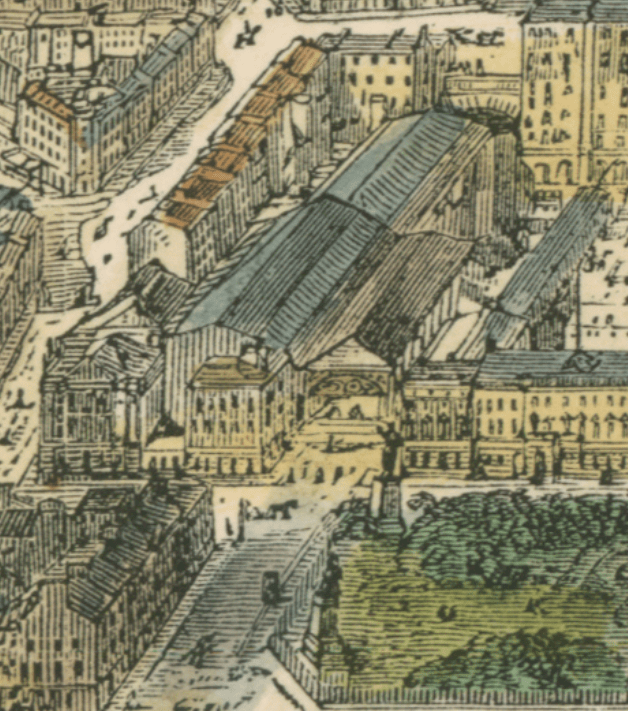
A weaver to trade James Cloggie moved into Glasgow from Kirkintilloch sometime between 1864 and 1868. He found employment as a porter at the North British Railway’s Queen Street Station and the family settled nearby at Tarbert Street, off Rottenrow. The death of his wife Ann Gillespie in 1868 resulted in the purchase of a lair in the Necropolis and the erection of a small gravestone. As well as Ann herself, James commemorated two children who had predeceased their mother and had presumably been buried in Kirkintilloch before the family moved to Glasgow. The next name added to the stone was that of James who died as the result of an accident at Queen Street station in August 1875 at the age of 53.
As is so often the case at this time newspapers were happy to fill column inches with reports of accidents of any kind, the more gruesome the better. This report comes from the Renfrewshire Independent of Saturday 14 August 1875.
FATAL ACCIDENT. – On Monday night, between 9 and 10 o’clock, James Cloggie, railway porter, 53 years of age, was killed at Queen Street Station, Glasgow. The deceased was crossing the line of the North British Railway, at the entrance to the tunnel, from the Dundas Street to the Queen Street side of the station, when he was knocked down by a pilot engine, which was emerging from the tunnel at the time. The man was killed on the spot, and his body, which was dragged along the line for some distance, was frightfully mangled.
Archibald Glen died 1875
A son of the manse, Archibald Glen was born at Parton, Kirkcudbrightshire in 1806 and named for his father. After his father’s death in 1808 Archibald is lost from view until two Archibald Glens turn up in the Glasgow Post Office directories 1829-1832 but by 1838 this has been resolved and this Archibald Glen is firmly identified as a partner in James Dunlop & Sons, cotton spinners and power loom cloth manufacturers. By 1836 Archibald had felt sufficiently well established and able to marry. His bride was Henrietta McBrayne and the couple are found in the Glasgow censuses of 1841 and 1851 They lived at addresses in Buchanan Street and Hill Street, Garnethill before moving in 1847 to a newly built terrace house at 13 Kelvingrove Place, later 66 Kelvingrove Street.
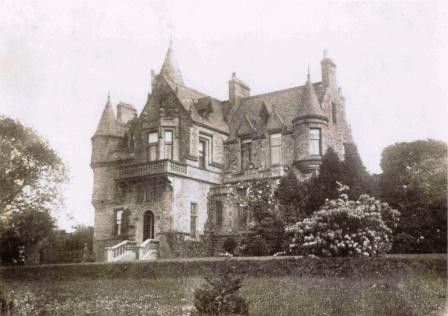
Business must have been good in the 1850s as Archibald could afford to rent Cartside House in Johnstone from the Houston family in 1860/61 and he remained there until his death. By 1861 he was describing himself as an East India merchant, but things took a turn for the worse when losses relating to his business in Singapore, Malaya and the Philippines caused his bankruptcy in January 1874. His death was noticed in the Paisley Herald and Renfrewshire Advertiser of Saturday 4th December 1875 as follows:
DEATH OF MR ARCHIBALD GLEN – This gentleman, who is known in commercial circles in Glasgow, expired on Thursday at his residence, Cartside House, after a few months illness. Mr Glen was a commission agent in Glasgow, and transacted business principally with the East. Some years ago he took a prominent interest in the Society of the Sons of the Clergy of the Church of Scotland, of which he acted as president, being himself the son of a parish minister in the South of Scotland. A melancholy interest attaches to his death, as his wife expired only on Sunday last; and on Thursday while her remains were being conveyed to the Glasgow Necropolis, Mr Glen also died. He leaves two daughters, one of whom is married to the Rev. Dr Graham, minister of Kilbarchan parish.
As a result of his financial difficulties Archibald died intestate and his estate only amounted to £1611 17s 11d when confirmation was granted to his younger daughter and executrix Catherine Parlane Glen in April 1876.
Archibald and Henrietta also had a son, Archibald Henry, who died aged 4 in 1847 and whose death occasioned the purchase of the lair in Compartment Omega in the Necropolis.
A final melancholy footnote to the story of Archibald Glen is that in May 1869 his only grandchild, Henrietta Graham, died by falling from an express train between Croy and Castlecary while in his care. It seems the door against which she was leaning, which should have been locked but was not, opened and she fell out.
The Petersen family of Christiansund, Norway, Glasgow and New York
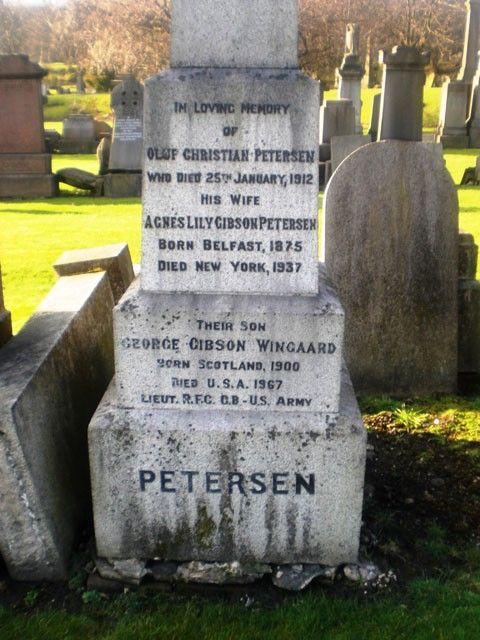
Oluf Christian Petersen was a Norwegian citizen from Christiansund who settled in Glasgow, married and took British citizenship (in 1907). He was a partner in Petersen, Honeyman & Co, shipbrokers, shipowners, and coal exporters, of 11 Bothwell Street, Glasgow. Dying in 1912 aged only 48 he left behind a widow Agnes Lily/Lizzie Gibson and four surviving children. Agnes purchased a small lair of 2½ sq. feet in Compartment Quartus of the Necropolis and buried Oluf there.
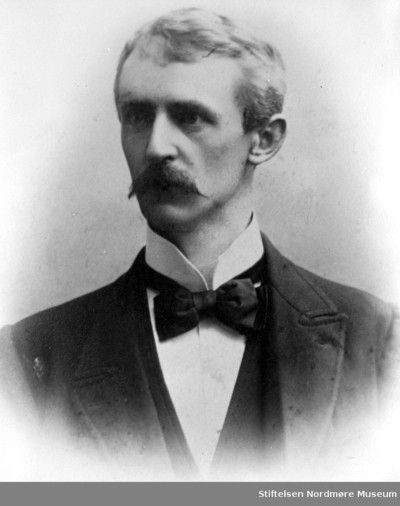
Their second son George Gibson Wingaard Petersen (born 19 March 1898) served in the Royal Flying Corps in the First World War. He started his service as a cadet on 14 May 1917 and was gazetted a probationary 2nd Lieut on 19 July 1917.In September 1917 he was posted to the newly formed 79 Squadron RFC, based somewhere in England. In November 1917 he moved to 29 Squadron a fighter squadron stationed at Poperinghe, Belgium. Two weeks after joining the squadron he was posted as missing on 2 December 1917 and it was later ascertained that he was a prisoner of war. Nothing is known about how he was captured near Lille but the fact he survived to be taken prisoner suggests he may not have been shot down. He was an inexperienced pilot and it may be he suffered mechanical failure or became lost and was forced to land. Once in German hands records survive for his time as a prisoner of war. He was repatriated on 14 December 1918 so spent just over a year as a prisoner during which time he spent time in three different POW camps. He was first sent to Karlsruhe, Baden which was a staging camp for distributing officer prisoners to other camps.
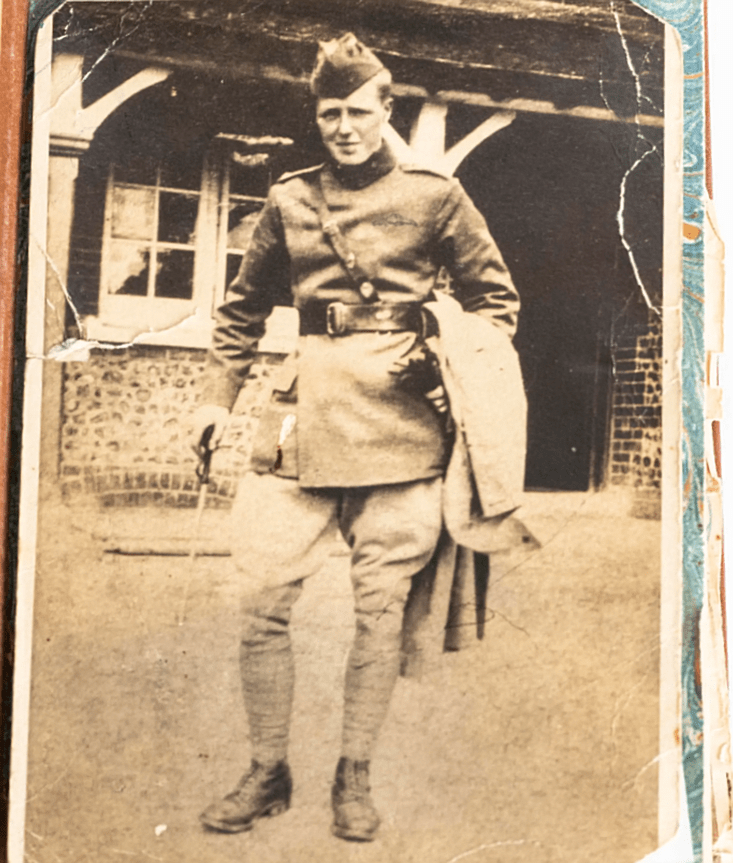
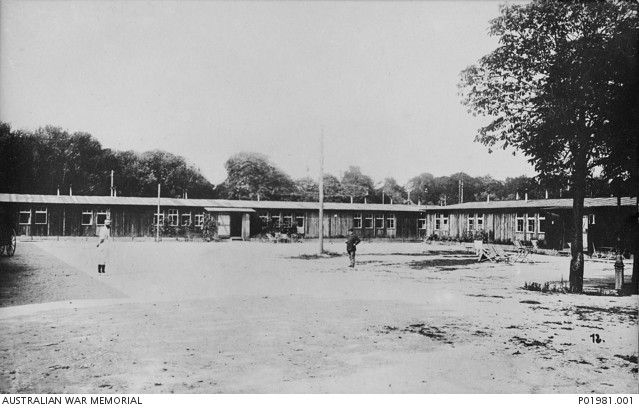
From there he was able to send a reassuring message to his family in Scotland asking for shortbread and chocolate to be sent. At the beginning of January 1918, he and a group of fellow airmen travelled over 200 miles eastward to Landshut in Bavaria but he did not remain there long as the following month he moved about 350 miles north west to Holzminden, Brunswick and there he seems to have remained for the rest of the war
George returned to Glasgow after his wartime service and seems to have trained as an accountant. At some point in the early 1930s he emigrated to the USA, and by 1934 held an American passport. He settled first in New York and is found living with his sister Gertrude and her husband William Paton in Queens, New York in the 1940 census. In 1942 George was just young enough to be registered for military service with the US army but it is not known in what capacity.
His mother, Agnes, died in New York in 1937 either on a visit to him and his sister or having emigrated along with him. George died in Florida in 1967 and both his and his mother’s ashes were brought back to Scotland to join Oluf Christian in the family grave. It turns out that his sister Gertrude’s ashes were also returned to Scotland to be placed in the family lair after his death in 1989 but, as sometimes happens with the last surviving member of the family, her name was not added to the gravestone.
Ebenezer Shand 1868-1925
The firm of monumental sculptors most closely associated with the Necropolis is that of J & G Mossman. An enquiry several months ago led to the discovery of the burial place of one of their employees in the Necropolis. On 1 May 1925 Ebenezer K Shand died in Ruchill Hospital and that same day his widow purchased 2 ½ sq. yds of ground in Compartment Sextus, lair 500 where he was buried 4 days later. The stone marking the lair is not a familiar family one but rather one supplied by his employers and workmates.
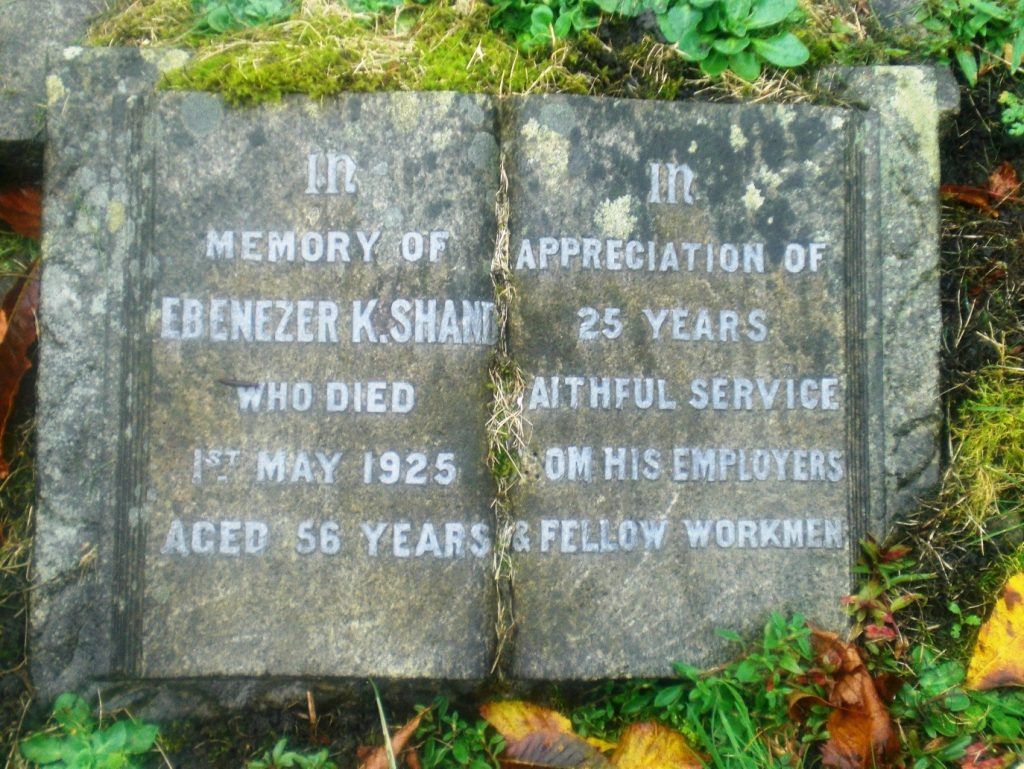
There is no mention on the stone of who employed Ebenezer but in the 1921 census he described himself as a sculptor employed by J & G Mossman. Unfortunately, Gary Nisbet, who cares for the Mossman job books was unable to find any mention of Ebenezer in them so we cannot identify any work he was associated with.
Ebenezer Kilgour Shand was born at Methlick, Aberdeenshire in 1868. By 1891 he had moved to Glasgow and describes himself as a stone cutter and he still called himself as a stone cutter in the 1901 census. A Dictionary of Occupational Terms Based on the Classification of Occupations used in the Census of Population, 1921 defines a stone cutter as one who ‘cuts to shape and size by hand with hammer and chisel, or by machine saw (cf. sawyer) various kinds of stone to make millstones, whetstones, tombstones, etc.; may also dress stone’. When he died in 1925 his widow described him as a monumental sculptor.
Ebenezer was twice married, first to Mary Rea in 1891 (died 1913), and secondly to Mary Somerville nee McLellan in 1918. He died in Ruchill Hospital from tuberculosis of the lungs and haemoptysis. Haemoptysis is defined as the discharge of blood from the lungs and airways. It looks very much as though Ebenezer’s death at 56 years old was caused by his occupation as a stone cutter and sculptor.
James Muir died 1863
As usual newspapers provide many interesting snippets, and this is one of several dealing with the death of 23 years old James Muir of the 4th Lanarkshire Rifle Volunteers who was shot on 6 November 1863 and died on the 10th. His grave is in Compartment Lambda.
Volunteer Funeral.—Yesterday afternoon, the remains of Lance-Corporal James Muir, late of the 1st Northern Battalion, who was accidentally shot at the rifle range, were interred, with military honours, in the Necropolis. The funeral was attended by members of the corps to which the deceased belonged, and by representatives from a number of other Volunteer companies, who thus desired to pay a last mark of respect to one who had so unfortunately been cut off while discharging his duty as a Volunteer. The general body of mourners met in Holmhead Street, where deceased resided, and afterwards—accompanied by the band of the 41st Regiment, playing the “Dead March in Saul”—proceeded to the Necropolis, where the body was consigned to the grave with military honours, the Rev. Dr. Robertson offering up prayer. A large number of people assembled in Holmhead Street as the hour at which the funeral was to take place drew near; and along the whole line of route the cortege naturally attracted much attention.
Glasgow Herald Wednesday, November 18, 1863.
******************************
Anyone who would like to help indexing the Burial Registers is very welcome to join us by contacting me at at research@glasgownecropolis.org