Compiled by Morag T Fyfe
The indexers have almost finished 1867, and the number of records indexed in the last three months is as follows –
| January 2023 | 466 |
| February 2023 | 447 |
| March 2023 | 496 |
Our database of persons buried or commemorated in the Necropolis now stands at 47083 entries at the end of March 2023 of which 20123 entries represent persons buried in common ground with no grave marker.
Identifying families buried in common ground
At present approximately 40% of the records in our database represent people buried in common ground. It is difficult to say anything about many of them but once addresses are recorded from 1855 onwards it is possible to tentatively identify some families, particularly those with young children who were born and died between two census dates, or who may have been living at a different address from that known at censuses. Using Burnside Street, off Duke Street as a random example three possible families have been identified 1855-1867. In 1855/56 Jane Gilchrist (39 years), Agnes Gilchrist (6 months) and John Gilchrist (age unrecorded) all of 51 Burnside Street were buried in common ground in Compartment Theta. In 1865/67 a family by the name of Groves was staying at the same address and buried Mary Groves (5 years), Agnes Groves (1 year), and two James Groves (3 years and age unrecorded) all in Compartment Iota. The third family lived at 7 Burnside Street 1863/64 when Edward and Barbara Fee (ages unknown) were buried. This exercise could be repeated for other addresses and more families identified.
William Archibald Edye
On the side of a stone erected by Archibald Smith (1798-1883) in memory of three of his children has been added the name of his grandson William Archibald Edye son of Elizabeth Maria Lydia Smith and her husband William Henry Edye. The couple were married at Trinity Church, Helensburgh on the 4th January 1865 and William was their first child. He only lived for seventeen days before his death on 4th December 1866. A second son, who survived, was born on 24th October 1867, probably at the Smith family home of Artarman, Rhu, Dunbartonshire.
Elizabeth belonged to the family of the Smiths of Craigend and Jordanhill, important West India merchants in 19th century Glasgow. Her husband William, born at Stoke Damerel, Devon, had a long career in the navy where he reached the rank of Vice-Admiral. At the time of their marriage William was second in command of the training ship Britannia at Portland.
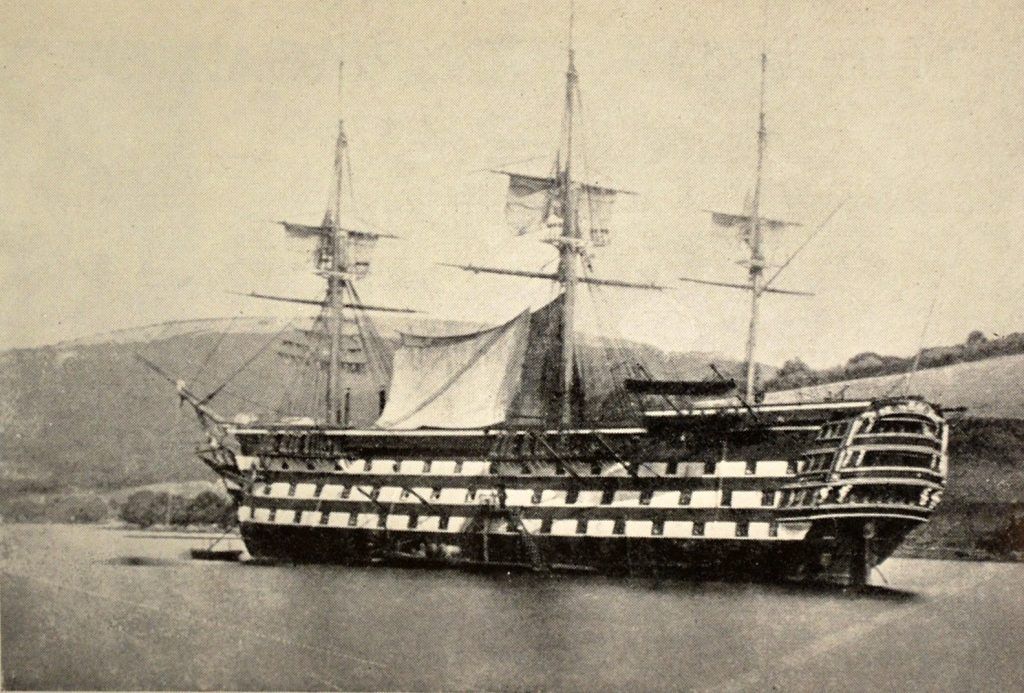
Subsequently he spent two years (1868-1870) on the China station in command of HMS Satellite and two years (1872-1874) as captain of HMS Doris part of the 1873 Flying Squadron during which time they visited the Caribbean, Halifax, N S, Gibraltar and many ports throughout the Mediterranean. His last active roll (1878-1881) was as Senior Naval Officer, Gibraltar after which he was placed on half-pay until he retired in 1890. He retained links with Rhu and died there in 1910.
James Stewart
The cause of death of a young man buried on 21st January 1867 was starkly recorded as “killed at Eglinton Iron Works, Canal Street”. As is often the case local newspapers fleshed out the story. The following comes from the Glasgow Herald of Saturday 19th January 1867.
MELANCHOLY OCCURRENCE – Yesterday forenoon at ten o’clock, a melancholy accident occurred in the works of Messrs Robert M’Laren & Co., engineers and ironfounders, Canal St, Port-Eglinton, whereby an ironturner named James Stewart, 24 years of age, was instantaneously deprived of life. It appears that the unfortunate man was working at his bench, at the end of which is situated the shafting of some machinery. Through some cause, at present unknown, the clothes of poor Stewart came in contact with two revolving cog-wheels, and before the machinery could be stopped the unfortunate man’s head and right arm were severed from his body. Deceased, who was unmarried, resided in [156] Crookston Street.
The Glasgow Free Press of the same date sensationally headed the story “MAN CUT IN TWO BY MACHINERY”
Size of lairs in Glasgow Necropolis
A short survey of the entries in what the Family Search microfilms called ‘Compartment Index’ found on Film 1598746 (DGS 7909338) from image 418 onwards provides information on the size of lairs purchased in each compartment.
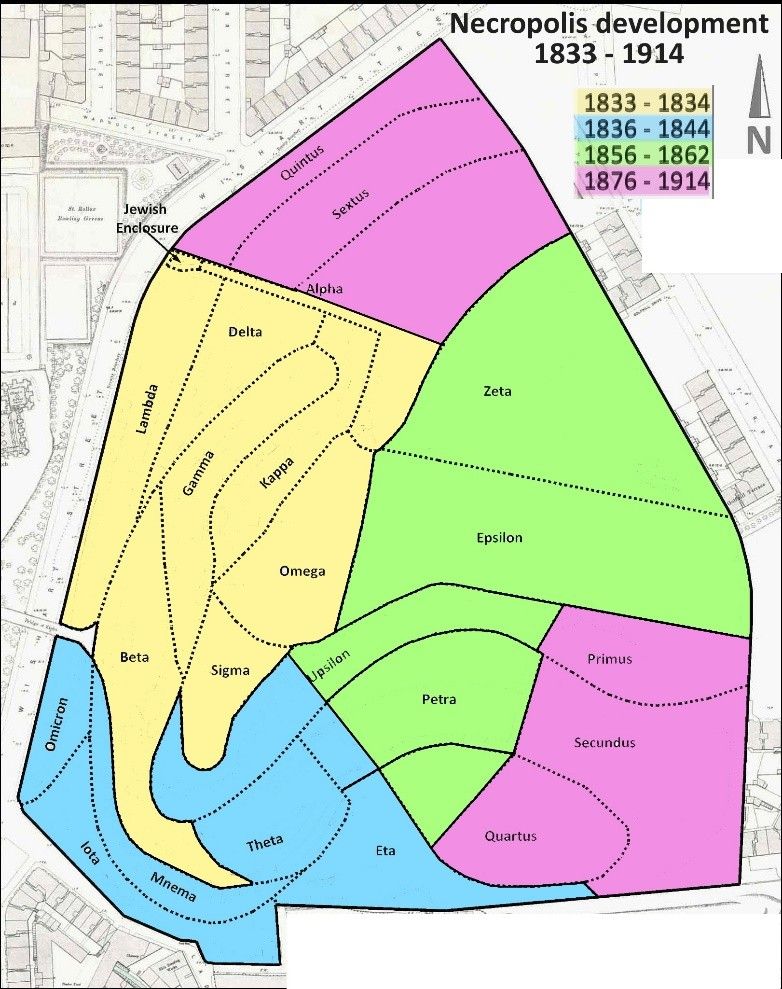
The map above is intended to show the rough chronological development of the Necropolis and locate the Compartments mentioned below. Many of the early compartments were irregular in shape and topography meaning there was a large variation in the size of lair available. In 1833 four compartments were made available for burials (yellow on map). Gamma, Beta and Omega offered lairs between 3 and 9 sq yds in general but larger areas could be purchased. J D Hedderwick bought 21 sq yds in Gamma; the Pattison family bought 25 sq yds in Beta (below)
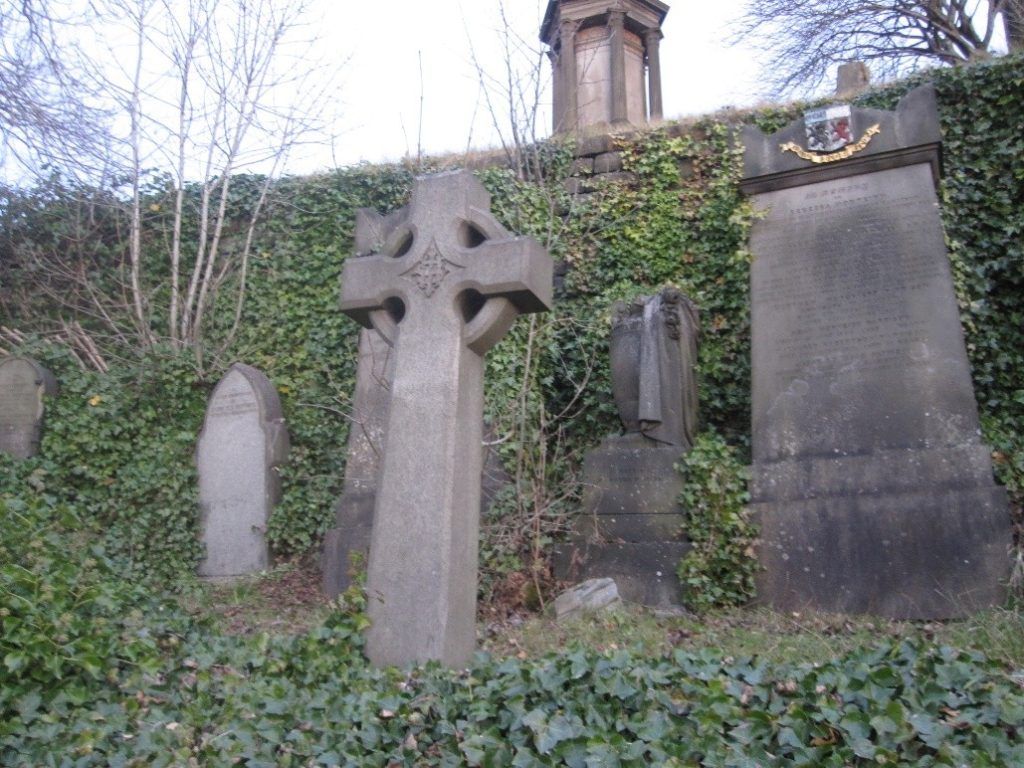
as did Robert Kettle in Omega. The following year (1834) another four compartments opened for business – Kappa, Sigma, Lambda and Alpha. Sigma and particularly Kappa offered the largest lairs, the Cogan lair in Kappa covers 52 sq yds (below).
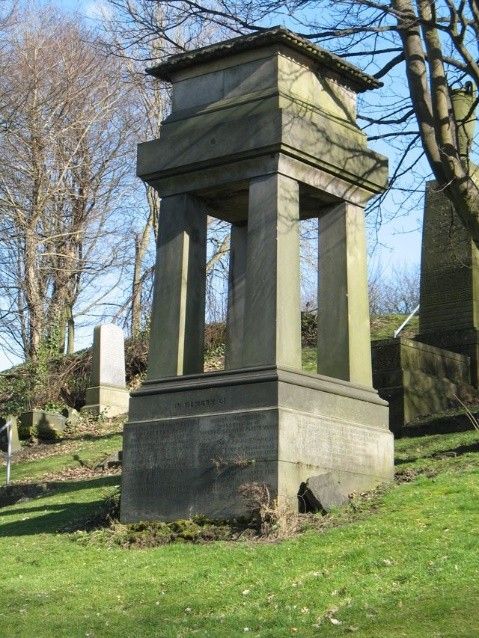
The earliest lairs in Lambda could be up to 9 sq yds but over the years they gradually shrank in size until some measuring only 2 sq yds were purchased. Alpha was always an area of relatively small lairs, generally 2 1/2 sq yds but in it the Jewish community in Glasgow purchased 90 sq yds for their burial ground (Alpha 1) in 1832.
With the exceptions of Upsilon and Zeta (green on map) among the later compartments there was not such a large variety of sizes. It is a matter of regret that in the entry for Upsilon 2 (the Monteath mausoleum) the figure for the number of square yards purchased is illegible. Zeta contains lairs up to 52 sq yds in area (John Wylie, below)
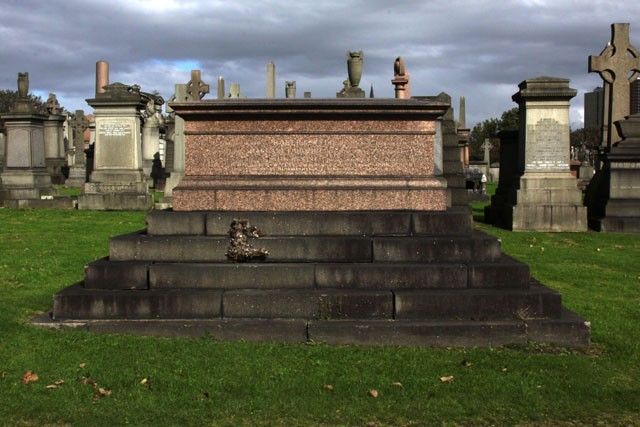
but 10 to 15 sq yds is more common. The impression is given that when Epsilon, with its rigid layout of rows, was opened in 1856 the size of lairs available was controlled and most seem to be of 4 ½ or 6 sq yds.
Most of the later compartments were aimed at working class purchasers and lairs of 2 or 2 ½ sq yds were common although it is obvious that sometimes two adjoining plots were bought. In many of the older compartments spaces were filled with smaller lairs matching the size of those in the newer compartments.
Fatal drownings on Tuesday 15 February 1853
None of the following men were buried in the Necropolis but the newspaper report caught my eye and emphasises how dangerous water could be.
Bodies found – On Tuesday morning the body of a man was found about half-past seven o’clock in the Drumpeller Coal Basin, near Port-Dundas, and was taken to the Central Police Office, where it was subsequently identified as that of a coal riddler, named James Barbour. The body did not appear to have been long in the water. In the course of the afternoon of Tuesday another body was found in the same basin, and was also taken to the Central Police Office. It was instantly identified as that of a man named Wm. Irvine, a waiter, who resided in Little Hamilton Street. Irvine has been missing for a week, having been last seen by his wife on Tuesday, the 8th, in the afternoon when he left the bouse with the view of meeting some person or other, at which time he was perfectly sober and collected. As yet no account can be given of the cause of the death of either of the parties. About half-past 10 o’clock the same night, the dead body of a man was brought to the Police Office, being the third taken from the Canal on Tuesday. In this case it appeared that, as the schooner Hope was coming through the Forth and Clyde Canal, on her voyage from London, and when near to the Glasgow Bridge, near Kirkintilloch, several of the crew, who had been enjoying themselves, were amusing themselves on deck, when three of them fell into the water. Two of them were immediately got out, but the third was drowned before his body could be got at. Deceased, whose name is Isaac Gooch, was a native of Suffolk, and about 20 years of age. He had been only two months aboard the Hope.
Scottish Guardian (Glasgow) – Friday 18 February 1853
William Patrick Paton (1794-1867)
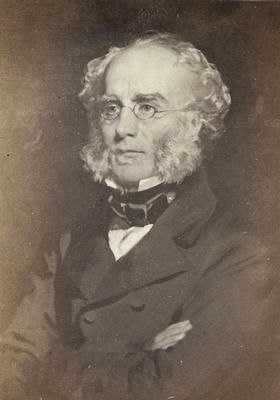
On Thursday 10th January 1867 the body of W. P. Paton, Esq was conveyed to the Glasgow Necropolis in a hearse and four, attended by four mutes and followed by 15 mourning carriages where it was buried in the family lair in compartment Alpha. Paton was an Edinburgh man who settled in Glasgow in the late 1820s after spending time in Singapore and the East Indies. He was a partner in Hunter, Morgans, Paton & Co in Singapore and Batavia, Java. He married Caroline Mercy Ann Evans (1801-1838/40?) of London in Antwerp in 1820 and took his young bride east with him. They visited Glasgow in May 1825 when two daughters born in Singapore and Batavia were baptised and returned for good in 1827. The homecoming was marred by Paton and his partners becoming bankrupt in 1828 but nonetheless he became a burgess and guild brother of Glasgow by purchase in 1830.
Paton did not sever his links to China when he settled in Glasgow; he seems to have acted as agent for Jardine, Matheson & Co in the 1830s and was connected to the Medical Missionary Society in China founded in 1838.
He became deeply embedded in Glasgow society as a list of his positions and interests listed at his death shows: President of the Glasgow Benevolent Society, President of the Glasgow Mission to the Blind, vice-president of the Seamen’s Friend Society, vice-president of the Glasgow Continental Society, vice-president of the Cabmen’s Mission, vice-president of the Magdalene Institution, vice-president of the Glasgow Auxiliary to the London Missionary Society; honorary member of the Working Men’s Sabbath Protection Association; a director of the Lying-in Hospital and Dispensary; honorary president of the Glasgow Protestant Laymen’s Association; member of the National Bible Society of Scotland. In the 1850s he had been active in the Abolition movement and hosted Harriet Beecher Stowe on a visit to Glasgow in 1853. During this decade he was also in correspondence with David Livingstone.
His son John Paterson Paton and some of his family are commemorated on the gravestone in Alpha and two married daughters and members of their families are buried elsewhere in the Necropolis. Augusta Mary Paton and William Gourlie can be found in compartment Epsilon while Caroline Agnes Paton, William Ker and some of their family can be found in Upsilon. Incidentally Lieut William Ker of Hawke Battalion, RND who was killed in action on 13 November 1916 (see WW1 Roll of Honour) was a great grandson of W P Paton.
Margaret Adam Watson or McCaul (1836-1867)
In 1859 Margaret Adam Watson married Gilbert John McCaul in Glasgow and three years later her brother Robert Ker Watson married Gilbert’s sister Isabella Alston McCaul. The close links between the two families are symbolized by the twin gravestones to the two couples and their families found in Compartment Omega in the Necropolis.
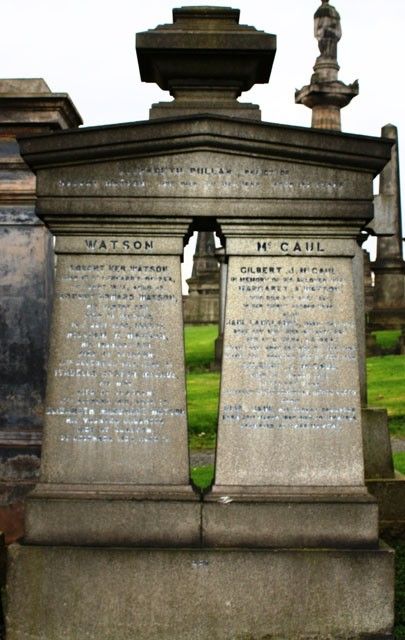
Born in Partick to Malcolm McCaul and Isabella Alston in 1834 Gilbert emigrated to Australia in 1855, returning in 1859 to marry Margaret. The young couple settled in St Kilda, Melbourne, Victoria where five children were born; two unnamed sons only survived for a day each but three daughters survived to return with their parents to Glasgow in 1867. Margaret was pregnant with her sixth child when they returned to Glasgow and on 23rd August she gave birth to a fourth daughter Jane Langlands McCaul. Margaret died on 27 August, presumably from complications of childbirth, although that would need to be verified by purchasing her death certificate. Baby Jane only lived for three weeks, dying on 16 September. Margaret’s mother, Elizabeth Pullar, had already been buried here and these two deaths in 1867 may have been the reason for the erection of the double stone. Gilbert took the opportunity, with the erection of this stone, to commemorate the two baby sons left behind in Australia.
Gilbert did not remain long in Glasgow. By 1871 he had moved south to Dorking, Surrey with his remaining daughters, his mother and a sister. He established a firm in London named after himself and traded as an Australian Merchant. He remarried, lived the rest of his life in Kent and on his death in 1922 was buried in Hither Green Cemetery, Lewisham, London but someone made sure he was commemorated on the stone in the Necropolis along with his first wife and young children. Eliza Jane, his eldest and only unmarried daughter, was also named on the stone after she died and was cremated in 1936.
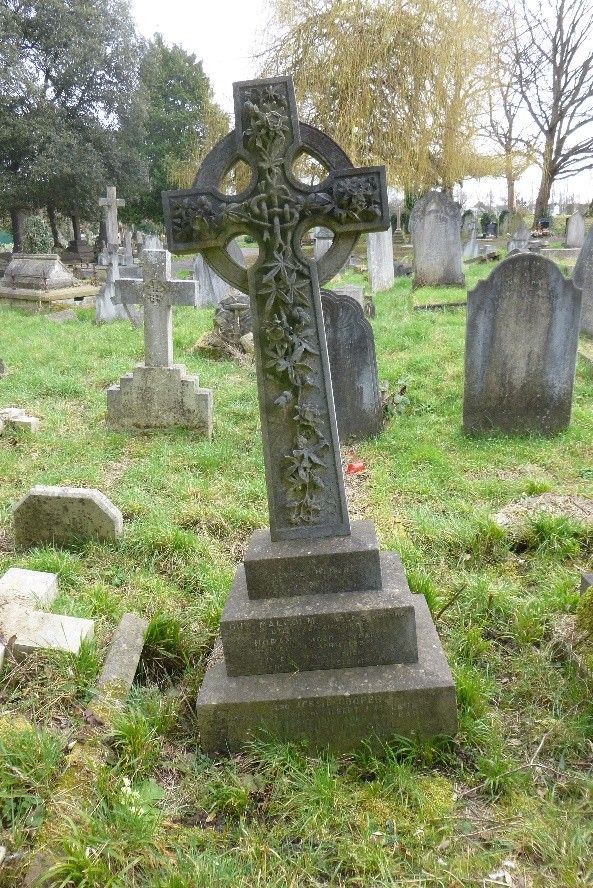
Unsurprisingly Gilbert’s parents Malcolm McCaul and Isabella Alston are also buried in the Necropolis in Compartment Kappa.
New cemetery Friends in Glasgow
Readers may be interested to know that efforts are being made to establish Friends Groups for other Glasgow cemeteries.
Friends of Ramshorn Graveyard
https://mctcc.scot/campaigns/ramshorn-graveyard
Initial meeting held Tuesday, 22 November 2022,
Friends of Maryhill Road Graveyard
Initial meeting held Thursday 19th January 2023. No further information.
New profiles
No new profiles have been uploaded this quarter.
******************************
Anyone who would like to help indexing the Burial Registers is very welcome to join us by contacting me at research@glasgownecropolis.org