Complied by Morag T Fyfe
The indexers have now reached 1866, and the number of records indexed in the last three months is as follows –
| July 2022 | 462 |
| August 2022 | 526 |
| September 2022 | 300 |
Our database of persons buried or commemorated in the Necropolis now stands at 44814 entries at the end of September 2022 of which 18237 entries represent persons buried in common ground with no grave marker.
Kilbirnie Street fire 25th August 1972
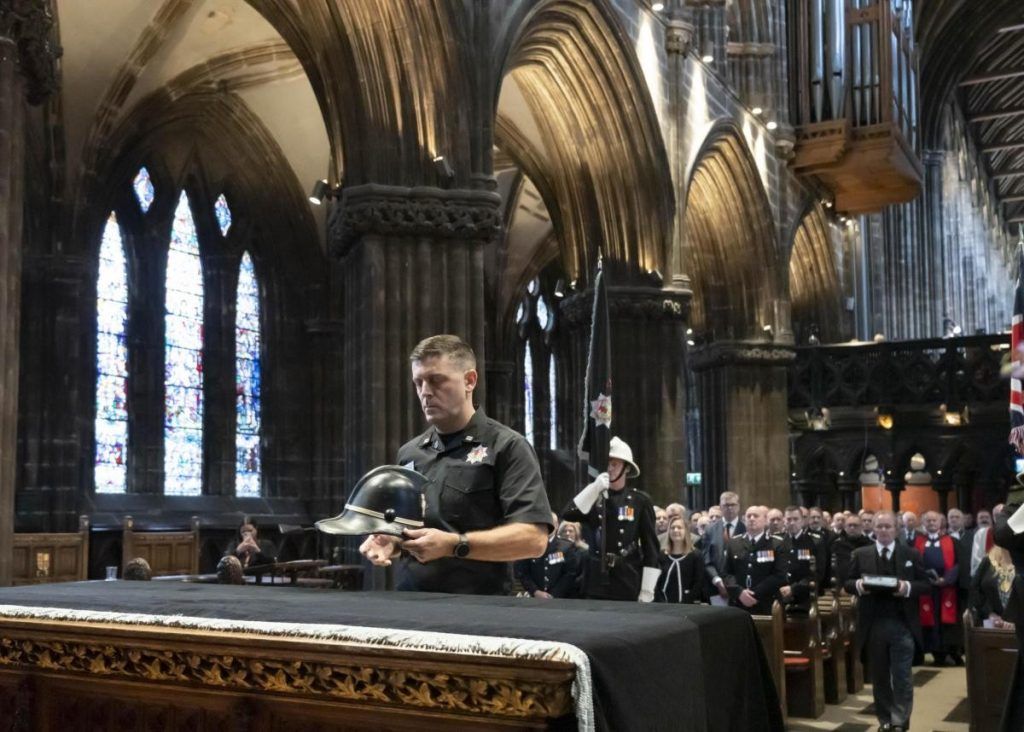
This year marks the 50th Anniversary of the Kilbirnie Street fire in which seven firefighters lost their lives. The Kilbirnie Street blaze sometimes seems a little bit overshadowed in public memory by the Cheapside Street fire of 28th March 1960 in which 19 lives were lost and the James Watt Street fire of 19th November 1968 when 22 people employed in a factory died. This year a special memorial service was held in Glasgow Cathedral on 25th August 2022 to mark the anniversary.
James Breeze 1818-1879
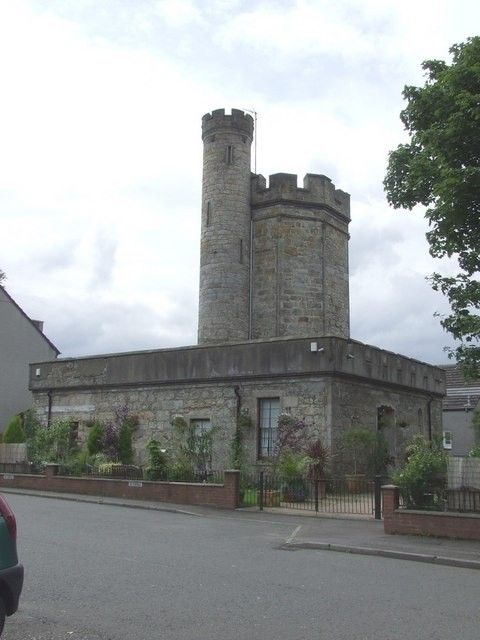
Older residents of Springburn and their descendants (like me) will have heard of Breeze’s Tower. The Tower still stands on Balgray Hill though its surroundings are now much altered and it is more commonly referred to as Springburn Tower or Balgray Tower. It takes its nickname from the Breeze family who owned it for most of the second half of the nineteenth century. Its origins are somewhat obscure but it was built either by David Hamilton, a Glasgow architect, or more likely in his style for Mr Duncan of Mosesfield House c1820-30.
The Breeze family originated with an Irishman James Breeze and his Scottish wife Isabella Brodie. We first catch sight of the family in Copiapo, Chile where at least four children were born between 1851 and 1855. It is not known how James Breeze was employed at Copiapo but considering silver had been discovered in 1832 it is likely James was involved in some aspect of silver mining.
By 1857 the Breezes had arrived in Glasgow and the 1858-59 Post Office directory lists James Breeze, spirit dealer as living in Old Mosesfield House, Springburn. A son George was born there is 1857. By 1859 the family had moved into Balgray Tower where Isabella was born that year. In 1858 four newly built villas sitting on Balgray Hill, Springburn were advertised for let by their builder, James Breeze. Their names were Santiago, Valparaiso, Copiapo and Lima obviously given to commemorate his sojourn in Chile.
Valuation Rolls 1865-1935 record the family’s ownership of various properties in Glasgow. In 1865 and 1875 James Breeze is listed as proprietor of a number of properties in Calton and Springburn but after that the Calton properties are disposed of and only the Springburn properties remain.
James Breeze (d. 27 June 1879) and Isabella Brodie (d. 19 February 1902) are both buried in compartment Epsilon along with three of their children, John, George and Margaret.
Death by misadventure?
The following report from the Scottish Guardian (Glasgow) of Friday 18 February 1853 highlights the dangers to be found working on or near water. None of these men are buried in the Necropolis but there are many examples in the burial registers of similar occurrences.
Bodies found – On Tuesday morning [15 February] the body of a man was found about half-past seven o’clock in the Drumpeller Coal Basin, near Port-Dundas, and was taken to the Central Police Office, where it was subsequently identified as that of a coal riddler, named James Barbour. The body did not appear to have been long in the water. In the course of the afternoon of Tuesday another body was found in the same basin, and was also taken to the Central Police Office. It was instantly identified as that of a man named Wm. Irvine, a waiter, who resided in Little Hamilton Street. Irvine has been missing for a week, having been last seen by his wife on Tuesday, the 8th, in the afternoon when he left the bouse with the view of meeting some person or other, at which time he was perfectly sober and collected. As yet no account can be given of the cause of the death of either of the parties. About half-past 10 o’clock the same night, the dead body of a man was brought to the Police Office, being the third taken from the Canal on Tuesday. In this case it appeared that, as the schooner Hope was coming through the Forth and Clyde Canal, on her voyage from London, and when near to the Glasgow Bridge, near Kirkintilloch, several of the crew, who had been enjoying themselves, were amusing themselves on deck, when three of them fell into the water. Two of them were immediately got out, but the third was drowned before his body could be got at. Deceased, whose name is Isaac Gooch, was a native of Suffolk, and about 20 years of age. He had been only two months aboard the Hope.
GOW Family
A stone in compartment Beta commemorates two generations of a Gow family (there are about six Gow families found in the Necropolis). The family is typical of many middle-class families who aspired to a hygienic burial place in pleasant surroundings as urban churchyards became over-full and obnoxious. The location of the lair (in Beta) suggests the family was relatively well to do and this is borne out by male occupations and census addresses.
Robert Gow, snr bought the lair in 1845 on the death of his daughter Agnes. By this time Robert was in his mid sixties and living with his second wife, Janet Stiven, and unmarried daughters probably at 13 Abbotsford Place, Laurieston. In 1851 he was still working as an insurance agent (at the age of 70) but by 1861 he could afford to retire and live on the rents produced from an unknown number of rental properties. He and his wife and remaining unmarried daughter (Susan) were living at Annfield Terrace, Partick and this remained the family home until at least 1875.
Interestingly in the 20 years between the burial of Agnes and the next family burial (of Susan in 1865), Robert Gow allowed the burial of 5 ‘strangers’ who do not seem to be related to the family and who were not commemorated on the gravestone. Three of these ‘stranger’ burials were Frank, John and Emily Wagstaff. It proved easy to identify them as children of John Buckley Wagstaff, an engraver, and his wife Elizabeth Morris. Careful study of the Post Office directories revealed that Robert Gow, jnr and J B Wagstaff both lived at 12 Florence Place, Stanley Street between 1853 and 1856. Frank M Wagstaff died in 1856 and once he was buried in the Gow family plot his brother and sister both joined him in 1859. Wagstaff came from Manchester and only spent about 10 years in Glasgow where he established the firm of Wagstaff, Glen, & Collier, engravers to calico-printers before returning to the Manchester area.
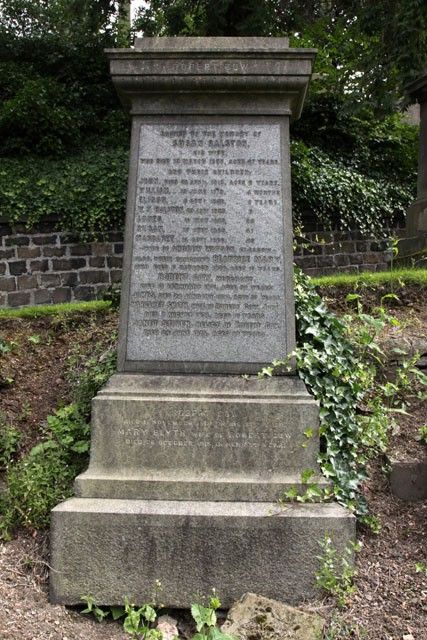
Only two of Robert, snr’s children seem to have married and his only grandchildren seem to have been those of his daughter Margaret, Mrs Andrew Watson though Beatrice Mary died before her grandfather. Although Beatrice Mary’s mother is buried in the Gow family lair it is not known where or when her father died.
Robert Gow, jnr also married twice but does not seem to have had any children. He became an accountant and lived at various addresses in Partick before settling at Cairndowan, Dowanhill Gardens sometime before 1871. In spite of the street address changing between 1891 and 1901 he remained at Cairndowan (later renumbered as 3 Victoria Circus) until his death at the ripe old age of 94 in 1908.
Hubert Thomas Rossborough
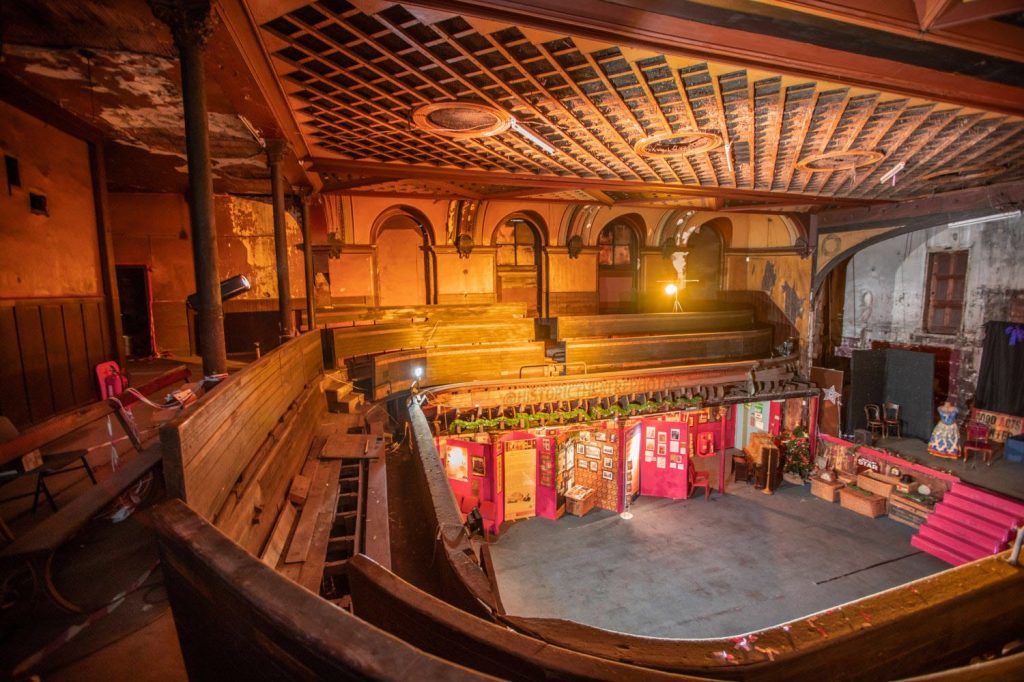
Hubert Thomas Rossborough, generally known as H.T. Rossborough, was the American born lessee and manager of the Britannia Music Hall at 115 Trongate from 1869 until his death in 1887.
Nothing is known about Rossborough’s early life until he turns up in the 1861 census as boarding with a widow in Cowcaddens Street, Glasgow. All subsequent census entries record his birth place as America but in 1861 it is specifically recorded as New York. He was only 22 years old and unmarried which suggests he may have been a recent arrival in Scotland. Two years later he was sufficiently established to marry a widow called Elizabeth McGown (nee Gilbee) and acquire a stepson called Alexander McGown. From 1865 he appears in the post office directories as a wine and spirit merchant with premises in St Enoch’s Lane and St Enoch’s Wynd. 1869 marks a change of direction with his acquisition of the Britannia Music Hall lease and by next year he seems to have given up his premises in St Enoch’s Lane to concentrate on the music hall. It may be that this change of direction came through the influence of his wife Elizabeth. She was the daughter of Henry Gilbee, a concert -room manager and the widow of Lachlan McGown, a comic vocalist who had performed in the Shakespeare Singing Saloon at 36 Saltmarket. Certainly when Rossborough died in 1887 with five years of his lease still to run his widow and step-son ran the business until 1892.
Rossborough died at Luss on Loch Lomond on 28th March where he had moved for a complete rest and change of scene; he is reported to have been in poor health for some time. His funeral in compartment Zeta in the Necropolis on 1st April was attended by many persons connected to the Glasgow music halls. Rossborough, his wife and stepson had lived at The Cottage, Mount Vernon for several years but under the terms of his will this was left to his sister Mrs Sarah Jane Sheridan of New York and her children. As a result, Elizabeth and her son moved to Maxwell Drive, Kinning Park and thereafter to Hastings where she died in 1907. She was not buried beside her husband who is left alone in his grave.
William Rossborough 1813-1892
East Campbell Street is a short street only one block long running north from Gallowgate to Graeme Street. Nevertheless by c1800 it was home to three churches, one Relief Church and two Secession churches. In the following half century there were a number of amalgamations between Protestant denominations and by 1858 when William Rossborough came to Glasgow the churches had become two United Presbyterian Churches and one Free Church. In 1858 East Campbell Street Free Church required a new minister and the congregation called the Rev William Rossborough of First Rathfriland Presbyterian Church, Co. Down, Ireland. (No connection is known between William Rossborough and H.T. Rossborough, above).
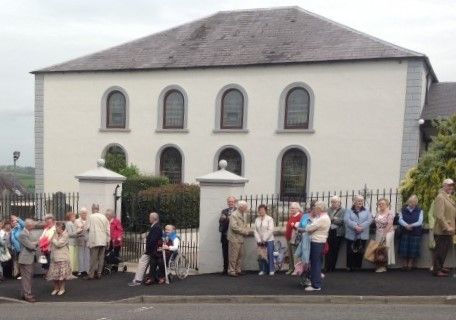
Rossborough was a 45 year old married man with six children when he moved to Glasgow. He was born near Ballymena in 1813, studied Natural Philosophy, mathematics, moral philosophy, logic, belles letters, Greek and Latin at Royal Belfast Academical Institution and gained his General Certificate in 1834. He continued his divinity studies there and was licensed to preach in November 1836. On accepting a call from First Rathfriland Presbyterian church he was ordained there in October 1837. He spent 21 years at Rathfrisland during which time he married and buried his first wife, Margaret McAlister (c1817-1847), married his second wife Margaret Allen, fathered seven children and buried one.
Five years after he arrived in Glasgow Rossborough bought his lair in the Necropolis on the death of his eldest son 19 year old James and two years later his youngest son William Alfred was also buried there.
He remained at East Campbell Street church until his retirement in 1881 when he moved to Kirn, Argyll until about 1885 when he removed to Belfast and died there in 1892. His body was returned to Glasgow to lie alongside his second wife and two sons in the Necropolis.
John Bulley and family
In the 19th century Glasgow suffered two major bank collapses. The more well known of the two is that of the City of Glasgow Bank in October 1878 which ruined all but 254 of its 1,200 shareholders. Almost exactly 20 years before, in November 1857, the Western Bank of Scotland failed. The second largest bank in Scotland after the Royal Bank of Scotland it had a paid-up capital of £1.5m, £5.3m deposits, 1,280 shareholders and 101 branches in 1857.
The cashier in post when the bank failed in 1857 was Ayrshire born John Bulley. Bulley first appears in the Directories of 1834-35 when he is shown as cashier of the Western Bank branch in Paisley. About 1843 he was transferred to Glasgow and by 1849 he was serving as cashier in the Glasgow branch at 10 Miller Street and occupying the bank house next door at 12 Miller Street. There he and his family remained until the fatal crash when Bulley drops out of the directories for a couple of years before reappearing with no listed occupation. Designed by William Burn and David Bryce 1845/6 the Western Bank building stood on the east side of Miller Street until it was demolished c1960. The southern door led to the banking hall and that to the north give access to the living quarters.
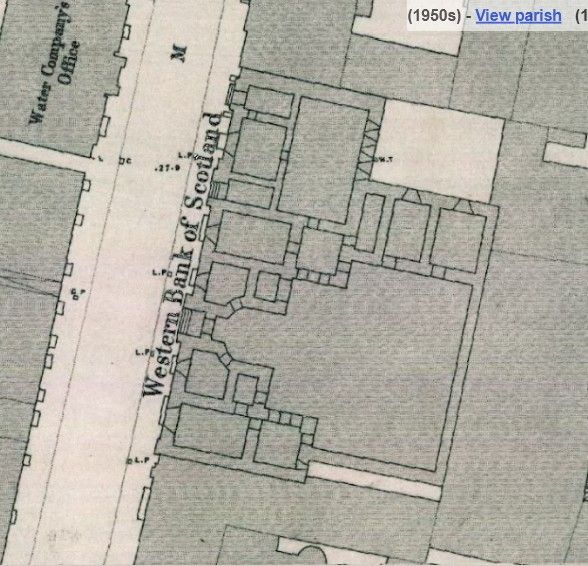
Reproduced with the permission of the National Library of Scotland
As a shareholder of the bank with 31 shares Bulley not only lost his job but faced finding money to pay the two calls made on the shareholders to settle the bank’s liabilities. It is not known how badly he was affected by this but there is no will registered at Glasgow Sheriff Court only an inventory.
John Bulley married Elizabeth Grant in 1834 and six children are known. John Bulley died in 1867 aged 69 preceded by his wife in 1864. Both are buried in the Necropolis along with four of their children and several grandchildren.
Christmas Day burials
Present day readers will, I think, be surprised to learn that virtually every year between 1834 and 1865 at least one burial took place in the Necropolis on 25th December, some years as many as five or six. Most of these burials took place in common ground. Remember it wasn’t until 1958 that Christmas Day became a Public Holiday in Scotland. As a child I can remember my father going out on Christmas Day as train services still ran and he was employed at the Central Station, Glasgow. Burials also took place on New Year’s Day.
David M Richmond, died 14 August 2022
Over the course of the five years during which volunteers have been helping with the Burial Registers project indexers have come and gone but this is the first time we have lost a colleague through death. David had been with the project since the beginning and made a huge contribution to it. I, personally, will miss his input very much as he was always curious about the people and places he encountered and ready to comment and question. Many a time his comments sent me off to look more closely at a particular person and the result was often a short piece in Grave Matters.
Morag Fyfe
******************************
Anyone who would like to help indexing the Burial Registers is very welcome to join us by contacting me at research@glasgownecropolis.org