Complied by Morag T Fyfe
The indexers have now reached 1865, and the number of records indexed in the last three months is as follows –
| April 2022 | 479 |
| May 2022 | 423 |
| June 2022 | 465 |
Our database of persons buried or commemorated in the Necropolis now stands at 43716 entries at the end of June 2022 of which 17426 entries represent persons buried in common ground with no grave marker.
H Moje, seaman
Glasgow Harbour was a busy, dangerous place in the nineteenth century and resulted in the burial of H Moje on 23 February 1865 in common ground in the Necropolis. He was a twenty-nine year old seaman from Hamburg whose body was fished out of the harbour at Finnieston. The death was registered by the captain of the deceased’s vessel (unnamed) who knew nothing of the seaman’s parentage and either didn’t know or didn’t care what the deceased’s forename was.
Johanna Donaldson
A plain stone stands in compartment Sextus erected by Frederick Donaldson in memory of his wife Johanna Zanelli. So far so good. Johanna died in 1903 and the entry in the burial register gives her name as Johanna Rahr Donaldson and place of death as 11 Lynedoch Place, Glasgow. Problems arise when one looks for her death registration as there is nothing for Johanna Donaldson that year. However there is a death for Johanna Zanelli, wife of Mr Rahr, actor registered by Frederick Donaldson, a friend. Probate for Johanna Zanelli Rahr, widow of 269 Kennington Road, Surrey who died on 10 September 1903 at 11 Lynedoch Place, Glasgow was granted to Frederick Donaldson, music hall artist in October 1903.
Two years before her death Frederick and Johanna were living at 231 Brixton Road (over the estate agents), London as husband and wife. Both were music hall artists and Frederick was American. Further investigation turned up the marriage of Johanna Zanelli to John Dittel Rahr at St Stephens, Leeds on 19 July 1882 when Johanna was sixteen. Although Johanna was described as a widow in some sources this was untrue as John D Rahr did not die until the beginning of 1922 in London.
In 1903 11 Lynedoch Place was home to the Nursing Institution and it looks as though Johanna died there during or after an operation for a fibroid tumour from which she had suffered for three years. The surgeon who signed her death certificate was Robert B Lothian and he will be found elsewhere in this issue.
Eliza de Munnick and her daughter Sophia
Occasionally a foreign looking name catches an indexer’s attention and warrants further investigation.
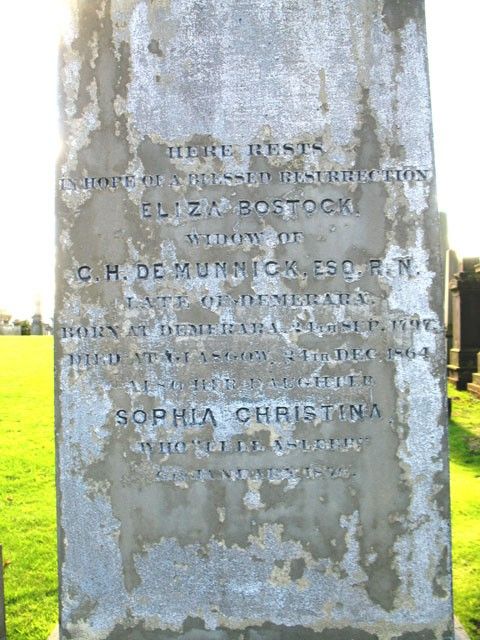
This happened when the burial of Eliza de Munnick was found on 28 December 1864. She was buried in compartment Kappa but it was quickly obvious that she had not been buried in a de Munnick family grave but in that belonging to a Honeyman family. None the less she, and her daughter, were named on the gravestone and not given an anonymous burial in the grave as is not uncommon. This suggested that she and Sophia were related in some way to the Honeymans. They may have been connected by marriage or by friendship but so far the link has not been discovered.
Eliza’s journey from Demerara to Scotland via the Netherlands is worth recording. She was born Eliza Bortock/Bostock to Dr W Bortock and his wife Sarah Carmedy in Demerara on 24 September 1797. The previous year the British, at war with France, had taken over what had been the Dutch colonies of Demerara, Berbice and Essequibo as the Netherlands were now in enemy (French) hands. Eliza was only fifteen when, in 1813, she married a widower twenty eight years older than herself in Demerara, now British Guyana. Her groom, Cornelius Hendrick de Munnick was probably born in Utrecht, the Netherlands in 1769. It is not known when he came to Demerara but he seems to have married his first wife there in 1809. In 1812, when
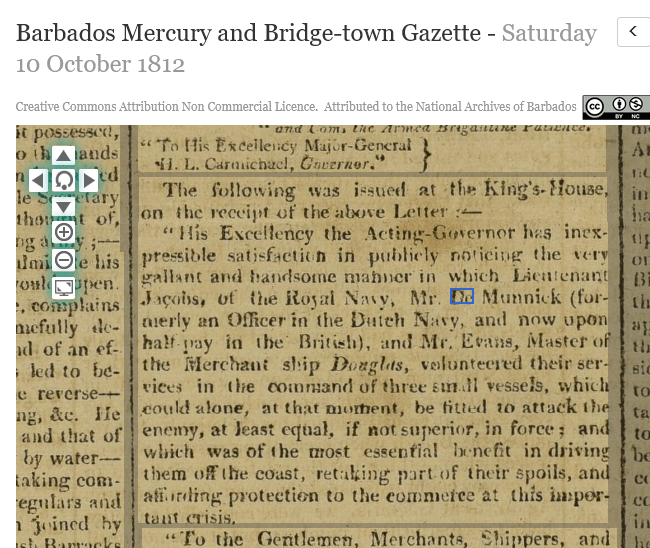
he helped chase off an American privateer from Demerara during the War of 1812, he is described as formerly a Dutch naval officer, now on half-pay in the British navy (see above).
Sometime after this Cornelius returned to the Netherlands with his new wife where five children were born between 1818 and 1826 in which year Cornelius died.
Eliza and two children (Sophia and John) next appear in the 1841 census for Port Bannatyne, Bute which is quite a jump from the Netherlands. None of them are present in Scotland in 1851 but Eliza and Sophia appear again in 1861 and Sophia alone in 1871. In 1861 Sophia was a forty year old governess living with her mother who kept a lodging house at 10 Newton Street, Glasgow. When Eliza died there three years later from pleuritis her death was registered by Robert McGowan described as an inmate which suggests he may have been lodging at Newton Street. When Sophia died in 1876 after suffering from paralysis for seven years her death was registered by Mary M Pacil, inmate who may have been the Mary Pacil, annuitant who was recorded as boarding with Sophia in the 1871 census.
Nothing has turned up to explain why the Honeymans buried Eliza and Sophia in their family lair and commemorated them on the gravestone, albeit on the back of the stone (below).
James Russell
It is always a happy surprise to come across the burial of a soldier in the records particularly when the man in question turns out to be a Waterloo veteran. There is a worn stone in compartment Gamma commemorating a Russell family. James Burn Russell (d. 1904) was the first full time Medical Officer of Health for Glasgow and played a major role in establishing public health medicine in Glasgow. But it is his grandfather James Russell with whom we are concerned.
James Russell, born in Shettleston, Barony Parish about 1780, enlisted in the 2nd or Royal North British Dragoons (Scots Greys) in 1798 and was discharged as a Troop Sergeant Major at Birmingham in 1821. By then he was judged ‘unfit for further service having received a severe contusion on his breast and right testicle when the regiment was reviewed by his late Majesty on 24th Sept 1802 on Ashford Common, the effects of which accident he has never since entirely recovered.’
Russell had been promoted Troop Sergeant Major in May/June 1814 after serving almost six years as Sergeant. At the battle of Waterloo on 24th June 1815 he was serving in Captain Poole’s while Sergeant Charles Ewart, famous for capturing a French Eagle, served in Captain Vernor’s Troop. Six days after the battle Russell wrote to his wife Margaret Macdonald in Glasgow to reassure her that he had survived the battle but had lost all his kit and was about to put on a dead Frenchman’s shirt. It is said that this letter, still in the hands of Russell’s descendants, brought the first news of the battle to Glasgow.
Russell was awarded a pension of 1s 10 ½d when he left the army, later reduced, in 1829, to 1s. When he returned to Glasgow he became the first steamboat harbour master at the Broomielaw until he retired in 1846. For at least part of his time in Glasgow Russell lived in Robertson Street convenient to the Broomielaw. From 1837 he also owned a cottage in Rutherglen and it was to Auburn cottage that he retired in 1846 and where he died on 3rd November 1864. His wife Margaret Macdonald whom he married in 1805 died the previous year.
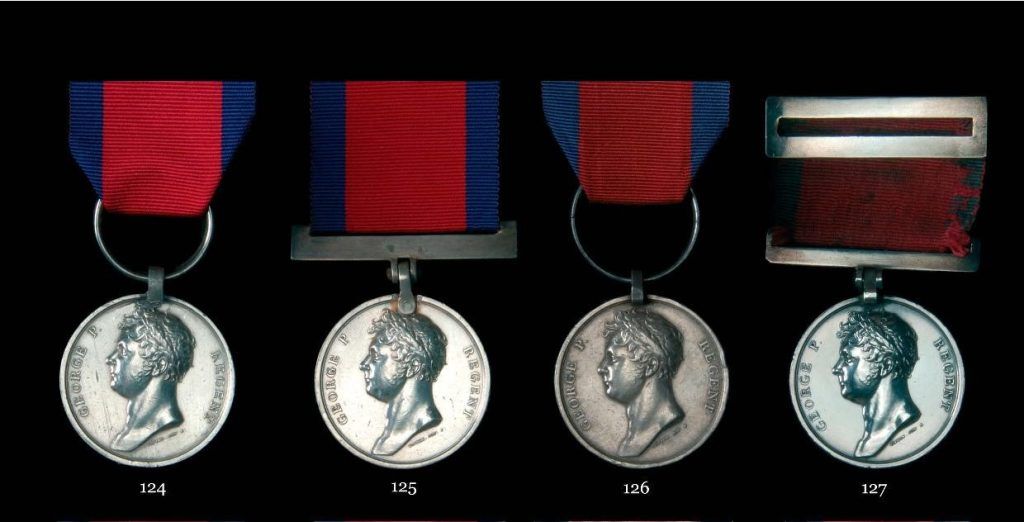
In 2012 a collection of Waterloo Medals was auctioned including that of James Russell which was considered the star of the collection and valued at £6000-8000 (no 127 below).
Robert Bain Lothian
Robert Bain Lothian was born in Glasgow in 1864. His father John A Lothian had practiced as a surgeon in Glasgow for thirty seven years, for twenty two years as a surgeon at the Glasgow Royal Infirmary. R B Lothian’s career took a different path. After study at the University of Glasgow and two London hospitals he set up in general practice but from 1896 he spent much of his professional career as a Police Surgeon in Glasgow. As such he frequently appears in local newspaper reports attending victims of accidents or examining the bodies of murder victims. He was also lecturer on ambulance techniques to both the Police and the Fire Brigade.
Lothian was a vice-president of the Old Glasgow Club and a founder and honorary secretary of the Provand’s Lordship Literary Club founded in 1906.
At the outbreak of the First World War Lothian busied himself organizing the collection of tobacco to be sent to the troops in France but in November 1915 his name appears in a list of men appointed temporary lieutenants in the RAMC. It is noteworthy that with the exception of Lothian who graduated in 1888, all the other men on the list graduated between 1911 and 1915. By the end of the war he had been promoted captain. Nothing is known of his war time service but it is assumed he spent it in Glasgow.
In 1892 Lothian married Margaret Anderson Baird and had at least three daughters and a son. He died at 2 Queen’s Terrace, Glasgow on 30 March 1922 and was buried beside his wife in his parents’ lair in compartment Primus but neither he nor his wife are named on the stone.
James Beaumont Neilson (Hot-blast Neilson) 1792-1865
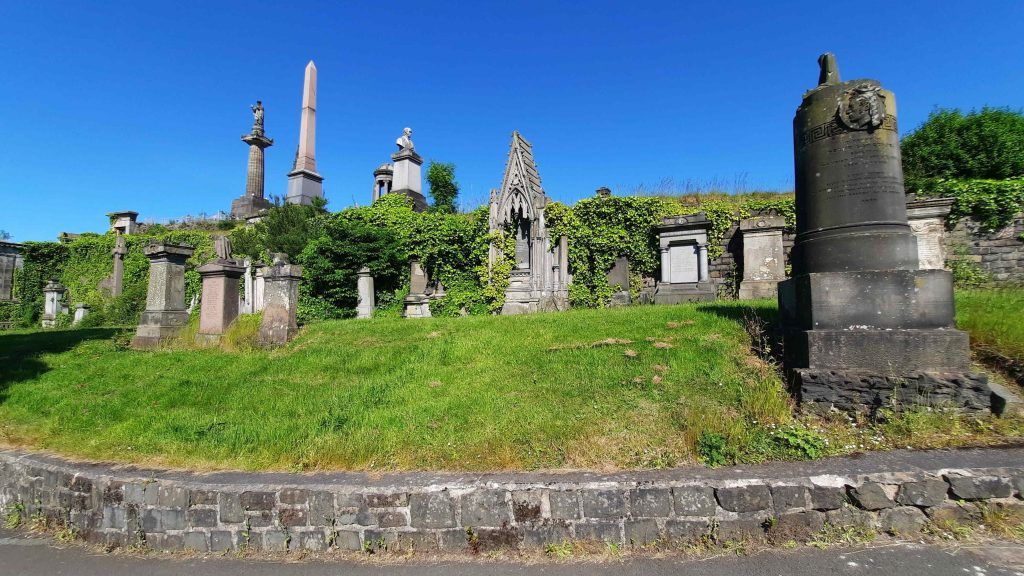
This short note is going to deal with the overlooked grave of James Beaumont Neilson and his family in the Necropolis. It is unnecessary to say anything about the industrial career of J B Neilson as plenty has been published about him, but what is not well known is that he is buried in an anonymous grave in the Glasgow Necropolis. He, his two wives and five children lie in compartment Gamma in a grave which is no longer marked by a stone (below).
J B Neilson and his first wife, Barbara Montgomery, had ten children born between 1819 and 1838 and an eleventh born at Rothesay in 1841. Between c1817 and 1847 Neilson was the manager of the Glasgow Gas Works, living in Weaver Street close to the gas works. In 1842 the death of his sixteen year old daughter Marion from consumption necessitated the purchase of a lair in the Necropolis. The following year (1843) Neilson buried another daughter, Margaret, followed two months later by his wife, Barbara. In 1846 a third daughter, Barbara died and was buried in the family lair. At the 1851 census Neilson was still living in Glasgow with his second wife and some unmarried daughters but it was about this time that he bought the estate of Queenshill in Kirkcudbrightshire. This did not bring an end to the family association with the Necropolis as, after a gap of seventeen years, Jane Gemmell, Neilson’s second wife was buried there in August 1863. Less than two years later Neilson himself joined his wives and daughters when he was buried there on 27 January 1865. Even this did not end the use of the plot. In 1880 his son George Macintosh Neilson died and was buried in the Necropolis and finally his youngest daughter Mary Montgomery Neilson, wife of William Simons the Renfrew shipbuilder followed in 1889.
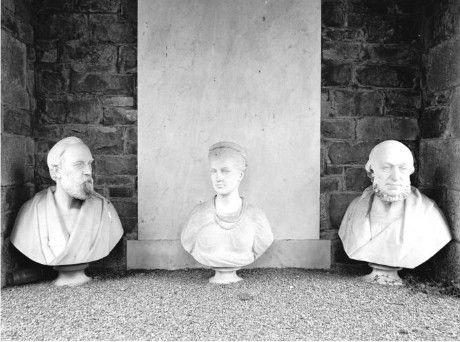
It is generally, but incorrectly, believed that J B Neilson, who died at his home of Queenshill, is buried in the Neilson mausoleum in Tongland churchyard where he and his first wife are commemorated along with their son Walter Montgomerie Neilson and Walter’s wife Janet Henderson.
© HES. Reproduced courtesy of J R Hume
******************************
Anyone who would like to help indexing the Burial Registers is very welcome to join us by contacting me at research@glasgownecropolis.org