Compiled by Morag T Fyfe
When Grave Matters started in 2017 it was intended primarily for the benefit and interest of the indexers engaged on the burial registers indexing project and many of the items discussed were first drawn to my attention by the indexers themselves. It now serves more generally as the newsletter of the Friends of Glasgow Necropolis and previous issues can be downloaded from https://www.glasgownecropolis.org/grave-matters/.
We have reached the end of 1854 and are just starting work on 1855. This marks quite a change in the history of death records in Scotland with the introduction of civil registration of births, marriages and deaths from 1st January 1855. As a result of this and other changes in the burial registers several of the topics below touch on this change.
The indexers continue to make progress and the number of records indexed in the last three months is as follows –
| April 2020 | 285 |
| May 2020 | 410 |
| June 2020 | 394 |
Our database of persons buried or commemorated in the Necropolis now stands at 32915 entries at the end of June 2020.
The Friends of Glasgow Necropolis celebrate their 15th anniversary in July 2020 and to mark the occasion Ruth Johnston, Chair of the Friends, has produced a new extensively revised edition of her book Glasgow Necropolis Afterlives, tales of interments. Otherwise it will be a quiet celebration as coronavirus has brought a temporary halt to our tours and other outreach projects.
Message from Ruth Johnston, Chair of the Friends
Unfortunately we have had to postpone our popular Tour Programme as we are unable to run them at present and we wouldn’t put our guides at risk anyway. Our tour manager is still taking bookings and monitoring the situation month by month. Our guides are all well and are desperate to get going again.
The lack of donations from our tours and presentations will mean our restoration and conservation funds will not be increasing as we would have liked this year. However we can still apply for various small grants which I intend to do very soon.
Our representative from the Merchants House, Douglas Anderson, a very committed supporter of the Friends, has now stood down but we are delighted to welcome a new representative, Ann O’Connell.
Addresses in the Burial Registers
Since the second half of 1853 addresses have been provided for many of the deceased in the burial registers and this will generally continue from now on. It is sometimes not always clear whether the addresses given are residential or business addresses and later two addresses may be given – where the deceased normally resided and where the death actually took place.
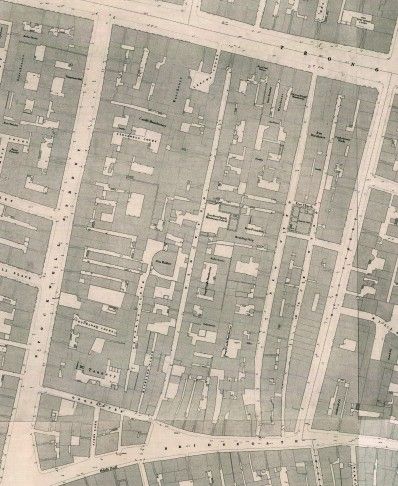
To help identify the streets of 1850s Glasgow we are fortunate to have the lists of streets found in the Post Office directories of and the Ordnance Survey town plan of 1857/8. Even in the short time since addresses appeared it has become obvious that there are duplicate street names and it is not always possible to tell which one is meant. Thus there is Muse/Meuse/Mews Lane either in Cowcaddens or east of High Street; unless Cowcaddens is specified either location is possible. There are three Kirk Streets in the Post Office directories; in the burial registers there have been entries for Kirk Street, Calton and for an otherwise unidentified Kirk Street which is most likely to be that one running from Castle Street to the top of High Street. The City Improvement Trust had not yet been set up so the vennels, wynds, courts and closes off High Street and Saltmarket have not been swept away.
The extract (below) from the 1857 O S town plan of Glasgow shows a block of closes and wynds delimited by Trongate (N), King Street (E), Bridgegate (S) and Stockwell Street (W). Within the block are located Back Wynd, New Wynd and Old Wynd all running north-south between Trongate and Bridgegate and all with addresses recently found in the burial registers. Closes and courts can be more difficult to locate. On the same map extract Highland Close is named running north from the eastern end of Goosedubs but Hunter’s Court which is described in the burial registers as being in New Wynd is not named on the map or in the Post Office directories. Out of 1105 burials in 1853-54 for which an address is provided many can be located to the older and poorer parts of Glasgow and it is possibly no surprise that three quarters of the deceased in that period were buried in common ground.
Introduction of Civil Registration
In his introduction to Social and Economic Statistics of Glasgow for 1854 John Strang noted that the Registration of Births, Deaths and Marriages (Scotland) Act 1854 made the compilation of Bills of Mortality unnecessary from then on. Responsibility had now passed to the new Registrar General. In fact the Act of 1854 was the ninth attempt to introduce civil registration of births, marriages and deaths into Scotland since 1829.
It took the authorities running the Necropolis a few months to come to terms with the requirements of the new act and how it affected their record keeping. Cause of death was dropped almost immediately from the burial registers with the exception of still born children. Occupations were also omitted. The most grievous loss from a family history point of view is that almost all relationships like ‘son of …’, relict of…’ soon stopped being recorded. Married women were generally recorded as ‘Mary Watson or Campbell’ if their marital status was acknowledged at all. On the positive side with the passing of the years the addresses of the deceased gradually come to cover not only Glasgow and the west of Scotland but much of Britain and even abroad.
The Allan Family, shipowners
Visitors to the Necropolis may be familiar with the memorial to Alexander Allan (1825-1892) and his family in compartment Zeta (below). Allan was the youngest of the five sons of Alexander Allan, senior, founder of the Allan Line shipping company.
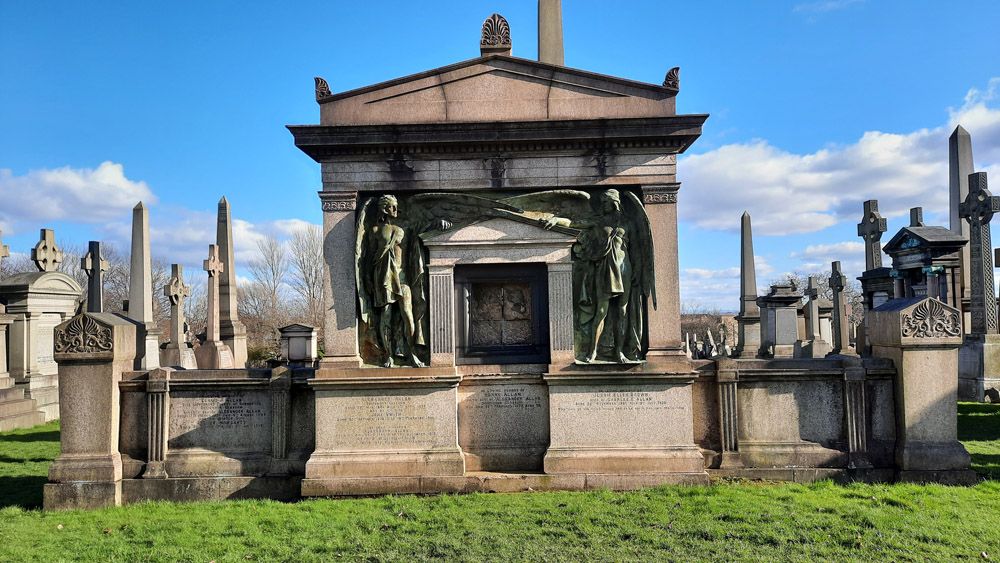
What is not so widely realised is that a more modest monument marks the grave of Allan’s father and eldest brother elsewhere in the Necropolis. Alexander Allan, senior died at Newton Place, Glasgow on 18th March 1854 at the age of 74 and was buried in a grave in compartment Omega followed two years later by his wife Jean Crawford. His eldest son, James (1807-1880), who, together with his youngest brother, ran the Glasgow end of the Allan Line, is also buried there. A third family gravestone standing in compartment Epsilon commemorates Bryce Allan (1859-1922) the youngest son of James, and his family.
Servants
Over fifty adults buried in the Necropolis are described as servants in the burial registers and generally were buried in common ground. In most cases the occupation was simply given as servant although farm servants are mentioned as well as one or two servants employed in commercial premises.
Recently entries have been found in the burial registers for two servants buried by their employers in the employers’ family lairs and commemorated on the gravestones. It turns out that twelve burials are known where long-serving servants have been buried either with their employer or by their employer in a separate grave, complete with gravestone.
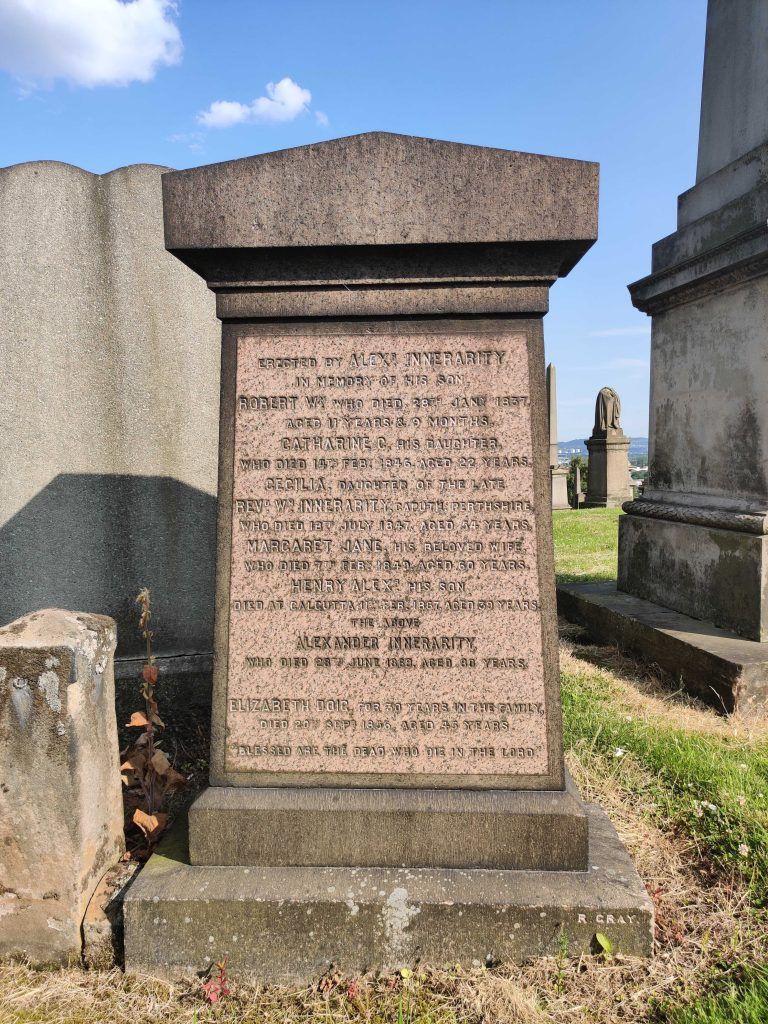
On the 20th September 1854 Elizabeth Doig, aged 45, died from cholera at 407 St Vincent Street and six days later was buried by her employer Alexander Innerarity. A notice of her death was placed in the Glasgow Herald of 29th September. She is recorded on the Innerarity gravestone in compartment Omega where she is described as being “for 30 years in the family”. Incidentally there is a discrepancy about the date of her death, the stone records it as 20th September but the intimation in the Glasgow Herald gives 26th which was actually the date of her burial. In Elizabeth’s case her service with the Innerarities can be substantiated by finding her with Alexander and his wife at Eldon Place, Govan in the 1841 census and with Alexander, now a widower, at 407 St Vincent Street in the 1851 census.
A stone in compartment Epsilon commemorates a family by the name of Miller/Millar and their servant Isabella Craig. Isabella was 75 years old when she died on 21st September 1854 and the gravestone records her service of over 60 years to the Miller family. However this stone is misleading as neither Isabella nor five Miller children and their mother named on the stone are actually buried there. Instead they were buried in the original family lair in Lambda. It seems that about 1863 John Miller, who had remarried by then, sold his lair in Lambda and purchased a more prestigious one in Epsilon for his second wife and new family but did not exhume and move the remains of his first family. The stone standing in Lambda now commemorates a family by the name of Stark.
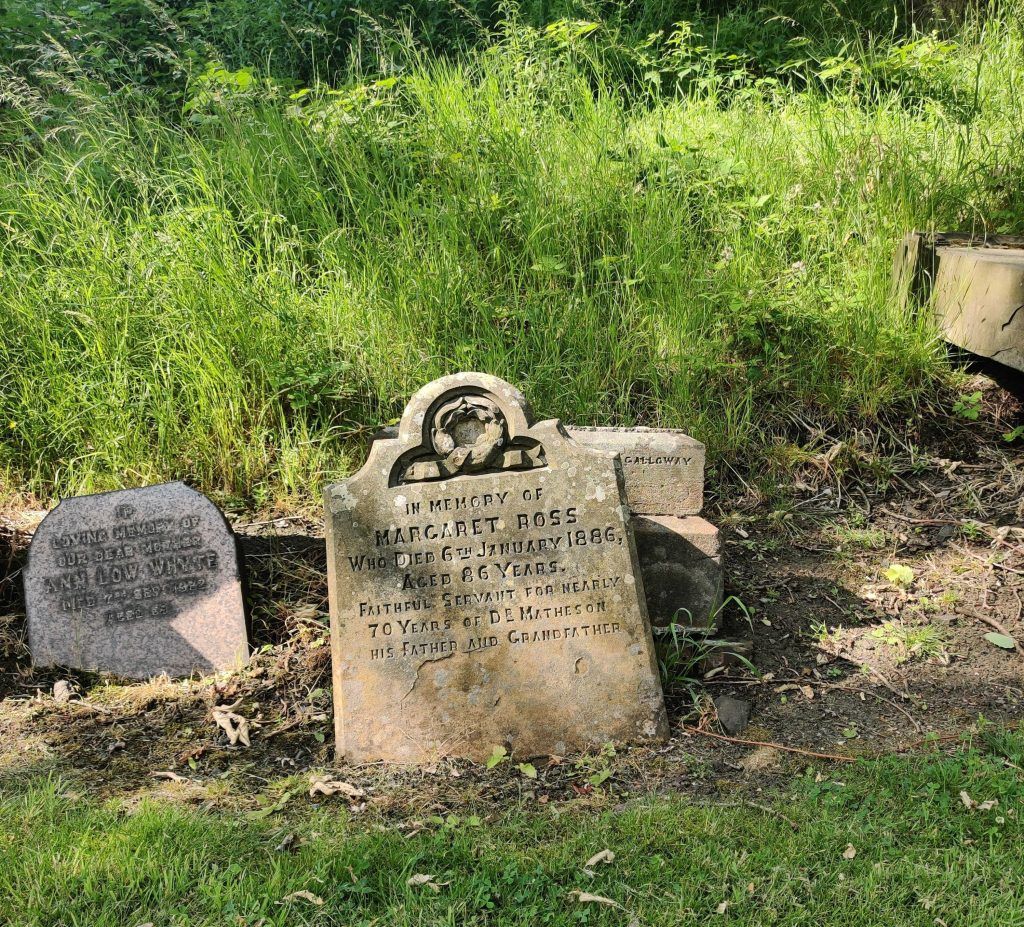
Another example of a servant who spent her whole working life with one family is Margaret Ross who died at Innellan in 1886 at the age of 86. The Matheson family buried her in her own grave in compartment Mnema and described her on the grave stone as a ‘faithful servant for nearly 70 years of Dr Matheson, his father and grandfather’. Margaret spent the last two decades of her life at Innellan near Dunoon in the household of the Rev Dr George Matheson, the parish minister of Innellan. George Matheson, sometimes known as ‘the blind preacher’ for obvious reasons died in 1906 and is buried with other members of his family in compartment Zeta of the Necropolis.
Cholera in Glasgow 1853-4
1854 saw a third major outbreak of cholera in Britain and, naturally, Glasgow was affected. The 1848-49 outbreak was discussed in Grave Matters no 9. In this outbreak 151 cases (17%) were recorded in the burial registers of the Necropolis as dying from cholera out of total burials of 877 for the period between 26th Dec 1853 and 25th October 1854, a much lower percentage than occurred in 1848. In his analysis of the statistics relating to cholera in Social and Economic Statistics of Glasgow for 1854 John Strang also included deaths from diarrhoea and dysentery in his discussion of the figures but that has not been done here. 120 of the deceased were buried in common ground and only 31 in family-owned lairs, which suggests that the poorer inhabitants of the city were more badly affected this time.
James Watt’s connection to the Muirhead family
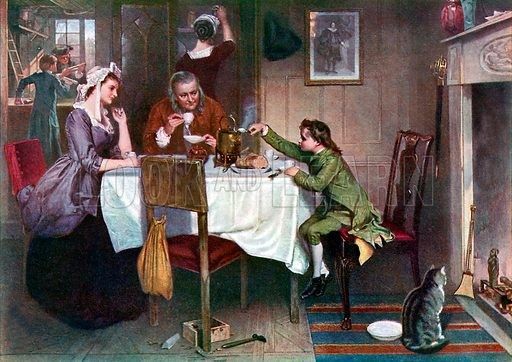
In Grave Matters 5 there was an article entitled Are people buried where expected? in which a stone in compartment Delta commemorating James Campbell, his wife Marion Muirhead and their family was discussed. In the piece it was noted that Marion Muirhead seemed to have been a cousin of James Watt of steam engine fame. An article published in the current issue of History Scotland vol 20 no 4 July/August 2020 by Frances Green entitled The aunt with the kettle examines the story of the young James Watt being inspired by the steam rising from his aunt’s kettle. In the course of the article details are provided about the Muirhead family and their property in Gorbals.
******************************
Anyone who would like to help indexing the Burial Registers is very welcome to join us by contacting me at research@glasgownecropolis.org