Compiled by Morag T Fyfe
The indexers continue to make progress and the number of records indexed in the last three months is as follows –
| July 2020 | 638 |
| August 2020 | 691 |
| September 2020 | 658 |
Our database of persons buried or commemorated in the Necropolis now stands at 34558 entries at the end of September 2020.
Lorenza Elizabeth Merrow
An intriguing entry in the burial registers for 27th September 1855 sent me looking for the related grave stone in compartment Theta which said:
Sacred / to the memory of / LORENZA ELIZABETH / beloved wife of / Capt LEWIS T. MERROW / of Bowdoinham, Maine U.S.A. / who departed this life / on the / 26th day of September 1855 / aged 31 years
It is not uncommon for strangers to be buried in the Necropolis but the amount found out about them can vary a great deal. In this case, though Lorenza herself remains a shadowy figure, a great deal can be found out about her husband Lewis Thorpe Merrow.
Bowdoinham is a small town in Maine on the Kennebec River with a current population of just under 3000. In the first half of the 19th century it was home to a number of branches of the Merrow family including Lewis and Lorenza Merrow. They are found there at the US census of 1850 which was a fortunate chance as Lewis was a ship’s captain. Lorenza and their children accompanied him on his voyages as shown when a son of seven months died on the ship Sewall on passage from New York to Liverpool in 1852. By 1855 Lewis was master of the clipper ship Lorenza.
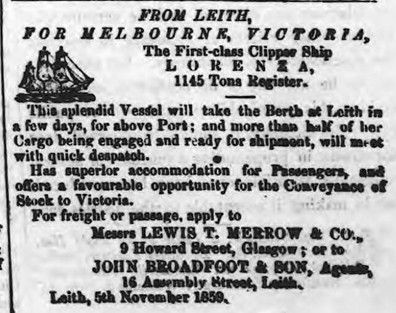
With Lorenza’s death in 1855 one might have imagined that that would be the last of the Merrows in Glasgow but not so. In 1858 Lewis and his new wife arrived in Scotland from Boston and in the same year it is clear from notifications in the newspapers that Lewis is trading as a ship’s agent under the name Lewis T Merrow and Company. The following year he appears in the Glasgow Post Office directory as a ship’s broker with an address in Howard Street. From then on his life in Scotland can be traced through the births of children, notices of bankruptcy, naturalisation, and commercial ventures until his death at the doorway of his son’s church in 1905. Merrow’s second wife died before him but is not buried alongside Lorenza who remains alone in her grave in the Necropolis.
Start of burials in compartment Epsilon
1856 marked the start of a new phase in the development of the Necropolis. That year the Necropolis was further extended onto the flat ground on the summit of the hill and compartment Epsilon was created. Three years later compartment Petra was opened in part of the former quarry to satisfy a demand for less expensive burial plots. Epsilon was the first compartment where graves were laid out and numbered in a regular fashion. Previously the purchaser of a lair could pick any available spot within a compartment and this grave was given the next available running number in that compartment. Thus, for example, lair number 40 could be found between lairs 3 and 30. The first burial to take place in Epsilon was that of Robert Baird of Auchmedden, one of the Bairds of Gartsherrie, on 12th August 1856. He was a lawyer by training but worked in the family firm of William Baird and Company. At the time of his death he was Lord Dean of Guild of Glasgow.
The Aikmans of Grosvenor Terrace
Visitors to compartment Omega in the Necropolis may notice a standard gravestone that records the loss of six children in 1857.
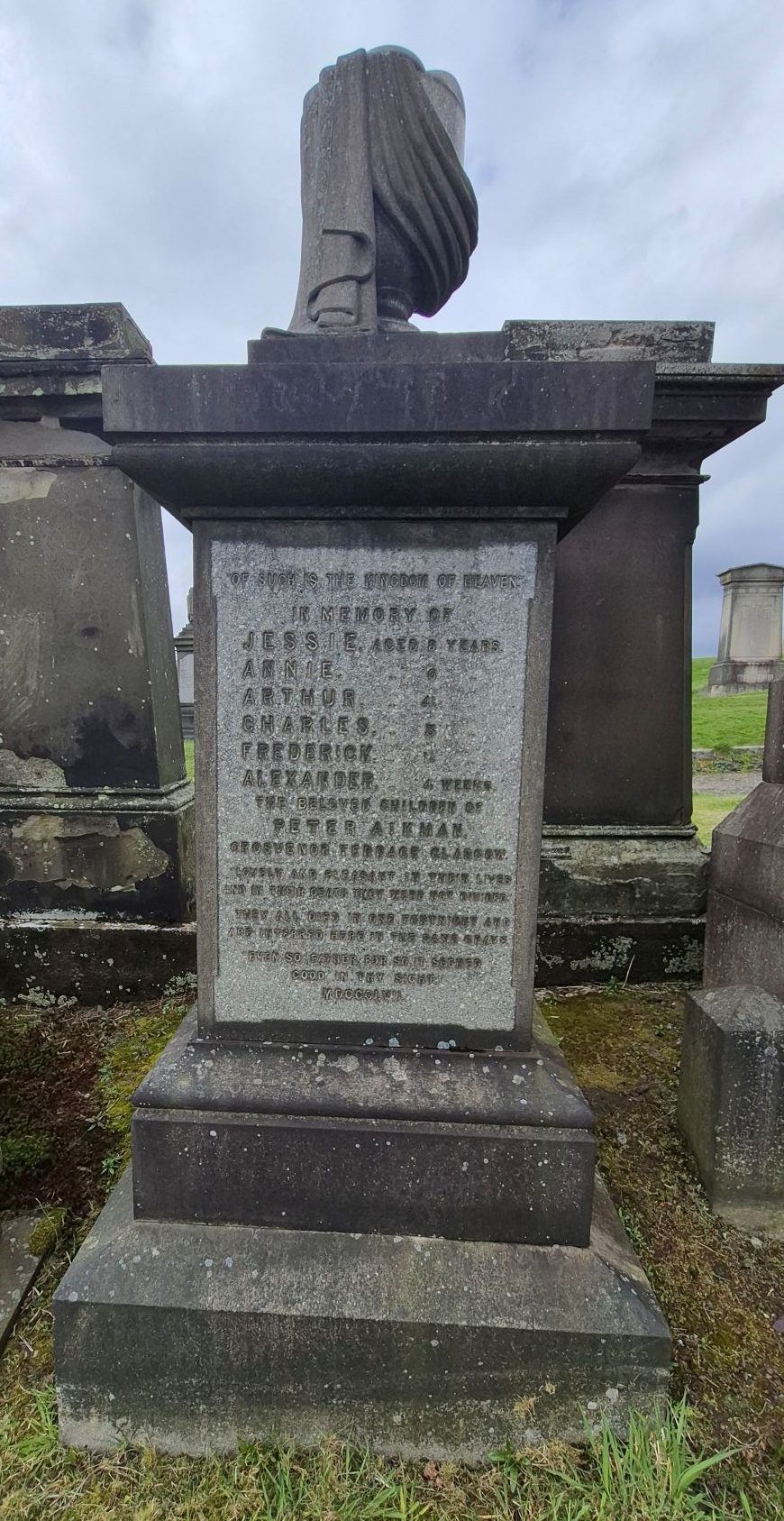
In memory of /JESSIE aged 8 years/ANNIE aged 6 years/ARTHUR aged 4 ½ years /CHARLES aged 3 years /FREDERICK aged 1 ½ years /ALEXANDER aged 4 weeks /The beloved children of /PETER AIKMAN, /Grosvenor Terrace Glasgow.
“Lovely and pleasant in their lives /and in their death they were not divided. /They all died in one fortnight and /are interred here in the same grave. /Even so Father as it seemed /good in Thy sight
MDCCCLVII”.
Now that the indexers have reached 1857, the burial registers and other sources have allowed us to flesh out their story. Baby Alexander was the first to be buried, by his father, on the 10th March 1857. He was followed six days later by Jessie, Annie and Frederick. The last two surviving children, Arthur and Charles, were buried together on the 24th March. Peter Aikman organized the first two funerals but when it came to the third the boys were buried by their grandfather.
The deaths of so many children in such a short space of time warranted sympathetic comment in some of the local newspapers and it is from these notices that we learn that all the children died from whooping cough. On obtaining the death certificates of Annie and Jessie it turned out that their cause of death was more complicated than that reported in the newspapers. The official cause of death was ‘Rubeola followed by Pertussis and consequences from 29th January 1857’. Rubeola is measles as opposed to Rubella which is the less serious German measles. It seems that one of the side effects of Rubeola is to suppress the immune system and lay the patient open to other infections of which whooping cough is the most likely in the nineteenth century.
A second panel on the monument records the death of Peter Aikman in London in 1862 and of his wife Janet A Cochran also in London in 1911. Neither of them is buried in the lair alongside their children but one of the three daughters born to the couple subsequent to 1857 is. Evelyn, their youngest daughter who was born in London in 1860, died in Edinburgh in 1907 and is the last member of the family to be buried there.
James Shanks, civil engineer and surveyor
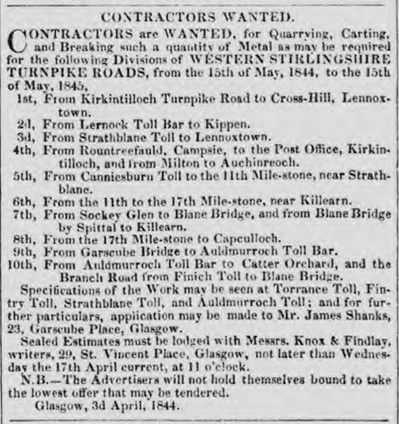
James Shanks lived at 23 Garscube Place for over twenty years and died there in 1855 at the age of 72. He appears in the Glasgow Post Office directories from 1830 onwards as a civil engineer and road surveyor. Thanks to papers deposited in the National Archives of Scotland it is possible to recover part of his working life. In 1834 and 1835 he was engaged by James Glassford of Dougalston and John Campbell Colquhoun of Killermont to survey some parcels of land in Milngavie. Between 1836 and 1847 there are plans of roads surveyed by Shanks and held in the Glasgow Sheriff Court records. These seem to be mainly new turnpike roads in the general area of Strathblane, Lennoxtown, Baldernock and as far as Port of Menteith as the advert from the Glasgow Herald of 8th April 1844 shows.
James Shanks was married to Mary Adie for over twenty years but the couple do not seem to have had any children.
Glasgow Doors Open Days
Due to the continuing coronavirus pandemic Glasgow’s Doors Open Days in September this year was a wholly virtual event. This allowed exiles living away from Glasgow to view a wide variety of video tours. The Friends of Glasgow Necropolis produced a video of the cemetery shot from a drone which is well worth viewing. See https://www.youtube.com/watch?v=EI4eJgqRpZg
Mary and Elizabeth Duncan
On 2 September 1856 Mary Duncan of 39 Sidney Street was buried in the Necropolis and four days later Elizabeth Duncan of the same address was also buried. In neither case was an age given (as is not uncommon at this period in the burial registers) so, although it was fairly clear they were probably related, it was not known whether they were mother and daughter or two sisters. Many, but not all, burials where no age is given belong to children, often infants, and that seemed a fair assumption to start from.
A search of the index to the death registrations on Scotlands People for 1856 revealed the deaths of a Mary Duncan, aged less than a year who died in the High Church Registration District (644/2 1080) and of an Elizabeth Duncan who also died there (644/2 1093) shortly afterwards also at less than a year old. The maiden name of the mother of both these children was Erskine.
Turning to the index to the birth registrations the births of Elizabeth and Mary Duncan were found registered consecutively in the High Church Registration District also in 1856. Elizabeth was registered as entry 644/2 1371 and Mary as entry 644/2 1372. Can we deduce from the order in which the girls were registered that Elizabeth was the elder twin?
A further sad coda to the loss of these twins is that although they were buried only four days apart in common ground, Mary was buried in compartment Theta and Elizabeth in compartment Omicron.
The clearance of St Mungo burial ground
In 1876 a number of the older burial grounds in Glasgow were closed to new burials under the Public Health (Scotland) Act of 1867. It can be a problem for family historians to locate the final resting places of the people buried in these locations assuming the burial grounds were cleared and redeveloped. An enquiry received by the Friends has at least answered that question with reference to St Mungo burial ground situated to the north of the original Glasgow Royal Infirmary building and opened at almost the same time as the Necropolis. A search in the British Newspaper Archive produced a brief report in the Greenock Telegraph of 3 October 1903 which announced that Glasgow Royal Infirmary was planning an extension of the site of the burial ground and the bodies from were going to be reinterred in Riddrie Cemetery.
Billiongraves.com
Another recent enquiry has demonstrated what many family historians already know, that sites like billiongraves.com have to be treated with caution. An enquirer sent a link to the photograph of the gravestone of John McPherson who died at sea in 1879 and which was described as being “at Glasgow Cathedral”. One glance at the photograph was enough to identify it as being in the Necropolis instead, in one of the compartments looking down on Wishart Street.
******************************
Anyone who would like to help indexing the Burial Registers is very welcome to join us by contacting me at research@glasgownecropolis.org