Alexander Ewing and Maria McAulay
Where there’s a will…
By Diana Burns, October 2026
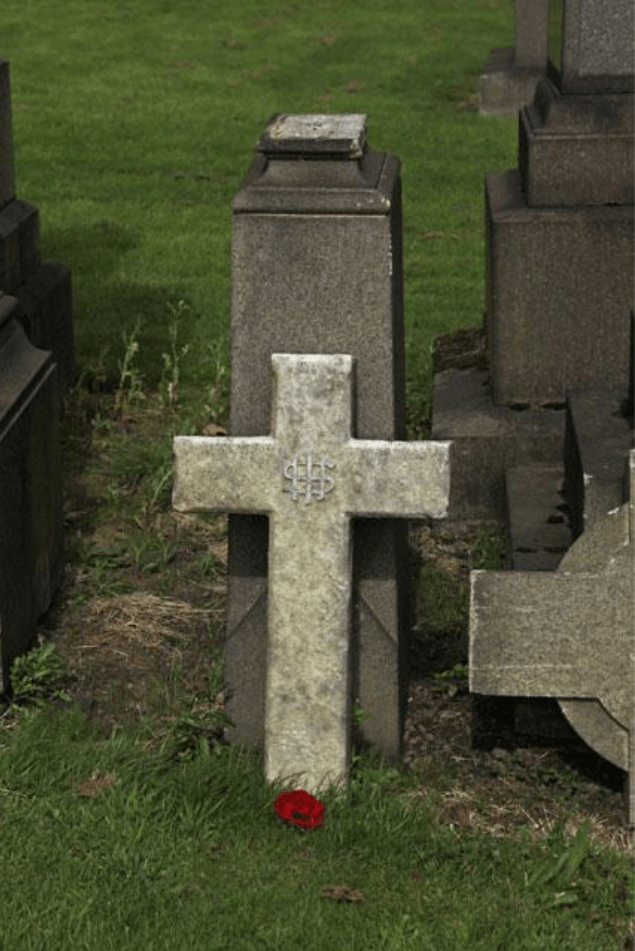
Alexander Ewing died 13 March 1876, aged 65 years
Maria Macaulay, his wife, died at Angash in Nubia 29 January 1878, aged 63 years
What was a wealthy, sixty-three-year-old widow doing in darkest Africa, halfway up the Nile, hundreds of miles from her family, friends and comfort zone? She knew it would be hazardous – she had made her will before she left home – and, as events were to prove, she had been correct.
Maria Macaulay was the third daughter of Robert Macaulay Esq. of Glen Oak, Crumlin, County Antrim. She was married to Alexander Ewing, a Glasgow grain merchant, at Glen Oak on 3rd November 1840. It would be nice to think that the couple went off afterwards for a long honeymoon and hence their absence from the 1841 census, or they may have simply stayed on in Antrim. In any event, they were back Glasgow by 1842 when their first son, Robert, was born, named after his paternal grandfather. Alexander, named after his father, followed in June 1843. Maria had no more surviving children.
For a while, the family lived with Alexander’s father, Robert, at West Stewart Street, Greenock. Robert was a widower and the father of six sons and a daughter, but when he composed his will, it was clear that Alexander was his favourite. Also clear was his anxiety about the lifestyle choices of another son, James.
After legacies to his two nieces and the son of another niece, and £1000 to his daughter in law, Maria, ‘in token of my respect and affection for her’, Robert left the bulk of his estate to Alexander. This was subject to the payment by Alexander of an annuity of £100 to his brother, James ‘presently in Australia or elsewhere furth of Scotland, during all the days of his life’. This modest allowance was to be supplemented, on Robert’s death, by rentals from some properties in Greenock which would be ‘sufficient for his comfortable and respectable maintenance’. Robert’s doubts about the conduct of his son are further underlined by conditions designed to prevent James’s creditors getting their hands on his money. His paternal fears, however, were unfounded – James Ewing died in Victoria, Australia in 1863.
Alexander and Maria moved with their sons to a smart address at Claremont Terrace in Glasgow.
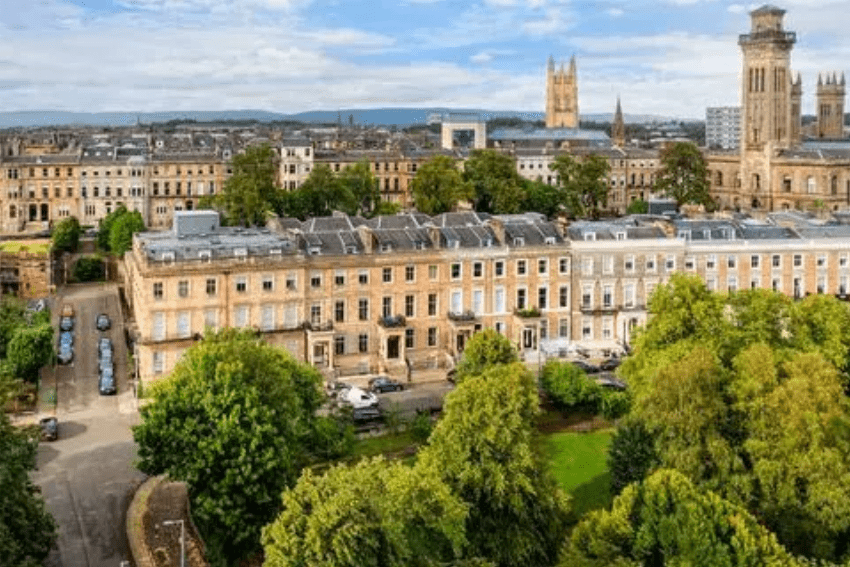
Claremont Terrace sitting behind its private gardens. The towers of Park are back right.
Robert, their elder son, became a highly successful merchant trading in the East Indies, and in 1880 married Lizzie Macaulay, daughter of John Macaulay J.P. of Red Hall, Co. Antrim. Still living at home in 1871, Alexander appears in the census as a grain merchant. After his father’s death in 1876, Alexander gave up any attempt to earn a living, and went off to Oxford.
There Alexander was joined by his mother, already planning her trip to Egypt. She prudently decided to make a will before she left and, in October 1877, the document was witnessed by Alexander’s friend, clergyman and botanist the Reverend Henry Garnsey of Magdalen College. Maria Ewing had a breath-taking array of worldly possessions. In her will, she itemises and allocates them with careful precision to relatives and friends, down to the last photograph album and mourning locket. She was also very protective of her younger son, naming him as her residuary legatee. In other words, Alexander would scoop the pool. She explained that this was because he was not in business and unlikely ever to possess the means enjoyed by Robert. Of course, Robert was not forgotten. Aside from a glittering cache of jewellery and ornaments, he was to receive half his mother’s household furniture, all the hall and library furniture from the house at Claremont Terrace, and numerous other bequests besides.
Her affairs now in order, Maria departed. But why would an unattached middle-aged woman choose the Nile as her holiday destination? She may have picked up a copy of Amelia Edwards’s book, ‘One Thousand Miles Up The Nile’, a travelogue published in 1877, the same year as she began planning her own trip to Egypt. Amelia, accompanied by several friends, hired a dahabiyeh and sailed south up the Nile, spending six weeks at Abu Simbel and writing vivid descriptions of the scenery, archaeology and Egyptian people. In 1876, Thomas Cook had started conducted tours to the Second Cataract on the Nile, terminating at the steamer port of Wadi Haifa. So Maria could have made her journey as an independent traveller, accompanied by friends or relatives, or in a party through a travel agent.
Something went wrong and Maria died on 29th January 1878. Although the cause of death remains unknown, diarrhoea, dysentery and enteric fever were endemic in the area and it is probable that Maria succumbed to one of these. Her death notice was published seven weeks later in the Pall Mall Gazette. It named the place of her death as Wadi Haifa, a district of northern Sudan from where Maria doubtless hoped to visit the rich archaeological sites of the upper Nile. The hamlet of Angash is specifically recorded on her headstone. Her body was repatriated and buried on 22nd March beside that of her husband in Compartment Zeta, lair 22 in the Glasgow Necropolis.
Both brothers settled in England. Robert moved to Burton Grange in Cheshunt, a handsome red brick house, and became a Justice of the Peace and County Councillor. Alexander lived in Statenborough House, Eastry, Kent, looked after by a team of servants. He made his will in 1893 and took the unusual step of attaching a sealed envelope to the document, to be opened immediately on his death by Robert. Two matters were causing him particular concern – his funeral arrangements and the future of his housekeeper, Miss Sophie Foster. He asked to be buried beside his father and mother and, if this was not possible, in the local churchyard at Worth. His friend, the Reverend Walker Flower, was to conduct the service and ‘on no account is Mr Sampson of Eastry to have anything to do with it.’ Heaven alone knows what Mr Sampson had done to offend!
Sophie Foster was Alexander’s thirty-two-year-old lady housekeeper. Tongues had been wagging regarding the relationship between her and her middle-aged employer, and he was anxious to set the record straight. He declared that she had been his devoted friend and guardian angel, ‘the noblest and purest woman I have ever met with the exception of my own mother and though here living with me as my housekeeper may have given rise to evil reports they are all absolutely false and she is as pure and true a woman as ever lived.’ He then made financial arrangements which would ensure Sophie’s comfort for the rest of her days. Finally, he bequeathed to his sister-in-law, Lizzie, the Dog Stamp Damper which she had given him, as it had been a most useful present.
Alexander died suddenly on Christmas Eve 1895 and was buried beside his parents, as requested, on New Year’s Eve. His name, however, does not appear on the gravestone. While he may not have allayed suspicions about their relationship, his provisions for Sophie were honoured and she retired to live at St Alban’s Villas in Ramsgate, far from the gossips and scandal mongers of Eastry.