John Wright (1822-1892)
By Stephanie Brady
John Wright was born in Glasgow on 20 August 1822, the son of Daniel Wright and Catherine Campbell. His parents had married on 20 August 1821 in Sleat, Skye. John was one of eight children and followed in his father’s footsteps, becoming a joiner (foreman).
On 8 December 1850, John married Elizabeth Kelly in Glasgow. Together they had seven children: Daniel, Mary, Elizabeth, Robert, Margaret, Jane (Jean) and John. In the 1861 and 1871 census we can see that John and Elizabeth paid homage to the poet Robert Burns by naming two of their children Jane (Jean) Armour Wright and Robert Burns Wright. The naming of his children in honour of the Bard may perhaps have been a nod to Burns’s social and political outlook, particularly his egalitarian ideals and sympathy for ordinary working people—values that appear to have resonated with John.
John Wright appears to have been a broad-minded Victorian with strong beliefs in free thinking and land reform. His life suggests a man who was prepared to question established ideas and take an active part in movements concerned with religion, society and reform.
In the 1850s, John was the Secretary of the Glasgow Eclectic Association, a nineteenth-century Glasgow free thought and debating society. The association provided a place where people could come together to hear lectures, discuss controversial ideas and debate religious questions. It formed part of the wider movement of people who questioned orthodox Christianity and promoted secularism, rationalism and freedom of thought.
In 1853, in his capacity as Secretary of the Glasgow Eclectic Association/Institute, John wrote to Dr William Anderson, prominent Glasgow Presbyterian minister, conversationalist and the minister of John Street Relief Church in Glasgow, to propose a public debate with George Jacob Holyoake, who was coming to Glasgow to give a course of lectures on secularism. Dr Anderson declined the invitation and instead directed the challenge towards Rev. Brewin Grant, a prominent Protestant preacher and controversialist who became well known for debating secularists. Grant accepted.
A copy of John Wright’s letter to Dr Anderson appears in The Dissenting World: An Autobiography of Rev. Brewin Grant. The letter provides a rare opportunity to hear John’s own voice and gives an insight into the confidence with which he approached questions of religion and public debate.
The letter was written from 14 Garthland Street, Glasgow, on 29 July 1853:
Glasgow Eclectic Association,
14, Garthland Street, July 29, 1853.
Rev. Sir,
In my official capacity as Secretary of the above Society, I beg most respectfully, in accordance with their instructions, to state that Mr. George Jacob Holyoake. Editor of the ‘Reasoner.’ has made arrangements to visit Glasgow in a few days, for the purpose of delivering a course of lectures on Secularism. The Freethinkers of Glasgow, as well as in other places of Scotland and England, are, I believe, almost unanimous in considering Mr. Holyoake as their most distinguished leader and efficient advocate. And as you, rev. Sir, have acquired a widely-spread celebrity by your eminent controversial abilities in defence of what you deem Protestant truth against Popish error and delusion, the members of the above society, desirous that truth, and truth alone, by whomsoever taught or wheresoever found, should reign and flourish everywhere among men, and that falsehood, whatever form or aspect it may assume, may speedily be detected and overthrown, deem this a most opportune occasion for a collision of sentiment between two such gentlemen of unquestioned ability. The Freethinkers of Glasgow are emboldened to address your reverence more especially, from the circumstance of your having very recently challenged Dr. Cahill to meet you in public controversy; and as it is believed by the Christian world that Infidelity, no less than Popery, is a system of delusion, subversive of morals, and fatal to the noblest instincts of humanity, a public controversy upon the merits of the two systems, between persons of acknowledged ability, would inevitably, we think, tend to beneficial results. Mr. Holyoake is a man of unblemished moral reputation and held in high esteem by many persons in every sphere of life, even venerated by many who are altogether opposed to his doctrines. He has also held more public controversies with distinguished divines than any other advocate of Infidelity.
J. Wright
Secretary
The letter reveals a confident man who was prepared to approach a prominent Protestant minister on behalf of a free thought society and invite him to engage in a public examination of competing beliefs. John presented the proposed debate as an opportunity for “truth, and truth alone” to prevail, regardless of who taught it or where it was found.
The debate that followed ran over six evenings in Glasgow City Hall, from 2 to 19 October 1854, on the question of whether secularism was inconsistent with reason and the moral sense and condemned by experience. Holyoake defended secularism, broadly the idea that people should base their lives and social arrangements on reason, experience and considerations of this world rather than religious revelation. Grant defended Christianity and attacked secularism.
The debate was very well attended, with one contemporary account putting the audience at around 3,000 people. For the Secularists, the debate was considered a significant success because it brought discussion about freethinking to a much wider audience. Holyoake’s periodical, The Reasoner, is said to have significantly increased its circulation.
The debate was sufficiently important that the complete proceedings were subsequently published as Discussion on Secularism: Report of a Public Discussion between the Rev. Brewin Grant and George Jacob Holyoake, Glasgow, 1854. The proceedings extended to approximately 220 pages.
John Wright was therefore instrumental in bringing about a major public confrontation between Christianity and secularism in Glasgow. Although he was not one of the principal debaters, his initiative set in motion a chain of events that culminated in a major six-evening confrontation between Christianity and secularism before a large Glasgow audience.
But John’s interests were not confined to religious and philosophical questions. He was also a member of the Bridgeton branch of the Scottish Land Restoration League, which believed in land reform and opposition to landlordism, and whose slogan was The Land for The People.
The Scottish Land Restoration League was founded in Glasgow in 1884, following a major Scottish tour by the American reformer Henry George, author of Progress and Poverty. George believed that land should be restored to the people, that private ownership of land should be brought to an end, and that the income generated from land should be used for the benefit of society as a whole. Rather than relying on taxation of people’s wages, homes and businesses, the state could raise revenue through the taxation of land and use it for public benefit.
The League gained support from both Highland communities, where the legacy of the Highland Clearances and the ongoing struggles of crofters to secure access to land remained important issues, and from rapidly growing urban areas, where workers faced poverty, insecure employment and poor housing conditions.
John’s involvement in both the Glasgow Eclectic Association and the Scottish Land Restoration League reveals a striking continuity in his outlook. In one movement he was involved in questioning established religious ideas and promoting free thought; in the other he supported a movement questioning established systems of land ownership and landlordism.
Given his involvement with both organisations, it would be fair to describe John as an intellectually curious and politically engaged man who was prepared to challenge established authority, believed strongly in public debate and self-education, and remained involved in reform movements throughout his life.
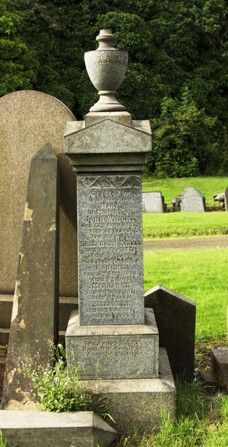
John Wright died on 22 April 1892, aged 69 at his home, of some twenty years, 31 McAslin Street. He died, having succumbed to a uremic coma and paralysis of the right side, and was interred in compartment Petra 442. The stone was erected by his daughter Mary and as well as commemorating John it included her mother Elizabeth Kelly, her brother Robert and sisters Margaret and Elizabeth who had all predeceased John. There had been further un-noted burials in the lair including Mary’s grandmother Catherine Wright and three aunts, Catherine, Margaret and Jane. Mary Wright, Mrs Baird joined her family in 1921 and the final burial was that of her brother John who died in Gartloch Hospital in 1952.
The National Reformer 1 May 1892