The indexers have reached 1905, and the number of records indexed in the last three months is as follows
| April 2026 | 404 |
| May 2026 | 280 |
| June 2026 | 302 |
Our database of persons buried or commemorated in the Necropolis now stands at 54355 entries at the end of June 2026 of which 21869 entries represent persons buried in common ground with no grave marker.
Charles Pitceathly, d. 1867
On the 10th October 1887 Charles Pitceathly lost his life at the Dufferin Dock, Belfast. He was an apprentice on the SS Saraca and, while working onboard, fell into the river or onto the quay (accounts vary). His death was noted in the Ulster Echo of that same day, 10th October and he was buried three days later in Compartment Theta, lair 161 in the Glasgow Necropolis.
FATAL ACCIDENT An accident of a painful character, resulting fatally, occurred at the Belfast Quay this morning. It appears a young man named Charles Pitceathely, a sailor belonging to the Glasgow steamship Saraca, was working on board when he slipped and fell into the river. Every effort was made to rescue him, but when brought ashore he expired in a short time. The deceased was about twenty years of age. An inquest will be held at the Royal Hospital.
Charles was the son of Alexander Pitceathly, a commercial traveller and Elizabeth
Thomson who predeceased him. He was apprenticed to J. W. Clements on 7th May 1884 at the age of sixteen. J. W. Clements worked for Allan C. Gow & Co the owners of the Saraca.
Rashleigh Halliday Bonar, d. 1950
Towards the end of the Necropolis’s working life record keeping became a little slap dash and one finds pieces of correspondence that have not been correctly filed. The following letter was found in the Index to the Burial Registers at the end of entries for Compartment Sigma.
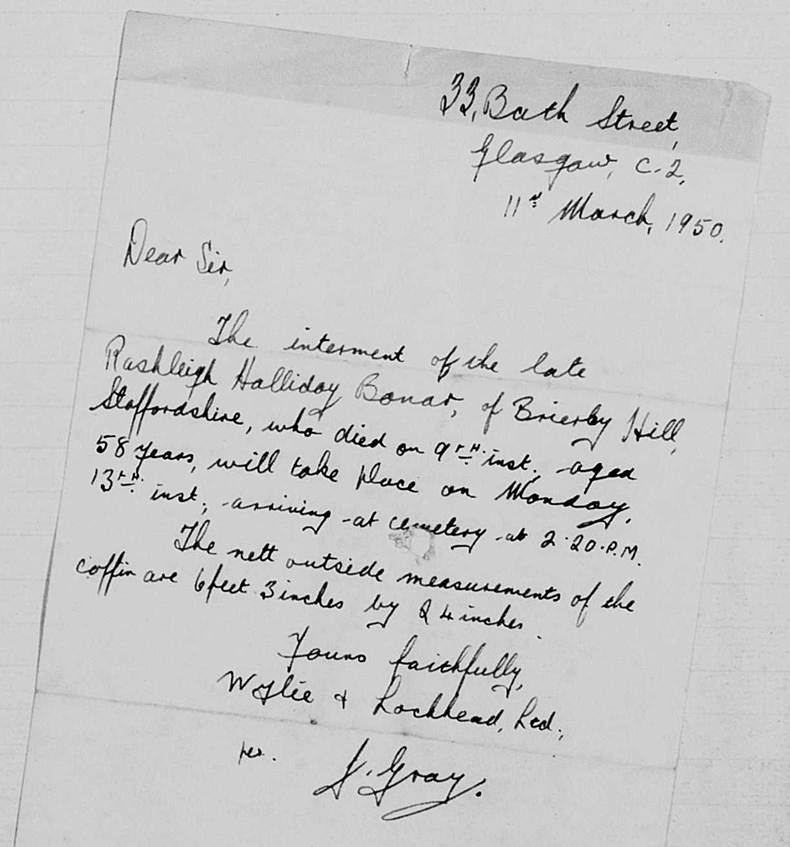
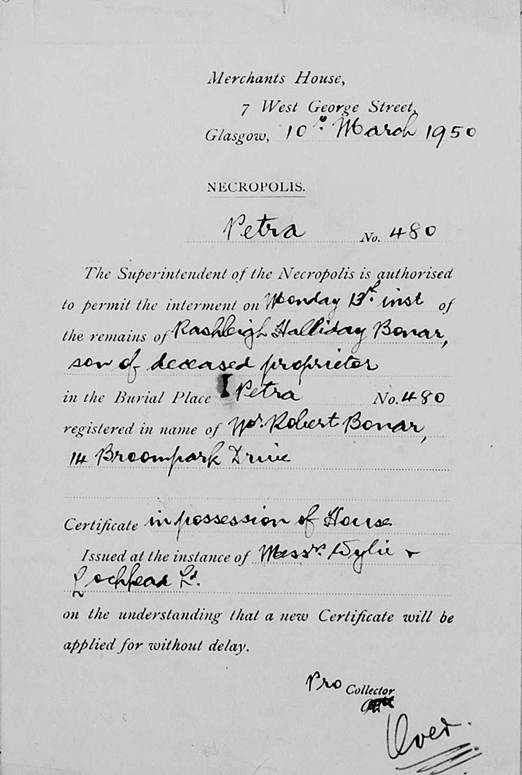
Turning it over (below) reveals that Rashleigh Bonar was to be buried in
Compartment Petra lair 480 and not somewhere in Sigma. There are two Bonar lairs in Petra but only one has a gravestone and it is not clear which that is. In any case Rashleigh’s name is not on the stone but this is not unusual by the 1950s when the last survivor of a family comes to be buried.
Andrew McCrudden, d. 1894
There are several suicides buried in the Glasgow Necropolis and one has always to be sensitive to the fact that there may be descendants of these people alive and unaware of their ancestor’s fate. The nineteenth century newspapers had no such qualms and were happy to report such tragedies in as much titillating detail as possible. The following report appeared in the Glasgow Herald of 24 December 1894.
FATAL LEAP FROM A WINDOW. — On Saturday night [22nd Dec] a man named Andrew M’Crudden died in the Royal Infirmary from injuries received by jumping from the window of his house on the third storey of a tenement at 73 Albert Street. It is said that M’Crudden, who had suffered from sunstroke while a soldier in India, had been in a desponding state of mind since the death of his wife a fortnight ago. He was 53 years of age.
Elizabeth Jane Coombe or McCrudden died suddenly of apoplexy on 8 December 1894 and was buried in Compartment Quintus, lair 128 on the 11th of the month. She was 50 years old and left four children aged between seven and fourteen as well as an adult daughter of twenty nine by a first marriage. This daughter, Mary Anna Bilkey, married in 1892 and was, presumably, no longer at home when her stepfather died. Mary Anna and her husband David Caldwell do not seem to have had children of their own but her two eldest half-brothers, John and James McCrudden were living with the couple in 1901. James died later that year and was buried beside his parents. According to family trees on Ancestry.com John and his two younger siblings Elizabeth Jane and Joseph survived to adulthood.
The newspaper mentions that Andrew suffered from sunstroke while a soldier in
India. By the greatest good fortune his service records survive and, as he was not a ‘good’ soldier, they provide much detail about his life in the ranks. There is not room in this short piece to go into a great deal of detail about Andrew’s life in the 57th Regiment between 1857 and 1878 but it was certainly eventful. He was recruited as an 18 or 20 year old labourer by a recruiting party in Northern Ireland. The 57th had taken part in the Crimea War and was making up numbers before proceeding to India. Andrew joined the Regiment in Malta and almost immediately moved with it to
India where he spent the next three years. Hostilities between the colonists and the
Māori in New Zealand at this time resulted in the Regiment moving to New Zealand in 1861 where it remained for six years. On returning home in 1867 the regiment moved regularly between various postings in England and then Ireland before being order abroad again in 1874 to Ceylon.
Andrew served for almost 20 years with the 57th and during that time his name appeared 30 times in the Regimental defaulters book and he was court martialled three times. His first court martial occurred less than a year after he enlisted when he was imprisoned for 3 weeks for being absent without leave. Most of his serious offences relate to absence without leave or drunkenness but disappear from his records after 1869. Once he returns to the UK he starts appearing in the medical records as requiring treatment for various venereal diseases though this did not prevent him marrying in 1871 and fathering at least four children. By the time Andrew reached Ceylon in 1874 his health seems to have been breaking down with several occurrences of mania and delirium tremens recorded. He went before a Discharge Board in Colombo in February 1878, was invalided back to the UK and reached Netley Hospital in April from where he was finally discharged in June 1878. His discharge documents record his intention to settle in Glasgow which is a bit of a surprise as his wife seems to have come from Devon and one might have thought they would settle there.
John Ferguson d.1887
The following obituary provides a useful summary of the life and career of John Ferguson.
DEATH OF A GREENOCKIAN AT PARTICK
Mr John Ferguson, shipbuilder, and ex-Provost of Partick, died on Saturday evening at his residence, Larkfield, Partick, in the 64th year of his age. About a week ago he was operated upon for a small tumour on the forehead. The operation was very successful, and the patient continued to do well until Friday last, when erysipelas set in on the side of the head and neck. On Saturday it suddenly left this, and attacked the kidney and surrounding organs, ending in gangrene, and Mr Ferguson breathed his last at 11.50 in the evening. He was born in Greenock in 1823, and was a brother of Mr Alexander Ferguson, sailmaker, Brougham Street. Having served his time as a shipwright, nearly forty years ago he removed to Glasgow, entering the service of Messrs Barclay & Curle, shipbuilders. Latterly Mr Ferguson became manager of the shipbuilding department and was assumed a partner. The management of the yard was conducted by the deceased gentleman practically till the date of his death, although in recent years he took a less active part. In 1869 he became a member of the Police Commission of Partick, representing the Third Ward, and at each successive election he was continued in office. During the three years – from 1875 to 1877 – he was Provost of the burgh, discharging the duties in such a way as to command the respect and confidence of his colleagues and the ratepayers. Mr Ferguson was a Liberal in politics, and he was also a temperance reformer. He was of a kindly and charitable disposition, and did much good in a quiet way. He was married to a Greenock lady, and had five daughters, three of whom are married, and four sons, the eldest being Mr John Ferguson, of Messrs Ramage & Ferguson, shipbuilders, Leith. Greenock Telegraph 13 June 1887
Census records confirm John Ferguson had moved to Glasgow by 1851 and was living in lodgings. The following year he married Margaret Ann Miller from Greenock and by 1861 the couple and four children can be found at Minerva Street. Anderston. Before moving to Larkfield sometime towards the end of the following decade the family lived at Jordan Vale, Whiteinch. Larkfield must have been a large property as it had to accommodate fifteen people on census night 1871 – John and Margaret Ann with eight children, her widowed mother Jane Miller, two Ramsay nieces and two servants to look after the family.
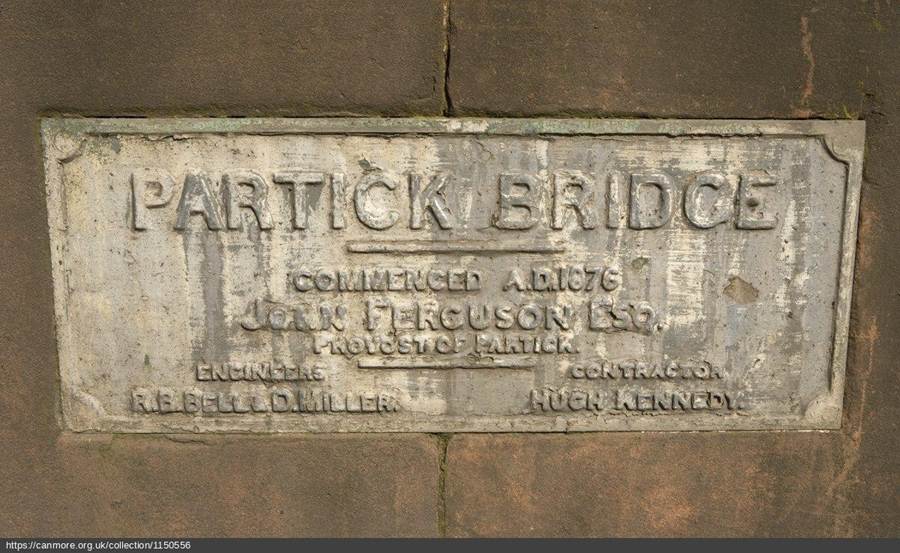
Crown Coyright: HES
During John’s period as Provost of Partick a new bridge was built over the river Kelvin on Dumbarton Road as this plaque records. He was also concerned with the acquisition and laying out of Victoria Park, named in honour of Queen Victoria to celebrate her Golden Jubilee in 1887. John presented the park with a 90 feet high flagpole (no longer there) but died a month before the official opening of the park on 2 July 1887.
Major Norman MacLeod Adam MC
One of the names found on our First World War Roll of Honour is that of Norman M Adam. Norman was a professional soldier who joined the Royal Field Artillery. He served throughout the War and survived until 28 August 1918 when he was killed in action in France. His body was surreptitiously retrieved from France by his family, and reburied in the Glasgow Necropolis on 6 July 1922. In 1918 after the war ended a firm of Inverness solicitors wrote to the War Office regarding the possibility of recompense to his estate for the loss of his kit due to his ship being torpedoed in the Mediterranean. The following letter was found on Twitter and is an interesting survival. It provides information not known when the Roll of Honour was compiled.
Major Norman MacLeod Adam
Letter Copy – December 26, 1918
COPY LETTER.
Messrs. Fraser & MacCallum, Solicitors, Inverness to
Officers Effects, War Office, Accounts 4, Imperial Institute, S. Kensington, London. dated 26th December, 1918.
Sir,
We have been instructed to wind up the affairs of the late Major Norman MacLeod Adam, Royal Field artillery who was killed in action in France on 28th August last, and we shall be obliged by your informing us whether you have received any allowances or monies due to the estate since the death or at any time. We have been advised to write you by Messrs. Cox & Co. Bankers.
When the deceased was on his way from Mesipotamia to France the transport on which he sailed ‘Kingstonian’ was torpedoed off Sardinia at 5-30 a.m. on the 12th of April of this year. The deceased lost the whole of his kit and private property valued at something like £500. The relatives feel that they have a just claim against the nation for payment of this money, as the goods were lost on active service through no fault of the deceased. We shall be glad to be advised by you whether such a claim would hold or not, and if it would, we shall get particulars of the property and a particular valuation thereof.
Yours faithfully,
(Signed) FRASER & MACCALLUM,
Hugh M Campbell, d. 1893
Donald Campbell from Kilninver, Argyll married Margaret McGregor from Crieff,
Perthshire in Cambuslang in 1854. Their second son born in 1858 was named Hugh McGregor Campbell and on his death in 1893 merited a short newspaper obituary. This obituary published in the Glasgow Herald on 13 February 1893 was copied verbatim by several other Scottish newspapers.
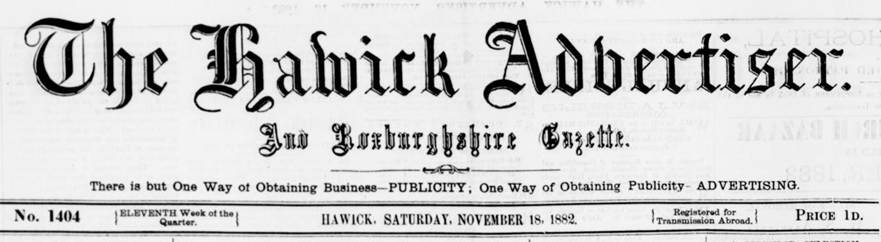
DEATH OF A JOURNALIST. — There has just passed away, after a long and painful illness, Hugh MacGregor Campbell, journalist. He entered on his journalistic career as a member of the staff of the Glasgow News, where he remained five years during the latter half of which he was sub-editor of the Evening News. For some time afterwards, he was editor of the Hawick Advertiser. He did not stay long in Hawick, as he had accepted an invitation from the editor of Society to become his assistant. After three years’ service on Society he became assistant editor of the Argosy Magazine, being at the same time attached to the London staff of the North British Daily Mail.
Death and interment
From the earliest days of the Necropolis firms of undertakers existed in Glasgow to provide services to the bereaved families. Eight firms of Funeral Undertakers are listed in the Glasgow Post Office directory of 1839-1840 and this had risen to thirty four in that of 1907-1908. The use of the modern term ‘Funeral Director’ doesn’t seem to appear in Britain until the 1930s when the British Undertakers’ Association became the National Association of Funeral Directors in 1935.
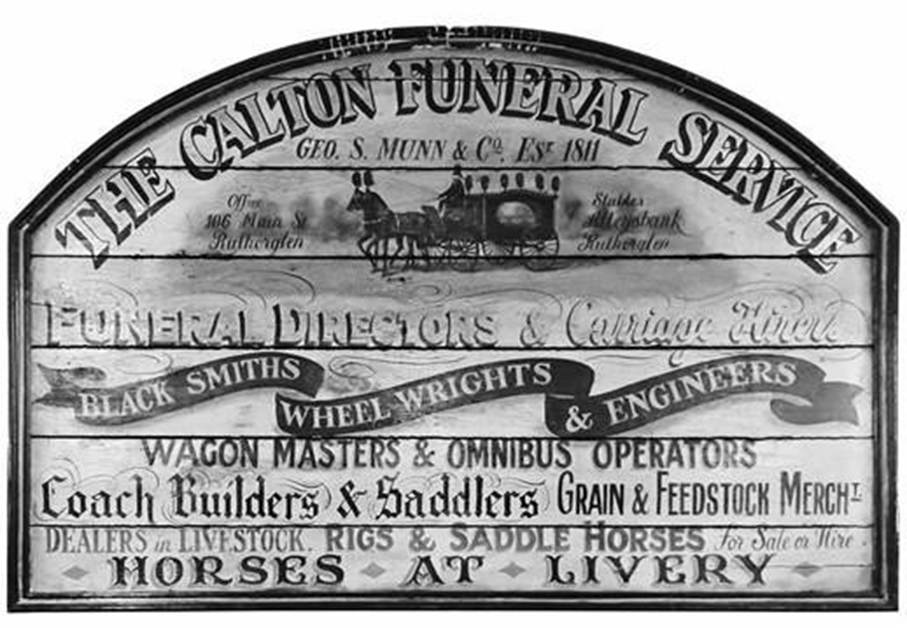
George S Munn & Co, Rutherglen, established 1811
in the 19th and first part of the 20th century a comparison of the date of death on the gravestone and the date of burial in the Burial Register for the Necropolis shows that the gap between death and burial was commonly about 3 days.
Deaths generally occurred at home and once a person died, they were bathed by either family or servants and laid out in their best clothes so their loved ones could say one last goodbye. Because embalming did not enter the mainstream until the later 19th century, time was of the essence. While the body was laid out at home, the undertaker (traditionally, at that time, undertakers were furniture or cabinet makers) would come and measure the body and deliver a coffin, its extravagance dependent on the family’s social stature and economic class. The body would usually lay out for one day (not only for the family to view, but to ensure that the deceased was actually dead), sometimes on a cooling table packed with ice (to help with preservation), before being placed in the coffin with the lid closed. A wooden coffin is not airtight and typically, it would be surrounded by lilies or another strong-smelling flower to hide any smell of decomposition.
The above description only relates to the middle and upper classes of Glasgow. What happened if a family living in a single end or a room and kitchen, as 70% of the inhabitants of Glasgow were classified as doing at the census of 4 April 1881, suffered a bereavement? The death rate in these small houses was much higher than in the larger ones – James Burn Russell states
“of all the children who die in Glasgow before they complete their fifth year, 32 per cent die in houses of one apartment; … There they die, and their little bodies are laid on a table or a dresser, so as to be somewhat out of the way of their brothers and sisters, who play and sleep and eat in their ghastly company.”
Adults too died in these small houses and James Burn Russell got quite carried away when he imagined the circumstances
“If that one room were your house, what a ghastly intrusion you would be! The bed on which you lie is wanted for the accommodation of the living. The table at which your children ought to sit must bear your coffin, and they must keep your unwelcome company. Day and night you lie there until with difficulty those who carry you out thread their tortuous way along the dark lobby and down the narrow stair through a crowd of women and children. You are driven along the busy and unsympathetic streets, lumbering beneath the vehicle which conveys your scanty company to the distant and cheerless cemetery, where the acrid and deadly air of the city in which you lived will still blow over you and prevent even a blade of grass from growing upon your grave.”
Nowadays it is not uncommon for a funeral to be postponed for several weeks until a suitable date can be agreed for the convenience of the family and mourners. This is only possible due to modern means of refrigeration and embalming not available to our ancestors.
Quotes are taken from Life in one room, or, Some serious considerations for the citizens of Glasgow : a lecture delivered to the Park Parish Literary Institute, Glasgow on 27th February, 1888 by James B. Russell, M.D., LL.D., Medical Officer of Health for the City of Glasgow.
******************************
Anyone who would like to help indexing the Burial Registers is very welcome to join us by contacting me at morag.fyfe@glasgownecropolis.org