Compiled by Morag T Fyfe
The indexers have had a very successful three months and the number of records indexed in the last three months is as follows –
| July 2019 | 614 records |
| August 2019 | 669 records |
| September 2019 | 509 records |
This brings our database of persons buried or commemorated in the Necropolis to 30064 entries at the end of September.
Cholera in Glasgow
In the 19th century there were several bad outbreaks of cholera in the United Kingdom which killed thousands of people. The first major outbreak occurred in 1831-32 just before the Necropolis opened but the second one of 1848-49 certainly shows up in the burial registers. Cholera reached Glasgow on 11 November 1848 and between then and the official end date of 8 March 3800 people died in the town. The first burial in the Necropolis relating to the disease occurred on 2 December when William Meighan, a blacksmith, was buried in a common grave and the last burial of the main outbreak occurred on 7 March when Agnes Brown the relict of Ebenezer Brown was buried in the family grave in compartment Lambda. The entries in the burial register show that no attempt was made to quarantine the bodies of cholera victims and they were buried normally in their family graves or common ground as appropriate. In total 132 burials gave the cause of death as cholera out of a total number of burials in this period of 345.
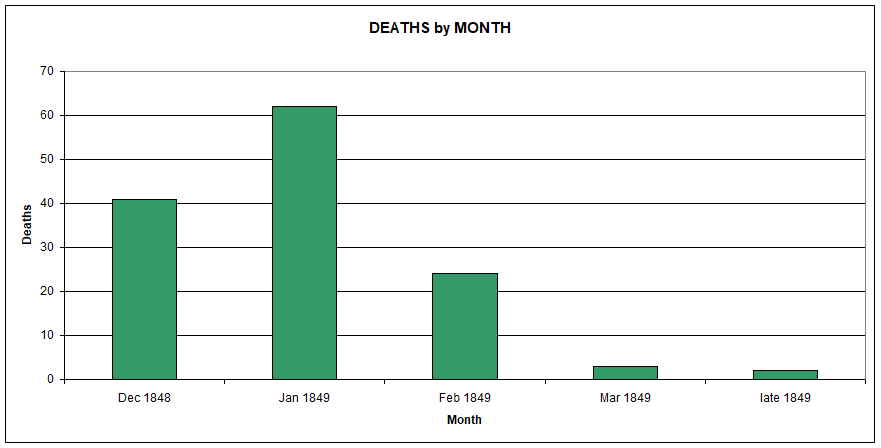
Where we have both death and burial dates (43 out of 131) the vast majority of burials took place within one or two days of death. In one case, that of Dr James Thomson, professor of mathematics at the university, there was a delay of six days before his burial.
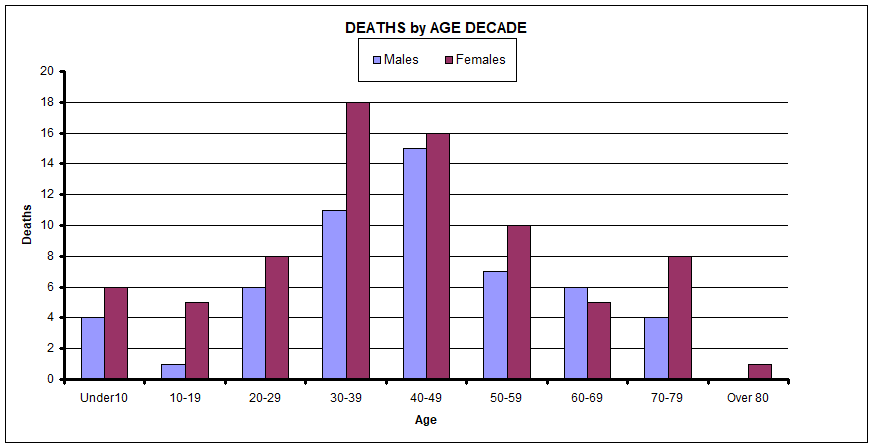
The graph above shows the breakdown of deaths by age decade and highlights the fact that very few children died in this outbreak and overall 77 women died but only 54 men.
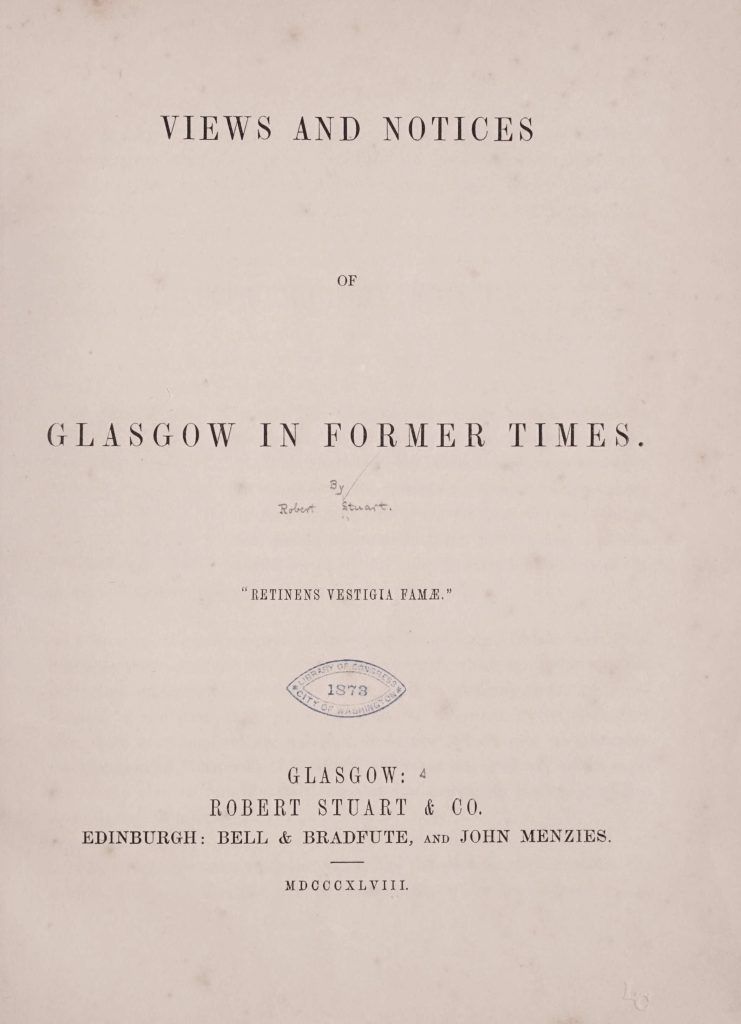
One of the cholera deaths that caught my eye was that of Robert Stuart, bookseller, who died aged 37 on 23 December 1848 and was buried on 25 December, in the family plot in Delta. He not only sold books but published them and is now best known for Views and Notices of Glasgow in Former Times.
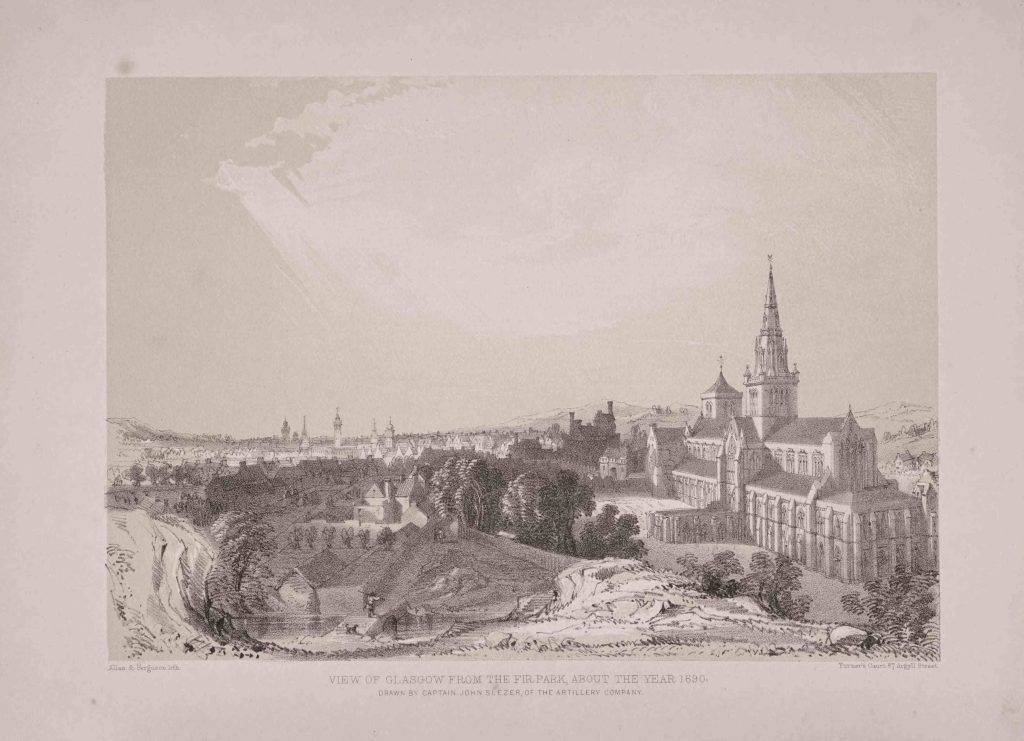
In the book he reproduced John Slezer’s “View of Glasgow from the Fir Park, about the year 1690”.
There was no abatement in the normal childhood killers during the cholera outbreak and measles and hooping cough continued as normal.
Later, in November 1849 there was a particularly bad outbreak of scarlet fever and several families lost more than one child. David Grant, a dyer, buried two daughters on 20th and 23rd November while Humphrey Millington, a muslin singer, also buried two daughters on 15th and 22nd November. The worst case known is that of James Cumming, a blacksmith, who lost two sons and a daughter between 8th and 22nd November. All the children were buried in common graves with no stones to mark their location.
North Quarter Washing Green
In Grave Matters 7 I mentioned the death of Angus McKay of the North Quarter Washing Green. In April 1849 his widow died and was also buried in the Necropolis. Puzzlingly she was not buried in the same lair as her husband (Lambda 93) but in Lambda 157 along with what seems to be an unrelated family of Grays. Although both graves are in compartment Lambda they are not even close to one another.
A family tragedy
Newspapers supply many stories of human interest and the Glasgow Herald of 19 October 1849 was no exception.
Melancholy Occurrence at Millport.
On Thursday afternoon last, a very distressing accident occurred to a son of Mr. James Begg, formerly of this city, and who has been for some time past residing in Millport. On that day the boy had attended school as usual, and in the afternoon he, with two of his school-fellows, proceeded along the cliffs to gather bramble berries, little dreaming of the sad fate which awaited him, and the anguish his parents and friends were soon to be plunged into. He was an only son, an interesting little boy of nine or ten years of age. He had not been long engaged at what he thought innocent and safe amusement, when by some treacherous step he was hurled over the precipice to the depth of 108 feet, unnoticed by his comrades, for they had left him a little way. The distance from the top to the bottom of the cliff is 172 feet, but he fell on a projecting rock 6 ½ feet from the base. How long the poor little fellow might have remained in that place is not known, it being a spot very little traversed; but a gamekeeper happened to see him falling, and proceeded to the spot, where a woeful spectacle met his eye. The poor boy was lying with his skull dreadfully fractured, and otherwise severely bruised. He was conveyed home, still in life, but it was only to add to the grief of his family, for the agony of the boy showed but too plainly that he could not survive. He lived till Sunday morning. We can easily imagine the feelings of the bereaved family, and sympathize with them in their grief. Mr Begg lost an interesting and accomplished daughter but a short time ago, which adds to the present affliction. – Constitutional.
John Henry Begg was the only surviving son and probably the youngest child of James Begg and his wife Janet Henry; at least two elder brothers died in infancy. The interesting and accomplished daughter mentioned in the last sentence above was Margaret Nicol Begg, wife of Gavin Steel and probably the eldest of the family. She died in childbirth in June 1849 and was followed to the grave three weeks later by her infant daughter. There are three stones on a large lair in Lambda commemorating the family and their offshoots.
Temporary burials
Recently an example has been found of a visitor to Glasgow whose untimely death resulted in her coffin being placed temporarily in the Egyptian Vaults before returning home. The coffin of Catherine Latham, relict of John Latham, spent four days there before being removed to England on 1 February 1850.
The opposite procedure in which a body is brought home from abroad is well known in the Necropolis as the example of Emily Julia Clarendon, Mrs Wood described in Grave Matters 6 shows. The earliest occurrence known to me is that of Jane Turner, relict of William Buchanan who died in Dublin on 17 April 1849 and was buried in the Necropolis on the 23rd.
Unknown man
The day after Catherine Latham’s body was placed in the Egyptian Vaults a more humble burial took place when the body of a man aged about 30 was sent from the police office for burial. This unknown man had been found dead on a stair according to the recorded cause of death. An examination of the newspapers around the time of his death failed to provide any more information and we are left wondering who he was. As he was unidentified it suggests that he did not live close to where he was found. The plainly stated cause of death gives no clue to how he actually died. He was buried on the 29 January in the middle of winter and it may simply be that, as a rough sleeper, he succumbed to the cold one January night.
Theatre Royal, Glasgow
In February 1849, while the cholera outbreak was in progress, Glasgow was hit by another tragedy. Many theatres in the nineteenth, and even the twentieth, century suffered damage due to fires but in the case of the Theatre Royal in Dunlop Street sixty five people lost their lives on Saturday 17 February 1849 due to a false fire alarm. A very small fire occurred which was immediately extinguished but in the ensuing panic sixty five people were crushed to death on the stairs or died later as a result of their injuries. The vast majority of the dead were aged between 10 and 20 years of age.
The burial registers record the burials of five of these people on Monday 19 February. Peter, son of the late John Dent, is not found in the published list of the dead (I wonder if he was listed under his step-father’s name?) but his cause of death clearly states that he died as a result of the accident at the Theatre Royal. Peter was only 12 years old and another 12 year old who lost his life was George Mitchell, the son of James Mitchell, painter. James Mitchell has an elaborate monument in compartment Mnema where it marks ‘the spot where stood the dwelling place of his father and grandfather, which was occupied by them for a period of forty years previous to the formation of this necropolis and is now chosen as the final resting place of his descendants.’
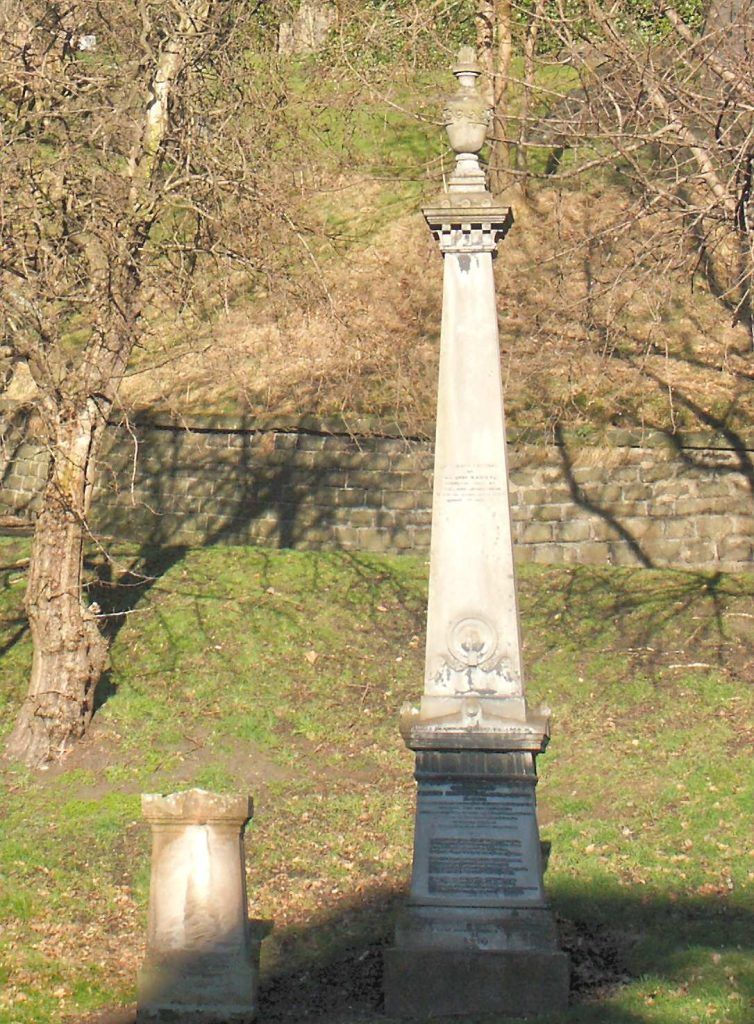
The final victims were a family of three: Andrew Tonachie, ages 40 and two daughters, Mary, aged 11 and Andraina, aged 3. Unfortunately it has proved impossible to trace them further at the moment and it is not known whether a wife and mother was left to mourn them.
At the time of the accident the Theatre royal was owned by John Henry Alexander who died in 1851 and is also buried in the Necropolis.
Highgate Cemetery
Highgate Cemetery in north London is one of the so-called ‘Magnificent Seven’ cemeteries established round London between 1833 and 1841. Kensal Green was first in 1833 followed by West Norwood, 1837, and Highgate in 1839. Visiting Highgate is a very different experience to our own Necropolis. Highgate sprawls over a hillside with the most prestigious burials at the northern, highest point of the site. It is roughly the same size as us (37 acres) having doubled its size in the 1850s with the establishment of the East Cemetery across the road from the original site (now known as the West Cemetery). Highgate was used much more intensively than the Glasgow Necropolis and has 170,000 burials in 53,000 graves compared with our 52,000 burials in 6,000 graves. It is still a working cemetery, owned and run by the Friends of Highgate Cemetery – one wonders what the FOGN think of the idea of owning and being wholly responsible for the maintenance and running of the Necropolis?
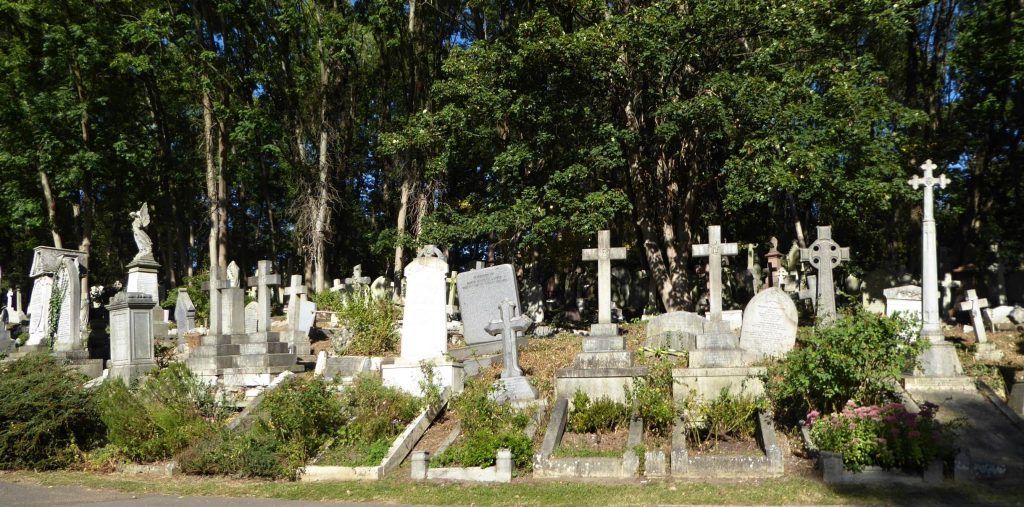
Physically Highgate has a very different ambience to the Necropolis. Although it is on the south-facing slope of a hill it is a very enclosed somewhat claustrophobic site with few views to the outside due to the hundreds (thousands?) of self seeded trees that fill both parts of it. It is also still rather overgrown in parts despite the labours of the Highgate volunteers. The trees and undergrowth must be a great threat to the survival of the gravestones and their inscriptions.
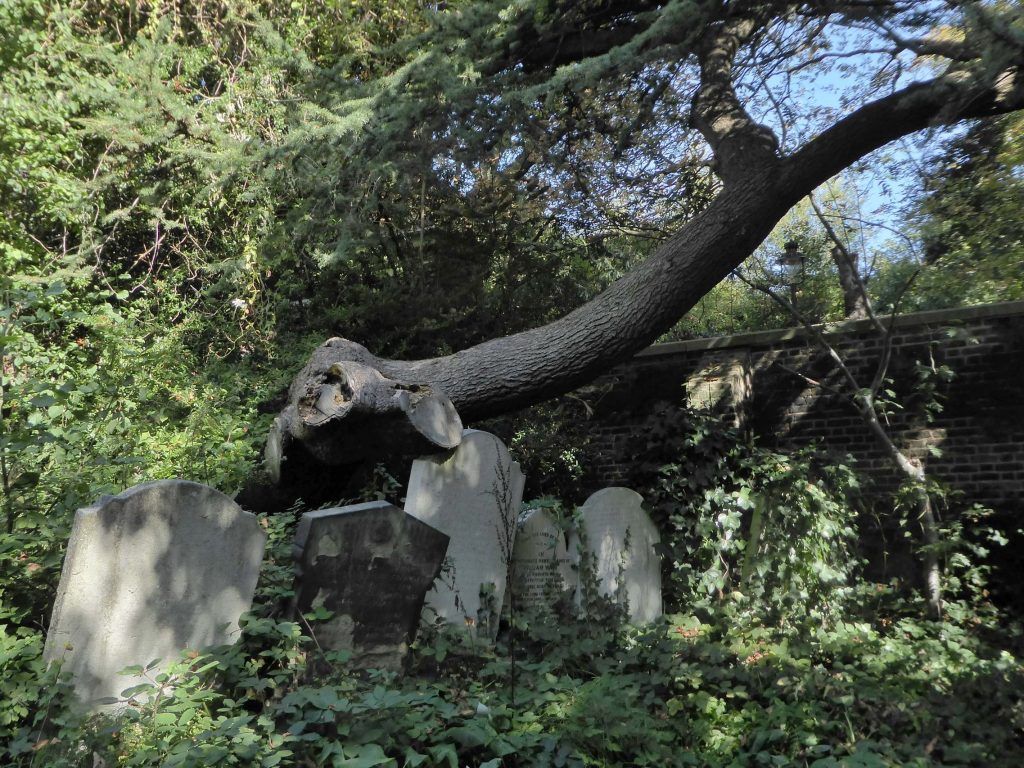
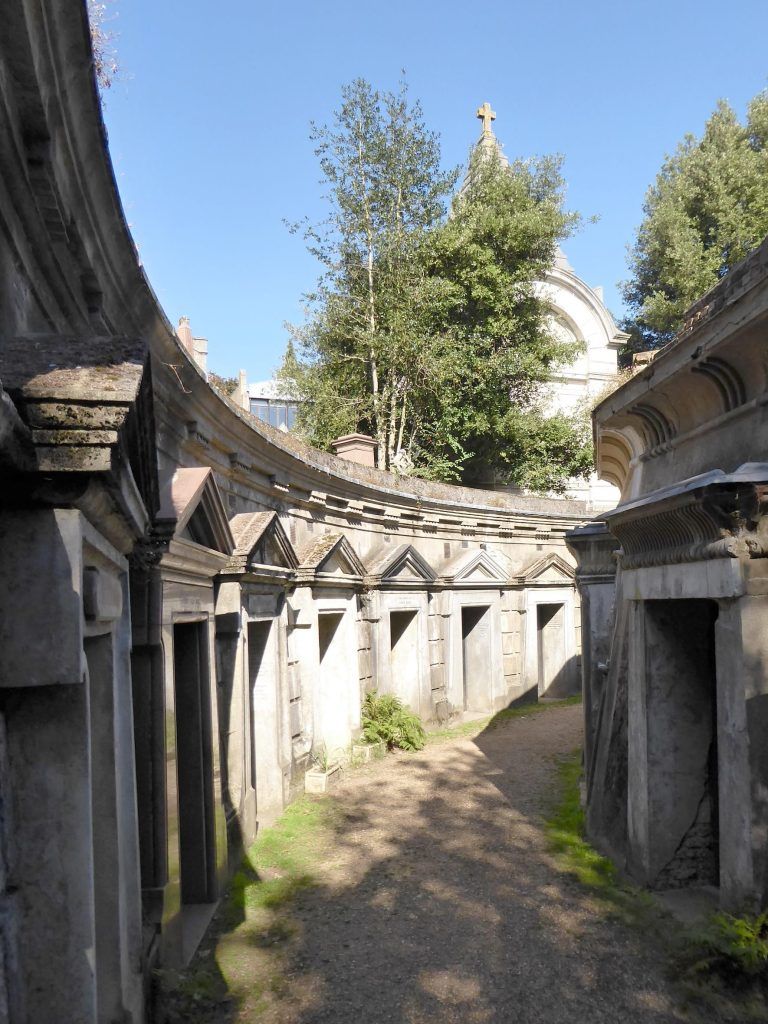
There don’t seem to be nearly as many free-standing architecturally significant 19th century mausolea and monuments as in the Necropolis. The main significant Victorian monuments are the catacombs but it was very disappointing to discover that these are built of stucco-covered brick, not stone.
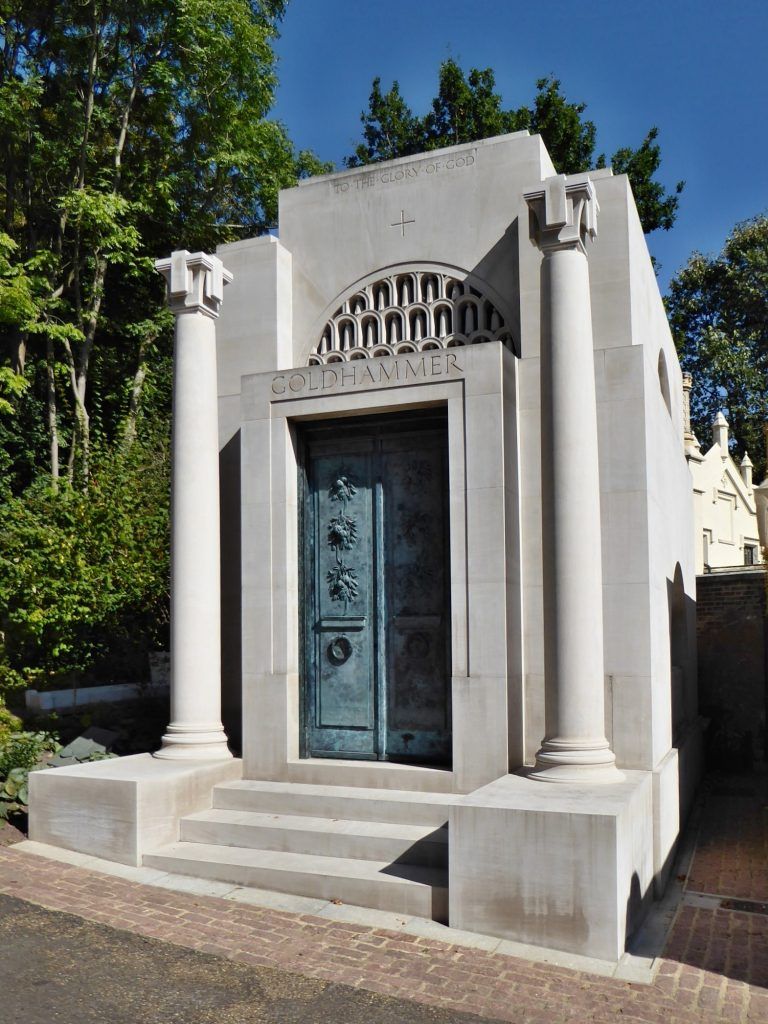
On the other hand, because Highgate has had a much longer active life than the Necropolis there are some very interesting, modern gravestones in the East Cemetery. There are also a small number of ostentatious late 19th and 20th century mausolea in both parts of the cemetery.
One further contrast between Highgate and the Necropolis is that the location of common graves is known from the existing cemetery plans. It is a great frustration to FOGN that they only know within broad terms where the common graves in the necropolis are located.
Highgate’s burial registers have been available on deceased online (https://www.deceasedonline.com/servlet/GSDOSearch) since 2016 but the gravestone inscriptions (monumental inscriptions) have not been recorded and must be deteriorating further every year. It seems there are plans to remedy this when a new cemetery management system is in place. This will entail photographing the stones and entering details directly into a database. Based on personal experience and that of the G&WSFHS volunteers who completed the recording of the Necropolis stones it is going to be very difficult and time consuming obtaining high quality images for the transcribers to work from.
Anyone who would like to help indexing the Burial Registers is very welcome to join us by contacting me at research@glasgownecropolis.org