Compiled by Morag T Fyfe
Here I am in January 2019 preparing Grave Matters number 6; no one is more surprised than I am that I have managed to keep it going so far. Thanks are due to my band of indexers who always manage to find something interesting for me or ask an awkward question.
Three German Dwarfs
The last column on each page of the early burial registers is headed ‘Relative Directing Funeral’ and tends to be rather uninformative as it only notes whether it is the husband, the father, the uncle and so on. Occasionally the relative may be named as when the Rev Mr Anderson of Carluke buried his sister, Mrs Margaret Allan, on 4th March 1845. On the following day, 5th March, the funeral of Hans Nicoles Bolt of Hamburg occurred and was organized by ‘Three German Dwarfs’. Nothing further is known about Hans Bolt except what is recorded in the burial register – he came from Hamburg, died from asthma, aged 63, was buried in a common grave and was described as ‘Legatee of Children’.
On the other hand the Three German Dwarfs feature frequently in the newspapers between 1844 and 1846 during which time they seem to have toured extensively in the UK. They comprised two brothers and their sister; Henrick Brockstedt was 22 years of age, 36 inches tall and weighed 36 lbs, his sister Maria was 18 years of age, 32 inches tall and weighed 22 lbs while their young brother Christian was only 13 years old, 28 inches tall and weighed 16 lbs. Their act comprised a ballet called Napoleon’s Generosity, written specially for the dwarfs, by command of the King of Denmark and they danced polkas.
They appeared in the Assembly Rooms, Ingram Street between Saturday 22nd February and Saturday 1st March 1845 generally giving three 2 hour performances each day. They were still in the city on Saturday 8th March when their last appearance was advertised at the Theatre Royal Adelphi, Glasgow Green in which they provided the supporting act to a performance of Macbeth.

Two brothers drown
“On Sunday night about half-past six o’clock, two young men, brothers, were drowned in the Clyde, at the Green, under circumstances of a very distressing nature. The names of the drowned are George and Robert Linn, the former a bleacher in the employment of Messrs H Monteith & Co. at Barrowfield, and the latter a tailor, who has recently been working, we believe, in Paisley. It appears that in the course of the day (Sunday), the two brothers, who had not seen each other for a considerable time, met in town so far as is known, accidentally, and had some whisky together, by which they both became somewhat intoxicated. They afterwards proceeded along Glasgow Green, where they were seen quarrelling with each other, though seemingly neither of them were in a very ill-natured mood. George, the elder brother, repeatedly pushed and knocked Robert about, and once or twice threw him on the ground, at which the latter appeared vexed and mortified, but so far as we have heard, made no attempt at retaliation. This conduct attracted the notice of a number of blackguard boys in the green, who latterly followed and assailed them with expressions of jeering and mockery, such as are frequently used towards persons found in a state of intoxication. When they reached the well, situated immediately beyond Dominie’s Hole, a short way westward of Allan’s Pen, the elder brother threw the younger down upon the ground, and soiled his clothes which were wiped by a little girl who chanced to be upon the spot. While she was doing so, he complained to her that his brother had been teasing and ill-using him, and narrated some circumstances of a trifling nature, which it is unnecessary here to report. He then went to the brink of the river, and at the moment his brother George was drinking at the well, exclaimed, “Farewell, Geordie,” threw himself into the water. The elder brother at once plunged in to his rescue, but fell upon him, and they both went below. They came again to the surface, however, and Robert, the youngest brother, contrived to get to the shore, where he lay for a short time half in and half out the water. He then saw his brother struggling for life, and went back into the river, obviously to render him assistance; but by this time the strength of both was gone, and they sunk to the bottom. The bodies were recovered in the course of the evening. The two young men belonged, we understand, to Denny. The eldest of the brothers is about 24, and the youngest about 16 or 17 years of age. –Glasgow Argus”
From the Stirling Observer Thursday August 14, 1845 The two brothers drowned on 10th August and were buried the following day by their father in a common grave in the Necropolis.
Disentangling Julia Flynn’s marriages
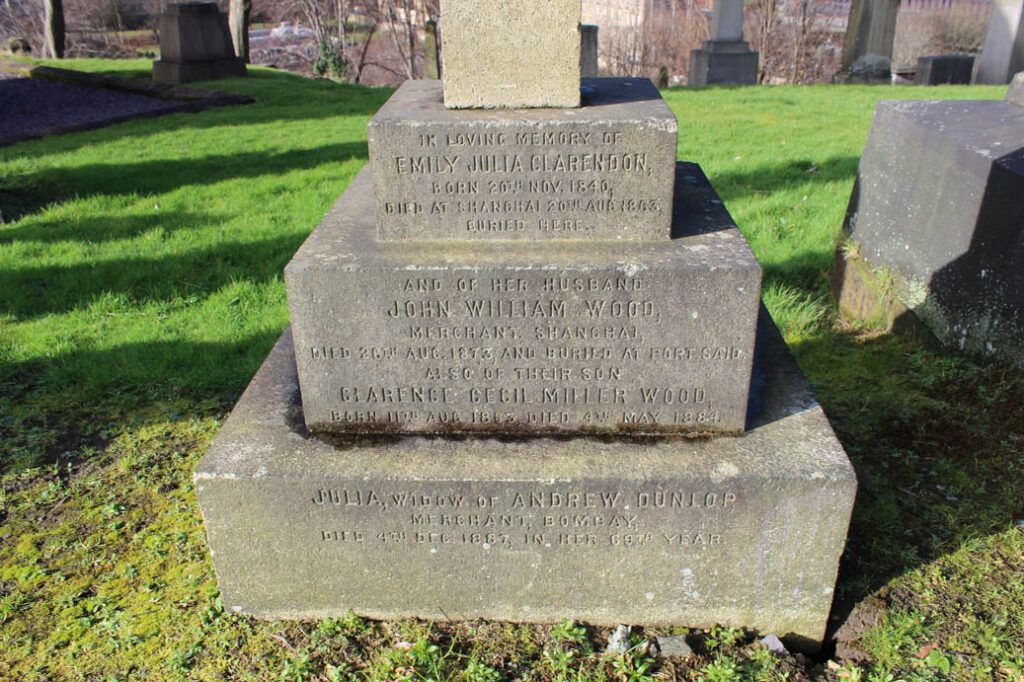
Sometimes a simple gravestone can hide a very tangled family tree as is illustrated by this stone found in compartment Alpha. Four people are commemorated on the front of the stone, one person is named on each side and the seventh to be buried had no one left to arrange for her name to be added.
In loving memory of / EMILY JULIA CLAREDON / born 20th November 1840 / died at Shanghai 20 August 1863 / buried here.
And of her husband / JOHN WILLIAM WOOD / Merchant Shanghai / died 26th August 1873 and buried at Port Said.
Also of their son / CLARENCE CECIL MILLER WOOD / born 11th August 1863 died 4 May 1884.
JULIA, widow of ANDREW DUNLOP / Merchant Bombay / died 4th December 1887 in her 69th year.
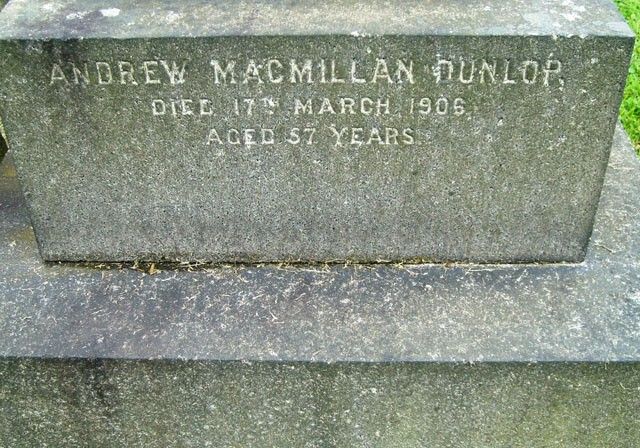
ANDREW MACMILLAN DUNLOP / died 17th March 1906 / aged 57 years.
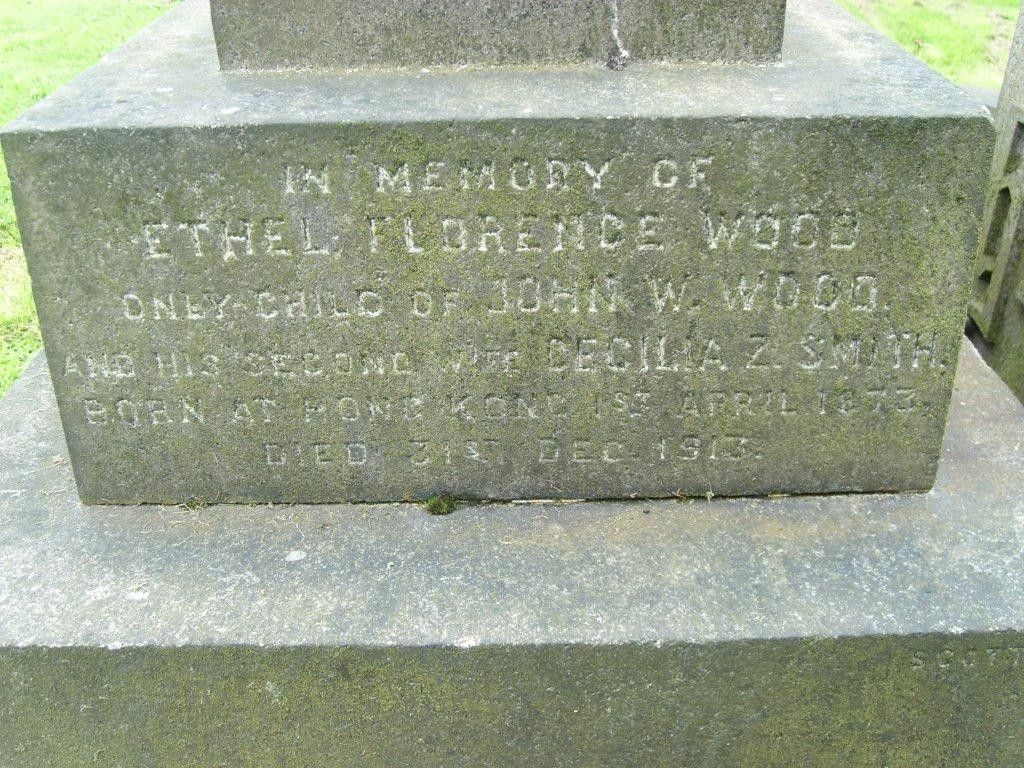
In memory of / ETHEL FLORENCE WOOD / only child of JOHN W WOOD / and his second wife CECILIA Z SMITH / born at Hong Kong 1st April 1873 / died 31st December 1913.
The person missing from the stone is Charlotte M B DUNLOP (formerly BOULT), aged 75 who was buried on 15th October 1918.
At first glance the stone seems to commemorate John William Wood, his two wives and two children but how to account for Julia and Andrew M Dunlop and Charlotte Dunlop or Boult? It turns out that the link is Julia Flynn, born c1819 probably in London who married three times and had children with all three husbands.
Nothing is known of Julia before she married Sub Conductor Peter Clarendon of the Commissariat Department in Bombay in 1833. The couple had at least one child, Emily Julia Clarendon in 1839, before Peter died in 1840. Julia did not remain a widow long and next married William Henry Boult with whom she had a daughter in 1843, Charlotte Margaret Boult. Soon after Charlotte’s birth Julia was widowed again because her third marriage occurred in 1844 in Bombay to Andrew Dunlop. This marriage produced three children between 1849 and 1853, Andrew, Marianne and Robert Dunlop.
Presumably Julia’s husband, Andrew, died soon after the birth of Robert c1853 but whether in India or Scotland is unknown. What is known, however, is that by 1861 Julia and her various children had settled in Glasgow, where they appear in that year’s census. Julia’s daughter, Emily Clarendon, did not remain in Glasgow long as she travelled to Shanghai, China in 1862 to marry John William Wood. She died in August 1863 in China (Shanghai?) nine days after the birth of her son Clarence and it seems a reasonable assumption that she died from complications in childbirth. Her body was brought back to Scotland and she was buried in the Necropolis in March 1864. When her husband John William Wood died in 1873 in Port Said, Egypt he was buried there and his body was not brought back to Glasgow.
Young Clarence Wood, Emily’s son and Julia’s grandson is found living with his grandmother and aunts and uncles in Glasgow at the 1871 and 1881 censuses before dying in 1884 and joining his mother in the Necropolis. Three years later his grandmother Julia Flynn died and was buried in the Necropolis under the name of Julia Dunlop with no clues as to her complicated married life.
When Clarence’s half-sister Ethel returned to Britain with her mother they settled instead in London and Ethel seems to have lived there or thereabouts all her life. None the less it seems that some kind of contact must have been maintained between her and her Glasgow relatives as she was duly buried in the Necropolis when she died.
The final member of the extended family to be buried in the Necropolis was Charlotte M Boult in 1918. After their mother’s death in 1887 she and her half-brother, Andrew, continued to live together until his death in 1906 during which time she used her mother’s surname Dunlop. Her death was registered as ‘Charlotte Margaret Boult Dunlop (formerly Boult)’, which seemed to cover all eventualities and the entry in the burial register used the same form of name.
To be removed
In the last issue I wrote about the Neilson/Thomson/Alexander burials which were removed from Sigma 3 and reburied in Quintus 103. Sometimes we find the rather peremptory note ‘to be removed’ against an entry which tends to make me ask, why? where? It occurs most commonly against a burial in the Egyptian Vaults, which were only intended to be temporary, and may sometimes say whereabouts the coffin was to be reinterred. In one instance though the burial occurred in common ground in compartment Iota and was described as being buried in Private Iota. Does this mean that a private burial in common ground is only temporary, in which case where was the deceased moved to? So far there have been 123 private burials in common ground but only one in which the deceased was to be removed. It is one of many puzzles of the Necropolis to which we don’t know the answer.
First World War Roll of Honour
In the run up to the commemoration of the centenary of the 1918 Armistice we received an enquiry from a journalist at the Sunday Times who was interested in contacting any relative of Norman Macleod Adam. Tracing living relatives is not something that the FOGN usual do but I managed to find a relatively recent address for a great niece and she provided a quote. This earned the FOGN a brief mention on Twitter but nothing in the printed edition of the Sunday Times on 11th November.
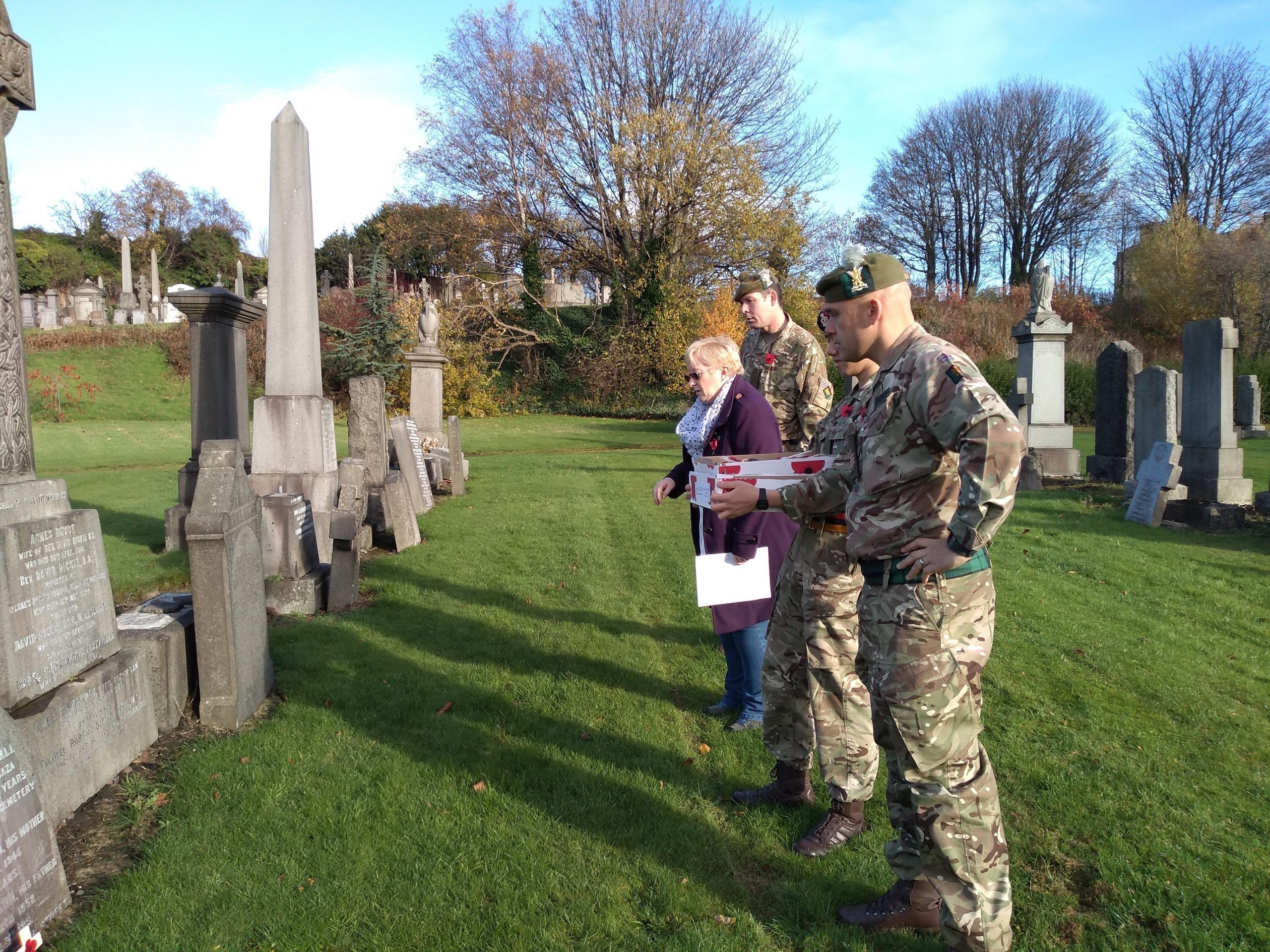
As usual our two guides who conduct the Armistice tour in November spent a little time prior to the tour visiting each grave and marking it with a poppy. This year they were helped by members of 6 SCOTS C Company who had previously held their own ceremony to honour Major James D Black, M C.
In a similar case to Norman Adam we were contacted by someone trying to trace relatives of another of our Roll of Honour casualties John Norton Norwood, a Second Lieutenant in the Royal Inniskilling Fusiliers. The enquirer had his field glasses in her possession and was hoping to return them to a member of his family. John was an only child and died unmarried so we provided details of collateral lines for the enquirer to pursue.
–
Anyone who would like to help indexing the Burial Registers is very welcome to join us by contacting me at research@glasgownecropolis.org